

Quick answer: In home ABA therapy brings behavior-analytic services into the learner’s everyday environment. Depending on the provider and treatment plan, a BCBA may assess needs, update goals, supervise implementation, coach caregivers, observe routines, and coordinate with the care team. An RBT or another trained implementer may work directly with the learner. The setting can support practice with communication, transitions, self-care, play, and family routines where those skills actually occur.
Table of Contents
- What Is In Home ABA Therapy?
- What Happens During an In-Home ABA Session?
- Which Goals Can Be Practiced at Home?
- What Is the Caregiver’s Role?
- What Privacy and Household Boundaries Matter?
- How Does In-Home ABA Compare With Clinic and Virtual Care?
- How Do You Compare In-Home ABA Providers?
- What About Insurance, Scheduling, and Location?
- What Ethical Boundaries Should an In-Home Program Respect?
- In-Home ABA Therapy FAQ
- Key Takeaway
- Quick Review Checklist
- Take the Free BCBA Mock Exam
Home-based care is not automatically better than clinic or virtual ABA. Fit depends on goals, safety, routines, caregiver availability, provider model, payer rules, and measurable progress. Ask about a typical visit, privacy, participation, and alternatives.
What Is In Home ABA Therapy?
In-home ABA therapy is a service arrangement in which some or all behavior-analytic work occurs in the learner’s home or another familiar setting. The phrase describes location, not one universal schedule or staffing model. One provider may send an RBT for direct sessions while a BCBA supervises; another may emphasize caregiver coaching or combine home visits with clinic, school, or telehealth meetings. That difference is important when comparing providers. Ask whether the program includes:
- an assessment or reassessment connected to the learner’s current routines;
- individualized goals and a written treatment plan;
- direct teaching with the learner, caregiver coaching, or both;
- BCBA supervision and a clear process for treatment-plan changes;
- data collection that identifies who records what and how decisions are made;
- coordination with school, medical, or other support providers when appropriate; and
- a plan for situations that require clinic, community, school, or virtual observation.
The word “home” should not mean that every room becomes a therapy space. A responsible team explains the purpose of each visit, respects household boundaries, and adapts teaching to realistic routines. The service should improve useful participation, not simply fill the home with worksheets or make the caregiver feel observed all day.
What Happens During an In-Home ABA Session?
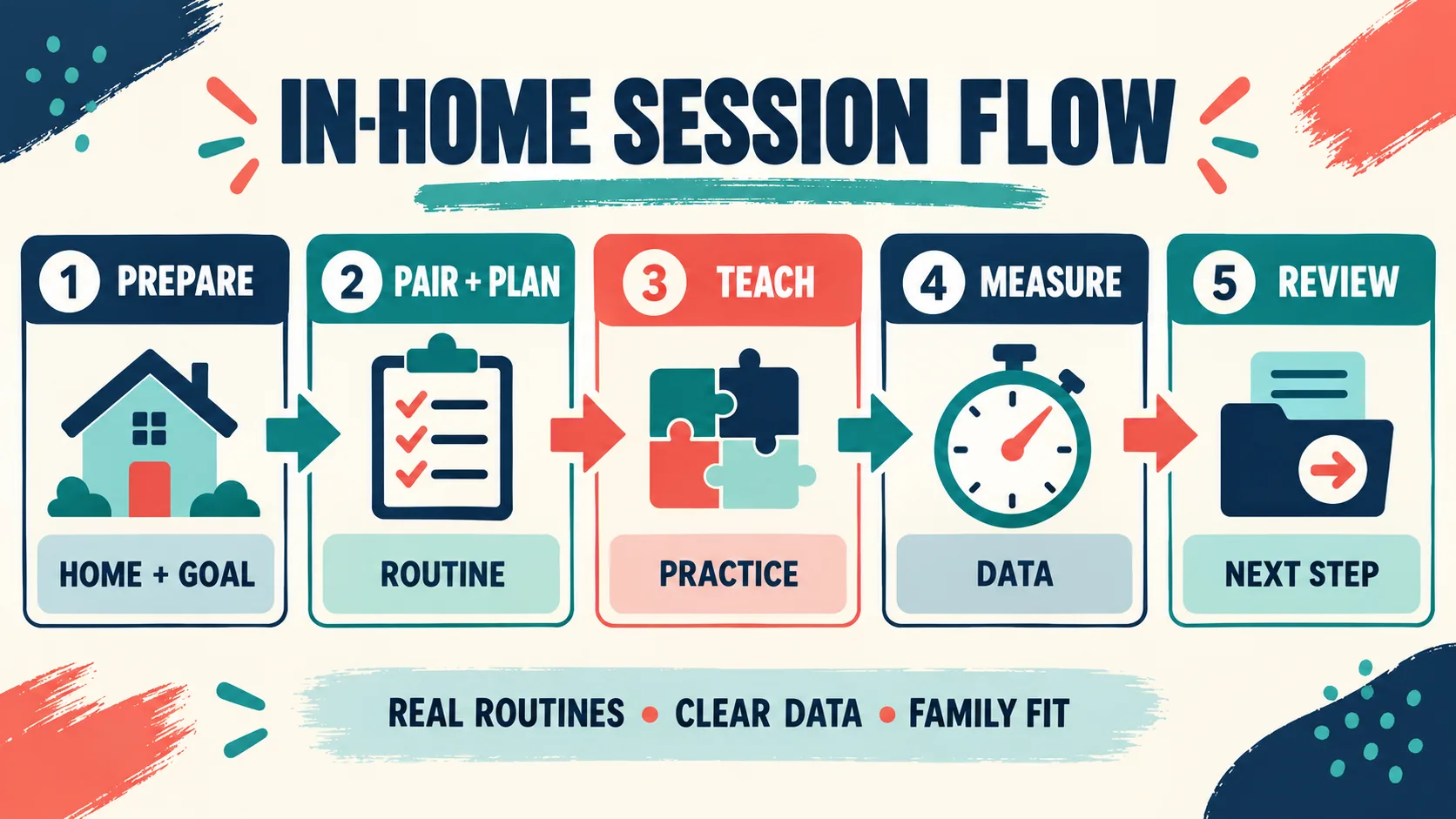
A typical home session begins with a short check-in. The team may review sleep, health, schedule changes, recent successes, challenging situations, and the routine that will be practiced. The BCBA or implementer should identify a specific objective instead of treating the entire visit as an unstructured observation. The objective might involve requesting help, completing a morning routine, tolerating a transition, playing with a sibling, following a visual schedule, or using a communication system.
The provider then arranges practice in a way that is safe and meaningful. A caregiver may describe what usually happens, the implementer may model a strategy, and the learner may try the routine with prompts that are gradually adjusted. Data can include frequency, duration, latency, task-analysis steps, opportunities completed, communication attempts, or caregiver implementation measures. The exact measure should match the goal. A family should be able to ask what is being counted, why it matters, and how the information changes the next session.
The end of the visit should include a brief review. What worked? What was difficult? What should the learner and caregiver practice before the next visit? If the team recommends a procedure between sessions, the instructions should be specific enough to use during breakfast, homework, bedtime, shopping, or another real routine. If the plan is too complicated for the household, that is useful clinical information and the team should adjust it.
Which Goals Can Be Practiced at Home?
Home sessions can be useful when the target skill is closely connected to the home environment. Examples may include communication during meals, dressing, toileting routines, play, transitions between preferred and less preferred activities, safety routines, asking for a break, completing chores, or participating in family activities. Working in the natural context can help the team see which materials, instructions, distractions, and people affect performance.
However, natural-environment teaching does not mean that every behavior should be addressed everywhere at once. The team should prioritize goals, define observable outcomes, and decide how to generalize skills across people and settings. A learner may practice a request at home and later need opportunities with a teacher, peer, or community partner. A plan that works only when one specific adult is standing beside the learner is not yet a complete generalization plan.
Ask how the provider will identify the routine, measure progress, and test whether the skill transfers. Also ask what materials the family must provide. A good home-based plan should fit the household without unsupported promises about speed or outcome.
What Is the Caregiver’s Role?
Caregiver participation varies by program, learner, and goal. A caregiver may observe, practice a procedure with coaching, help arrange materials, share information about routines, or implement a plan between visits. The caregiver is an important source of context, but should not be treated as an unpaid replacement for clinical supervision or as the only person responsible for treatment quality. Before starting, clarify:
- which adults should attend or participate in each visit;
- how much practice is expected between sessions;
- how the provider teaches and checks implementation;
- what to do when a procedure is not working or feels unsafe;
- how language, culture, schedule, disability, or household constraints affect the plan; and
- how the team will respect a family’s decision to pause, modify, or discuss a recommendation.
Caregiver coaching should be observable and supportive. The BCBA or other qualified clinician can model, prompt, provide feedback, and review data. The goal is not to grade a parent’s performance; it is to make useful strategies understandable and feasible. If the expected workload is not realistic, say so early. A plan that the household cannot maintain will not become stronger merely because it is written in technical language.
What Privacy and Household Boundaries Matter?
In-home care requires a conversation about privacy before the first visit. Ask who is allowed to enter the home, whether sessions are recorded, how notes and images are stored, and which areas or routines are outside the scope of service. The provider should explain what information is collected, who can access it, and how the family can raise a concern.
Household boundaries are part of service quality. The team should obtain consent for the people and activities involved, avoid unnecessary observation, and use the least intrusive arrangement that still allows meaningful assessment or teaching. Families can ask the provider to explain why a particular person, room, item, or recording is needed. If the provider uses an app, camera, or messaging channel, ask how access is protected and which channels should not be used for clinical information.
Privacy also includes the learner’s dignity. A home visit should not turn sensitive routines into demonstrations or encourage unnecessary filming. Review consent and confidentiality practices, and make sure the learner’s preferences and assent or dissent are considered.
How Does In-Home ABA Compare With Clinic and Virtual Care?
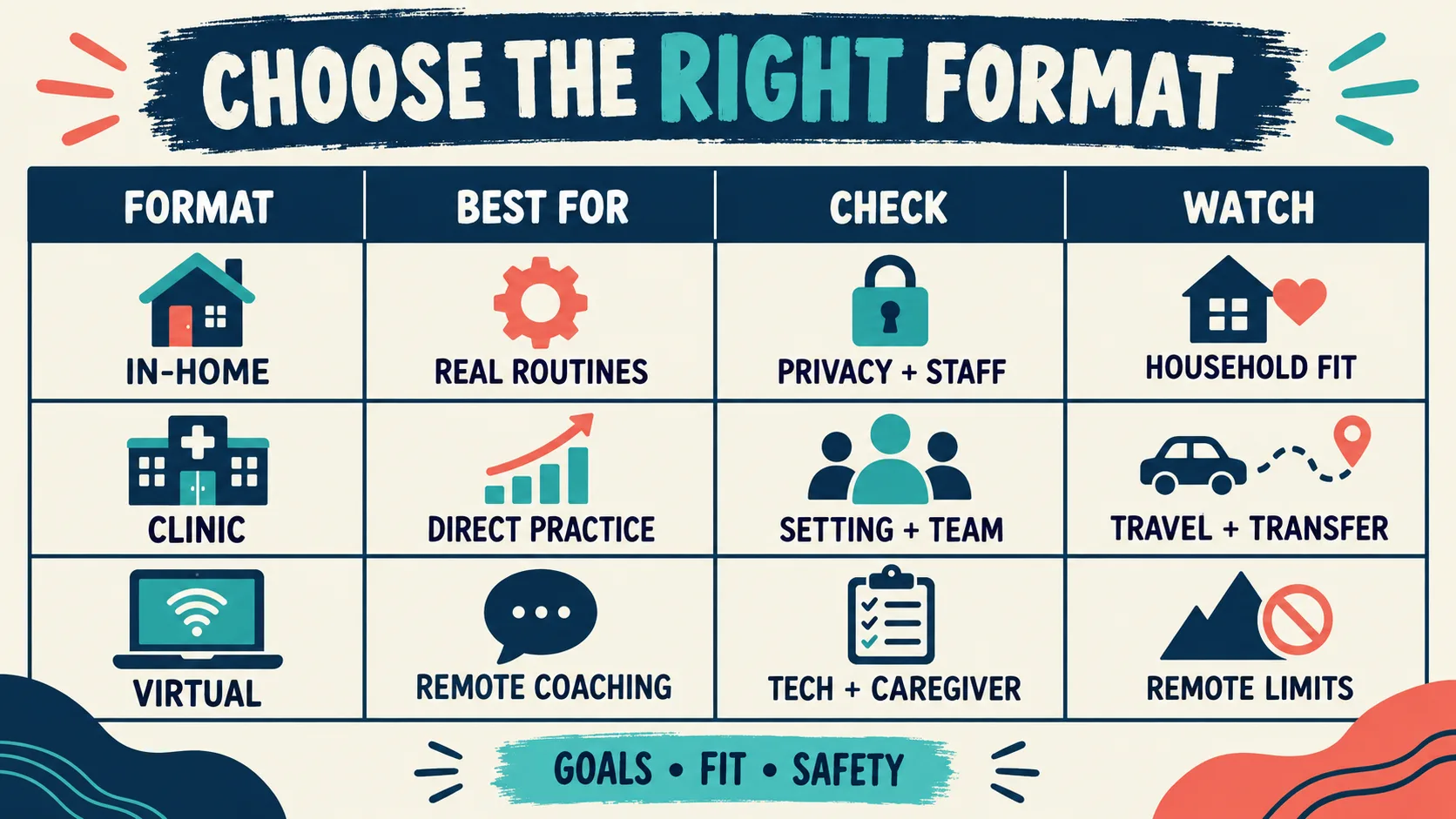
Compare the actual service model rather than assuming that one setting is universally superior. In-home care can show the team how a routine naturally unfolds, while a clinic may offer more staff, materials, and controlled practice opportunities. Virtual care may make BCBA coaching easier to access and can place the caregiver in the routine, but it requires technology and an available implementer. Some families use a hybrid plan to combine formats.
| Format | Often useful for | Questions to ask | Possible limitation |
|---|---|---|---|
| In home | Home routines, caregiver coaching, and skills that need natural materials or people | Who visits, what areas are observed, and how boundaries and data are handled | Household privacy, staffing, space, or schedule may limit consistency |
| Clinic | Direct practice, structured materials, peer opportunities, and access to a larger team | How skills transfer home and how caregivers receive coaching | Travel or an unfamiliar setting may reduce access or generalization |
| Virtual | Remote coaching, consultation, plan review, and access when travel is difficult | Who participates, what the camera captures, and when in-person support is added | Technology, privacy, and the need for an available implementer |
| Hybrid | Combining direct practice with home coaching or remote BCBA oversight | How data, goals, and responsibilities are shared across settings | Additional handoffs can create gaps without written coordination |
The site’s remote telehealth BCBA workflow guide explains professional remote practice in more detail. This page has a narrower purpose: helping a family evaluate in-home ABA as a service setting and decide what to ask before an intake.
How Do You Compare In-Home ABA Providers?
Provider pages often use similar language, so ask for concrete details instead of comparing slogans. A useful intake conversation should cover the service model, staffing, supervision, measurement, scheduling, and alternatives. Questions to ask include:
- Who will work in the home? Ask for the roles of the BCBA, RBT, caregiver, and any other implementer, along with how continuity is handled when staff are absent.
- What does a normal visit look like? Ask how the session starts, what routines may be practiced, how feedback is delivered, and what happens at the end.
- How is progress measured? Ask which behaviors or skills are recorded, who collects the data, and how often the BCBA reviews and explains it.
- When will the plan use another setting? Ask how the team handles goals that need clinic, school, community, or virtual observation.
- How much caregiver participation is expected? Ask what happens if the caregiver is working, caring for another child, sick, or unable to practice that day.
- How are privacy and boundaries protected? Ask about recordings, visitors, documentation, communication channels, and the family’s ability to limit unnecessary observation.
- What is the response plan? Ask who to contact if a procedure creates risk, a behavior escalates, staff are late, or the household needs a change.
Specific answers help you compare providers fairly. Be cautious if a company promises a fixed result, presents one setting as right for everyone, or cannot explain what the BCBA directly observes and how the treatment plan changes when data do not support the current approach.
What About Insurance, Scheduling, and Location?
Coverage depends on the family’s plan, state, network, authorization, provider credentials, service codes, and documentation. The official Medicaid autism-services information is useful background, but it does not approve a particular request for every family. HealthCare.gov also explains that behavioral-health benefits are tied to the applicable plan and rules. Ask the insurer and provider about the exact member plan, in-network status, prior authorization, copay or coinsurance, visit limits, and what happens if the provider travels to the home.
Location matters for more than travel time. The learner’s location, provider credentials, payer requirements, and service model may affect delivery. Ask how the provider handles moves, vacations, school breaks, and a change of setting. “Home-based” or “available in your state” may not include every ZIP code, plan, or service combination.
What Ethical Boundaries Should an In-Home Program Respect?
The BACB Ethics Code for Behavior Analysts provides professional context for competence, client welfare, confidentiality, informed participation, and individualized decisions. In-home service should be selected because it supports the learner’s goals and context, not simply because it is convenient for a provider.
The team should explain its procedures, respect household boundaries, protect confidential information, and reassess when the setting is not producing useful progress. It should not present home sessions as automatically more effective or family-friendly. Ask for a plain-language explanation of benefits, burdens, risks, and alternatives before agreeing.
In-Home ABA Therapy FAQ
Is in-home ABA therapy better than clinic-based ABA?: Not automatically. Home-based care may fit goals connected to household routines, while a clinic may provide materials, staff, or structured practice that a learner needs. The team should select and review the setting based on goals, safety, access, data, and generalization rather than a blanket claim.
Does a parent have to be present for every in-home session?: Requirements vary by provider, payer, learner, and service model. Some programs require a caregiver for coaching or implementation; others may use a trained staff member for direct work while asking the caregiver to participate at defined times. Ask before scheduling and clarify what happens when the expected adult is unavailable.
Does insurance cover in-home ABA therapy?: Some plans may cover applicable services, but coverage is not universal. Verify the exact plan, network, authorization, provider credentials, service codes, cost sharing, and location rules with the insurer and provider. A provider’s general coverage statement is not a guarantee for one learner.
What if the home is too small or busy for a session?: Tell the provider. The team may be able to use a smaller routine, another safe area, a different schedule, a clinic visit, or virtual coaching. The family should not have to hide normal household conditions to make the service appear successful; those conditions are part of deciding what format is workable.
Key Takeaway
In-home ABA therapy can connect teaching to real routines, but the label alone does not tell you whether a program is a good fit. Compare the actual roles, goals, data, caregiver expectations, privacy protections, coverage rules, and alternatives. If you are studying supervision, ethics, measurement, and treatment planning for the BCBA exam, reinforce those concepts with the site’s free BCBA mock exam. For targeted review, use our in home aba therapy practice questions to apply the concept in exam-style scenarios.
Quick Review Checklist
Use this final checklist to turn in home aba therapy into exam-ready reasoning. The goal is not to memorize a label in isolation; it is to identify the relevant evidence and explain why the best answer fits the scenario. Key ideas to review:
- State the central definition or decision point for in home aba therapy in your own words.
- Identify the detail that makes in home aba therapy different from its closest related ABA term.
- Separate the observable facts in a scenario from assumptions that are not supported by the facts.
- Write one example and one nonexample so you can recognize the concept in a new setting.
Exam application checks:
- Ask what the question is actually requesting before comparing the answer choices.
- Mark the antecedent, response, consequence, or other evidence that supports the selected answer.
- Look for a distractor that describes a related process but does not answer the specific question.
Final self-check:
- Explain how you would verify the interpretation with clear observations or data.
- Change one detail in the scenario and decide whether your answer should change.
- Give a one-sentence rationale that a supervisor or study partner could evaluate.
Take the Free BCBA Mock Exam
If you want a low-pressure way to check your recall, use the free practice resource below. Take the Free BCBA Mock Exam



