

Quick answer: When someone asks what does an ABA therapist do, they are usually asking about a direct-care professional who helps implement behavior-analytic teaching and support plans under the supervision of a qualified clinician. The day may include preparing materials, teaching communication or daily-living skills, following reinforcement and prompting procedures, recording data, supporting safe behavior, sharing observations, and receiving feedback. The exact duties depend on the person’s credential, employer, state rules, client goals, and supervision plan.
Table of Contents
- What Does an ABA Therapist Do in Plain Language?
- Which ABA Professional Does Which Work?
- What Does an ABA Therapist Do Before a Session?
- How Does an ABA Therapist Teach Skills?
- How Are Reinforcement and Prompting Used?
- What Data Does an ABA Therapist Collect?
- What Does an ABA Therapist Do When Behavior Escalates?
- What Does a Typical ABA Session Workflow Include?
- How Does an ABA Therapist Work With Families and Teams?
- Why Is Supervision Part of the Job?
- What Should an ABA Therapist Not Do Independently?
- How Can Families Evaluate an ABA Therapist?
- How Do ABA Therapist Roles Compare?
- What Should a Job Candidate Ask?
- What Does an ABA Therapist Do? FAQ
- What does an ABA therapist do all day?
- Is an ABA therapist always an RBT?
- Key Takeaway
- Quick Review Checklist
- Take the Free BCBA Mock Exam
“ABA therapist” is not one universal job title. An agency may use it for an RBT, a behavior technician who is trained by the employer, a BCaBA, or—less precisely—a BCBA. The person delivering direct care should not automatically be treated as the person who independently assesses behavior, designs the treatment plan, changes clinical procedures, or supervises the team. A good explanation starts by matching the daily task to the role and credential.
What Does an ABA Therapist Do in Plain Language?
Most direct-care ABA work turns a written plan into teachable, observable actions. The therapist may arrange the environment, present a learning opportunity, use an approved prompt, reinforce a useful response, record what happened, and adjust the immediate teaching support within the supervisor’s instructions. The purpose is not to make every moment look identical. It is to help the learner build functional skills and participate more successfully in everyday routines.
The work can involve communication, play, social interaction, self-care, transitions, tolerance, academic readiness, community participation, or other goals selected by the clinical team and family. A responsible therapist follows the individualized plan, watches for the learner’s response, protects dignity and safety, and tells the supervisor when the plan is unclear or the learner’s needs change.
Which ABA Professional Does Which Work?
| Role or label | Typical daily contribution | Supervision boundary | What to ask |
|---|---|---|---|
| RBT | Implements assigned services, teaches skills, records data, and reports observations | Works under close, ongoing supervision and does not independently design the case plan | Who is the supervisor and how is feedback documented? |
| Behavior technician | Performs employer-defined direct-care tasks after training | Scope comes from training, supervision, state rules, and the service plan | What credential, training, and state step does the job require? |
| BCaBA | May analyze and oversee parts of services within the assistant-analyst role | Practices under a qualified BCBA or other permitted supervisor | Which decisions require the supervising BCBA’s review? |
| BCBA | Assesses, designs or oversees plans, interprets data, trains staff, and supervises | Still follows ethics, state law, payer rules, and competence limits | Who holds clinical responsibility for the case? |
If a procedure is not working, the therapist documents the observation and contacts the supervisor rather than inventing a new intervention. Clear role boundaries protect the learner, family, and staff member.
What Does an ABA Therapist Do Before a Session?
Preparation prevents a session from becoming a series of improvised demands. The therapist may review the current goals, gather materials, check the schedule, identify transition points, and confirm the reinforcement or prompting procedures authorized by the supervisor. In a home, clinic, school, or community setting, preparation also means checking the environment for distractions, hazards, privacy concerns, and access needs.
The therapist should know what data to collect and what counts as a completed opportunity. A clear definition might specify the response, the opportunity, the prompt level, the latency, the duration, or another measurement dimension. If the instructions conflict with the learner’s current presentation, the therapist should pause and ask for guidance rather than treat a confusing plan as permission to guess.
How Does an ABA Therapist Teach Skills?
Teaching usually involves arranging an opportunity, giving a clear instruction or cue, waiting for the learner to respond, and using the approved prompt or reinforcement procedure. The therapist may break a complex routine into smaller steps, model a response, offer choices, practice in a natural routine, or vary materials so the learner can use the skill beyond one table or one adult.
Good teaching is responsive. The therapist watches whether the learner is engaged, understands the cue, needs a break, or is showing a sign that the task is too difficult. The goal is not to force a response or create compliance at any cost. The plan should be implemented with respect for communication, assent signals, dignity, and the learner’s safety. Questions about goals or procedures belong in supervision and team discussion.
How Are Reinforcement and Prompting Used?
An ABA therapist may use reinforcement to make a useful response more likely in the future. Reinforcement is individualized; it is not automatically a prize, a food item, or praise. The supervisor and learner’s team identify what is meaningful, how it can be offered, and how the learner can gain more independence over time.
Prompts provide extra help so the learner can contact success. The therapist may use a gesture, model, visual cue, verbal cue, or physical guidance only as authorized and appropriate. Prompting should be planned carefully, delivered respectfully, and faded when the learner can respond with less help. A therapist should not continue a prompt that causes distress or use a more intrusive procedure simply because it is convenient.
What Data Does an ABA Therapist Collect?
Data make a session observable. Depending on the goal, a therapist may record whether a response occurred, how many times it occurred, how long it lasted, how quickly it began, the level of prompt needed, or how many opportunities were successful. The exact measurement should match the operational definition and the question the team is trying to answer.
Accurate data are more important than impressive-looking data. Record what happened, including an unusual context, a missed opportunity, a prompt error, or a safety concern. Do not fill in a number later from memory or change a record to make progress look smoother. The supervisor uses these observations to evaluate teaching, adjust goals, and decide whether the plan is helping.
What Does an ABA Therapist Do When Behavior Escalates?
The response should follow the learner’s safety plan, crisis procedures, and supervisor instructions. A therapist may reduce unnecessary demands, create space, protect the learner and others, offer a taught communication response, or contact the supervisor according to the plan. The therapist should know which situations require an immediate call, incident report, medical response, or emergency service. Behavior reduction does not mean punishing every difficult moment. The team should consider what the behavior communicates, what skill could replace it, and what the direct-care therapist observed in context.
What Does a Typical ABA Session Workflow Include?
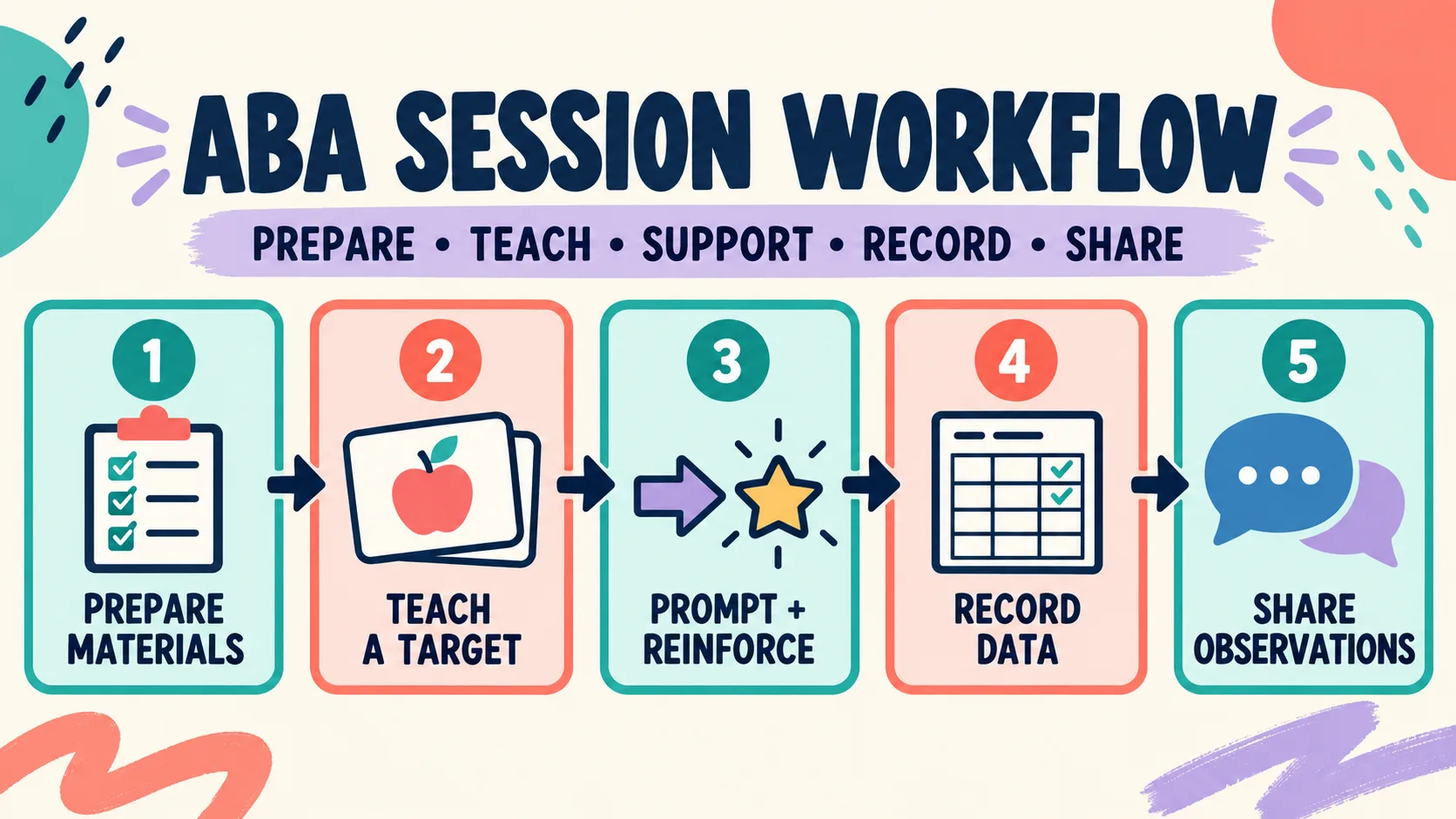
A session may move through a repeating cycle: prepare the environment, teach a target skill, provide the planned support, record the response, and share what the data and learner experience suggest. The order can change with the routine, and not every session should be reduced to a rigid checklist. The visual is a memory aid, not a replacement for the individualized plan.
At the end of the session, the therapist completes notes and flags questions. A useful note distinguishes observation from interpretation: “the learner completed four of five opportunities with a model prompt” is more actionable than “the learner did well.”
How Does an ABA Therapist Work With Families and Teams?
ABA services usually involve more than one person. The therapist may communicate with a caregiver, teacher, BCaBA, BCBA, or other authorized team member. Share observable information and route clinical decisions to the person responsible for them.
Families should be able to ask what was practiced, what support was needed, what the therapist noticed, and what questions should go to the BCBA. A therapist should not promise a particular outcome, diagnose a new condition, disclose private information to an unauthorized person, or present an unapproved change as a treatment decision.
Why Is Supervision Part of the Job?
Supervision connects training to safe service delivery. The BACB supervision and training resource explains that qualified certificants may supervise, train, assess, or oversee people providing behavior-analytic services. Supervision can include observation, feedback, review of data or notes, problem solving, and ethical questions.
Ask who is responsible, how contact occurs, whether the supervisor observes real work, and how feedback is documented. A therapist needs a clear route for raising concerns when the plan is unclear or the request exceeds training.
What Should an ABA Therapist Not Do Independently?
A direct-care therapist should not independently diagnose, create a new treatment plan, change a clinical procedure outside the approved scope, promise that a service will produce a specific result, or represent a training certificate as a professional license. The therapist also should not hide an error, fabricate data, ignore a safety concern, or share confidential information without authorization.
Scope is not about minimizing the therapist’s contribution. Direct-care staff often develop the closest view of the learner’s daily experience. Their observations, implementation skill, and relationship with the learner are valuable. The boundary simply ensures that important decisions are made by the qualified person responsible for assessment, supervision, and the treatment plan.
How Can Families Evaluate an ABA Therapist?
Families can ask the agency to name the therapist’s credential, the supervising BCBA or BCaBA, and the responsibilities of each person. Ask how the therapist is trained, what data are collected, how the learner’s communication and assent are respected, and how concerns are handled. The answer should be specific enough that you can tell who makes decisions and how progress is reviewed.
- Who assessed the learner and who owns the treatment plan?
- Who supervises the therapist, and how can a family reach that person?
- What skills are being taught, and how will the family see meaningful progress?
- What data are collected, how often are they reviewed, and what would trigger a change?
- What happens if the learner signals distress, refuses, or needs a break?
- How are privacy, safety, culture, language, and family priorities handled?
Be cautious if a provider cannot explain the therapist’s role, discourages questions, or treats data as a billing formality. The team should still explain the plan in plain language.
How Do ABA Therapist Roles Compare?
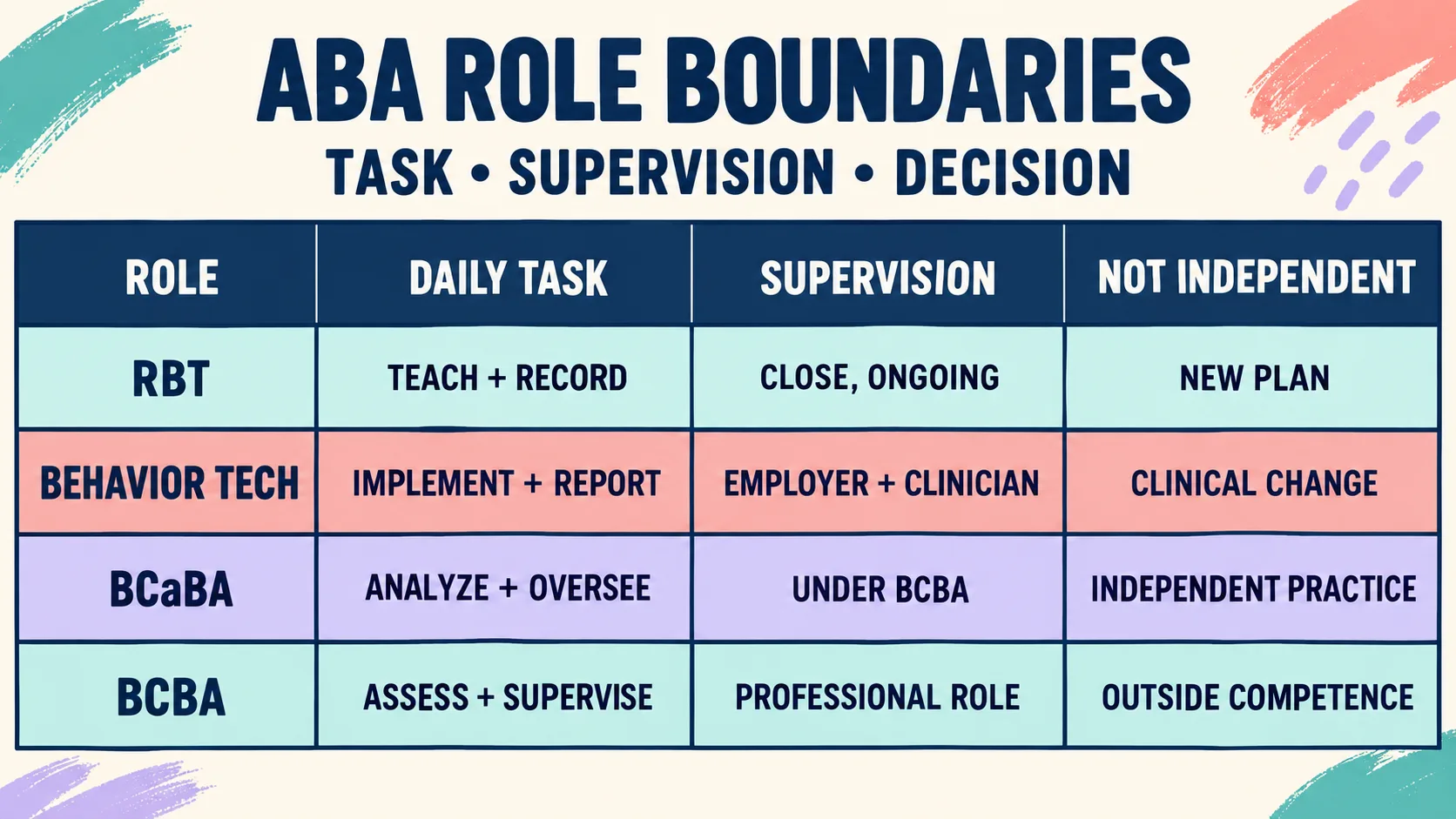
Use the visual to start a conversation about scope. “ABA therapist” may be the public label, but the credential, supervisor, daily responsibility, and decision-maker should be identifiable. If the role is different from the one advertised, ask why before services or employment begins.
What Should a Job Candidate Ask?
- What is the exact job title and credential expectation?
- Who provides the supervision, and is it included in paid work time?
- What training and competency checks happen before independent sessions?
- Which data system, notes, and communication tools will I use?
- What is the process for safety concerns, ethical questions, and plan clarification?
- What state, background-check, payer, or school requirements apply?
What Does an ABA Therapist Do? FAQ
What does an ABA therapist do all day?
A typical day may include preparing materials, teaching skills, using approved prompts and reinforcement, collecting data, documenting sessions, communicating observations, and meeting with or receiving feedback from a supervisor. The mix varies by setting, credential, schedule, and learner goals.
Is an ABA therapist always an RBT?
No. “ABA therapist” is a broad job label. The person may be an RBT, behavior technician, BCaBA, BCBA, or another employee defined by the agency. Ask for the exact credential and supervision structure.
Key Takeaway
What does an ABA therapist do? The answer is usually: implement individualized teaching and support procedures, collect honest data, communicate observations, protect the learner’s dignity and safety, and work within a clear supervision structure. The job title alone is not enough. If you are studying the analyst-level concepts behind measurement, prompting, reinforcement, ethics, and supervision, continue with the site’s free BCBA mock exam. For targeted review, use our what does an aba therapist do practice questions to apply the concept in exam-style scenarios.
Quick Review Checklist
Use this final checklist to turn what does an aba therapist do into exam-ready reasoning. The goal is not to memorize a label in isolation; it is to identify the relevant evidence and explain why the best answer fits the scenario. Key ideas to review:
- State the central definition or decision point for what does an aba therapist do in your own words.
- Identify the detail that makes what does an aba therapist do different from its closest related ABA term.
- Separate the observable facts in a scenario from assumptions that are not supported by the facts.
- Write one example and one nonexample so you can recognize the concept in a new setting.
Exam application checks:
- Ask what the question is actually requesting before comparing the answer choices.
- Mark the antecedent, response, consequence, or other evidence that supports the selected answer.
- Look for a distractor that describes a related process but does not answer the specific question.
Final self-check:
- Explain how you would verify the interpretation with clear observations or data.
- Change one detail in the scenario and decide whether your answer should change.
- Give a one-sentence rationale that a supervisor or study partner could evaluate.
Take the Free BCBA Mock Exam
If you want a low-pressure way to check your recall, use the free practice resource below. Take the Free BCBA Mock Exam



