

A practical ABA practice guide to calculating gross collection rate, reading the number in context, and knowing when net collection rate deserves the headline. If you are searching for ABA gross collection rate, the short answer is simple: divide payments received by gross charges for the same defined period, then multiply by 100. The useful answer is more careful. Gross collection rate tells you how much cash was collected against the amount billed at the practice’s charge schedule. It does not tell you by itself whether the practice collected everything it was contractually entitled to receive, whether a payer mix changed, or whether the practice is profitable.
Table of Contents
- What ABA Gross Collection Rate Means
- How to Calculate GCR
- How to Read a Monthly GCR
- Gross vs. Net Collection Rate
- A Practical Monthly Review Checklist
- Data, Privacy, and Reporting Boundaries
- Turn Practice Metrics Into Better Decisions
- Frequently Asked Questions
- Quick Review Checklist
- Take the Free BCBA Mock Exam
This guide explains the formula, a fictional ABA example, the effect of claim lag and payer mix, and the difference between gross and net collection rate. It is written for practice owners, administrators, and behavior analysts who want a clean operating definition—not a universal benchmark or a promise that one percentage proves financial health. Scope note: This is an educational revenue-cycle and practice-management guide. Use your own billing reports, contracts, accounting advice, privacy policies, and qualified professionals before making a financial, legal, coding, or clinical decision.
What ABA Gross Collection Rate Means
Gross collection rate (GCR) is the percentage of gross charges that a practice collects as payments. The basic formula is: Gross collection rate = payments received ÷ gross charges × 100 “Gross charges” means the amount posted at the practice’s charge schedule before contractual adjustments, write-offs, refunds, or other changes are removed. “Payments received” means the cash credited to the defined period or cohort according to the practice’s reporting method. The numerator and denominator must be defined together; a rate that mixes different periods can look precise while answering a different question.
GCR can be useful as a trend signal. For example, if the same practice, payer mix, charge schedule, and timing method move from 62% to 74% over several comparable months, that change deserves investigation. But GCR is not a stand-alone profit score. A practice can change its charge schedule and move the denominator without collecting more cash. A practice with a large contractual discount can also show a lower gross rate while collecting a high share of the amount it was actually expected to receive.
That is why a responsible dashboard shows GCR beside net collection rate, denial rate, days in accounts receivable, clean-claim rate, authorization utilization, and the age of open balances. Those metrics answer different questions. Do not collapse them into one “healthy” percentage.
How to Calculate GCR
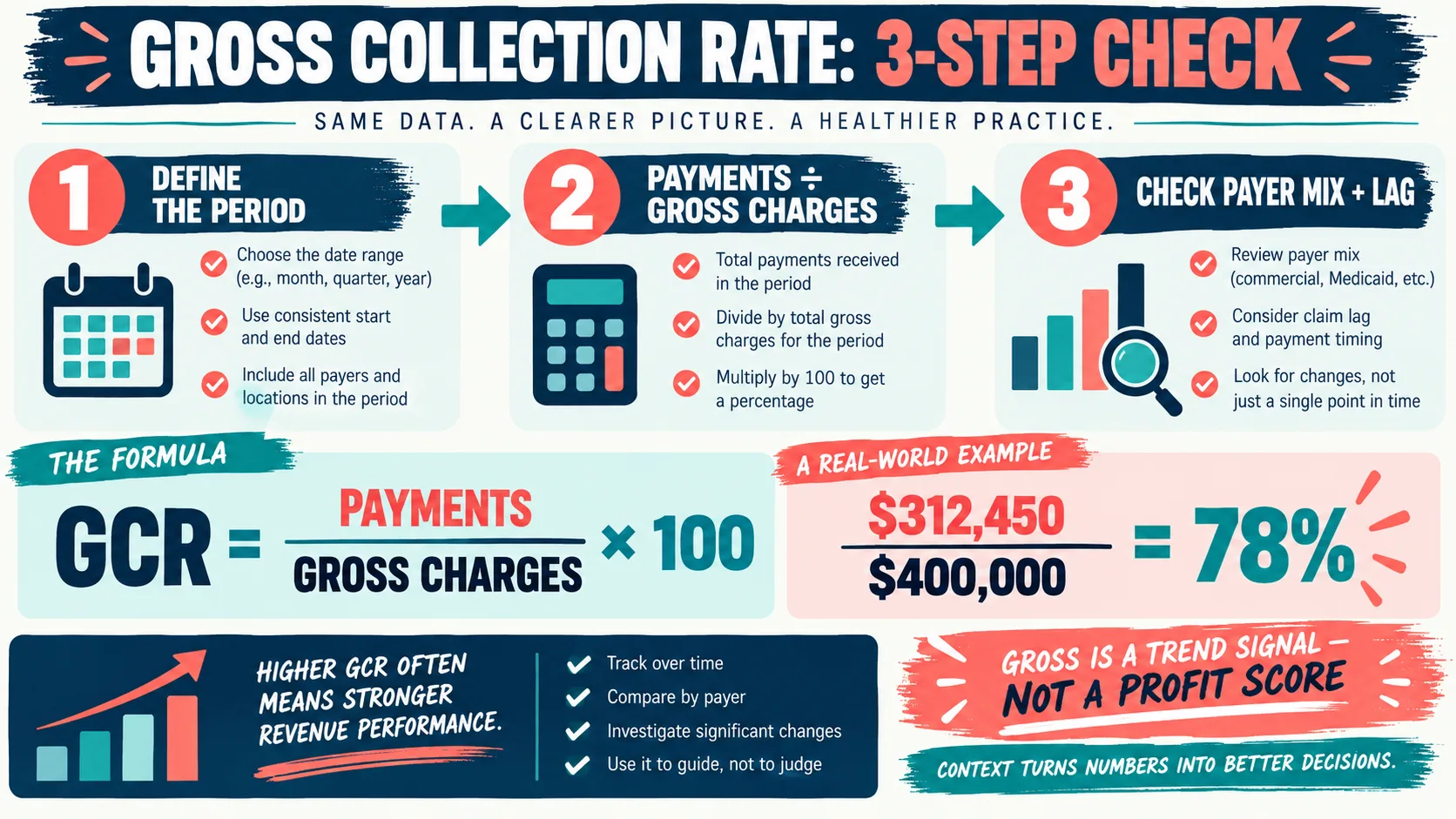
The calculation has three practical steps. Before you open the report, name the period, the population, and the accounting basis. A monthly cash-basis report and a date-of-service cohort report can both be valid, but they should not be compared as though they were the same measure.
| Step | What to define | Why it matters |
|---|---|---|
| 1. Set the period | Month, quarter, year, or a date-of-service cohort; include the locations and payers. | A short period may contain claims that have not had time to adjudicate. |
| 2. Pull the two amounts | Payments received and gross charges under the same reporting rule. | Mismatched dates, locations, or payment rules create a ratio that cannot be interpreted cleanly. |
| 3. Calculate and compare | Divide payments by gross charges, convert to a percentage, and review the trend with context. | One point is a signal to investigate; a comparable series is more useful for operating decisions. |
For example, suppose a fictional ABA practice reports $312,450 in payments and $400,000 in gross charges for a defined monthly report. The calculation is: $312,450 ÷ $400,000 × 100 = 78.1% Round according to your reporting policy. The answer is approximately 78%, but the percentage is only the beginning of the review. Ask whether the charges and payments belong to the same period, whether the month contains unusually young claims, whether a payer or location changed, and whether a large payment batch was posted late.
How to Read a Monthly GCR
A monthly GCR can be calculated on a simple cash basis: payments posted during the month divided by charges posted during the month. That method is easy to repeat and can be useful for a high-level cash report. Its weakness is that the payments may relate to services delivered in earlier months, while some current charges may not yet have been paid.
A cohort method instead groups charges by date of service and follows the related payments and adjustments over a stated maturity period. It is more informative for payer, service-line, or location analysis, but it requires stronger report design. A mature cohort can be compared with another mature cohort; a brand-new cohort should not be judged as if all claims have completed the payer cycle. When GCR changes, review four questions:
- Did the denominator change? Check the fee schedule, new services, locations, units, and charge-posting rules.
- Did the payer mix change? Separate commercial, Medicaid, self-pay, and other payer groups instead of assuming one blended rate tells the whole story.
- Did the payment timing change? Look for claim lag, payment batches, recoupments, refunds, and delayed posting.
- Did the collection workflow change? Review eligibility, authorizations, clean claims, denials, appeals, patient responsibility, and follow-up ownership.
Do not compare two ABA practices solely by GCR. Their charge schedules, payer contracts, service mix, geography, patient responsibility, and reporting maturity may be different. A higher GCR may reflect a lower charge master rather than better collection work. A lower GCR may reflect a higher list price combined with strong contractual reimbursement. The comparison only becomes useful after the underlying definitions are aligned.
Gross vs. Net Collection Rate
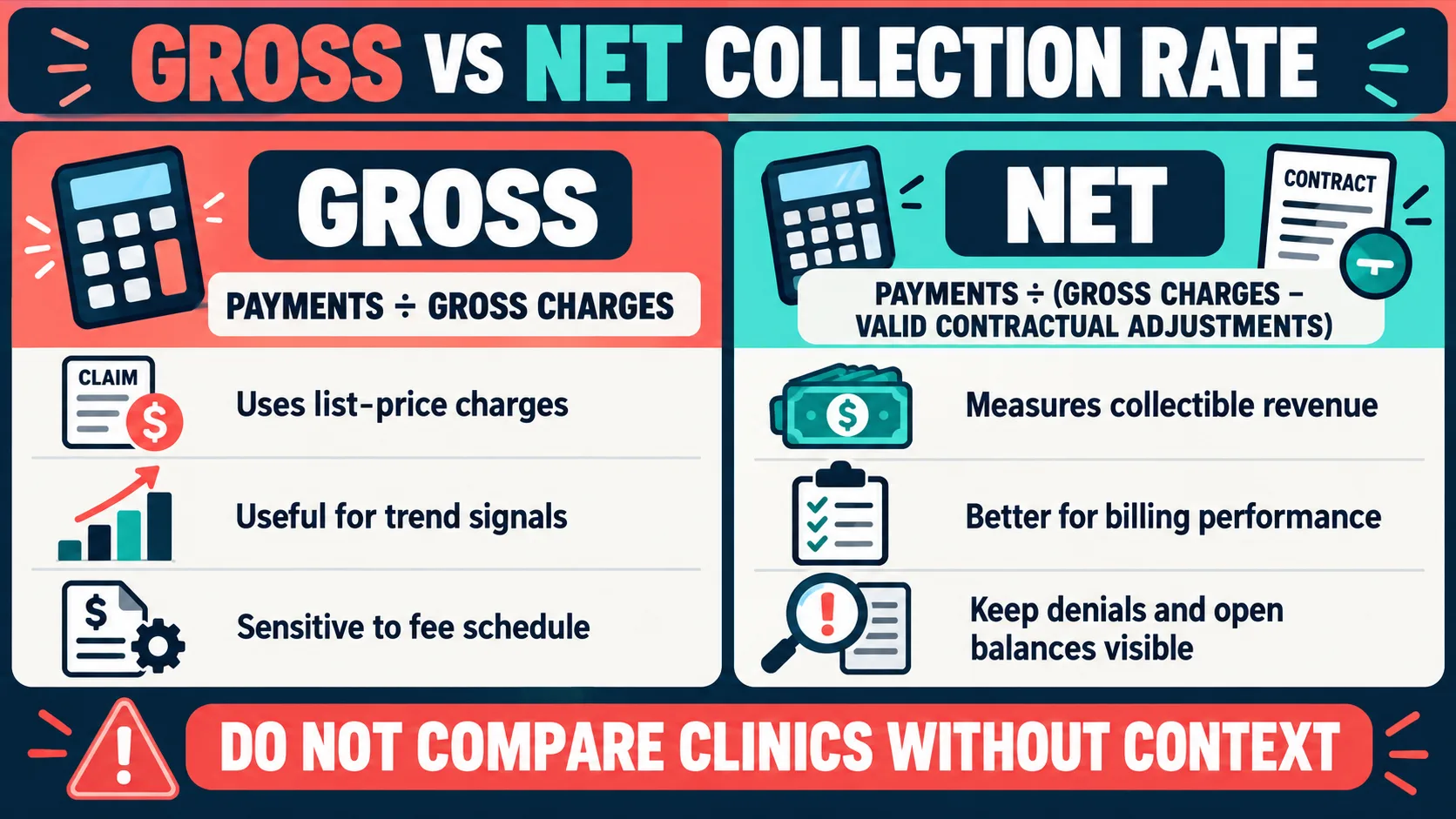
The central distinction is the denominator. GCR uses gross charges. Net collection rate (NCR) removes valid contractual adjustments from gross charges and asks how much of the amount the practice was realistically entitled to collect actually came in. A common conceptual formula is: Net collection rate = payments received ÷ (gross charges − valid contractual adjustments) × 100 The exact report logic should follow the practice’s accounting policy. Keep denials, avoidable write-offs, refunds, open balances, and payer-specific rules visible rather than hiding them inside one adjusted number.
| Metric | Denominator | Best use | Main caution |
|---|---|---|---|
| Gross collection rate | Gross charges at the practice charge schedule. | Trend monitoring, charge-schedule review, and an early signal that deserves context. | Sensitive to list prices, payer mix, and claim/payment lag; not directly comparable across practices. |
| Net collection rate | Gross charges minus valid contractual adjustments, under a documented policy. | Evaluating how much collectible revenue the workflow actually collected. | Can be distorted if adjustments, denials, refunds, or open balances are classified inconsistently. |
Suppose the same fictional month has $400,000 in gross charges, $62,300 in valid contractual adjustments, and $312,450 in payments. GCR is about 78.1%. The adjusted collectible denominator is $337,700, so the conceptual net rate is about 92.5%. Those numbers answer different questions: GCR shows payments against the list-price denominator, while the net calculation is closer to the amount the payer contracts made collectible.
Neither number should be treated as a magic target. First make the definitions repeatable, then compare trends within the same practice and mature cohort. If a billing vendor supplies a benchmark, ask what population, payer mix, aging rule, and adjustment policy produced it. “Good” is not meaningful when two reports use different denominators.
A Practical Monthly Review Checklist
A small recurring review can make the metric useful without turning it into a performance theater exercise. Document:
- The report period, locations, payer groups, and whether the report is cash-basis or cohort-based.
- Gross charges, payments, contractual adjustments, refunds, and open balances.
- Claim lag and the minimum age of the cohort being compared.
- GCR and NCR side by side, with definitions displayed next to the numbers.
- Denial rate, clean-claim rate, days in accounts receivable, and aged balances.
- One explanation for a material change and one next check with an owner and date.
If the rate falls, do not immediately increase charges or blame the billing team. Trace the change from charge posting to eligibility, authorization, claim submission, payer adjudication, denial work, patient responsibility, payment posting, and reconciliation. If the rate rises, confirm that the improvement is real and not a batch-posting artifact, a denominator change, or an adjustment-classification change.
Data, Privacy, and Reporting Boundaries
Revenue-cycle reports can contain client identifiers, payer information, dates of service, diagnoses, authorizations, and payment details. Use the minimum necessary information for the question, restrict access, and avoid copying protected information into a general-purpose spreadsheet or AI tool without authorization and appropriate safeguards. Review the HHS HIPAA resources for professionals and your organization’s policies before exporting or sharing reports.
Provider administration is also separate from collection-rate interpretation. For example, the CMS National Provider Identifier reference explains an administrative identification standard; it does not create a GCR benchmark. Keep official requirements, payer-contract terms, internal accounting policy, and educational explanations clearly separated.
Turn Practice Metrics Into Better Decisions
For a practice owner, the highest-value next step is a repeatable definition. Put the formula, period, denominator, maturity rule, and companion metrics in the report itself. For a BCBA candidate, the transferable exam skill is the same: identify what a number actually measures before choosing what to do next.
Use the ABA practice startup guide for the broader operating plan, then use the Free BCBA Mock Exam as a separate study checkpoint for measurement, data interpretation, and applied decision questions. The mock score is study feedback, not an official BACB result or a financial-health assessment.
Frequently Asked Questions
What is the ABA gross collection rate formula?: Gross collection rate is payments received divided by gross charges, multiplied by 100. Define the period and reporting basis before comparing the result. What is a good gross collection rate for an ABA practice?: There is no universal number that can be applied responsibly to every ABA practice. Payer mix, fee schedules, service mix, claim maturity, contractual terms, and reporting rules change the result. Use a consistent internal trend and review net collection rate alongside it.
Is gross collection rate the same as net collection rate?: No. Gross collection rate uses gross charges. Net collection rate adjusts the denominator for valid contractual adjustments and is intended to describe collection against collectible revenue. The definitions and adjustment policy must be documented.
Why can GCR fall even if billing improves?: A new fee schedule, payer mix shift, younger claims, delayed payment posting, service mix change, or denominator rule can lower GCR without proving that the workflow deteriorated. Compare mature, like-for-like periods and review companion metrics.
Can I compare the GCR of two ABA clinics?: Only after aligning the charge schedule, payer mix, service lines, period/cohort maturity, adjustment policy, and payment-posting rules. Otherwise the comparison may reflect different denominators rather than different collection performance.
Bottom line: ABA gross collection rate is a useful ratio when its period and denominator are visible. Calculate payments divided by gross charges, read the trend with payer and timing context, and keep net collection rate and open-balance metrics beside it. The goal is not to chase a percentage; it is to make the next operating decision more defensible.
Quick Review Checklist
Use this final checklist to turn aba gross collection rate into exam-ready reasoning. The goal is not to memorize a label in isolation; it is to identify the relevant evidence and explain why the best answer fits the scenario. Key ideas to review:
- State the central definition or decision point for aba gross collection rate in your own words.
- Identify the detail that makes aba gross collection rate different from its closest related ABA term.
- Separate the observable facts in a scenario from assumptions that are not supported by the facts.
- Write one example and one nonexample so you can recognize the concept in a new setting.
Exam application checks:
- Ask what the question is actually requesting before comparing the answer choices.
- Mark the antecedent, response, consequence, or other evidence that supports the selected answer.
- Look for a distractor that describes a related process but does not answer the specific question.
Final self-check:
- Explain how you would verify the interpretation with clear observations or data.
- Change one detail in the scenario and decide whether your answer should change.
- Give a one-sentence rationale that a supervisor or study partner could evaluate.
Take the Free BCBA Mock Exam
When you are ready to apply the idea, use the free practice resource below for additional feedback. Take the Free BCBA Mock Exam



