

BCBA experimental-design reasoning and study practice A parametric question ABA prompt asks what happens when you change the level or value of one variable while keeping the variable itself the same. Instead of comparing two unrelated procedures, the question usually examines a dose, duration, rate, intensity, delay, or other level of the same independent variable. The key is to identify the variable, name its levels, and interpret the pattern on the measured behavior.
Table of Contents
- What a Parametric Question ABA Prompt Is Asking
- How to Identify the Variable and Its Levels
- Parametric Versus Comparison and Component Questions
- How to Interpret a Parametric Pattern
- How to Work Through an Original ABA Scenario
- Common Parametric-Question Traps
- A Focused Study Routine for Parametric Questions
- Parametric Question ABA FAQ
- Take the Free BCBA Mock Exam
Use the current BCBA Test Content Outline to check the scope of experimental-design concepts, and use the current BCBA Handbook for official examination guidance. The examples below are original study examples, not official BACB questions, and no third-party practice result guarantees certification success.
What a Parametric Question ABA Prompt Is Asking
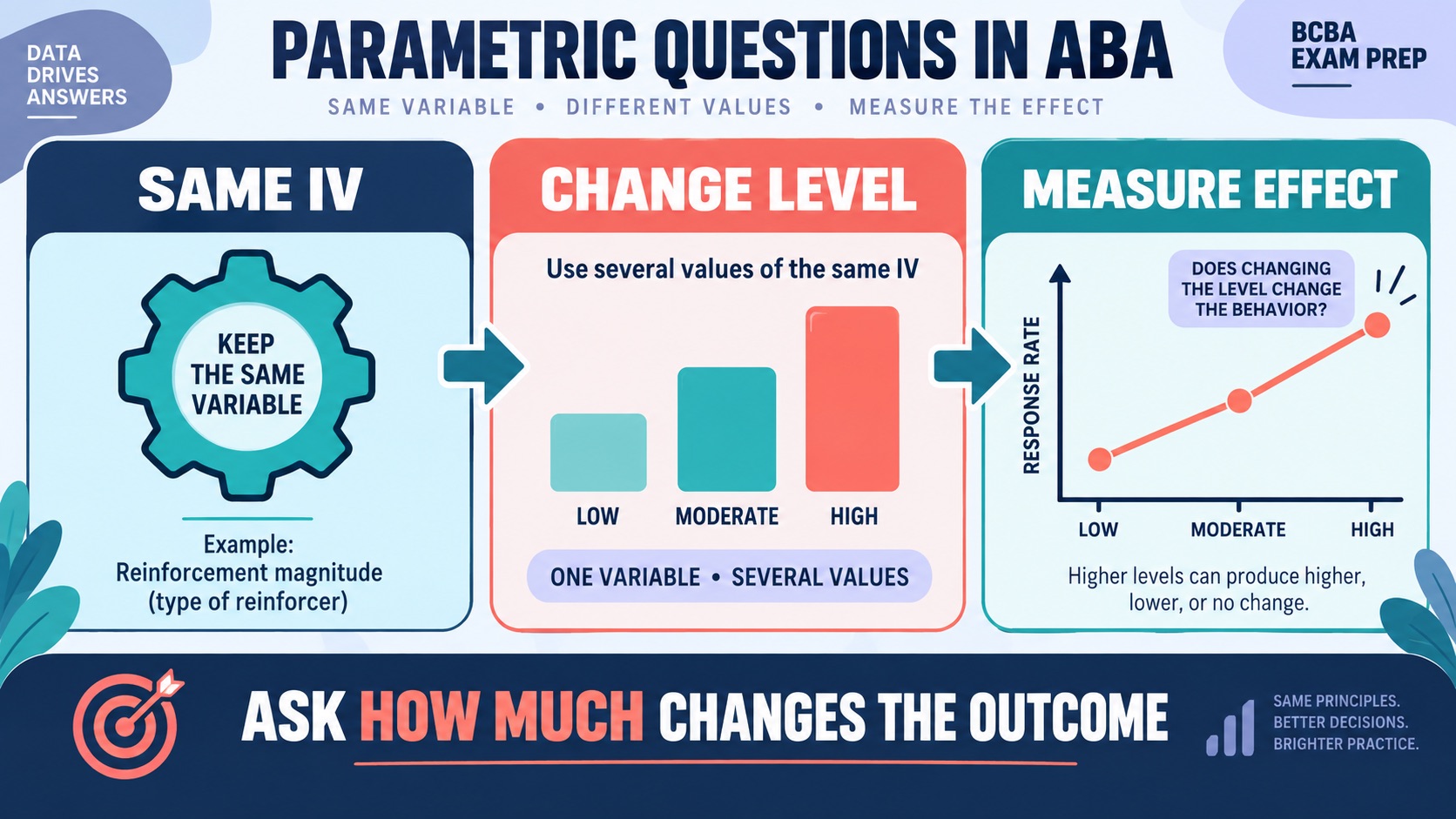
A parametric question focuses on the relation between how much of an independent variable is arranged and what happens to the dependent variable. The procedure may hold the type of intervention constant while changing its magnitude, frequency, duration, delay, or another measurable value.
Rewrite the prompt in one sentence: “The same independent variable is arranged at several levels, and the question asks how those levels relate to the measured behavior.” This sentence helps you avoid a common mistake: treating every two-condition comparison as a general treatment comparison.
- Same variable: the intervention or condition remains the conceptual variable of interest.
- Several values: the arrangement includes different levels, such as low, moderate, and high.
- Measured outcome: the analyst records a defined behavior and measurement dimension.
- Pattern: the conclusion depends on the data across levels, not on the highest value alone.
For example, an analyst might compare three durations of a teaching opportunity while measuring correct independent responses. The question is not simply whether teaching “worked.” It is whether different durations were associated with different response patterns under the described arrangement.
How to Identify the Variable and Its Levels
Begin with the variable that the researcher deliberately changes. Then list the exact values or levels used. A parametric question can be hidden inside a story about reinforcement magnitude, prompt delay, practice duration, schedule value, or treatment intensity, so do not rely on the word “dose” appearing in the stem.
- Underline the procedure or condition that stays conceptually the same.
- Circle the words that show its values or levels changed.
- Identify the behavior and measurement dimension used as the dependent variable.
- Note what was held constant, such as setting, task, materials, or response requirement.
- Ask whether the question requests a trend, an optimal level, a functional relation, or a practical recommendation.
Do not add a stronger claim than the prompt supports. If responding is higher at a moderate level than at a low level, the data show a difference in the measured outcome across those levels. They do not automatically establish that the moderate level is universally optimal, that the effect will generalize to every learner, or that the relation is causal without appropriate control and replication.
Parametric Versus Comparison and Component Questions
Parametric questions overlap with comparison questions because both can show more than one condition. The difference is what the conditions represent. Use the question’s purpose and the structure of the independent variable to classify it.
| Question type | What is varied? | Fast classification cue |
|---|---|---|
| Parametric | Different values of the same variable. | How does changing the level change the outcome? |
| General comparison | Different procedures, treatments, or conditions. | Which option differs on the target outcome? |
| Component | Parts added to or removed from a package. | Which element accounts for the package’s effect? |
| Demonstration | Intervention and control arrangements with replication logic. | Does the design demonstrate a functional relation? |
A stem may contain both a parametric comparison and a demonstration arrangement. That is why the final question matters. If it asks which level is associated with the highest response rate, focus on the parametric pattern. If it asks whether the intervention caused change, inspect the control and replication logic instead of stopping at the graph’s peak.
How to Interpret a Parametric Pattern
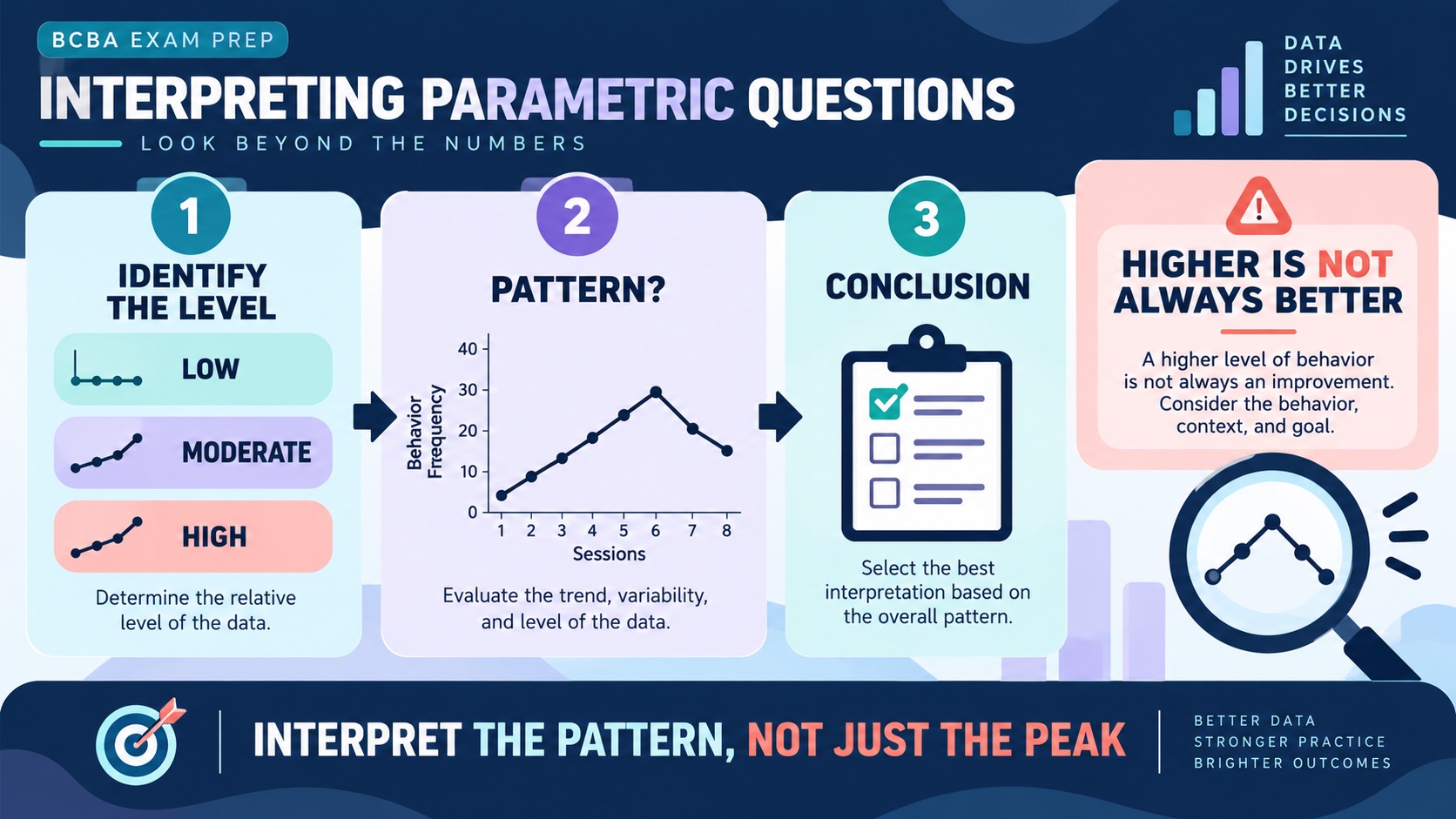
Interpret the shape and stability of the data across levels. A monotonic pattern may rise or fall as the level increases. A nonmonotonic pattern may show the strongest response at a middle level. A flat or highly variable pattern may suggest that changing the level did not produce a clear difference under the sampled conditions. Use four questions:
- Direction: does responding increase, decrease, or remain mixed as the level changes?
- Magnitude: are the differences large enough to matter for the question being asked?
- Variability: is the pattern consistent enough to interpret, or does it change from session to session?
- Context: is a higher behavior value desirable, undesirable, or dependent on the target and goal?
The last question is easy to miss. A higher rate of skill use may be desirable, while a higher rate of aggression may not be. “Higher” describes a data value; it does not automatically describe improvement.
How to Work Through an Original ABA Scenario
Imagine three levels of reinforcement magnitude are used during a brief training task: low, moderate, and high. The analyst keeps the response requirement and teaching materials consistent and records the percentage of correct independent responses. The question asks which statement best describes the parametric result.
First, identify the independent variable: reinforcement magnitude. Next, identify its levels: low, moderate, and high. The dependent variable is percentage of correct independent responses. If the graph shows the moderate level producing the highest stable responding, the best description is that the measured response was highest at the moderate level in the conditions sampled. That is a pattern statement.
Do not select a choice that says the high level is always best because it sounds intuitive. Do not select a choice that calls the levels three different interventions if the variable remains the same. Do not claim that the moderate level is optimal for every learner unless the evidence and question explicitly support that conclusion. The correct answer should match both the data pattern and the scope of the design.
Common Parametric-Question Traps
Parametric prompts often become difficult because answer choices use familiar terms in the wrong role. Watch for these traps:
- Variable substitution: treating different levels as different interventions.
- Peak-only reasoning: selecting the highest data point without considering trend or variability.
- Goal blindness: assuming a higher behavior value is automatically better.
- Measurement drift: overlooking that rate, duration, latency, accuracy, and percentage answer different questions.
- Optimality overclaim: turning a sampled result into a universal prescription.
- Design confusion: calling a component analysis parametric because it has multiple conditions.
A Focused Study Routine for Parametric Questions
Use a six-pass routine when you practice:
- Name the variable: write the independent variable in plain language.
- List the levels: record each value, dose, duration, delay, or intensity.
- Map the measure: state the dependent variable and measurement dimension.
- Read the pattern: describe the direction, magnitude, and variability without judging it yet.
- Match the conclusion: answer exactly what the stem asks and keep the claim narrow.
- Transfer the rule: solve a new scenario with a different behavior, level, or measurement.
When you review an error, label it as variable identification, level classification, graph interpretation, measurement, goal judgment, or conclusion scope. This produces a more useful study plan than simply recording “wrong.” If you repeatedly confuse parametric and component questions, build a contrast card that changes only the reason the conditions differ.
After targeted review, use the free BCBA mock exam for parametric question ABA practice to check whether the reasoning transfers to mixed scenarios. Treat the result as an unofficial practice signal and use the explanations to choose the next repair step.
Parametric Question ABA FAQ
What makes a question parametric in ABA?: The same conceptual independent variable is arranged at different values or levels, and the question asks how those levels relate to the measured behavior. The values might involve magnitude, duration, delay, rate, intensity, or another quantitative feature.
How is a parametric question different from a component question?: A parametric question changes the level of the same variable. A component question changes the parts of a treatment package to learn which element contributes to its effect. Identify why the conditions differ before choosing the label.
Does the highest level always produce the best outcome?: No. A higher behavior value may or may not be desirable, and the pattern may be flat, decreasing, or strongest at a middle level. Interpret the behavior, goal, context, and evidence together.
Take the Free BCBA Mock Exam
When you are ready to apply the idea, use the free practice resource below for additional feedback. Take the Free BCBA Mock Exam



