

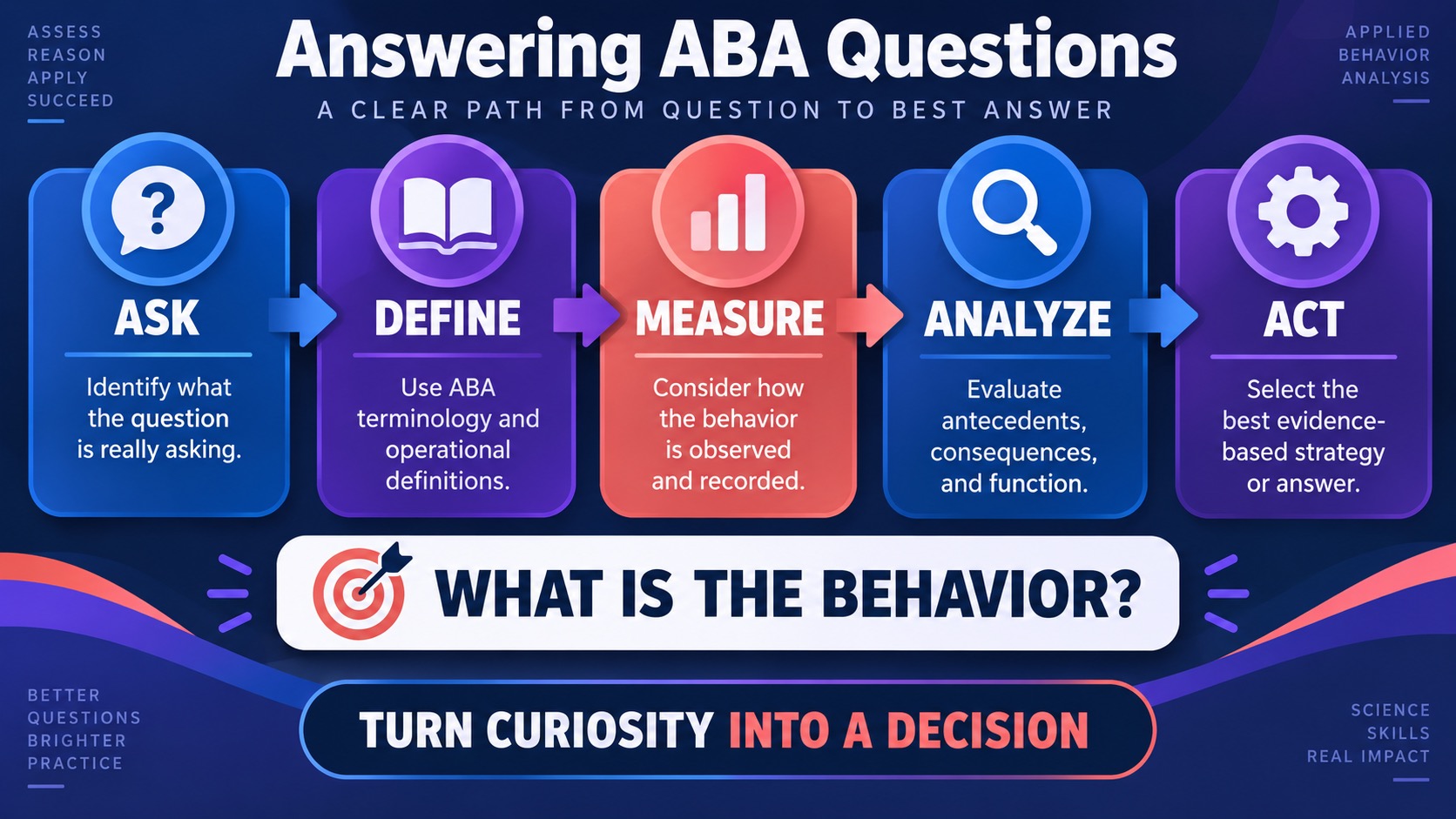
A practical framework for BCBA-style ABA questions When learners search for questions about ABA, they often need more than a glossary. They need a way to decide what a question is really asking, which evidence matters, and how to move from a definition to a defensible action. A reliable first pass is: ask what the behavior is, define it, decide how to measure it, analyze the relevant variables, and choose an evidence-based next step.
Table of Contents
- Where to Start With Questions About ABA
- Concept Questions: What Does the Term Mean?
- Measurement Questions: How Will We Count It?
- Function Questions: Why Is It Happening?
- Intervention Questions: What Should Change?
- A Question-to-Evidence Matrix
- A Repeatable Study Routine for ABA Questions
- Questions About ABA FAQ
- Take the Free BCBA Mock Exam
Use the current BCBA Test Content Outline to orient your study scope, and use the current BCBA Handbook for official examination guidance. The examples in this article are original study examples, not official BACB items. A practice score can guide review, but it does not establish eligibility or guarantee a passing result.
Where to Start With Questions About ABA
Do not begin by searching for a memorized phrase that resembles the answer choice. Begin by classifying the task. Is the question asking for a definition, a measurement system, a functional interpretation, an intervention decision, an ethical boundary, or a design conclusion? The category narrows the evidence you need.
Then translate the stem into a short decision sentence: “I need to decide what, using which evidence, for which behavior, under which condition.” This prevents a correct statement from becoming a wrong answer simply because it addresses another part of behavior analysis.
- Ask: identify the actual decision hidden inside the wording.
- Define: use observable, measurable terms rather than labels alone.
- Measure: select a dimension and system that capture meaningful change.
- Analyze: connect the pattern to antecedents, consequences, function, or design logic.
- Act: choose a response that fits the goal, evidence, context, and professional boundaries.
Concept Questions: What Does the Term Mean?
Concept questions test whether you can distinguish a technical term from a familiar everyday word. A good definition includes the defining feature and the boundary that separates the term from its nearest neighbor. “Reinforcement makes behavior stronger” is a useful starting phrase, but a study answer should also connect the consequence to a future increase in the behavior under relevant conditions.
When two terms look similar, write a contrast rather than two isolated definitions. For example, positive and negative reinforcement both describe procedures that increase behavior; the difference is whether a stimulus is added or removed after the behavior. The words “positive” and “negative” describe the stimulus operation, not whether the procedure is good or bad.
Use examples and nonexamples. If a definition cannot tell you why one scenario fits and another does not, it is probably too broad for an exam-style question. Avoid building a deck of slogans that never asks you to apply the boundary.
Measurement Questions: How Will We Count It?
Measurement questions are about the relation between the target behavior and the data system. Start with the behavior’s critical dimension. Frequency or rate may fit repeated responses, duration fits how long the behavior lasts, latency fits the time before it begins, and percentage can fit correct responses across opportunities. The best choice depends on what the behavior and decision require.
A useful operational definition is observable, clear, and complete enough that two trained observers can identify the behavior consistently. Ask what counts as an instance, what does not count, when observation starts and stops, and how the data will be summarized. A vague label such as “is disruptive” does not tell a team what to record.
| Question type | Evidence to locate | Common mistake |
|---|---|---|
| Concept | Defining feature and nearest contrast. | Choosing a broad slogan that fits several terms. |
| Measurement | Behavior dimension, observation rule, and data summary. | Selecting a system because it sounds familiar. |
| Function | Antecedent, behavior, consequence, and pattern across conditions. | Assuming the topography reveals the function. |
| Intervention | Goal, baseline, evidence, context, and monitoring plan. | Jumping to a procedure before defining the decision. |
Function Questions: Why Is It Happening?
Function questions ask what consequence or environmental relation may be maintaining behavior. Do not infer function from appearance alone. Two behaviors with the same topography can serve different functions, and one behavior can occur for different reasons across contexts.
Use the ABC sequence as a starting map: what happened before the behavior, what exactly occurred, and what followed? Look for repeated patterns, not a single memorable event. If a learner leaves a task and the task is consistently removed afterward, escape may be a hypothesis worth testing. It remains a hypothesis until the assessment and evidence support a stronger conclusion.
In an exam-style question, separate descriptive information from experimental evidence. A report that behavior often occurs after difficult tasks may support a descriptive hypothesis. A well-controlled functional analysis arrangement may provide stronger evidence about the relation. Choose the answer that matches the kind of evidence described.
Intervention Questions: What Should Change?
Intervention questions usually require you to connect the target behavior, function, goal, and data plan. Start with the outcome that matters. If the goal is to increase functional communication, a response-increase plan should specify the communication response, the conditions in which it should occur, and how progress will be measured.
Look for a plan that is function-based, feasible, socially meaningful, and monitored. A procedure is not automatically appropriate because it is common. Ask whether the plan addresses the relevant environmental relation, teaches a useful alternative when needed, includes reinforcement or other consequences that can be delivered as designed, and includes a way to adjust from data.
For a BCBA-style question, the best answer is often the one that solves the immediate decision while respecting professional boundaries. Avoid choices that promise a universal outcome, skip assessment, ignore consent or collaboration, or make a clinical change without a measurement plan.
- Goal: state the meaningful behavior change in observable terms.
- Fit: connect the procedure to the likely function and setting.
- Monitoring: decide what data will show progress or a need to adjust.
- Collaboration: account for feasibility, assent, communication, and professional responsibilities.
A Question-to-Evidence Matrix
The same scenario can contain several valid ABA facts. The question determines which fact should control your answer.
- Definition task: find the term’s defining operation and closest contrast.
- Measurement task: find the behavior dimension and observation constraint.
- Function task: find the repeated relation between context and consequence.
- Intervention task: find the goal, function-based strategy, and data-based adjustment.
Suppose a stem describes a child who shouts when a worksheet begins and receives a break after shouting. If the question asks for a likely function, focus on the task-to-break relation. If it asks for an operational definition, define exactly what “shouts” means. If it asks for a measurement system, decide whether frequency, rate, duration, or latency best fits the decision. The story stays the same; the requested evidence changes.
A Repeatable Study Routine for ABA Questions
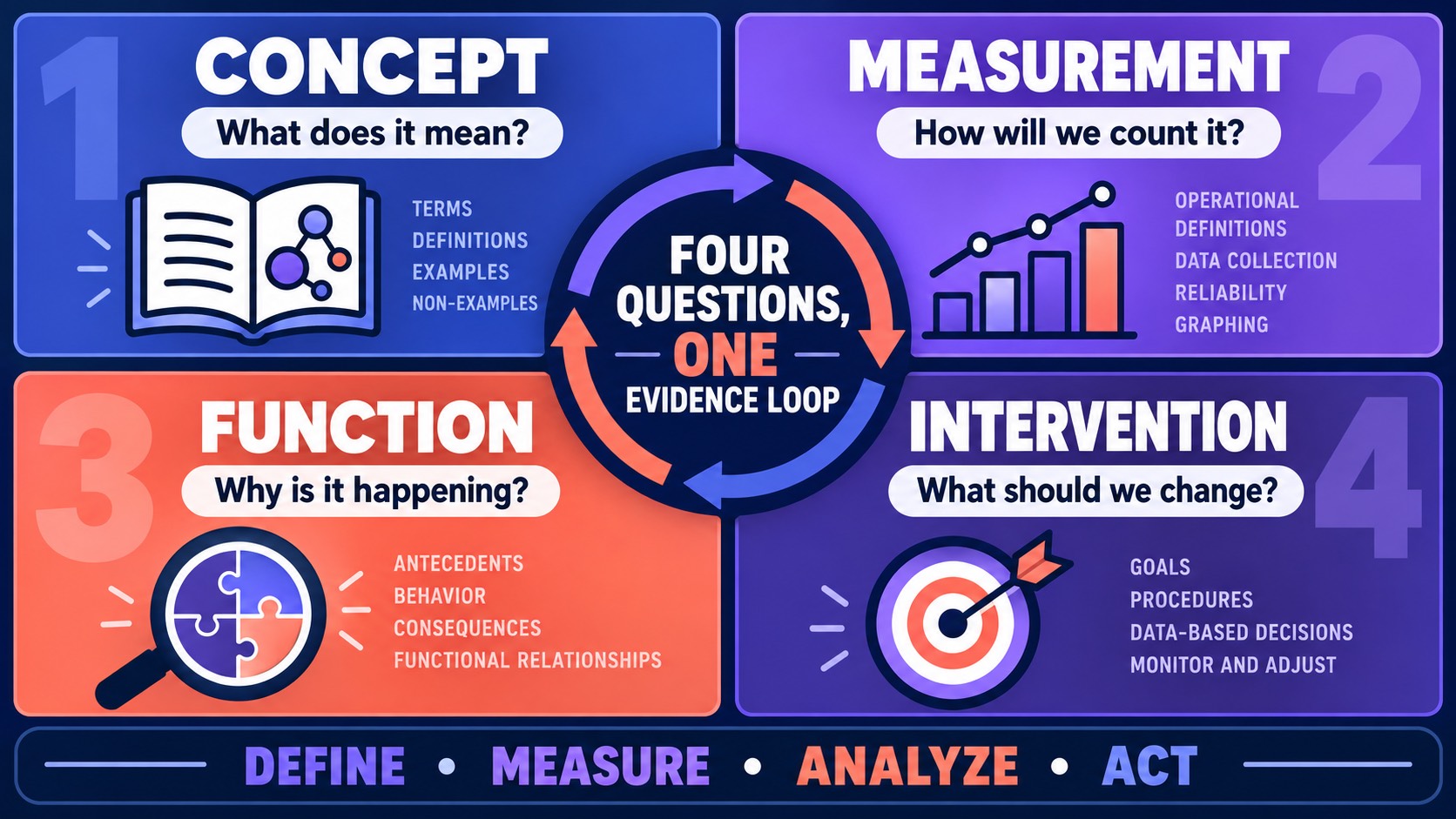
Use this routine for a mixed practice set:
- Classify the task: concept, measurement, function, intervention, ethics, or design.
- Extract the target: write the behavior, condition, and requested decision.
- Mark the evidence: underline the data, ABC pattern, experimental arrangement, or professional constraint.
- Compare choices: ask which option answers the exact task rather than a neighboring one.
- State the reason: explain the controlling clue in one sentence.
- Log the miss: label it as definition, measurement, function, intervention, reading, or scope.
Do not review only the questions you missed. A correct answer reached for the wrong reason can become a future error. After each practice set, choose one rule to transfer to a new scenario. This creates better preparation than memorizing the wording of one item.
When you want an additional mixed practice signal, try the free BCBA mock exam for questions about ABA practice. Use the explanations to decide what to repair next; the score is not a certification decision or a promise of exam performance.
Questions About ABA FAQ
What is the best way to answer a broad ABA question?: Classify the task first. Then identify the behavior, the relevant condition, the evidence described, and the decision requested. This keeps a correct fact from becoming an answer to the wrong question.
Why is an operational definition important?: It turns a label into an observable measurement target. A clear definition helps observers record the same behavior, choose an appropriate data system, and evaluate whether a change occurred.
Can I infer function from the behavior’s appearance?: No. Topography describes what behavior looks like; function concerns the relation that maintains it. Use context and consequence patterns, and match your conclusion to the evidence available.
Take the Free BCBA Mock Exam
When you are ready to apply the idea, use the free practice resource below for additional feedback. Take the Free BCBA Mock Exam



