
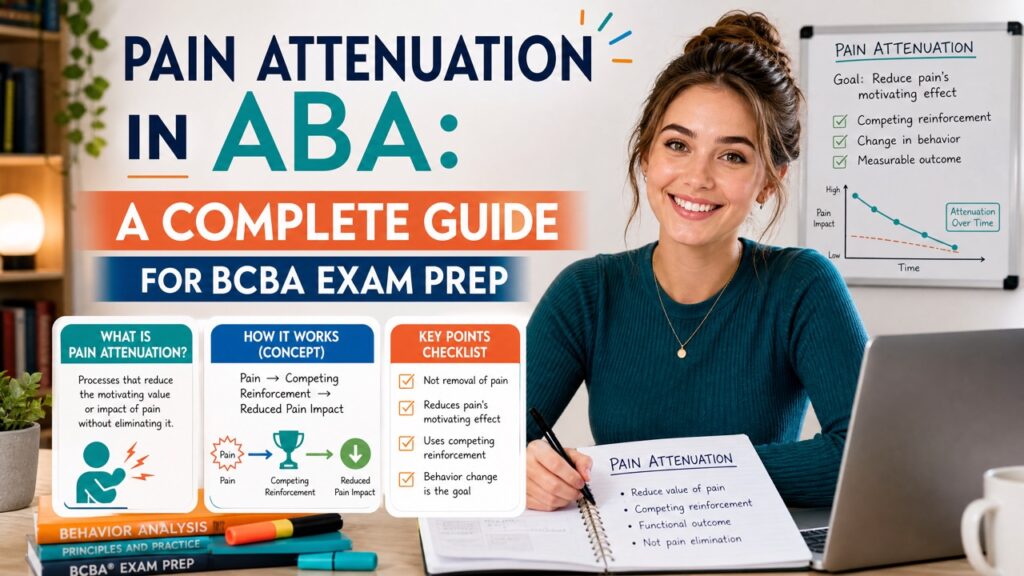
Understanding Pain Attenuation in Behavioral Terms
When studying for the BCBA exam, you will encounter terms that seem straightforward but carry specific meanings in behavior analysis. Pain attenuation is one of them. It refers to the reduction in the reinforcing or aversive properties of painful stimuli due to past learning. In simpler terms, a stimulus that once caused pain or served as a punisher may lose some of its impact after repeated exposure or conditioning.
Table of Contents
- Understanding Pain Attenuation in Behavioral Terms
- How Pain Attenuation Applies in Clinical ABA Settings
- Exam Relevance and Common Pitfalls
- Quick Review Checklist for Exam Day
- Summary and Final Tips
- Quick Review Checklist
- Take the Free BCBA Mock Exam
- References
This concept is not about the physical sensation itself but about how behavior changes in response to that sensation. For exam purposes, you need to think in terms of observable behavior: if a painful stimulus no longer suppresses a behavior or no longer functions as an effective punisher, attenuation has occurred. This aligns with the behavioral perspective that private events, including pain, are not off-limits but are analyzed through their effects on actions.
Operational Definition of Pain Attenuation: An operational definition is essential for any behavioral concept. In the context of pain, we define attenuation by the change in the frequency, intensity, or duration of a behavior that follows a painful stimulus. For example, if a child initially cries and withdraws from a needle prick, but after several exposures the crying decreases and the child tolerates the procedure without protest, we say the aversive property of the needle has attenuated.
It is critical to avoid mentalistic explanations. Instead, focus on the observable behavior change. In an exam scenario, look for data that show a decrease in escape or avoidance responses over time, even when the stimulus remains physically identical. This distinguishes attenuation from sensory adaptation or tissue damage, which are biological processes.
Behavioral Mechanisms Behind Pain Attenuation: Pain attenuation can be understood through both operant and respondent conditioning. In operant terms, if an individual successfully avoids a painful stimulus, the avoidance behavior is negatively reinforced. Over time, the presence of the stimulus may no longer evoke the same level of fear or avoidance, because the individual has learned that they can cope. This is a form of conditioned analgesia where neutral stimuli paired with pain relief become conditioned inhibitors.
Respondent conditioning also plays a role. If a painful stimulus is repeatedly paired with a safety signal, that signal can reduce the perceived aversiveness of the pain. This is similar to the placebo effect but explained behaviorally. An exam question might ask: “What is the most likely explanation for a reduction in pain-reported intensity after repeated pairing with a neutral stimulus?” The answer would be respondent conditioning and the development of a conditioned inhibitor.
How Pain Attenuation Applies in Clinical ABA Settings
In real-world ABA practice, pain attenuation is relevant for both assessment and intervention. When conducting a functional behavior assessment (FBA), you must consider whether a client’s medical history or current pain status affects the function of behavior. For instance, a child who engages in self-injury might do so because the behavior produces sensory stimulation that attenuates pain. Alternatively, a client may avoid certain tasks because of pain, and reinforcement-based interventions should address this.
Ignoring pain attenuation can lead to inaccurate functional hypotheses. If a behavior is maintained by automatic reinforcement that involves pain attenuation, social consequences may be irrelevant. This complicates intervention design and requires creative strategies that meet the client’s needs. The BCBA exam often presents scenarios like these to test your ability to think beyond obvious functions.
Worked Example: Reducing Pain-Related Avoidance: Consider a child named Sam who refuses dental procedures. The ABC analysis reveals that Sam’s screaming and pushing away are followed by the dentist stopping the procedure. The function is escape from a painful stimulus. A behavior plan might involve gradual exposure to dental tools, paired with high-quality reinforcers for remaining seated. Over time, the aversive properties of the tools diminish because they are no longer followed by pain but by preferred items. This is an example of pain attenuation through counterconditioning.
In this scenario, you would measure the latency to approach the dental chair, the duration of cooperative behavior, and the frequency of escape attempts. A decrease in escape attempts across sessions indicates that the pain stimulus has become less aversive. For the exam, remember that you can use differential reinforcement of alternative behavior (DRA) to reinforce tolerance behaviors.
Worked Example: Pain Attenuation in Self-Injurious Behavior: Another example involves an individual who engages in self-injurious behavior (SIB) such as head-hitting. Sometimes, SIB is maintained by automatic reinforcement, and the individual may show a high pain threshold. In this case, the pain from hitting may actually attenuate, making the behavior more likely to persist. The intervention might focus on providing alternative sensory stimulation that matches the hypothesized function, such as vibration or deep pressure.
Here, pain attenuation is a key factor in the maintenance of behavior. The automatic reinforcement may be the sensory consequence, and over time, the pain becomes less punishing. When developing an intervention, you might use non-contingent reinforcement (NCR) to deliver stimulation on a fixed schedule, thereby reducing the motivation to self-injure. This example highlights the importance of considering pain attenuation in the assessment of severe behavior.
Worked Example: Using Reinforcement to Attenuate Pain Perception: In adult pain management, ABA techniques can be applied to reduce reported pain levels. Consider a patient with chronic pain who engages in complaining and inactivity. A behavior plan might reinforce alternative behaviors like physical activity, even at low intensity, and ignore pain-related verbalizations. Over time, the patient may report lower pain intensity, and their activity level increases. This does not mean the physical pain has vanished, but the behavioral expression of pain has attenuated.
This approach uses differential reinforcement of other behavior (DRO) or DRA to increase adaptive responses. The BCBA exam might ask about the ethical considerations here: you are not denying the client’s pain but rather focusing on function. You would measure pain reports as a dependent variable and show that they decrease as a function of the reinforcement schedule.
Exam Relevance and Common Pitfalls
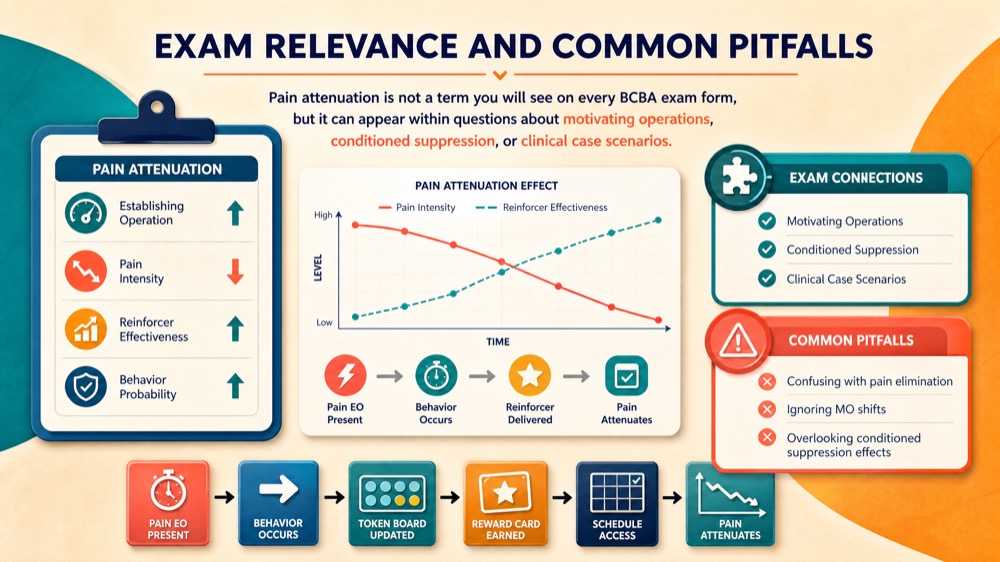
Pain attenuation is not a term you will see on every BCBA exam form, but it can appear within questions about motivating operations, conditioned suppression, or clinical case scenarios. It often acts as a distractor or as the correct answer in questions about why a behavior persists despite aversive consequences. Understanding the behavioral mechanisms helps you eliminate incorrect options.
For example, a question might describe a client who continues to self-injure despite showing no signs of pain. The options might include “automatic reinforcement” and “pain attenuation.” Both are related, but the correct answer is more likely the one that specifically addresses the decreased effectiveness of pain as a punisher. This is where your knowledge of how pain attenuation works becomes crucial.
Common Misconceptions Students Make: One of the biggest traps is confusing pain attenuation with pain tolerance or pain threshold. Pain threshold is the point at which a stimulus is perceived as painful, while tolerance is the maximum intensity a person can endure. Attenuation, on the other hand, is a learned reduction in the behavioral impact of pain. On the exam, read carefully: if the question is about a change in behavior, it’s attenuation; if it’s about physiological limits, it’s something else.
Another misconception is assuming that pain attenuation implies the client is not truly feeling pain. In behavior analysis, we avoid making claims about private events except through observable behavior. So, even if a client reports less pain, we focus on how that report is a behavior itself. An exam question might probe this by asking, “What is the most parsimonious explanation for a decrease in pain reports?” The answer should be based on reinforcement history.
Quick Review Checklist for Exam Day
Before you enter the exam, use this checklist to confirm you have mastered the essentials of pain attenuation in ABA.
- Definition: You can state that pain attenuation is the learned reduction in the punishing or reinforcing properties of painful stimuli.
- Mechanisms: You understand operant and respondent conditioning pathways to attenuation, including avoidance and conditioned inhibition.
- Assessment: You consider medical history and ongoing pain when hypothesizing functions of behavior, especially in SIB.
- Intervention: You can identify strategies like gradual exposure, DRA, NCR, and reinforcement of alternative behaviors to attenuate pain-related responses.
- Measurement: You know to measure observable behavior change, not subjective reports, as the primary data.
- Exam traps: You can distinguish attenuation from tolerance, threshold, and sensory adaptation, and you avoid mentalistic explanations.
Summary and Final Tips
Pain attenuation is a nuanced concept that ties together learning principles and clinical application. By now, you should have a clear picture of how it is defined, how it is acquired, and why it matters for BCBA exam questions. Remember that in behavior analysis, pain is treated as a legitimate area of study, but only through its observable correlates.
To deepen your understanding, revisit automatic reinforcement and functional behavior assessment articles on our site. They complement the concepts discussed here. Also, check out the BCBA exam blueprint guide to see how these topics are weighted. Good luck on your exam!
Quick Review Checklist
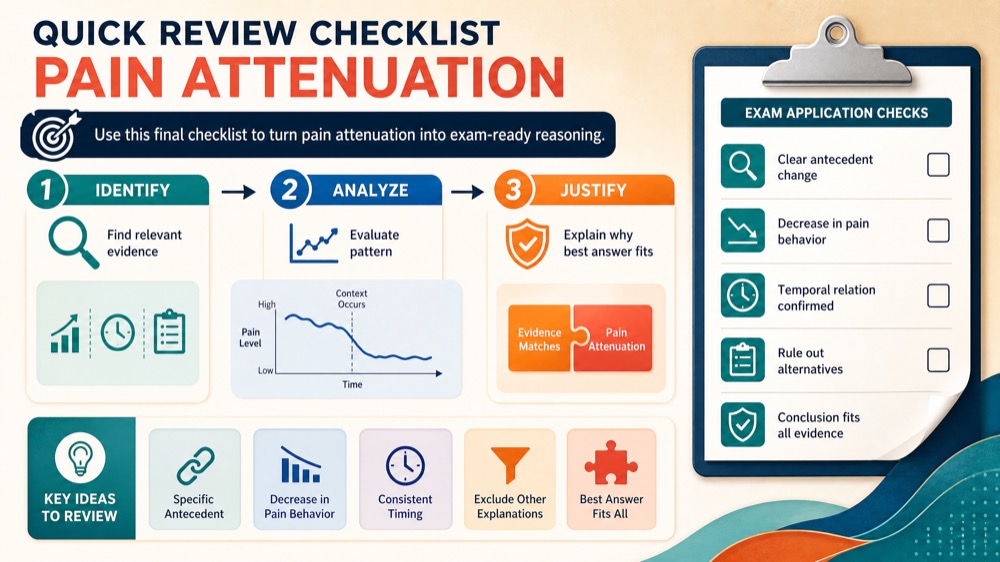
Use this final checklist to turn pain attenuation into exam-ready reasoning. The goal is not to memorize a label in isolation; it is to identify the relevant evidence and explain why the best answer fits the scenario. Key ideas to review:
- State the central definition or decision point for pain attenuation in your own words.
- Identify the detail that makes pain attenuation different from its closest related ABA term.
- Separate the observable facts in a scenario from assumptions that are not supported by the facts.
- Write one example and one nonexample so you can recognize the concept in a new setting.
Exam application checks:
- Ask what the question is actually requesting before comparing the answer choices.
- Mark the antecedent, response, consequence, or other evidence that supports the selected answer.
- Look for a distractor that describes a related process but does not answer the specific question.
Final self-check:
- Explain how you would verify the interpretation with clear observations or data.
- Change one detail in the scenario and decide whether your answer should change.
- Give a one-sentence rationale that a supervisor or study partner could evaluate.
Take the Free BCBA Mock Exam
Ready for more practice? Use the free mock exam to keep testing your accuracy with realistic BCBA-style items. Take the Free BCBA Mock Exam
References
Next step for BCBA exam prep
Turn this topic into exam-day practice
Use this topic as a focused review, then test it in exam-style conditions with a free mock before deciding whether five full-length mocks are the right next step.
Start the Free BCBA Mock ExamContinue with Five Full-Length Mocks — $99
Review the included materials and access details before ordering. No pass guarantee is implied.



