

What Is Behavior Momentum?
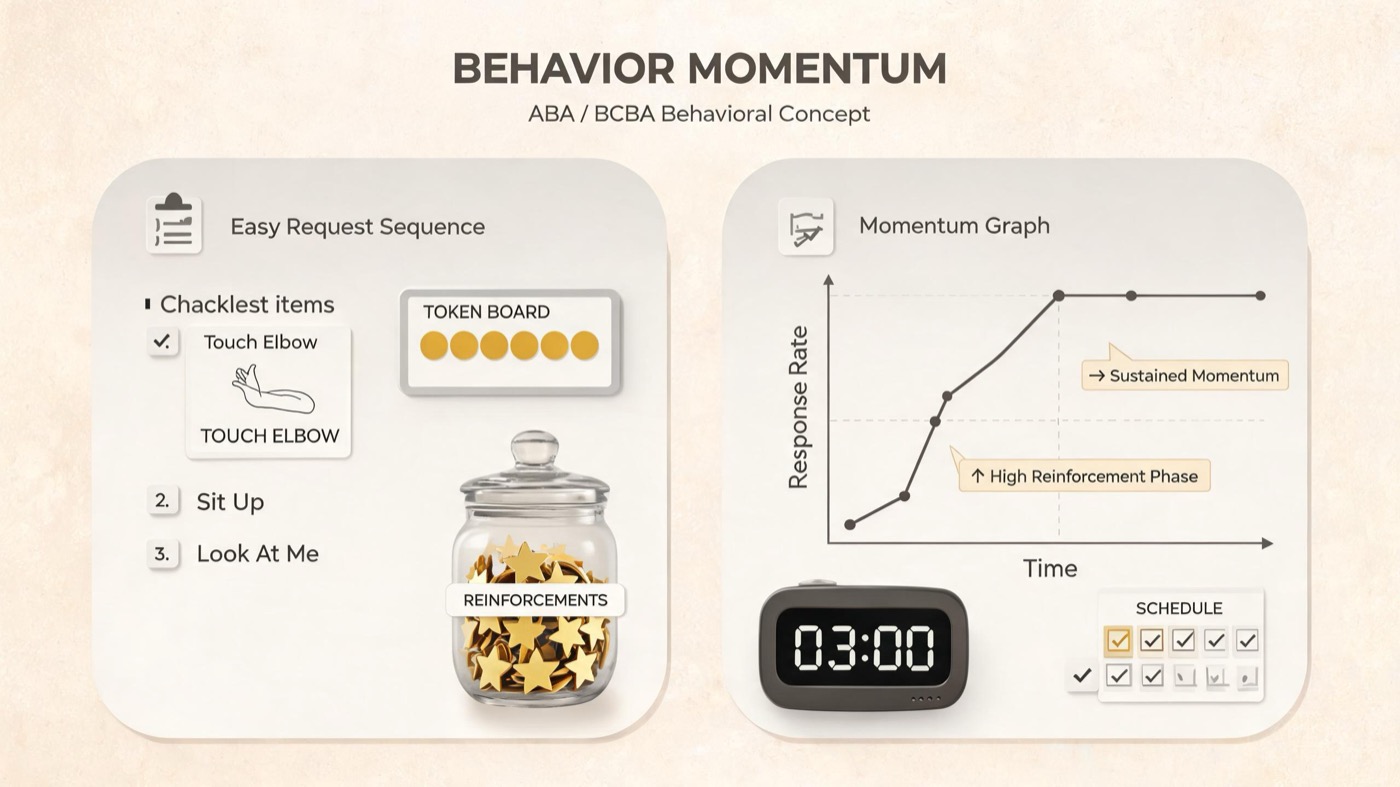
Behavior momentum refers to the tendency for a person to maintain a pattern of responding when a high rate of reinforcement is delivered for a series of easy requests. This concept, rooted in the matching law, describes how behavior is more likely to persist when it has been reinforced frequently in the immediate past. In practice, behavior momentum is implemented using the high-probability request sequence, where the instructor presents 2-3 easy requests (high-p) that the learner complies with consistently, followed by a target request (low-p) that has a low history of compliance. The momentum built by the high-p sequence increases the likelihood that the learner will comply with the low-p request.
Table of Contents
- What Is Behavior Momentum?
- Behavior Momentum Examples with ABC Analysis
- How Behavior Momentum Appears on the BCBA Exam
- Quick Study Checklist for Behavior Momentum
- Summary
The High-p Request Sequence
The procedure is straightforward: identify behaviors the learner already performs consistently (high-p), deliver praise or reinforcement after each compliance, then immediately present the difficult request (low-p). For example, a teacher might ask a student to ‘touch your nose,’ ‘clap your hands,’ and ‘stand up’ before asking ‘clean up your desk.’ The key is to maintain behavioral momentum by ensuring the high-p requests are truly easy and followed by reinforcement. Research suggests this technique is especially effective for escape-maintained behaviors, as the momentum reduces the aversiveness of the low-p demand.
Relevance to the Matching Law
Behavior momentum aligns with the matching law because the high-p sequence increases the local rate of reinforcement, making the learner more likely to continue responding. This connection is often emphasized on the BCBA exam, so understanding how reinforcement density affects response allocation is essential. For a deeper review of the matching law, see our matching law guide.
Behavior Momentum Examples with ABC Analysis
Real-world examples help clarify how behavior momentum works in practice. Below are three scenarios across different settings, each including an ABC analysis and the hypothesized function of behavior.
Example 1: Increasing Task Initiation in an Autism Clinic
In an autism clinic, a child frequently refuses to clean up toys (low-p). High-p requests include ‘touch your nose,’ ‘give me a high-five,’ and ‘show me your shoe.’ ABC analysis: Antecedent – therapist delivers high-p requests, child complies, receives praise. Then therapist says ‘clean up your toys.’ Behavior – child cleans up toys. Consequence – therapist provides enthusiastic praise. Hypothesized function: escape from demand. The high-p sequence reduces the child’s motivation to escape, increasing compliance.
Example 2: Promoting Self-Care in a School Setting
A student with developmental delays avoids brushing teeth (low-p). High-p requests include ‘point to the sink,’ ‘hold the toothbrush,’ and ‘open your mouth.’ ABC analysis: Antecedent – teacher gives high-p requests, student complies, receives a sticker. Then teacher says ‘brush your teeth.’ Behavior – student brushes teeth. Consequence – teacher gives social praise and a preferred toy. Hypothesized function: attention. The momentum built by high-p requests makes the low-p request more acceptable.
Example 3: Increasing Vocalizations in Early Intervention
A toddler with limited vocalizations imitates easy sounds (‘ah,’ ‘da’) but avoids saying ‘ball’ (low-p). High-p requests include ‘say ‘ah” and ‘say ‘da.” ABC analysis: Antecedent – therapist says ‘say ‘ah’,’ child responds, receives an edible. Then therapist says ‘say ‘ball.” Behavior – child says ‘ball.’ Consequence – therapist gives an edible. Hypothesized function: tangible. The high-p sequence ensures the child is already in a responding pattern, making the new sound more likely.
How Behavior Momentum Appears on the BCBA Exam
The BCBA exam often tests your ability to identify, distinguish, and apply behavior momentum in scenarios. Understanding common question formats and traps can boost your score.
Common Question Formats
- Identify the intervention: A scenario describes a series of easy requests followed by a difficult one. You must select ‘behavior momentum’ from a list of procedures.
- Compare to other procedures: You may need to differentiate behavior momentum from errorless teaching, shaping, or chaining. Errorless teaching uses prompts to prevent errors, while momentum uses compliance history.
- Select appropriate high-p requests: Given a learner’s skill set, you must choose which requests would serve as high-p (easy and compliant) versus low-p.
Typical Traps
- Confusing momentum with shaping or chaining: Shaping reinforces successive approximations; chaining sequences steps. Momentum is about increasing compliance for a specific low-p request.
- Using low-p requests as high-p: If the ‘easy’ requests are actually hard, momentum fails. Always verify the learner’s historical compliance.
- Ignoring function: Behavior momentum works best for escape-maintained behavior. For attention- or tangible-maintained behavior, other strategies may be needed.
- Forgetting to reinforce after high-p requests: Each high-p request must be followed by reinforcement to build momentum. Skipping this breaks the sequence.
Quick Study Checklist for Behavior Momentum
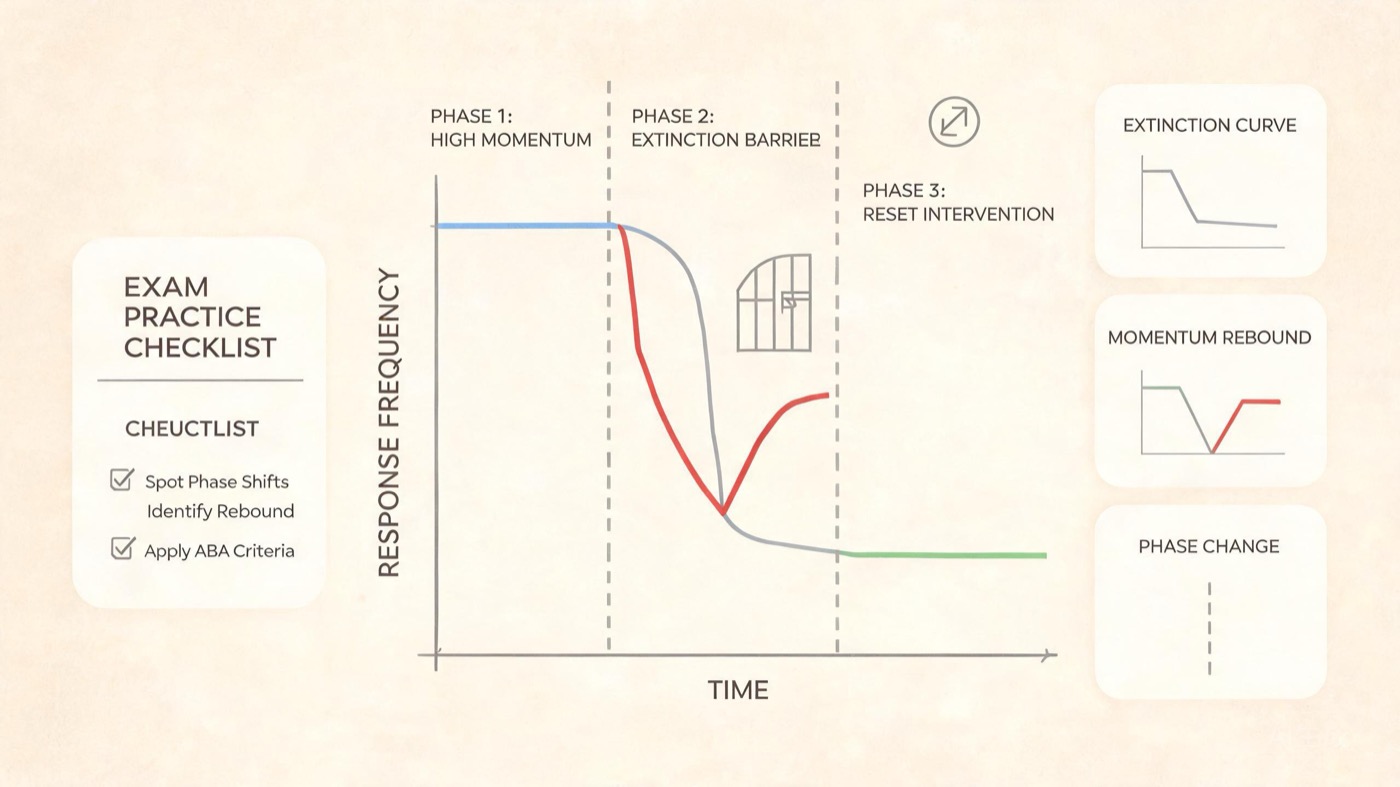
Use this checklist to review key facts before your exam:
- Define behavior momentum as the increased likelihood of compliance following a series of reinforced easy requests.
- Recall the high-p request sequence: 2-3 high-p followed by 1 low-p request.
- Identify that high-p requests must be easy and reinforced every time.
- Recognize that behavior momentum is most effective for escape-maintained behavior.
- Differentiate from errorless teaching, shaping, and chaining.
- Apply ABC analysis to confirm the function before implementing.
- Remember to reinforce the low-p request to maintain future compliance.
Summary
Behavior momentum is a powerful antecedent intervention that uses a series of easy, reinforced requests to increase compliance with more difficult tasks. The high-p request sequence is simple to implement and well-supported by research, especially for escape-maintained behaviors. On the BCBA exam, you’ll encounter questions that require you to identify the procedure, choose appropriate high-p requests, and avoid common traps like confusing momentum with shaping or forgetting to reinforce. For more exam prep resources, visit our free BCBA practice questions. To learn more about the science behind behavior momentum, refer to the BACB website for current task list details.



