

NET lesson plan ABA content should turn a learner’s real activity and current motivation into observable teaching opportunities. A useful plan names the target, the opportunity, the prompt, the natural consequence, the data rule, and the next generalization step without turning natural-environment teaching into a rigid script.
Table of Contents
- What Is a NET Lesson Plan in ABA?
- What Should a NET Lesson Plan Include?
- How Should NET Data Be Collected?
- What Is a NET Lesson Plan Example?
- How Should a NET Plan Include Generalization?
- Who Creates and Uses a NET Lesson Plan?
- What Are the BCBA Exam Clues?
- What Mistakes Should You Avoid?
- NET Lesson Plan ABA FAQ
- Sources and Date Check
- Take the Free BCBA Mock Exam
Natural Environment Teaching, or NET, embeds instruction in meaningful activities rather than requiring every learning opportunity to begin at a table with adult-selected materials. The environment may be play, snack, dressing, a classroom routine, a community task, or another activity that matters to the learner. The defining feature is not that the session looks casual. It is that the teaching opportunity, response, and consequence are connected to the activity and the learner’s current motivation.
What Is a NET Lesson Plan in ABA?
A NET lesson plan in ABA is a flexible planning document that explains how a team will capture or arrange natural learning opportunities during a routine. It should make the teaching goal observable while leaving room for the learner’s choices, changing materials, and naturally occurring events. It is a decision aid, not a script that requires the adult to force a predetermined number of trials. A strong plan answers seven practical questions:
- What activity or routine will create a meaningful opportunity?
- What behavior or skill is the learner expected to perform?
- What will count as an opportunity to respond?
- What prompt and prompt-fading plan will be used if help is needed?
- What consequence is naturally connected to the response?
- What data will show independent, prompted, incorrect, or missed responses?
- How will the team check the skill with another person, material, setting, or routine?
The plan should be individualized by the responsible behavior analyst and aligned with current assessment, goals, consent, safety procedures, and applicable documentation requirements. The example below is fictional and demonstrates planning logic; it is not a universal treatment protocol.
What Should a NET Lesson Plan Include?

NET planning works best when the fields are specific enough to guide implementation but not so rigid that they erase the natural event. The following components provide a useful checklist. 1. Routine and motivation: Start with a routine in which the learner has a meaningful reason to act. That reason might be access to a preferred item, continuation of an enjoyable activity, participation in a social exchange, completion of a daily task, or help with a problem. Record what signals motivation in the moment rather than assuming that a preferred item remains preferred across the entire session.
2. Observable target and opportunity: Write the target as an action that another observer can identify. “Improve communication” is too broad for a lesson plan. “When a desired item is visible but not immediately available, the learner uses the agreed communication response within the opportunity” is more measurable. Also define the opportunity: a reach, a pause in a routine, a missing material, a peer turn, or another event that makes the response relevant.
3. Instruction, prompt, and fading: NET does not mean “never prompt.” The plan should state what cue the adult will provide, what prompt hierarchy is allowed, and how prompts will be faded. A prompt should help the learner contact the relevant response and consequence without becoming the only cue that controls behavior. If the natural activity changes, the implementer should follow the approved plan rather than inventing a new procedure in the moment.
4. Natural consequence and data: Whenever appropriate, the response should contact a consequence that belongs to the activity. A functional request can produce access to the requested item or continuation of the interaction. A correctly completed step in a routine can allow the routine to continue. The plan still needs a data rule so “it went well” does not replace measurement.
How Should NET Data Be Collected?
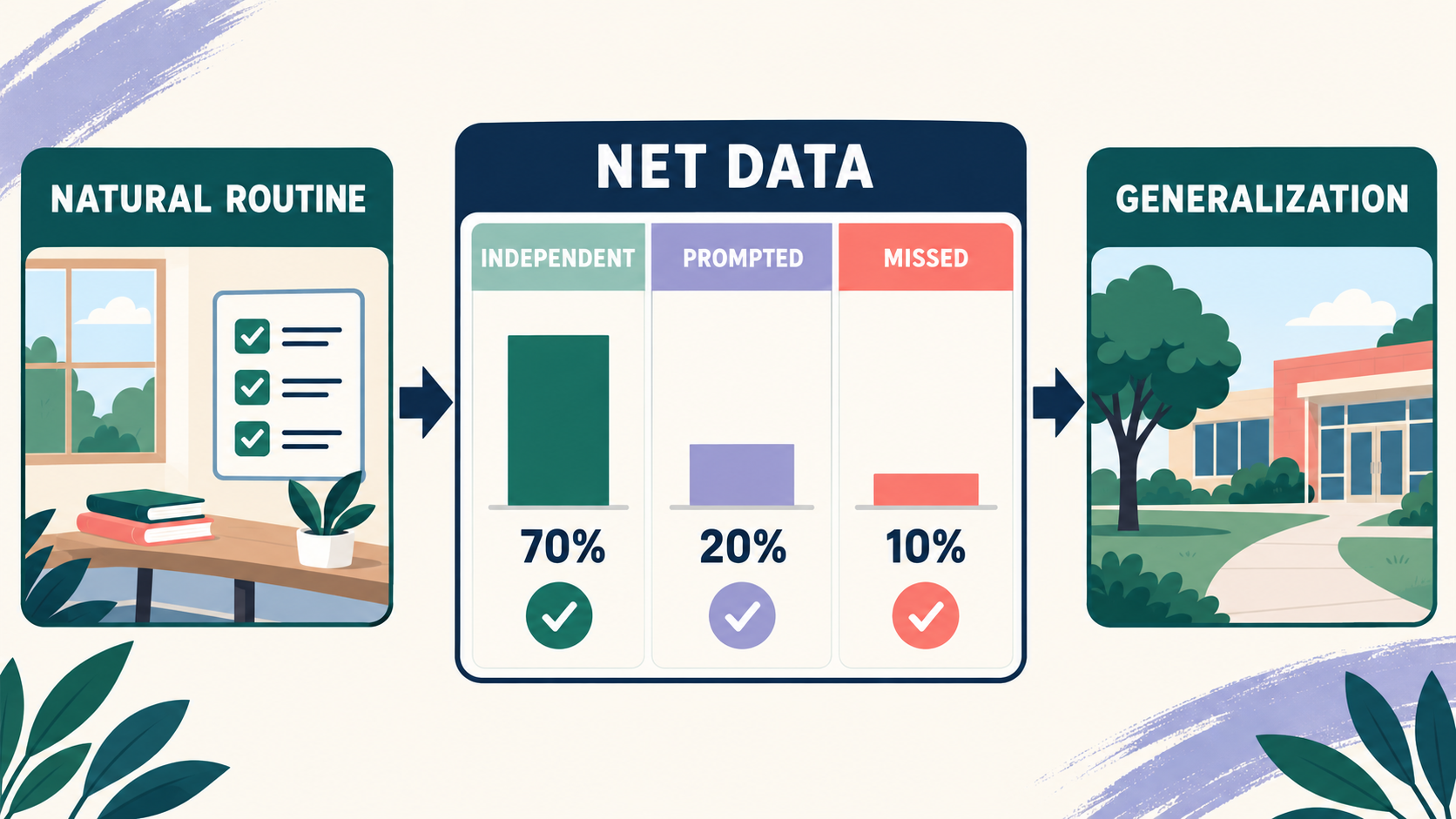
Data collection in NET should preserve the meaning of the activity while making the target response visible. A team might record opportunities and independent responses, prompted responses, errors, latency, duration, or a task-analysis step. The best measure depends on the target, the decision to be made, the burden of recording, and the current plan. For a simple opportunity-based measure: Independent-response percentage = independent responses ÷ valid opportunities × 100.
Suppose a fictional plan defines five valid opportunities during snack preparation. The learner responds independently on three, responds after a prompt on one, and misses one opportunity. The independent-response percentage is 3 ÷ 5 × 100 = 60%. The prompted response should not be silently counted as independent, and the missed opportunity should have a defined reason rather than being removed just because it makes the percentage lower.
| Plan field | Fictional example | Data rule |
|---|---|---|
| Routine | Snack preparation with two available choices | Count only opportunities in which the item or choice is available and the learner can respond. |
| Target | Use the agreed communication response to request a chosen item | Score independent, prompted, incorrect, and no response separately. |
| Support | Wait briefly, then use the least intrusive approved prompt | Record the highest prompt needed and review prompt fading over time. |
| Consequence | Provide the requested snack item when the response meets the plan definition | Check whether the consequence followed the response and was actually available. |
| Generalization probe | Use a different snack choice with another familiar adult | Report the new setting or person separately; do not blend it into the teaching-session score. |
In a real plan, also specify how the implementer will record opportunities that are interrupted, unsafe, unavailable, or outside the target definition. A clean data set is not created by deleting inconvenient observations. If the routine changes, document the change so the analyst can interpret the graph in context.
What Is a NET Lesson Plan Example?
Consider a fictional learner who enjoys assembling a snack plate but often waits silently when a preferred item is inside a closed container. The team’s target is functional communication. The plan does not require the adult to run a fixed sequence of trials. Instead, the adult arranges safe access to the routine, watches for interest, and uses the approved teaching response when the relevant opportunity occurs.
- Arrange the activity: Make the selected materials visible and safe while preserving a genuine reason to communicate.
- Capture the opportunity: When the learner approaches or indicates interest, pause according to the written plan rather than immediately handing over the item.
- Prompt only as planned: If the independent response does not occur within the defined interval, use the approved prompt and record it.
- Honor the response: Deliver the relevant item or continue the routine according to the plan.
- Record the trial: Mark independent, prompted, incorrect, no response, or not scored, along with a brief context note when needed.
- Review the pattern: Look at independence, prompt level, opportunities, and the learner’s engagement before deciding whether the plan needs clarification or revision.
The point is not to make every moment of play a disguised demand. A NET plan should protect choice, dignity, and access to enjoyable activities. If the learner is not interested, the adult should follow the approved response to that situation rather than repeatedly manufacturing demands. The plan is successful when it makes meaningful learning opportunities clearer, not when it produces the largest possible trial count.
How Should a NET Plan Include Generalization?
Generalization should be planned rather than assumed. A response learned during one routine may not occur with a different person, material, location, or form of motivation. Write a small, safe probe into the plan after the teaching conditions are clear. For example, a team might vary the snack item, move from a clinic table to a classroom counter, or involve another trained adult while keeping the response definition and measurement rule stable.
Change one important feature at a time when possible. If the person, location, materials, prompt level, and consequence all change together, a lower score will be difficult to interpret. Record generalization data separately from teaching data so the team can see whether the skill is transferring rather than averaging unlike conditions into one number. A compact generalization check can ask:
- Did the response occur with a different person?
- Did it occur with a different material or activity?
- Did the learner still respond when the prompt was faded?
- Did the response contact a relevant consequence in the new context?
Who Creates and Uses a NET Lesson Plan?
The responsible BCBA or other qualified professional determines how the plan fits the assessment, goals, ethics, consent, risk management, and service context. A technician, teacher, caregiver, or other trained implementer may use the plan within the role and training they have been given. The implementer should be able to ask for clarification when the plan does not match the routine or when a safety issue appears.
Supervision and treatment-integrity checks matter because a flexible plan can otherwise become ambiguous. The supervisor can observe whether the opportunity definition, prompt rule, consequence, and data system are being used as written. If a field is repeatedly unclear, the solution may be better instructions, modeling, rehearsal, feedback, materials, or a plan revision—not blame directed at the learner or implementer.
What Are the BCBA Exam Clues?
For current certification content, use the BACB sixth-edition Test Content Outline and the question’s own definitions. A NET lesson-plan question usually tests the relationship among motivation, naturally occurring activities, teaching opportunities, prompts, reinforcement, data, or generalization.
- “The learner’s interest creates the opportunity.” This supports a natural-environment teaching arrangement.
- “The reinforcer is directly related to the activity.” Look for a natural consequence, not an unrelated reward automatically delivered after every response.
- “The analyst records independent and prompted responses.” This is a measurement and prompt-fading issue.
- “The therapist follows the learner around without a target or data rule.” That is not enough to demonstrate a well-designed NET lesson plan.
- “The same response is checked with another person or material.” This points toward generalization or a transfer probe.
- “The question compares NET with DTT.” Do not conclude that NET is unstructured or that DTT cannot be used in a meaningful teaching program. Identify the arrangement and the procedure described in the stem.
For additional scenario practice, the free BCBA mock exam is an independent study aid. It is not an official BACB product and does not replace the current TCO, supervision, or professional judgment.
What Mistakes Should You Avoid?
- Writing a broad goal such as “work on language” without an observable response definition.
- Calling any activity with toys “NET” without identifying motivation, opportunity, teaching response, and data.
- Turning a flexible plan into a fixed script that ignores the learner’s choices and the actual routine.
- Counting prompted responses as independent or deleting missed opportunities without a stated rule.
- Using an unrelated reward when the plan calls for a consequence connected to the activity.
- Assuming that skill use in one room proves generalization everywhere.
- Giving an implementer a form without training, modeling, feedback, or a way to request clarification.
NET Lesson Plan ABA FAQ
What should be on a NET lesson plan?: Include the routine, motivation or relevant establishing conditions, observable target, opportunity definition, cue, prompt and fading rule, natural consequence, data system, safety notes, and a generalization or maintenance check. Is a NET lesson plan the same as a worksheet?
No. A worksheet can organize fields, but a lesson plan also explains how those fields fit the learner’s current goal and routine. It must be reviewed and adapted by the responsible professional rather than copied as a universal protocol. How many trials should a NET lesson include?
There is no universal number that makes an activity NET. The number of valid opportunities depends on the routine, the target, the learner’s motivation, the approved plan, and the data needed for a decision. Meaningful opportunities are more important than manufacturing a quota.
Does NET mean there are no prompts?: No. NET can include prompting, prompt fading, error correction, and reinforcement when those procedures are part of the approved plan. The natural-environment feature describes how the opportunity and activity are arranged; it does not eliminate instructional support.
Sources and Date Check
This article was reviewed on September 29, 2026 against the BACB sixth-edition Test Content Outline, the public NET Lesson Plan & Data on Verbal Operants resource, and current lesson-plan and natural-environment teaching references including sample ABA lesson plans and the natural-environment opportunity planning guide. Requirements and terminology can change; verify current BACB materials before making a practice or exam decision.
Take the Free BCBA Mock Exam
If you want a low-pressure way to check your recall, use the free practice resource below. Take the Free BCBA Mock Exam



