
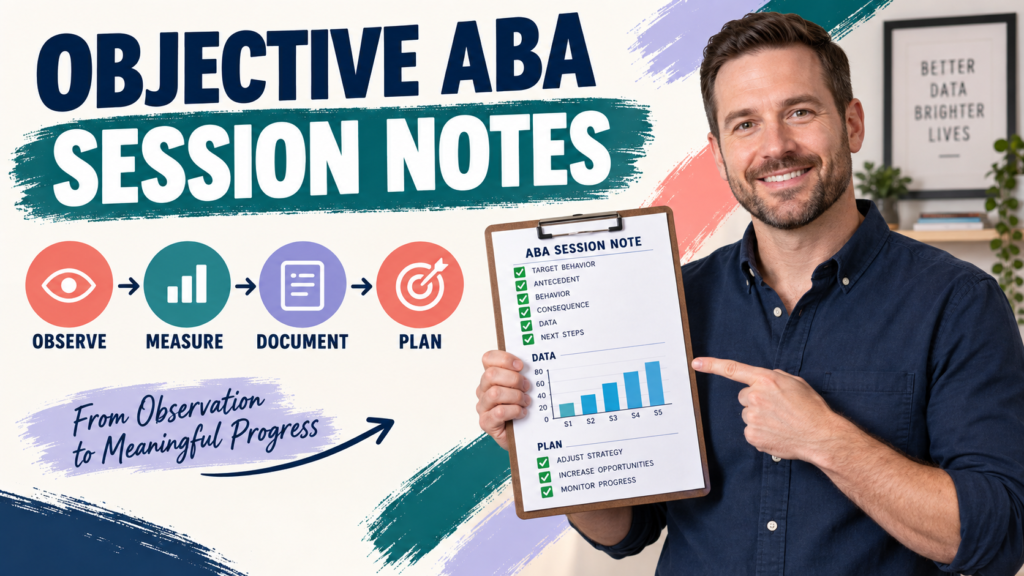
Objective session notes example ABA writing describes what was observed, measured, and implemented without adding guesses about a client’s character, motivation, diagnosis, or future. The strongest note connects a defined target to data, procedures, client response, and an appropriate next step.
Table of Contents
- What Makes an ABA Session Note Objective?
- What Belongs in an Objective Session Note?
- How Do You Replace Vague Wording?
- What Is an Objective Session Notes Example ABA?
- How Should Data and Interpretation Be Separated?
- What About Privacy, Scope, and Local Requirements?
- What Are the BCBA Exam Clues?
- What Final Review Checklist Should You Use?
- Objective ABA Session Notes FAQ
- Sources and Date Check
- Take the Free BCBA Mock Exam
An objective ABA session note is not a transcript and it is not a collection of compliments. It is a concise record that lets an authorized reader understand the relevant service context, targets, data, procedures, observable response, and next step. The exact format may be narrative, SOAP-style, electronic form, or an employer-specific template. The writing standard remains the same: another qualified reader should not have to guess what happened.
What Makes an ABA Session Note Objective?
Objective documentation uses observable and measurable descriptions. It identifies what the learner did, what the provider did, what was counted, and under what conditions. It avoids replacing evidence with labels such as “unmotivated,” “lazy,” “defiant,” “had a bad day,” or “did great.” Those words may reflect a writer’s impression, but they do not tell the next reader what was observed or how the conclusion was reached.
A useful test is: Could a second trained observer understand what to look for and reproduce the data from the sentence? “The learner completed 8 of 10 receptive-identification trials independently after the instruction was presented” is more objective than “The learner did well with receptive language.” The first sentence names the target, opportunity, response, and result. It also leaves room to add the prompt level, materials, or measurement rule when those details matter.
Objective does not mean emotionless or insensitive. A note can document assent signals, distress, communication, preferences, safety events, and contextual changes respectfully. The goal is accuracy and dignity, not a sterile style that removes important information.
What Belongs in an Objective Session Note?
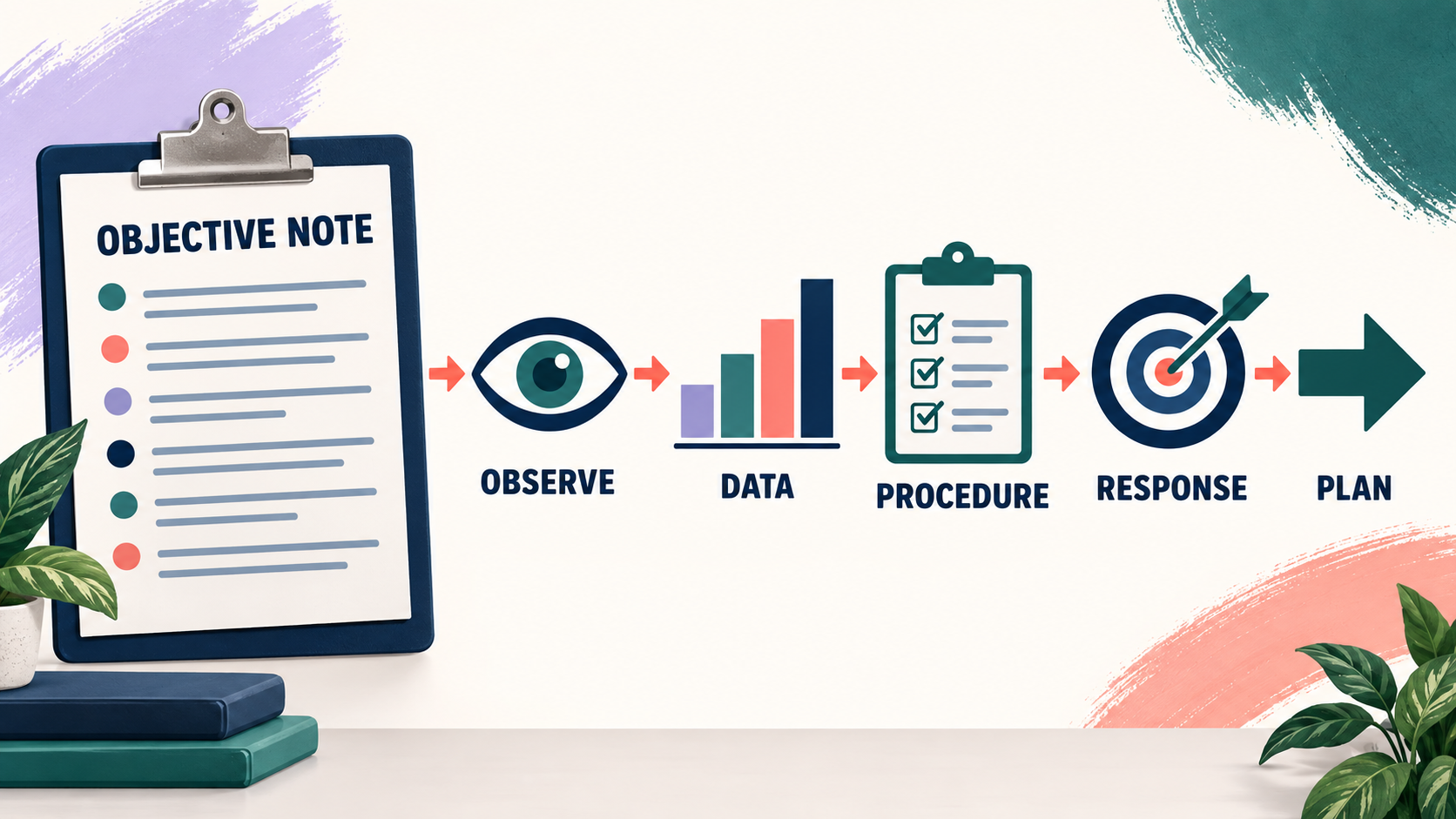
Local forms and payer requirements vary, so use the current requirements that apply to the service. As a study framework, an objective note commonly connects these elements:
- Session frame: date, time, duration, setting, provider role, and other required identifying or service information.
- Targets addressed: the treatment-plan goals or observable behaviors that were actually worked on.
- Data: the measurement used, the number or percentage observed, and the relevant opportunity or time unit.
- Procedures: what was implemented, such as prompting, reinforcement, error correction, task analysis, NET, or another approved procedure.
- Client response: the observable response to the procedure, including independence, prompt level, latency, duration, or behavior-reduction data when applicable.
- Context and events: relevant changes, caregiver report, materials, health or safety information, or environmental variables, clearly labeled as report or observation.
- Plan: the next approved action, data-review question, consultation need, or supervisor-directed change within the writer’s role.
Not every note needs a long paragraph for every field. A short note can be strong when each sentence carries traceable information. A long note can still be weak when it repeats adjectives without numbers or mixes a caregiver report with direct observation.
How Do You Replace Vague Wording?
The following table uses fictional examples. It is a study tool, not a list of forbidden words or a universal employer policy. The better replacement depends on the actual measurement system and the writer’s role.
| Vague wording | More objective wording | Why it is stronger |
|---|---|---|
| The learner had a great session. | The learner completed 12 of 15 matching trials independently; three responses required a gestural prompt. | It names the target, denominator, independence, and prompt level. |
| The learner was noncompliant. | After the instruction to place the materials in the bin, the learner pushed the bin away and did not begin the step within 30 seconds. | It describes the antecedent, observable response, and time criterion. |
| The client was anxious. | The caregiver reported poor sleep. During the transition, the learner covered their ears, moved two steps from the group, and requested a break. | It separates a report from direct observation and records communication. |
| Prompts were faded successfully. | Across 10 opportunities, the learner responded independently on seven, after a model prompt on two, and after a verbal prompt on one. | It shows the actual prompt distribution instead of declaring success. |
| The intervention worked. | Independent requests increased from 4 of 10 opportunities at the start of the session to 7 of 10 after the prompt procedure was implemented. | It reports a session pattern without claiming that one session proves causal effectiveness. |
Notice that objective wording is not merely “more formal.” It makes the observation auditable. It also prevents the writer from turning a single behavior sample into a global description of the person.
What Is an Objective Session Notes Example ABA?
A useful objective session notes example ABA should show enough context to interpret the numbers while remaining fictional and de-identified. The examples below use “Client A” and invented data. Real documentation must reflect the actual session and must follow the responsible provider’s requirements.
Skill-acquisition example: Target: requesting a preferred item using the learner’s established communication response. Observation: During 10 opportunities in a play routine, Client A responded independently on 6 opportunities, after a verbal model on 3, and did not respond on 1. The provider delivered the requested item after the response defined in the program and recorded the prompt level for each opportunity. Plan: Continue the approved program and review whether the verbal model can be delayed or faded according to the current prompt procedure. This example does not say that Client A “understood the lesson” or “was motivated.” It records the activity, target, opportunity count, response categories, procedure, consequence, and a plan-consistent next step.
Behavior-reduction example: Target: leaving the assigned area, defined in the program as crossing the marked boundary without permission. Observation: Client A crossed the boundary twice during a 90-minute session. The first event followed a transition instruction and lasted 18 seconds before the learner returned with the approved support. The second event occurred during a materials change and lasted 11 seconds. The provider recorded the events and implemented the current safety and response protocol. Plan: Review the event notes and transition conditions with the supervising BCBA; do not infer function from these two events alone. This example avoids saying “the client ran away because of attention” unless a supported assessment and authorized interpretation justify that statement. It records what happened and identifies the question that requires supervision.
Caregiver or environmental report example: Report: The caregiver stated that the learner slept less than usual. Direct observation: During the first transition, the learner paused for approximately 20 seconds, placed their head on the table, and used the established break response. Documentation note: The sleep information is labeled as caregiver report; the behavior observed during the session is recorded separately. The team will consider whether the context should be tracked across sessions rather than treating one report as an explanation. Separating sources protects accuracy. A caregiver report can be important without being presented as something the provider directly observed.
How Should Data and Interpretation Be Separated?
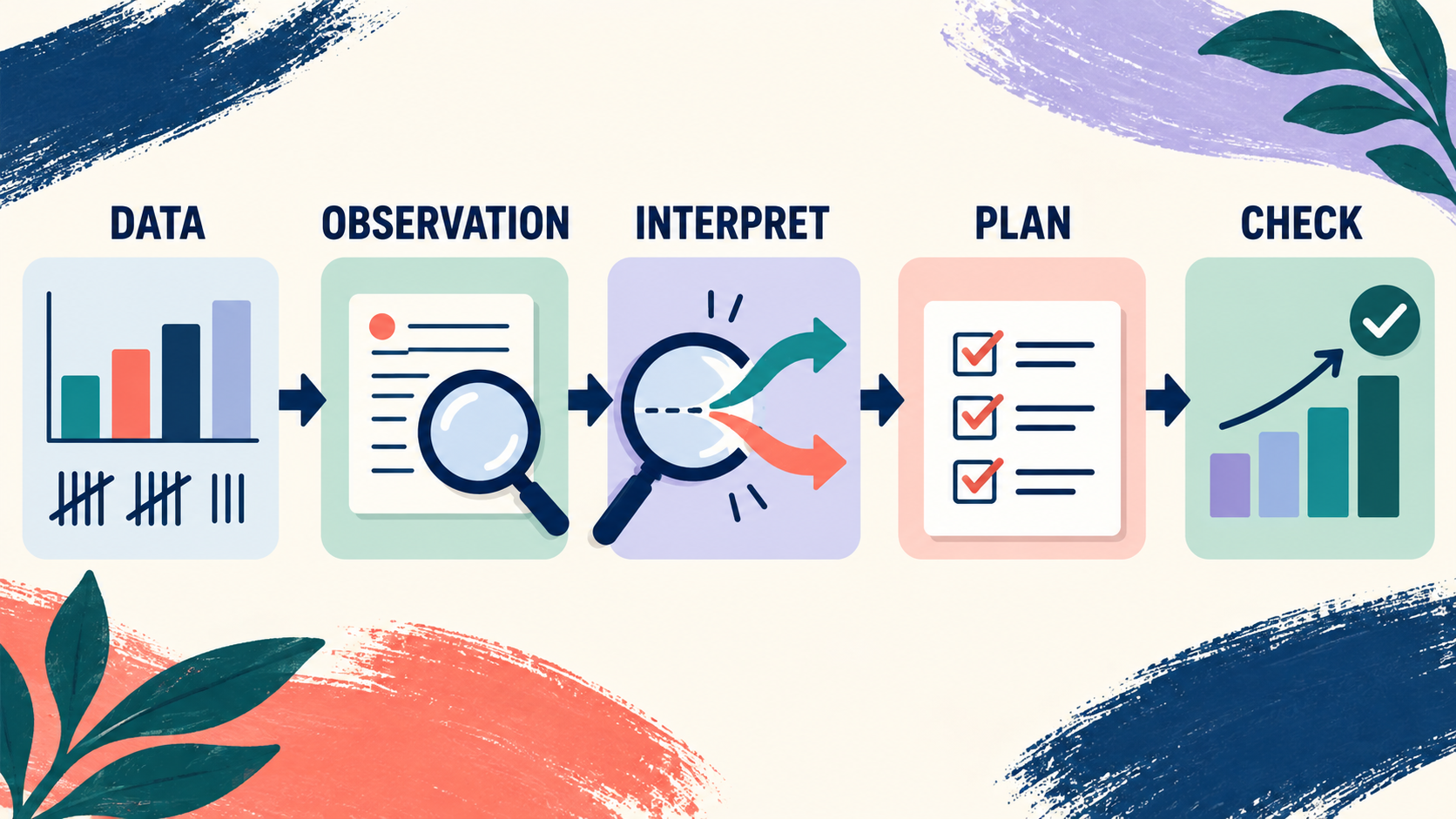
Data are the recorded measurement. Interpretation is the reasoned meaning a qualified professional may draw from a pattern across data, context, and assessment. The note can include both when the writer is authorized to do so, but the sentences should make the difference visible.
- Data statement: “The learner completed 8 of 10 opportunities independently.”
- Context statement: “The last two opportunities occurred after the materials were changed.”
- Procedure statement: “A gestural prompt was delivered after the defined wait interval.”
- Bounded interpretation: “The team should review whether material changes affected responding; this session alone does not establish why.”
- Plan statement: “Continue data collection under the current plan and bring the pattern to supervision.”
Percentages should show their denominator. “80%” is incomplete if the reader cannot tell whether it represents 8 of 10 trials, 4 of 5 opportunities, or a percentage of intervals. If the measurement is frequency, duration, latency, or interval recording, name that system. If the data are missing or a session was interrupted, document the limitation rather than presenting an apparently precise number with no context.
What About Privacy, Scope, and Local Requirements?
Use the minimum necessary information for the authorized purpose, protect identifiers, and follow the applicable record system. Do not put unnecessary diagnoses, family details, photographs, or identifying narrative into a public sample. A study article can teach note structure with fictional names and invented data; it should not encourage copying a real client’s note into a template or public tool.
Requirements can differ by payer, employer, location, service code, and provider role. A general article cannot promise that one template satisfies every billing or legal rule. Before submitting a note, check the current organization and payer instructions, required signatures, deadlines, confidentiality controls, and the scope of the writer’s credential. The BACB Ethics Code for Behavior Analysts is an official reference for professional responsibilities, but it does not replace local requirements.
What Are the BCBA Exam Clues?
The current BCBA Test Content Outline includes measurement, data interpretation, ethical and professional issues, intervention implementation, and supervision. A documentation question often tests whether the answer preserves observable facts and selects a decision supported by the available data.
- “Which note is most objective?” Choose the option with an operationally described response, measure, context, and procedure rather than a personality label.
- “What should the technician document?” Choose what was observed and implemented within the technician’s role; do not invent a diagnosis or independent treatment modification.
- “What does 80% mean?” Check the denominator, measurement system, opportunities, and prompt status before interpreting the number.
- “What should the analyst conclude?” Match the conclusion to the data. A single session may justify continued measurement or supervision, not a broad causal claim.
- “What should be done with a caregiver report?” Record it as a report and distinguish it from direct observation.
For additional scenario practice, the free BCBA mock exam is an independent study aid. It is not an official BACB product and does not replace the current TCO, ethics code, supervision, or local documentation instructions.
What Final Review Checklist Should You Use?
Before submitting an objective ABA session note, check:
- Does the note identify the relevant session frame without unnecessary personal information?
- Are the targets and behaviors observable rather than personality labels?
- Does every percentage have a denominator or clearly named measurement system?
- Are independent and prompted responses separated?
- Are direct observations separated from caregiver or client reports?
- Does the procedure description match the approved plan and the writer’s role?
- Does the next step stay within documented data and authorized supervision?
- Would another qualified reader understand what happened without guessing?
Objective ABA Session Notes FAQ
What is an objective sentence in an ABA note?: It describes an observable event or measured result, such as a response count, percentage, duration, latency, prompt level, or defined behavior in a stated context. It does not rely on vague praise or a global judgment about the person. Can an ABA session note include interpretation?
It may include a bounded interpretation when the writer is authorized and the interpretation is supported by the available data. Keep the interpretation distinct from the raw observation and avoid claiming more than the sample shows.
How do I write “noncompliance” objectively?: Use the program’s operational definition if one exists. Describe the instruction or event, the observable response, the time or opportunity criterion, and the context. Do not assume that one response proves a motive or function.
Can I reuse an objective session-note example?: Use examples to learn structure and wording, but never copy fictional data into a real record. Document what actually happened, protect confidentiality, and follow current organization and payer requirements.
Sources and Date Check
This article was reviewed on September 29, 2026 against the BACB Ethics Code for Behavior Analysts, the BACB sixth-edition Test Content Outline, and current documentation examples including ABA session-note templates, ABA note examples, and the ABA session-note writing guide. Requirements vary by payer, employer, location, and service; verify current local instructions before submitting a record.
Take the Free BCBA Mock Exam
If you want a low-pressure way to check your recall, use the free practice resource below. Take the Free BCBA Mock Exam



