
Defining the Variable Ratio Schedule in ABA
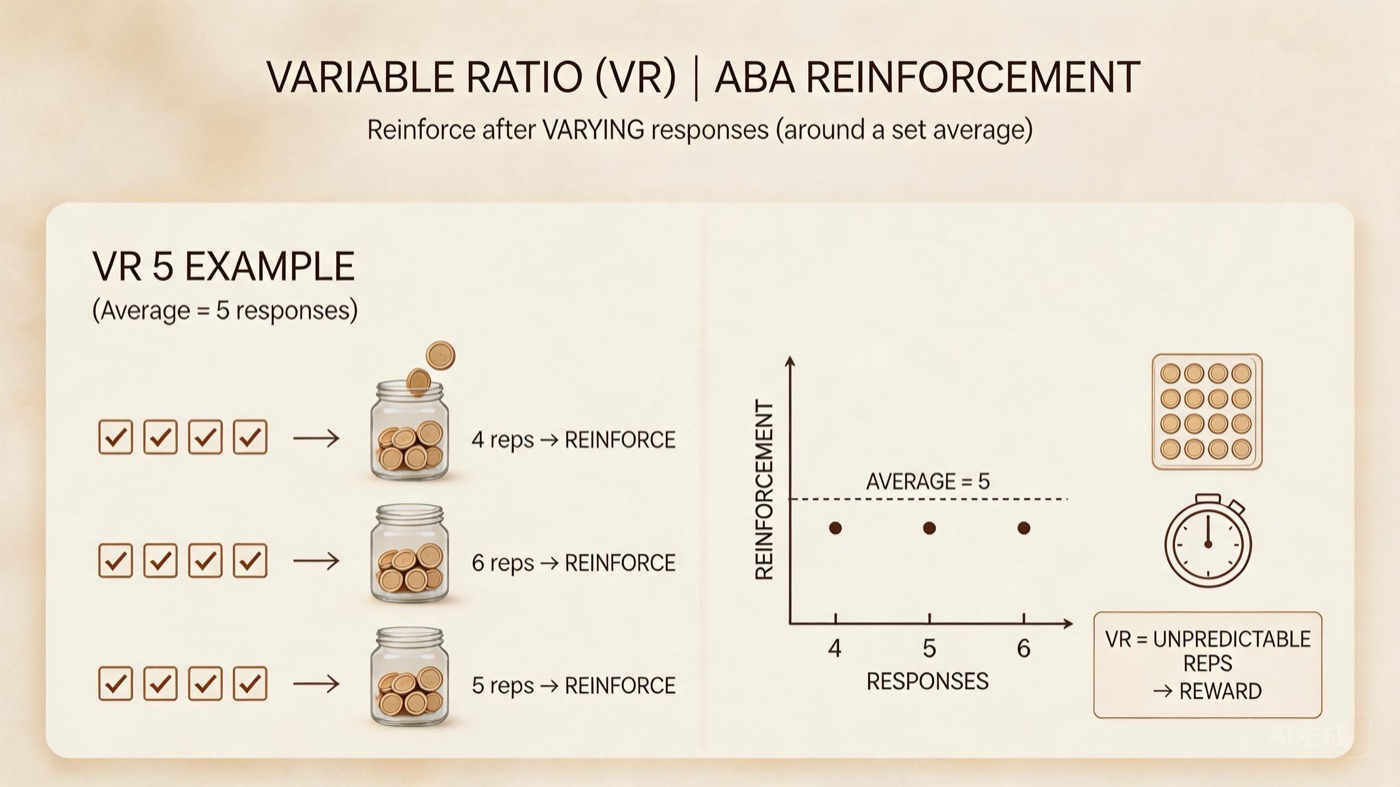
A variable ratio schedule of reinforcement delivers reinforcement after an unpredictable number of responses. The number of required responses varies around an average. For example, a VR 5 schedule means reinforcement occurs after approximately every fifth response, but not exactly after five – sometimes after three, sometimes after seven.
Practice this concept
After studying ratio schedules, test the concept with BCBA reinforcement practice questions.
Table of Contents
- Defining the Variable Ratio Schedule in ABA
- ABA Examples with ABC Analysis
- Variable Ratio vs. Other Reinforcement Schedules
- Exam Relevance and Common Traps
- Quick Checklist for Variable Ratio Schedules
- Final Summary
The variable ratio schedule is one of the four basic schedules of reinforcement defined by Ferster and Skinner (1957). It is characterized by the delivery of a reinforcer following a varying number of responses, with the number of responses required changing unpredictably from one reinforcement to the next. The schedule is typically described by its mean, such as VR 10, meaning that on average, 10 responses are needed for reinforcement, but the actual requirement can range from 1 to 20 or more.
Key Characteristics of Variable Ratio Schedules
- Unpredictable ratio: The learner never knows exactly how many responses are needed, which maintains consistent responding.
- High and steady response rates: Because reinforcement is tied to the number of responses, learners typically emit a rapid, steady stream of behavior.
- Minimal post-reinforcement pause: Unlike fixed ratio schedules, the pause after reinforcement is very brief or absent.
- Resistance to extinction: Behaviors maintained by a VR schedule are often more resistant to extinction because the pattern of intermittent reinforcement has built persistence.
Because the number of responses required is variable, the learner cannot predict exactly when the next reinforcer will come. This unpredictability encourages a high, steady rate of responding and makes the behavior very resistant to extinction. In clinical practice, VR schedules are often used to maintain already established behaviors, as they produce consistent performance with minimal disruption.
ABA Examples with ABC Analysis
Understanding variable ratio schedules through real-world scenarios helps you apply the concept on the BCBA exam. Below are two examples using the three-term contingency (ABC).
Example 1: Slot Machine Play
- Antecedent: Machine lights and sounds signal availability.
- Behavior: Pulling the lever (or pressing the button).
- Consequence: Occasionally winning money after a variable number of pulls.
- Function: Automatic positive reinforcement (the thrill of winning) and possibly social reinforcement if others celebrate.
- Schedule: The slot machine pays out on a variable ratio schedule – the player never knows which pull will win.
Example 2: Calling a Friend
- Antecedent: Wanting to chat and hearing the phone ring.
- Behavior: Dialing the friend’s number.
- Consequence: Friend answers after a variable number of attempts (sometimes first call, sometimes third).
- Function: Social positive reinforcement (getting to talk).
- Schedule: The friend’s availability creates a variable ratio schedule – the caller persists because the friend eventually picks up.
Example 3: Sales Cold Calls
- Antecedent: List of potential clients.
- Behavior: Dialing a prospect’s number and delivering a sales pitch.
- Consequence: Occasional successful sale after a varying number of calls (e.g., sometimes after 5 calls, sometimes after 20).
- Function: Tangible reinforcement (commission) and social reinforcement (praise from manager).
- Schedule: The salesperson maintains a high call rate because the ratio of calls to sales varies unpredictably.
Each of these examples illustrates how a variable ratio schedule produces persistent, high-rate behavior. On the exam, you may be asked to generate your own ABC example; practicing these will help you quickly identify the schedule.
Variable Ratio vs. Other Reinforcement Schedules
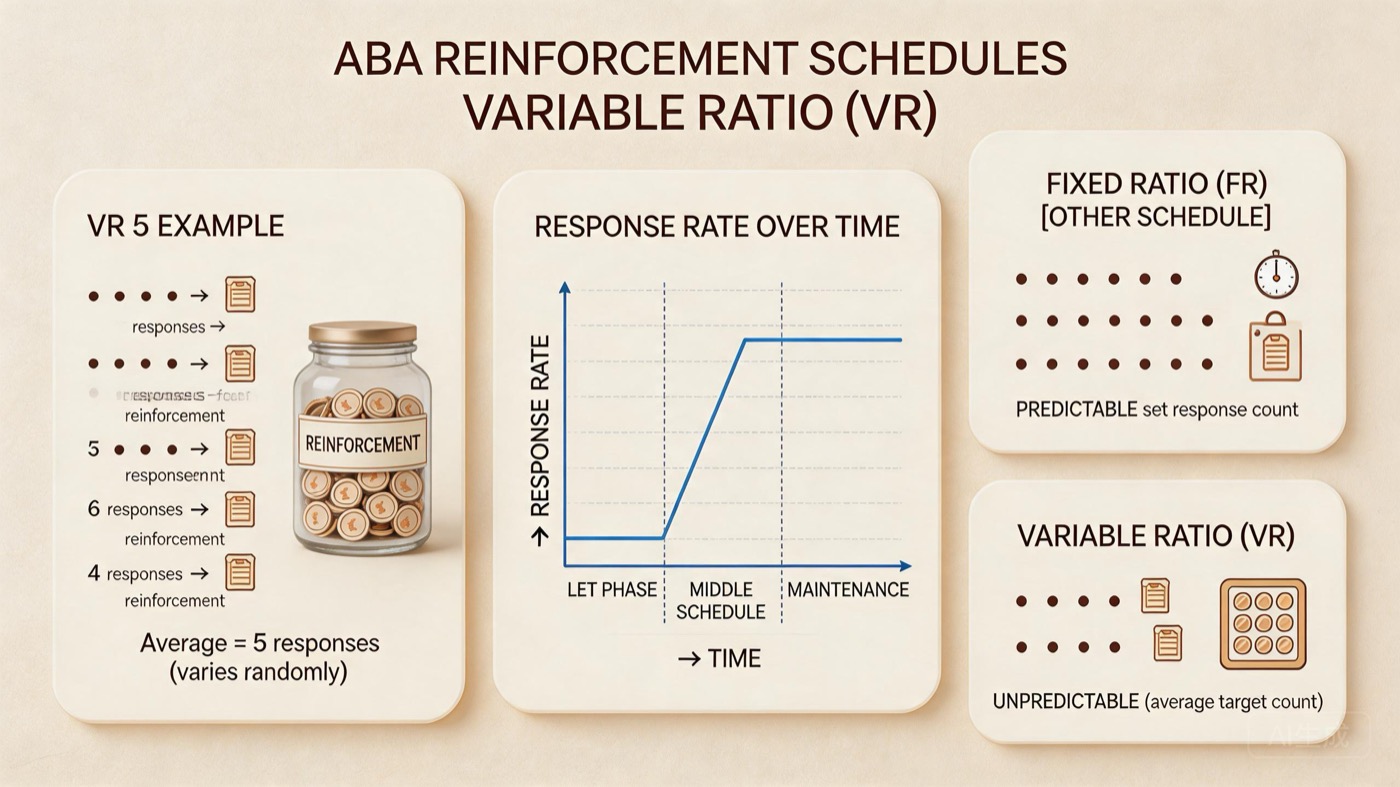
On the exam, you must distinguish variable ratio from other schedules. The table below summarizes the key differences.
Visual Comparison Table
| Schedule | Definition | Response Rate | Pause After Reinforcement | Example |
|---|---|---|---|---|
| Variable Ratio (VR) | Reinforcement after varying number of responses | High and steady | Minimal or none | Slot machine |
| Fixed Ratio (FR) | Reinforcement after a fixed number of responses | High, with brief pause after reinforcement | Short pause (post-reinforcement pause) | Piece-rate work |
| Variable Interval (VI) | Reinforcement for first response after varying time intervals | Moderate, steady | Minimal | Checking email |
| Fixed Interval (FI) | Reinforcement for first response after a fixed time interval | Low early, high near end of interval | Longer pause after reinforcement | Weekly paycheck |
Notice that the key distinction is whether the contingency is based on the number of responses (ratio) or the passage of time (interval). If the reinforcer is delivered after a number of responses, it’s a ratio schedule. If after a time period has elapsed (and a response must occur), it’s an interval schedule. Additionally, VR and FR both produce high rates, but FR has a notable post-reinforcement pause, whereas VR does not. This difference is critical on the exam: a VR schedule typically has little to no pause because the next response could always be the one that pays off.
Exam Relevance and Common Traps
The BCBA exam frequently tests your ability to identify the schedule from a scenario and predict response patterns. Pay attention to these common pitfalls.
Frequent Exam Questions
- Identify the schedule: “A student receives a token after an average of 5 correct answers.” Answer: Variable ratio schedule.
- Predict the response pattern: “What is the expected response rate under a VR schedule?” Answer: High and steady with minimal pause.
- Apply to a clinical scenario: “Design a schedule to maintain a high rate of on-task behavior.” Consider a VR schedule.
- Compare schedules: “Which schedule produces the greatest resistance to extinction?” Typically VR or VI, but VR often produces more persistent behavior because it is response-based.
Common Traps to Avoid
- Confusing VR with VI: VR is response-based; VI is time-based. If the reinforcer is delivered after a number of behaviors, it’s ratio. If after a time period, it’s interval.
- Misidentifying the schedule when average is unknown: The examiner may describe a pattern without giving the average. Focus on the contingency: does the number of responses required vary? If yes, it’s VR.
- Overlooking post-reinforcement pause differences: VR has minimal pause; FR has a short pause. Many students incorrectly apply the FR pause pattern to VR.
- Assuming VR always produces the highest rate: While VR generally produces high rates, FR can produce even higher rates temporarily just before reinforcement. However, VR rates are more consistent and resistant to extinction.
Exam Tip: How to Remember the Differences
A helpful mnemonic: Ratio = Responses (both start with R); Interval = Time (like an intermission). For variability, think “Varied = Unpredictable.” Practice by generating your own examples for each schedule and explaining why they fit the definition.
Quick Checklist for Variable Ratio Schedules
Use this checklist for last-minute review before the exam.
- Reinforcement is delivered after a varying number of responses.
- Produces a high, steady response rate.
- Minimal to no pause after reinforcement.
- High resistance to extinction compared to fixed schedules.
- Common natural examples: gambling, fishing, checking for messages.
- In clinical practice, use VR schedules to maintain behaviors that are already established.
- On the exam, look for phrases like “on average,” “unpredictable,” or “varies” to identify VR.
Final Summary
The variable ratio schedule of reinforcement is a cornerstone of ABA. It generates persistent, high-rate behavior with little pause. On the BCBA exam, expect questions that ask you to identify the schedule, compare it to others, and apply it to interventions. For more practice, check out our BCBA mock exams and review compound schedules of reinforcement. Additional details on reinforcement schedules can be found in the BACB Task List.
Next step for BCBA exam prep
Turn this topic into exam-day practice
Use this topic as a focused review, then test it in exam-style conditions with a free mock before deciding whether five full-length mocks are the right next step.
Start the Free BCBA Mock ExamContinue with Five Full-Length Mocks — $99
Review the included materials and access details before ordering. No pass guarantee is implied.



