
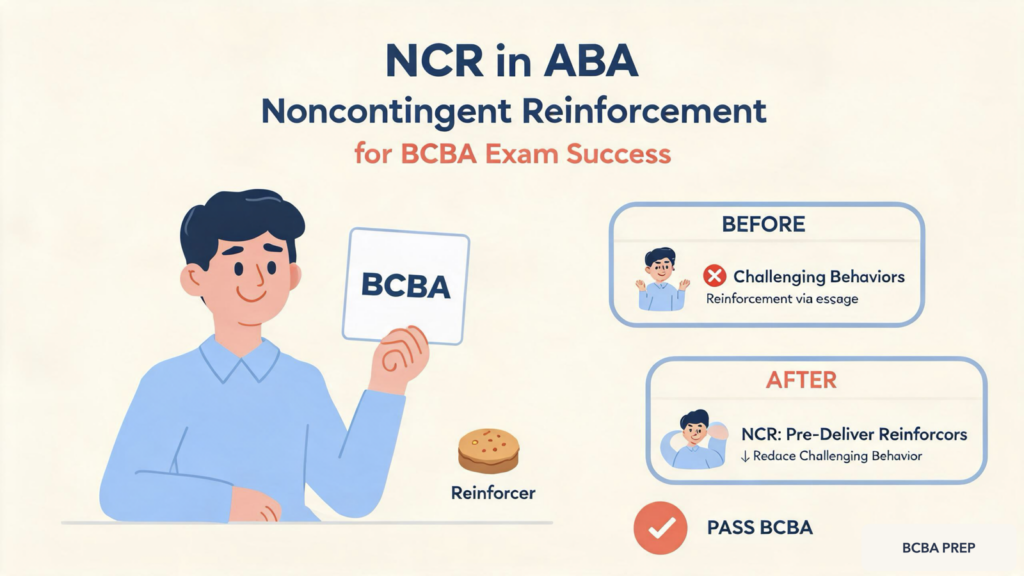
What Is Noncontingent Reinforcement (NCR) in ABA?
Noncontingent reinforcement (NCR) is an evidence-based antecedent intervention that involves delivering a reinforcer on a fixed-time (FT) schedule, regardless of the learner’s behavior. In other words, the reinforcer is provided at set intervals whether or not the target behavior occurs. This stands in contrast to contingent reinforcement, where the reinforcer is delivered only after a specific behavior.
Table of Contents
- What Is Noncontingent Reinforcement (NCR) in ABA?
- NCR ABA Examples With ABC Data and Hypothesized Function
- BCBA Exam Tips: Common Traps and Misconceptions About NCR
- When to Use NCR vs. Other Behavior Reduction Strategies
- Quick Checklist for Implementing NCR in ABA
- Summary: Key Takeaways on NCR for the BCBA Exam
The primary mechanism of NCR is to eliminate the response-reinforcer contingency. By making the reinforcer freely available, the behavior that previously produced that reinforcer is no longer necessary, leading to a reduction in the problem behavior. NCR is commonly used for behaviors maintained by social-positive reinforcement (e.g., attention), social-negative reinforcement (e.g., escape), or automatic reinforcement.
How NCR Differs From Other Reinforcement-Based Procedures
| Procedure | Reinforcer Delivery | Contingency |
|---|---|---|
| NCR | Fixed-time schedule, independent of behavior | None with target behavior |
| DRA (Differential Reinforcement of Alternative Behavior) | Contingent on an alternative, appropriate behavior | Alternative behavior produces reinforcer |
| DRO (Differential Reinforcement of Other Behavior) | Contingent on the absence of the target behavior during a set interval | No target behavior → reinforcer |
| Extinction | Reinforcer is withheld entirely | No reinforcer for any behavior |
NCR ABA Examples With ABC Data and Hypothesized Function
Understanding NCR through real-world examples helps solidify the concept for exam scenarios. Below are three common functions with corresponding ABC data and NCR intervention steps.
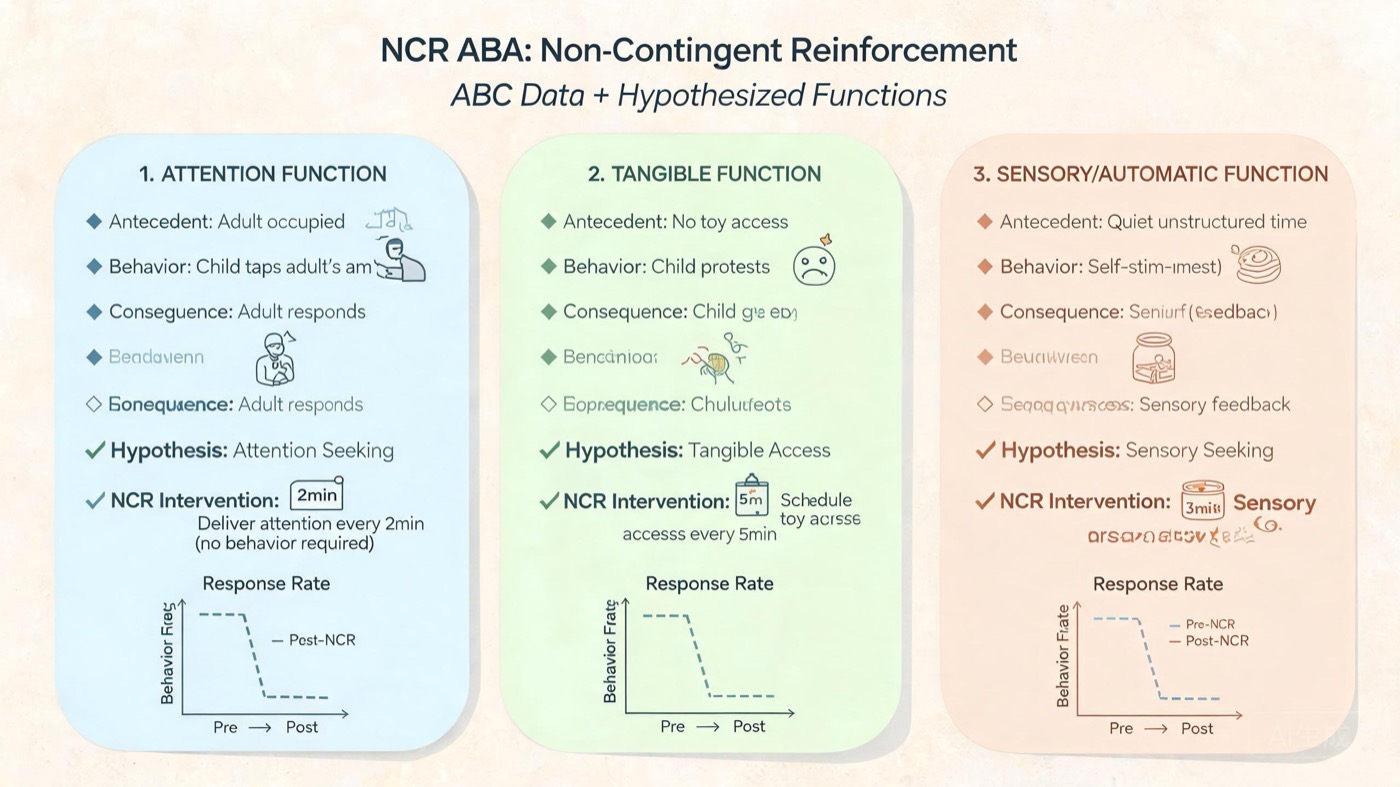
Example 1: Attention-Maintained Aggression
- Antecedent: Teacher is working with another student; child is not receiving attention.
- Behavior: Child hits peer (aggression).
- Consequence: Teacher reprimands child (“Stop hitting!”), providing immediate attention.
- Hypothesized function: Positive reinforcement (attention).
- NCR intervention: Deliver attention every 3 minutes on a fixed-time schedule, regardless of behavior. Provide praise, eye contact, or a brief interaction. Continue even if no aggression occurs.
Example 2: Escape-Maintained Tantrums
- Antecedent: Student is given a difficult math worksheet.
- Behavior: Student screams, throws pencil.
- Consequence: Teacher removes worksheet, student escapes the task.
- Hypothesized function: Negative reinforcement (escape from demand).
- NCR intervention: Provide a 2-minute break every 10 minutes noncontingently. Break is given even if the child is working quietly. During break, the child can engage in a preferred activity.
Example 3: Automatically Maintained Hand-Mouthing
- Antecedent: Child is alone in a quiet area with no stimulation.
- Behavior: Child places hand in mouth and sucks fingers.
- Consequence: Oral stimulation (sensory input).
- Hypothesized function: Automatic reinforcement (sensory stimulation).
- NCR intervention: Provide a chew tube or vibrating toy on a fixed-time schedule (e.g., every 5 minutes) as an alternative source of oral stimulation. The child receives the item regardless of hand-mouthing.
BCBA Exam Tips: Common Traps and Misconceptions About NCR
Exam questions often test your ability to distinguish NCR from similar procedures. Avoid these common errors to boost your score.
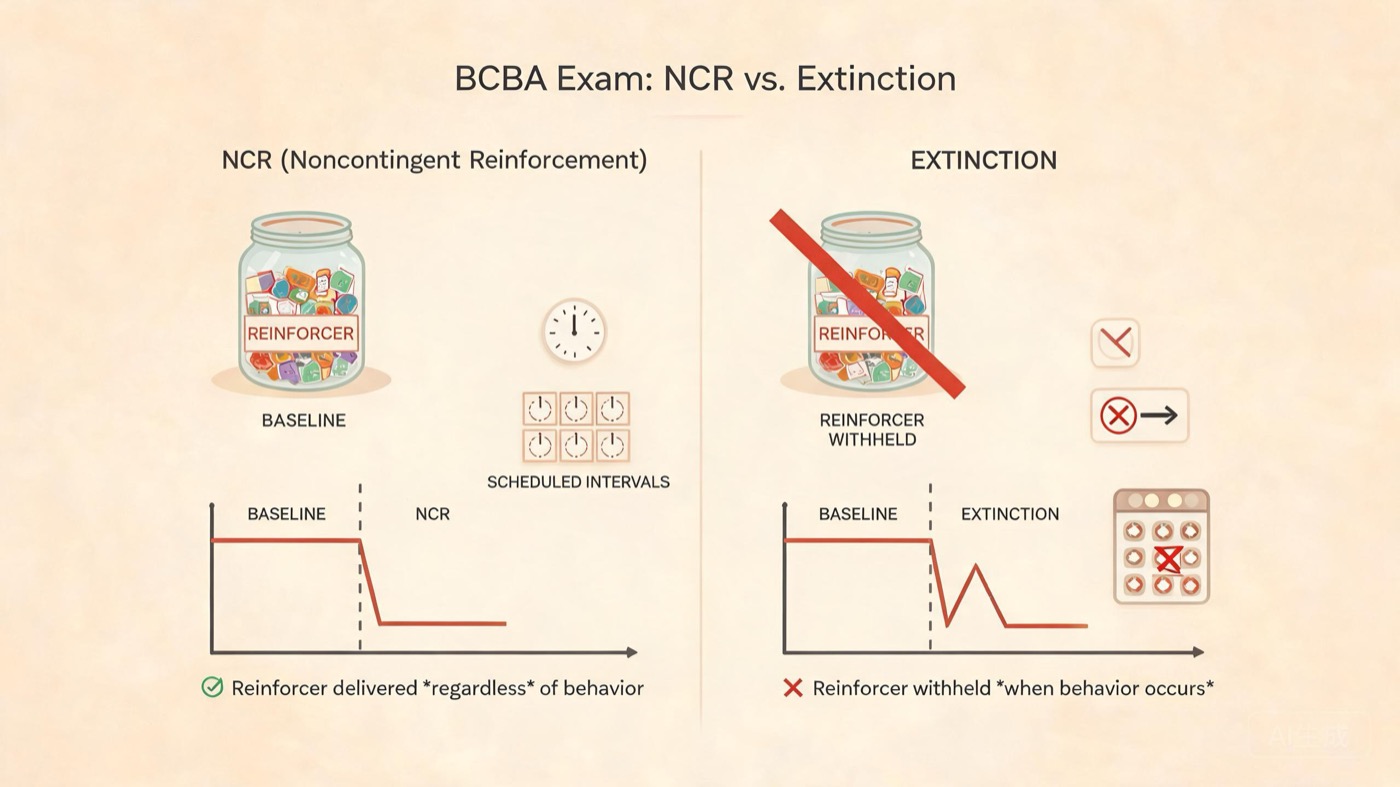
Trap 1: NCR Is the Same as Extinction
While both NCR and extinction can reduce problem behavior, they operate differently. Extinction involves withholding the reinforcer that maintains the behavior, whereas NCR delivers that reinforcer on a time schedule. In NCR, the response-reinforcer relation is dismantled because the reinforcer is no longer dependent on the behavior. However, the reinforcer is still available, which can make NCR more acceptable to caregivers and less likely to produce an extinction burst.
Trap 2: NCR Requires a Complete Functional Analysis
Some candidates think NCR can only be used after a full functional analysis (FA). In reality, NCR can be implemented based on a hypothesized function from a descriptive assessment or interview. While an FA strengthens the hypothesis, it is not always required for ethical and effective use. The BACB ethical code emphasizes using the least restrictive intervention, and NCR is often a good starting point.
When to Use NCR vs. Other Behavior Reduction Strategies
Choosing the right procedure depends on the function of behavior, client characteristics, and practical constraints. NCR is particularly useful in specific situations.
Quick Decision Guide
- NCR is preferred when: The behavior is severe and dangerous (avoids extinction bursts), the replacement behavior requires high effort, or the reinforcer is automatic (e.g., sensory stimulation).
- DRA is better when: The client can learn a functional alternative communication response, and the behavior is not too intense.
- DRO is useful when: The goal is to reduce overall occurrence, but the client may need frequent reinforcement for absence of behavior.
- Extinction alone is risky: If the behavior is dangerous or if the reinforcer cannot be fully withheld (e.g., automatic reinforcement), NCR or other strategies are safer.
Quick Checklist for Implementing NCR in ABA
Follow these steps to apply NCR effectively in practice and on exam vignettes.
- Identify the function: Use a functional behavior assessment to determine what reinforces the problem behavior (attention, escape, tangible, automatic).
- Select the reinforcer: Choose a reinforcer that matches the function (e.g., attention if attention-maintained).
- Determine the initial schedule: Start with a dense fixed-time schedule (e.g., every 2-5 minutes) to ensure the client receives frequent access to the reinforcer.
- Thin the schedule gradually: As behavior decreases, increase the time between deliveries (e.g., from 3 minutes to 5 minutes) to promote independence.
- Monitor data: Collect frequency or duration data on the target behavior to evaluate effectiveness. Adjust schedule if behavior persists.
- Combine with other procedures: NCR is often paired with extinction for faster effects, but ensure extinction is safe to implement.
Summary: Key Takeaways on NCR for the BCBA Exam
Noncontingent reinforcement is a powerful, non-punishment-based strategy that reduces problem behavior by eliminating the response-reinforcer contingency. On the BCBA exam, expect questions that ask you to identify NCR in a scenario, distinguish it from extinction or differential reinforcement, and recommend it based on function. Remember: NCR delivers reinforcers on a fixed-time schedule, works across all four functions, and can be used with a hypothesized function. For more in-depth ABA exam strategies, check out our differential reinforcement guide and functions of behavior guide. Additionally, the BACB Ethics Code provides guidance on using least restrictive procedures.
Complete BCBA Exam Prep
Turn this topic into exam-day practice
Practice concepts in context with five full-length 6th Edition mock exams, two bonus practice exams, a 6th Edition study guide, and key-term flashcards—all in one $120 USD package.
Get the $120 All-in-One Prep Pack
Review everything included on the product page before ordering. No pass guarantee is implied.



