
Understanding conditioned reinforcers is essential for both effective ABA practice and BCBA exam success. These learned reinforcers form the backbone of many behavior change programs, from token economies to social praise systems. This guide breaks down the concept with clear definitions, practical examples, and exam-focused insights.
Table of Contents
- Conditioned Reinforcer ABA: What is a Conditioned Reinforcer in ABA?
- Conditioned Reinforcer Examples in Practice
- Conditioned Reinforcers on the BCBA Exam
- Quick-Study Checklist and Summary
conditioned reinforcer ABA: What is a Conditioned Reinforcer in ABA?
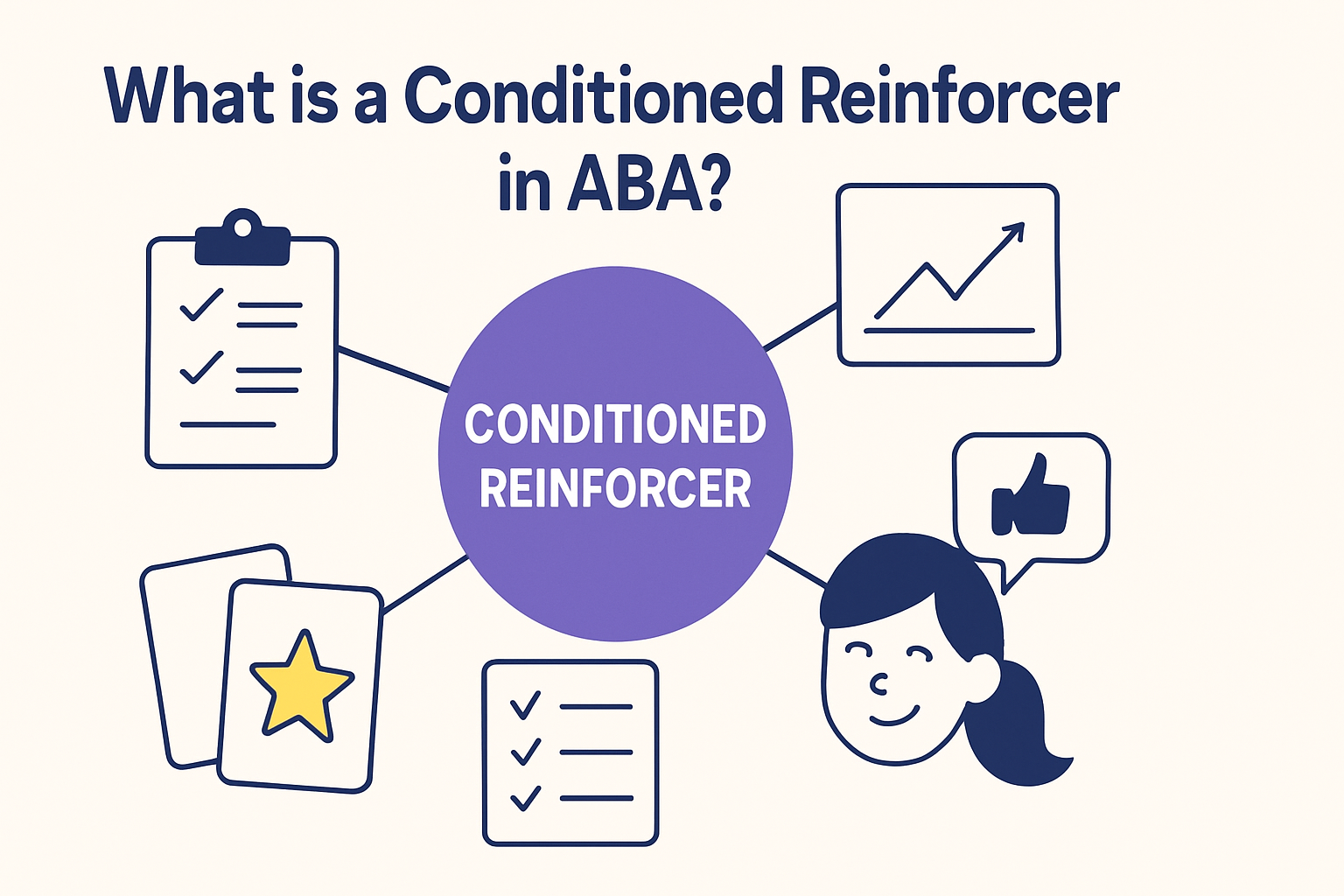
A conditioned reinforcer (also called a secondary reinforcer) is a previously neutral stimulus that gains reinforcing properties through consistent pairing with an established reinforcer. Unlike unconditioned reinforcers that are biologically significant, conditioned reinforcers acquire their value through learning history.
Definition and Key Characteristics
The defining feature of a conditioned reinforcer is its acquired value through pairing. Initially, the stimulus has no reinforcing properties, but through repeated association with a primary reinforcer, it becomes reinforcing itself. This process involves conditioned motivating operations that establish the value of the backup reinforcer.
Key characteristics include:
- Acquired through pairing with established reinforcers
- Value depends on the establishing operation for the backup reinforcer
- Can become a generalized conditioned reinforcer when paired with multiple reinforcers
- Essential for complex behavior change programs
Conditioned vs. Unconditioned Reinforcers: A Critical Distinction
The distinction between conditioned and unconditioned reinforcers isn’t about the item itself but its history. Food is typically an unconditioned reinforcer because of biological significance, while money is a conditioned reinforcer due to learned associations.
Common examples include:
- Unconditioned: Food, water, warmth, pain relief
- Conditioned: Praise, tokens, grades, money, clicker sounds
Remember: The same stimulus can serve different functions based on individual learning history. What’s conditioned for one person might be unconditioned for another in rare cases.
Conditioned Reinforcer Examples in Practice
Moving from theory to application, let’s examine three realistic scenarios that demonstrate how conditioned reinforcers work in ABA practice.
Example 1: The Token Economy System
Token economies represent one of the most common applications of conditioned reinforcement. In this classroom scenario:
- Antecedent: Teacher gives instruction to complete math worksheet
- Behavior: Student independently completes all problems
- Consequence: Teacher delivers a plastic token
- Function: Access to tokens (conditioned reinforcers) that can be exchanged later
The token gains value through pairing with backup reinforcers like preferred activities or items. This system allows for delayed reinforcement while maintaining motivation.
Example 2: Social Praise as a Generalized Conditioned Reinforcer
Social praise demonstrates how generalized conditioned reinforcers develop through extensive pairing history:
- Antecedent: Parent asks child to put away toys
- Behavior: Child complies within 30 seconds
- Consequence: Parent says, “Great job cleaning up!” with enthusiastic tone
- Function: Access to social approval and attention
Praise becomes reinforcing through pairing with multiple primary reinforcers from infancy, including food, comfort, and physical contact. This makes it a powerful generalized reinforcer across many contexts.
Example 3: A Clicker in Skill Acquisition
In discrete trial training, clickers serve as precise conditioned reinforcers:
- Antecedent: Therapist presents SD, “Touch blue” with two color cards
- Behavior: Client correctly touches blue card
- Consequence: Therapist clicks clicker, then delivers small edible
- Function: Access to clicker sound signaling correct response and imminent primary reinforcement
The clicker’s effectiveness depends on consistent pairing with primary reinforcers. It provides immediate feedback while bridging the delay to the actual reinforcer delivery.
Conditioned Reinforcers on the BCBA Exam
This concept appears frequently on the BCBA exam, particularly in sections covering basic principles. Understanding conditioned reinforcement is essential for answering questions across multiple domains.
Linking to the BACB Task List
The BACB Task List specifically addresses conditioned reinforcers in several sections. Most notably, Section B-8 requires candidates to “Define and provide examples of conditioned and unconditioned reinforcement.” This knowledge extends to domains like intervention design, where you might select appropriate reinforcement procedures.
For comprehensive exam preparation, review our guide to the BACB Task List 6th Edition to understand how this concept integrates with other exam content.
Common Exam Traps and How to Avoid Them
Several predictable traps appear in BCBA exam questions about conditioned reinforcers. Being aware of these can improve your accuracy:
Trap 1: Mistaking a conditioned reinforcer for unconditioned based on the item
- Example trap: “Money is an unconditioned reinforcer because everyone wants it.”
- Reality check: Money’s value is learned through pairing with primary reinforcers
- How to avoid: Ask “What is the learning history?” not “What is the item?”
Trap 2: Forgetting that value depends on the establishing operation
- Example trap: Assuming praise will reinforce behavior when the client is satiated on social attention
- Reality check: Conditioned reinforcers only work when the backup reinforcer is valuable
- How to avoid: Consider the current motivating operation for the backup reinforcer
Trap 3: Confusing conditioned reinforcement with stimulus control
- Example trap: Thinking a clicker establishes stimulus control rather than functioning as a reinforcer
- Reality check: Clickers reinforce behavior; they don’t signal availability of reinforcement
- How to avoid: Remember that reinforcers follow behavior, while discriminative stimuli precede it
For more on related concepts, see our guide to SD vs MO differences which helps clarify these distinctions.
Quick-Study Checklist and Summary
Use this checklist for last-minute review before your exam:
- ✓ Define conditioned reinforcer as a stimulus that gains value through pairing
- ✓ Distinguish from unconditioned reinforcers based on learning history
- ✓ Identify at least three examples of conditioned reinforcers in practice
- ✓ Explain how generalized conditioned reinforcers develop
- ✓ Describe the pairing process that establishes conditioned reinforcement
- ✓ Recognize common exam traps about money, praise, and token systems
- ✓ Connect conditioned reinforcement to relevant BACB Task List items
- ✓ Apply the concept to real-world ABA scenarios with ABC analysis
Conditioned reinforcers are fundamental to effective behavior change. They allow for flexible reinforcement systems that can be tailored to individual needs and contexts. Mastery of this concept not only prepares you for exam success but also enhances your clinical practice by expanding your reinforcement toolkit.
For additional study resources, explore our comprehensive BCBA exam prep guide which covers all essential concepts in detail. The official BACB Task List provides the complete framework for exam content.
Complete BCBA Exam Prep
Turn this topic into exam-day practice
Practice concepts in context with five full-length 6th Edition mock exams, two bonus practice exams, a 6th Edition study guide, and key-term flashcards—all in one $120 USD package.
Get the $120 All-in-One Prep Pack
Review everything included on the product page before ordering. No pass guarantee is implied.



