
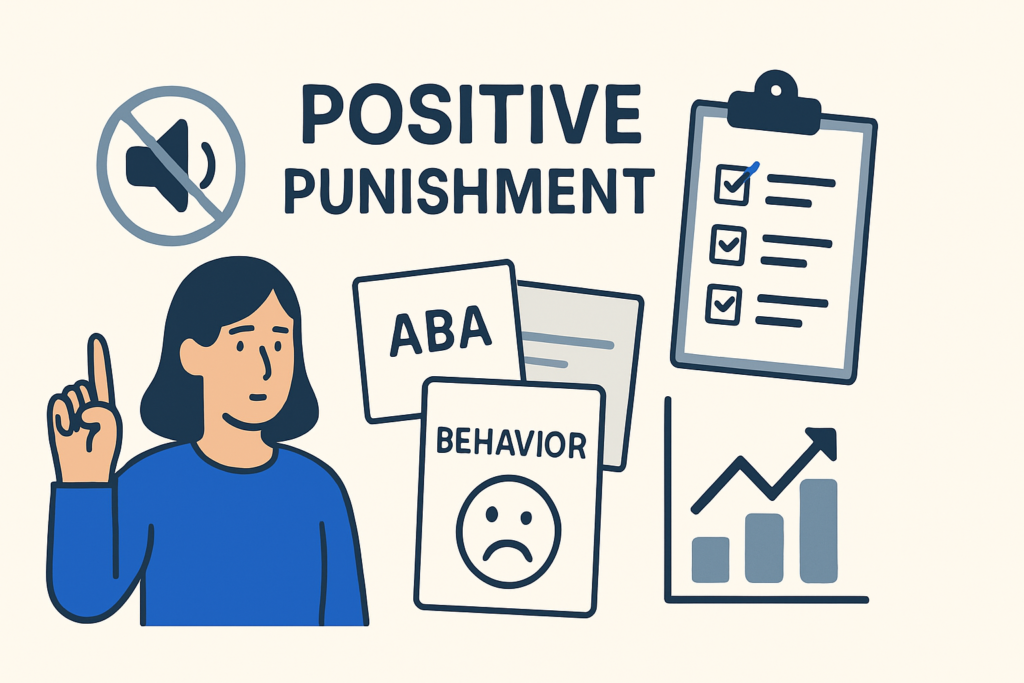
Understanding positive punishment is essential for any behavior analyst preparing for certification. This fundamental concept appears frequently on the BCBA exam and requires precise understanding to avoid common misconceptions. Unlike reinforcement procedures that increase behavior, punishment procedures focus on decreasing behavior through specific consequences.
Table of Contents
- Defining Positive Punishment: The Core Principle
- Positive Punishment in Practice: ABA Examples and Analysis
- Positive Punishment and the BCBA Exam: What to Expect
- Ethical Application and a Practitioner’s Checklist
- Final Summary and Key Takeaways
Defining Positive Punishment: The Core Principle
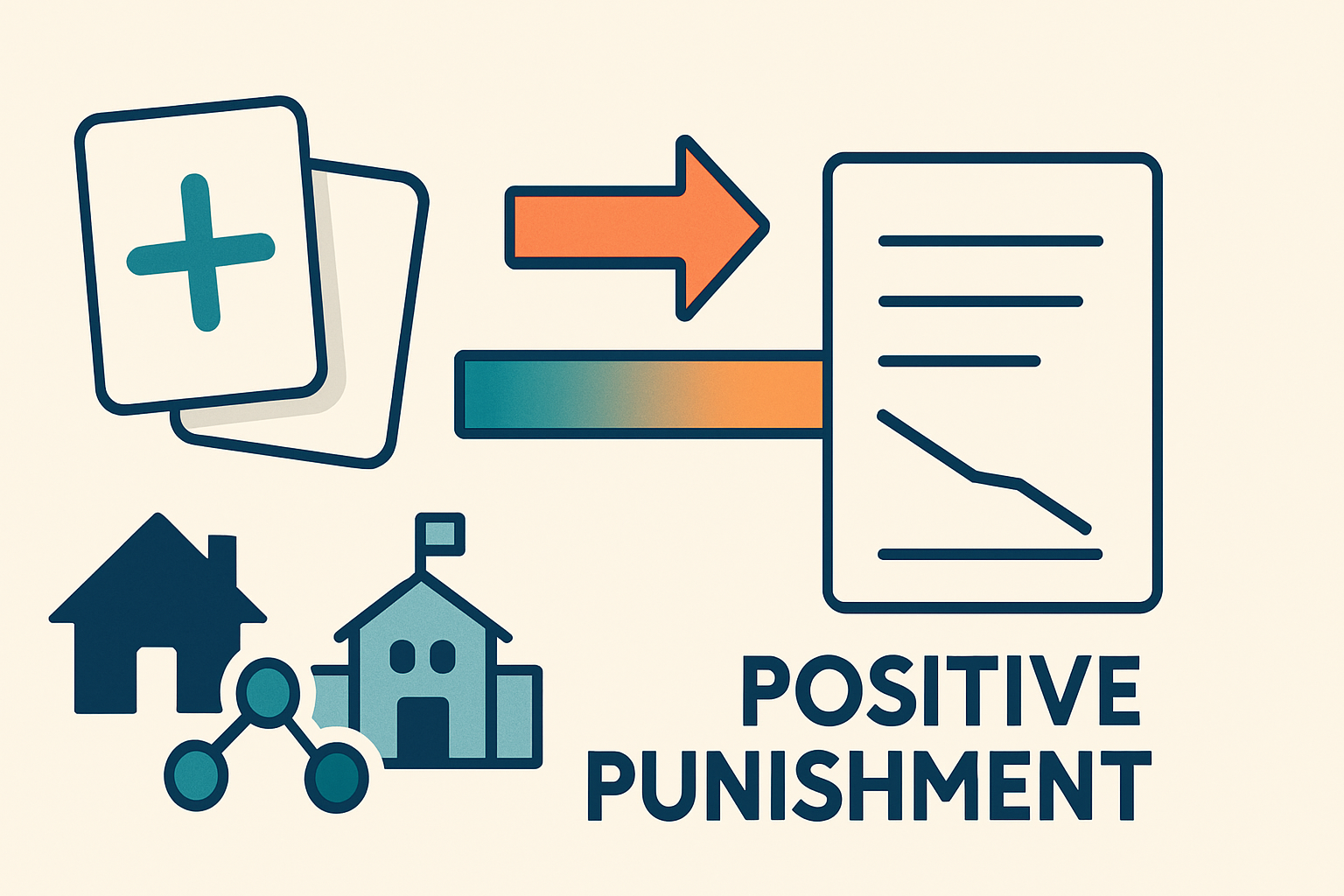
Positive punishment occurs when a stimulus is added following a behavior, resulting in a future decrease in that behavior. The term ‘positive’ refers to the addition of a stimulus, not to whether the consequence is pleasant or desirable. This distinction is crucial for exam success and ethical practice.
The Key Elements: ‘Positive’ and ‘Punishment’
The word ‘positive’ in this context means something is added to the environment. The term ‘punishment’ indicates that the behavior decreases in frequency as a result. This differs from negative punishment, where something is removed to decrease behavior. Both types of punishment focus on behavior reduction, while reinforcement procedures aim to increase behavior.
Understanding these distinctions requires careful attention to the operational definitions used in applied behavior analysis. The effect on behavior determines whether a procedure qualifies as punishment, not the subjective experience of the individual.
A Quick-Reference Contingency Matrix
To solidify your understanding, consider these four basic operant conditioning contingencies:
- Positive reinforcement: Adding a stimulus increases behavior
- Negative reinforcement: Removing a stimulus increases behavior
- Positive punishment: Adding a stimulus decreases behavior
- Negative punishment: Removing a stimulus decreases behavior
This matrix helps distinguish between procedures based on whether stimuli are added or removed and whether behavior increases or decreases. For more on related concepts, see our guide on positive vs negative punishment.
Positive Punishment in Practice: ABA Examples and Analysis
Real-world application requires analyzing behavior through the ABC framework: Antecedent, Behavior, Consequence. Each example below demonstrates how positive punishment operates in different settings.
Example 1: Classroom Setting – Loud Vocalizations
During independent work time, a student emits loud vocal protests. The teacher responds with a verbal reprimand, adding attention to the environment. If future loud protests decrease, this demonstrates positive punishment. The behavior’s function was likely attention-seeking, and the added reprimand served as the punishing stimulus.
This scenario highlights the importance of functional assessment before intervention. Without understanding why the behavior occurs, practitioners might inadvertently reinforce rather than punish the target behavior.
Example 2: Home Setting – Toy Throwing
When denied access to a preferred snack, a child throws toys. The parent assigns an extra chore, adding a non-preferred task. If toy throwing decreases in similar situations, this represents positive punishment. The behavior likely served an escape function from demands or a tangible-seeking function.
Ethical considerations are paramount here. Before implementing such procedures, practitioners should explore reinforcement-based alternatives and ensure proper safeguards are in place. For comprehensive ethical guidance, review our ethics in ABA practice guide.
Example 3: Clinical Setting – Hand Mouthing
During mildly aversive task demands, a client engages in hand mouthing with non-food items. A practitioner applies a safe, approved bitter-tasting solution to the hands. If hand mouthing decreases, this constitutes positive punishment. The behavior likely served an automatic reinforcement function or escape from demands.
This example represents a highly restrictive procedure requiring careful oversight. Such interventions should only follow exhaustive attempts with less restrictive alternatives and must include proper consent and monitoring protocols.
Positive Punishment and the BCBA Exam: What to Expect
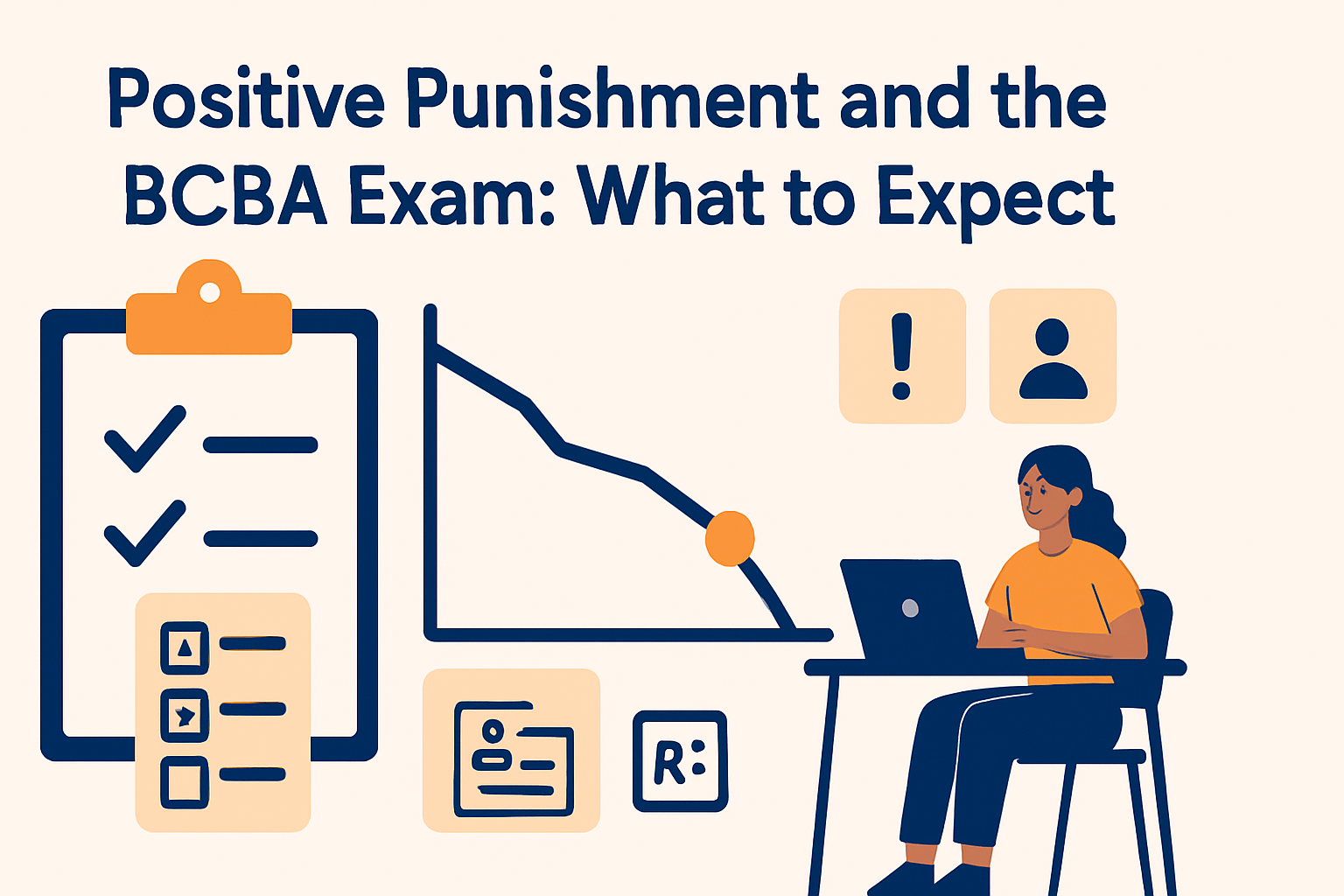
The BCBA exam frequently tests your ability to identify and analyze punishment procedures. Questions often present scenarios where you must determine whether positive punishment has occurred based on behavioral data.
Common Exam Traps and Misconceptions
Avoid these frequent mistakes when analyzing exam questions:
- Confusing positive punishment with negative punishment or positive reinforcement
- Misidentifying the ‘added stimulus’ in the scenario
- Assuming punishment procedures are always physical or harsh
- Forgetting that punishment is defined by behavioral effect, not consequence aversiveness
- Overlooking the need for baseline data to establish behavior decrease
These traps often appear in questions that describe interventions without clear data on behavior change. Always look for evidence of behavior reduction following stimulus addition.
Sample Exam-Style Practice Prompts
Test your understanding with these scenario-based questions:
Scenario 1: A child interrupts during story time. The teacher requires the child to write ‘I will not interrupt’ ten times. Interrupting decreases from 8 times per session to 1 time per session. What contingency is demonstrated?
Answer: Positive punishment. The teacher added a writing task (stimulus addition), and interrupting decreased.
Scenario 2: A client engages in property destruction during transitions. The therapist implements a response cost system where tokens are removed for destructive behavior. Property destruction decreases significantly. What contingency is this?
Answer: Negative punishment. Tokens are removed (stimulus removal), and behavior decreases.
Ethical Application and a Practitioner’s Checklist
Positive punishment procedures carry significant ethical responsibilities. The BACB Ethics Code emphasizes using the least restrictive interventions and prioritizing client dignity and welfare.
Aligning with the BACB Ethics Code
Behavior analysts must ensure that any punishment procedure aligns with ethical standards. This includes obtaining proper consent, using data-driven decision making, and prioritizing skill acquisition over suppression. Procedures should focus on teaching alternative behaviors rather than simply reducing problem behavior.
The right to effective treatment must be balanced with considerations of client dignity and the potential for negative side effects. For more on ethical considerations, consult the official BACB Ethics Codes.
Pre-Implementation Checklist for BCBAs
Before considering positive punishment, complete this essential checklist:
- Have reinforcement-based alternatives been thoroughly exhausted?
- Is there a clear plan to teach a functional replacement behavior?
- Are procedural safeguards (oversight, consent, data review) established?
- Is this intervention the least restrictive option available?
- Does the plan prioritize client welfare and skill acquisition?
- Have potential side effects been considered and monitored?
- Is there a data collection system to measure effectiveness?
- Will the procedure be faded as replacement behaviors strengthen?
This checklist helps ensure ethical implementation and protects client rights. Remember that punishment procedures should always be part of a comprehensive behavior intervention plan that emphasizes positive approaches.
Final Summary and Key Takeaways
Positive punishment involves adding a stimulus to decrease behavior. Success on the BCBA exam requires precise understanding of this definition and the ability to apply it to real-world scenarios. Key points to remember include:
- Positive means stimulus addition, not that the procedure is pleasant
- Punishment is defined by behavior reduction, not consequence severity
- Always analyze through the ABC framework with functional assessment
- Ethical implementation requires exhausting reinforcement alternatives first
- Exam questions often test your ability to distinguish between all four operant contingencies
For additional practice with related concepts, explore our resources on negative reinforcement and differential reinforcement. These complementary procedures often work together in comprehensive behavior plans.
Mastering positive punishment requires both conceptual understanding and practical application skills. By studying real examples, practicing exam-style questions, and considering ethical implications, you’ll be well-prepared for both the BCBA exam and ethical practice as a behavior analyst.
Next step for BCBA exam prep
Turn this topic into exam-day practice
Use this topic as a focused review, then test it in exam-style conditions with a free mock before deciding whether five full-length mocks are the right next step.
Start the Free BCBA Mock ExamContinue with Five Full-Length Mocks — $99
Review the included materials and access details before ordering. No pass guarantee is implied.



