
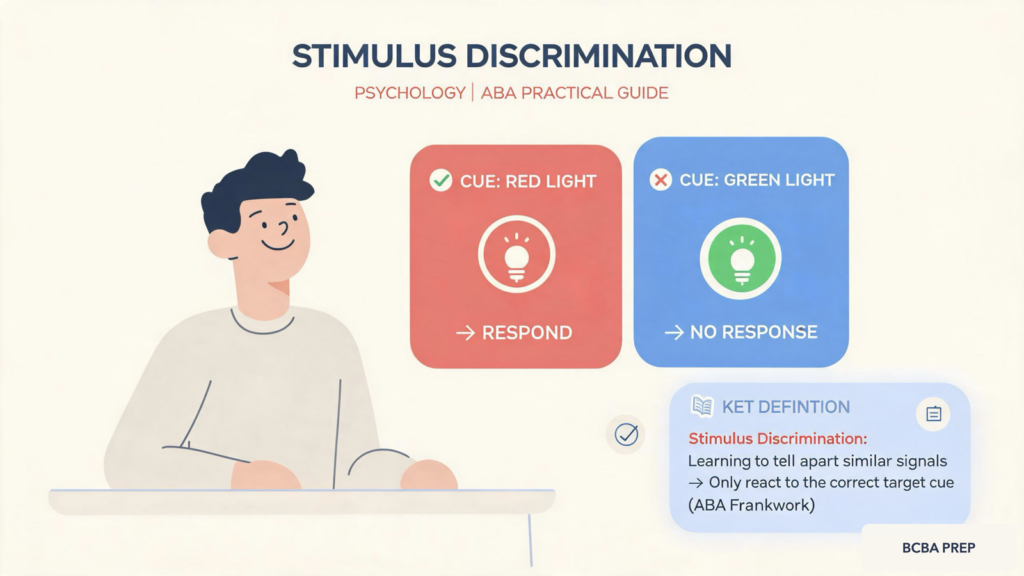
What Is Stimulus Discrimination? Psychology
In psychology, stimulus discrimination refers to the ability to respond differently to two or more stimuli that differ along a dimension. In behavior analysis, it is defined as a discriminative stimulus (SD) setting the occasion for a reinforced response, while an S-delta signals that a response will not be reinforced. This concept is central to understanding how individuals learn to differentiate between situations. For example, a child learns to say “please” only when a adult is looking (SD) and not when the adult is on the phone (S-delta). The process of discrimination allows for more adaptive and precise behavior by narrowing the range of stimuli that evoke a particular response.
Practice this concept
After reviewing discrimination, test the concept with BCBA stimulus control practice questions.
Discrimination is not just about recognizing differences; it is about acting on those differences to obtain reinforcement or avoid punishment. In everyday life, we constantly engage in stimulus discrimination: we stop at red lights but go on green, we speak differently to a boss than to a friend, and we use a fork for salad but a spoon for soup. These behaviors are under the control of specific stimuli because past reinforcement has been delivered selectively. Understanding the stimulus discrimination psychology definition is therefore essential for grasping how behavior is shaped by its consequences within specific contexts.
Table of Contents
- What Is Stimulus Discrimination? Psychology
- Stimulus Discrimination in ABA: Worked Examples
- Why Stimulus Discrimination Matters for the BCBA Exam
- Quick Checklist: Stimulus Discrimination for Exam Review
- Summary: Key Takeaways on Stimulus Discrimination
- References
Stimulus Discrimination vs. Stimulus Generalization
Whereas stimulus generalization occurs when a response spreads to similar stimuli, discrimination requires the learner to restrict responding only to the SD. For example, a child who says ‘cookie’ only when a cookie is present (and not a cracker) demonstrates discrimination. The opposite—calling all round foods ‘cookie’—would be generalization. Discrimination is essential for precise, adaptive behavior. In ABA programs, discrimination training is often the first step before generalization can be systematically taught. Without discrimination, a learner might respond to irrelevant stimuli, wasting time and effort.
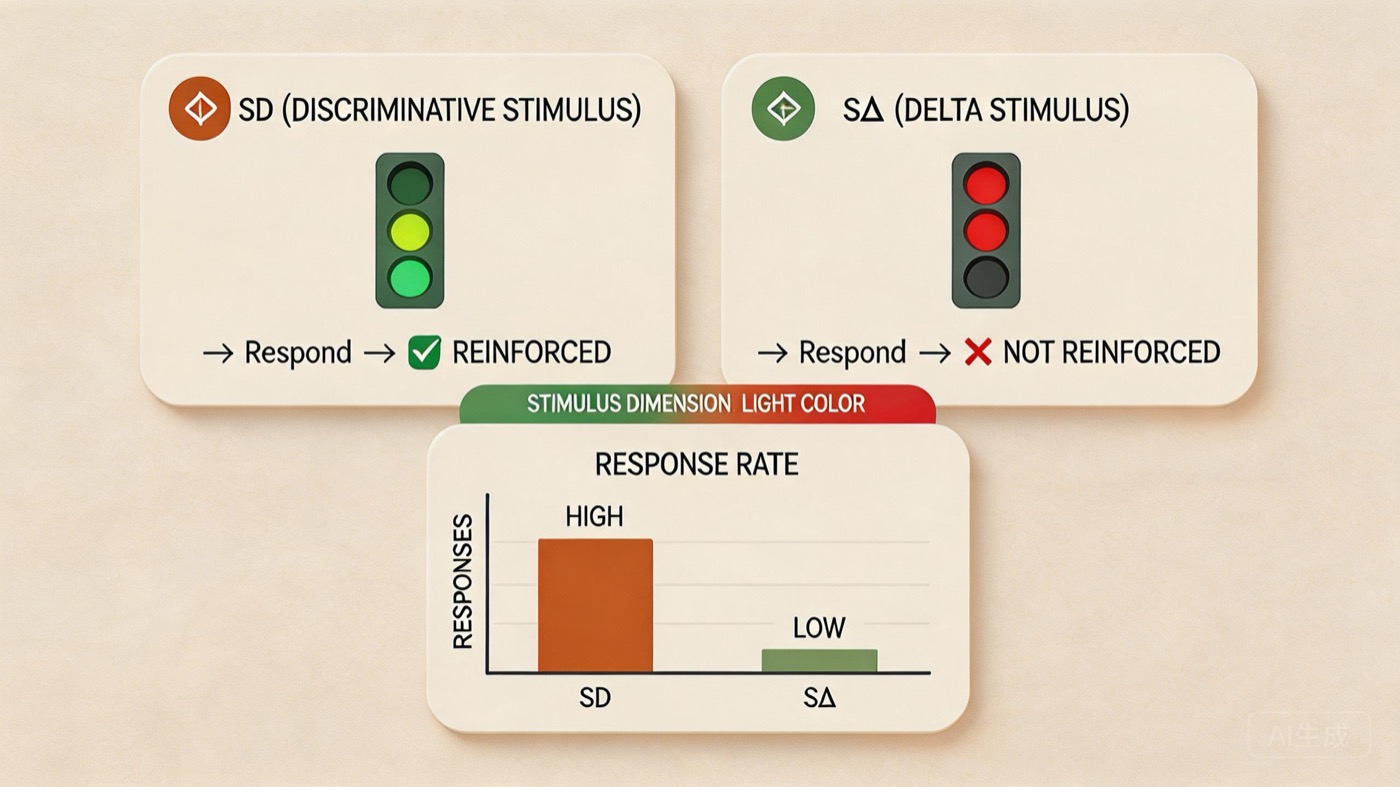
Stimulus Discrimination in ABA: Worked Examples
Here are three ABA examples in ABC format to illustrate stimulus discrimination in practice. Each example includes the hypothesized function. These scenarios mimic real-world applications that might appear on the BCBA exam.
Example 1: Teaching a Child to Request a Snack
- Antecedent: Therapist presents a cookie and a cracker. The SD is the cookie; the S-delta is the cracker.
- Behavior: Child says ‘cookie’ when looking at the cookie.
- Consequence: Therapist gives the cookie. Saying ‘cookie’ to the cracker results in no cookie.
- Function: Positive reinforcement (access to cookie).
This is a classic mand training procedure where the SD (cookie) signals that a request will be honored. Over time, the child learns to differentiate between the two stimuli and only request the cookie in the presence of the actual cookie.
Example 2: Safety Skills – Crossing the Street
- Antecedent: Walk sign illuminated (SD) vs. don’t walk sign (S-delta).
- Behavior: Child crosses the street only when the walk sign is on.
- Consequence: Safe crossing (negative reinforcement: avoidance of danger) and reaching the other side (positive reinforcement).
- Function: Negative reinforcement (avoiding harm) and positive reinforcement (goal completion).
This example demonstrates how discrimination training can be crucial for safety. The child must learn to respond exclusively to the walk sign and not to other signs or cues.
Example 3: Client Responding to Therapist vs. Stranger
- Antecedent: Familiar therapist (SD) vs. unknown adult (S-delta).
- Behavior: Client complies with therapist’s instruction but ignores the stranger’s request.
- Consequence: Therapist delivers praise and attention.
- Function: Social positive reinforcement.
This example is common in social skills training where the learner must discriminate between familiar and unfamiliar people to respond appropriately.
Why Stimulus Discrimination Matters for the BCBA Exam
The BCBA exam frequently tests stimulus discrimination through scenario-based questions. Recognizing the difference between discrimination and generalization is crucial. For a deeper dive into related concepts, check out our guide on stimulus control in ABA. The exam often presents a scenario and asks you to identify whether the behavior is under stimulus control, whether discrimination has occurred, or what training procedure would be appropriate. You may also be asked to differentiate between discrimination and generalization in multiple-choice questions.
Common Exam Traps: Confusing Discrimination with Generalization
Many test-takers mix up these two processes. A common trap: a question describes a child who only asks for a cookie when it’s visible—that’s discrimination. But if the child asks for a cookie whenever they see any round food, that’s generalization. Use the mnemonic: ‘D for Differentiate, G for Generalize.’ Another trap: the exam might describe a situation where a client responds correctly to an SD but also occasionally to similar S-deltas—this is actually a lack of discrimination, not a failure of generalization. Be sure to read the wording carefully.
Discrimination Training: Steps You Need to Know
- Step 1: Present the SD and S-delta simultaneously or in close succession.
- Step 2: Reinforce the correct response to the SD immediately.
- Step 3: Withhold reinforcement for responses to the S-delta (extinction).
- Repeat until the learner reliably responds only to the SD.
Effective discrimination training requires that the S-delta is present often enough for the learner to learn that responses to it are not reinforced. It is also important to vary the discriminative stimuli and S-deltas to prevent rote responding.
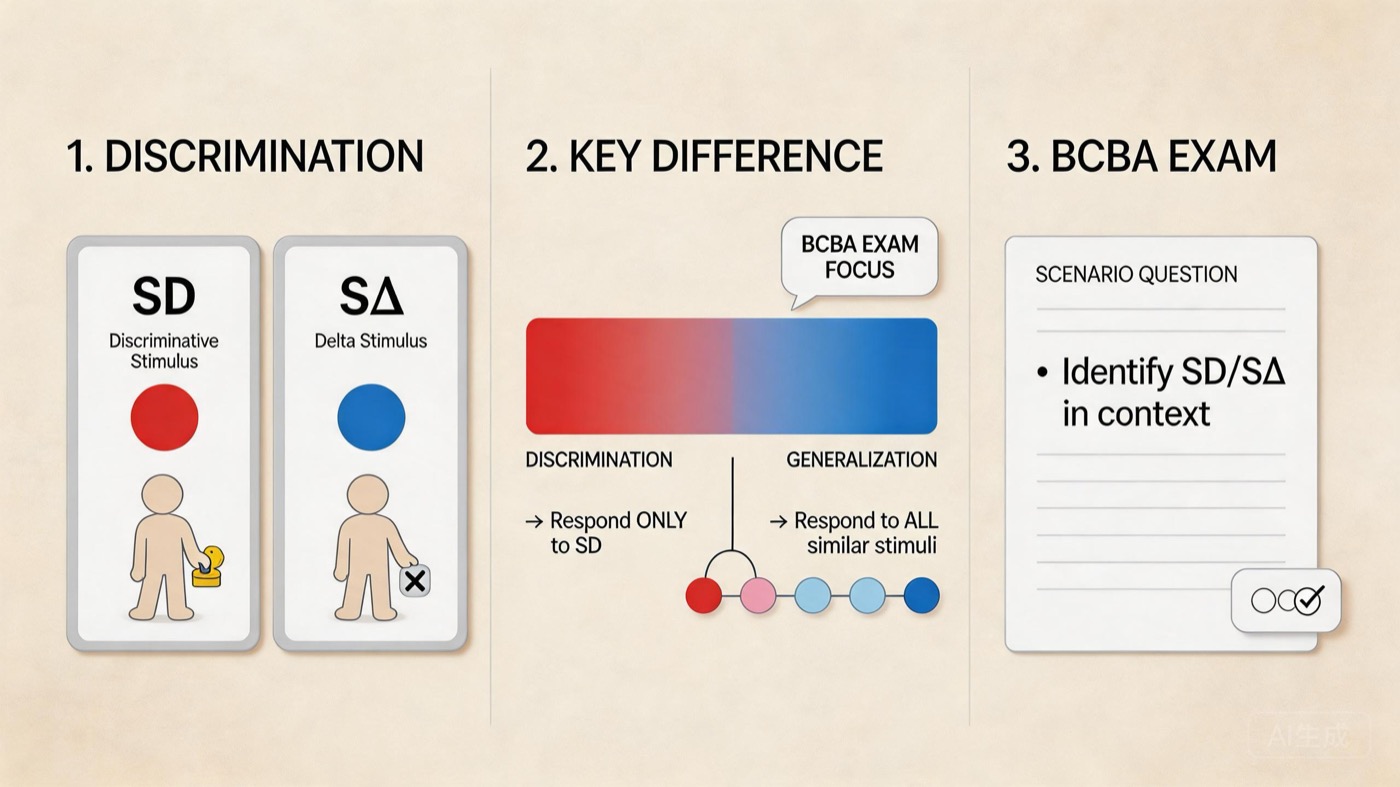
Quick Checklist: Stimulus Discrimination for Exam Review
- Know the definition: responding differently to SD vs. S-delta.
- Identify the function in examples (positive or negative reinforcement).
- Distinguish from generalization (same response to similar stimuli).
- Recall the three steps of discrimination training.
- Watch for exam questions that describe stimulus control—discrimination is the foundation.
- Review real-life applications like safety skills and mand training.
- Practice identifying the SD and S-delta in everyday scenarios.
Summary: Key Takeaways on Stimulus Discrimination
To summarize, the stimulus discrimination psychology definition focuses on differential responding based on environmental cues. In ABA, it is a cornerstone of effective teaching and behavior change. On the BCBA exam, you will need to identify discrimination scenarios, distinguish them from generalization, and know the training steps. For further study, see the BACB Task List and our article on discriminative stimuli in ABA. Also, refer to authoritative sources like Cooper, Heron, & Heward (2020) for foundational reading. Mastery of this concept will not only help you pass the exam but also enable you to design effective interventions for your clients.



