

Response Cost ABA: What is Response Cost? A Definition for BCBA Candidates
Response cost is a negative punishment procedure where a specific amount of a previously earned reinforcer is removed contingent on the occurrence of a target behavior. This intervention falls under Type II punishment in the operant conditioning framework, meaning it decreases future behavior by removing something valued. Unlike other punishment procedures, response cost specifically involves the loss of reinforcers rather than the presentation of aversive stimuli.
Table of Contents
- Response Cost ABA: What is Response Cost? A Definition for BCBA Candidates
- Response Cost in Practice: Worked ABA Examples
- Mastering Response Cost for the BCBA Exam
- Summary and Key Takeaways
Core Components and Key Terminology
Understanding response cost requires mastering several essential components. First, the ‘cost’ must be a specific, predetermined amount of a reinforcer that has already been established as valuable to the individual. This differs from a ‘fine’ in that it’s directly tied to behavioral contingencies rather than arbitrary monetary penalties. According to Cooper, Heron, and Heward, response cost procedures are most effective when implemented within systems like token economies where reinforcers are clearly defined and measurable.
The BACB Task List addresses response cost in Section F-6, which covers punishment procedures and their ethical implementation. Key elements include establishing the reinforcer beforehand, ensuring the cost is proportional to the behavior, and maintaining a reinforcement-rich environment to prevent over-reliance on punishment. Response cost should always be part of a comprehensive behavior plan that includes reinforcement strategies for appropriate alternatives.
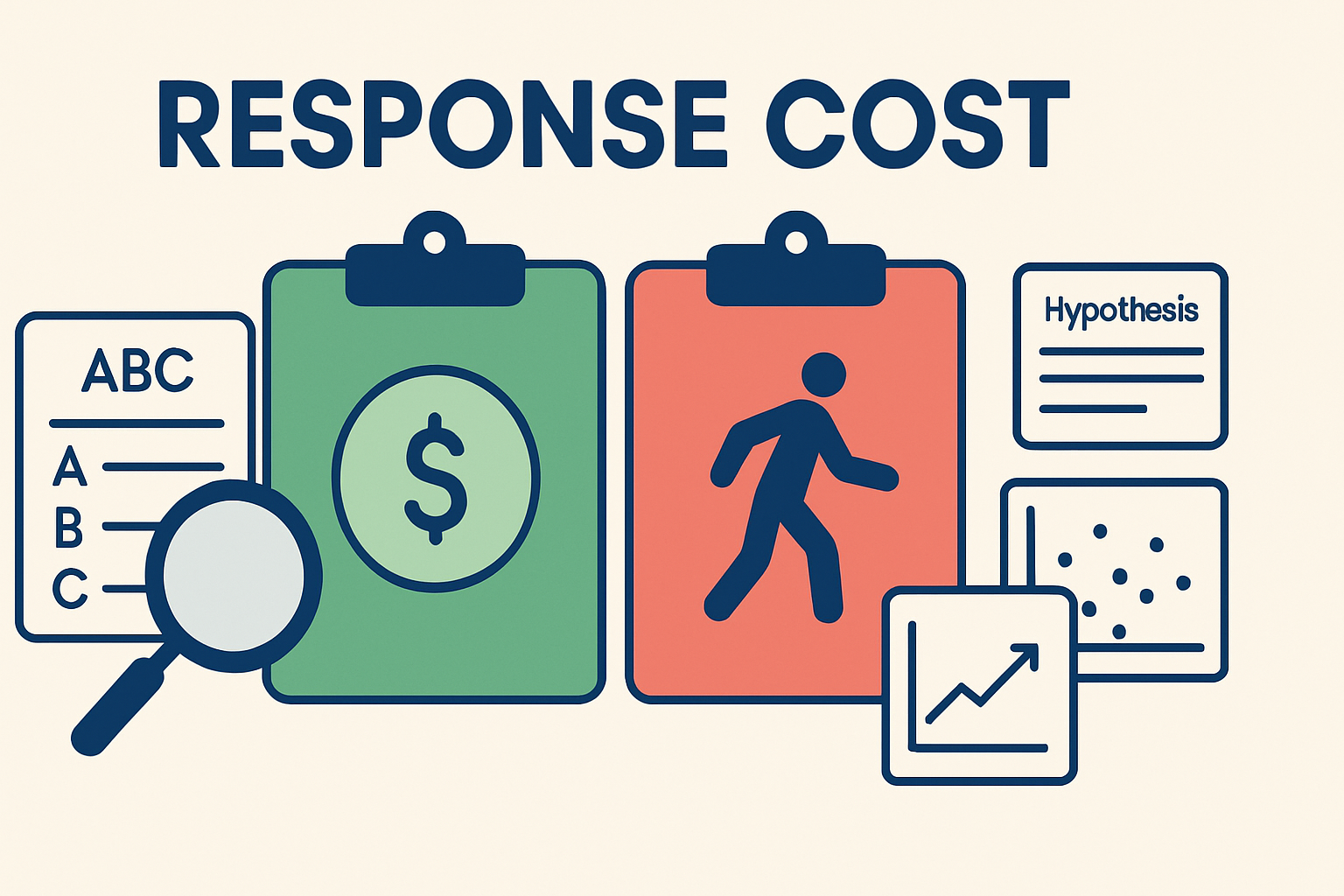
Response Cost in Practice: Worked ABA Examples
Seeing response cost applied in realistic scenarios helps solidify understanding beyond textbook definitions. These examples demonstrate how practitioners implement this procedure while considering behavioral function and ethical guidelines.
Example 1: Token Economy with a Tangible Function
Consider a student who engages in property destruction during independent work sessions. A functional behavior assessment reveals the behavior serves an escape function – the student destroys materials to avoid difficult tasks. The intervention team implements a token economy where the student earns tokens for task completion, which can be exchanged for preferred items.
- Antecedent: Difficult math worksheet presented
- Behavior: Student tears worksheet and throws materials
- Consequence: Teacher removes 2 tokens from student’s token board
- Function: Escape from academic demands
- Response cost: Loss of 2 previously earned tokens
This example shows how response cost can be integrated with differential reinforcement of alternative behaviors, such as asking for help or requesting a break appropriately. The token removal is immediate, specific, and tied directly to the problem behavior while maintaining opportunities to earn reinforcement through appropriate responses.
Example 2: Point Loss for Attention-Maintained Behavior
An adult in a group home setting makes inappropriate comments during community outings. Functional analysis indicates these comments are maintained by staff attention. The behavior plan includes a point system where the individual earns points for appropriate social interactions, which accumulate toward preferred activities like extra TV time.
- Antecedent: Staff attention directed toward other residents
- Behavior: Makes inappropriate sexual comment
- Consequence: Loses 15 minutes of previously earned TV time
- Function: Access to staff attention
- Ethical consideration: The ‘cost’ was selected based on preference assessment results
This scenario highlights the importance of ethical implementation. The lost reinforcer (TV time) was established as highly preferred through systematic assessment, and the amount (15 minutes) was proportional to the behavior’s severity. The environment remained reinforcement-rich with multiple opportunities to earn points through appropriate social behaviors.
Mastering Response Cost for the BCBA Exam
Response cost questions appear frequently on the BCBA exam, often testing both conceptual understanding and ethical application. Candidates must distinguish response cost from similar procedures and recognize appropriate implementation contexts. Understanding these nuances is crucial for exam success and ethical practice.
Common Exam Traps and How to Avoid Them
Several common distractor patterns appear in response cost questions. Being aware of these traps helps you select the correct answer more consistently.
- Confusing response cost with time-out: Response cost involves loss of specific reinforcers, while time-out involves loss of access to all reinforcement opportunities. Remember: response cost = specific items/tokens; time-out = generalized access removal.
- Mistaking it for positive punishment: Response cost is negative punishment (removing something to decrease behavior), not positive punishment (adding something aversive). If the consequence involves taking something away, it’s negative punishment.
- Forgetting the prerequisite: Response cost requires a pre-established reinforcer to lose. If no reinforcer has been established or earned, it’s not response cost.
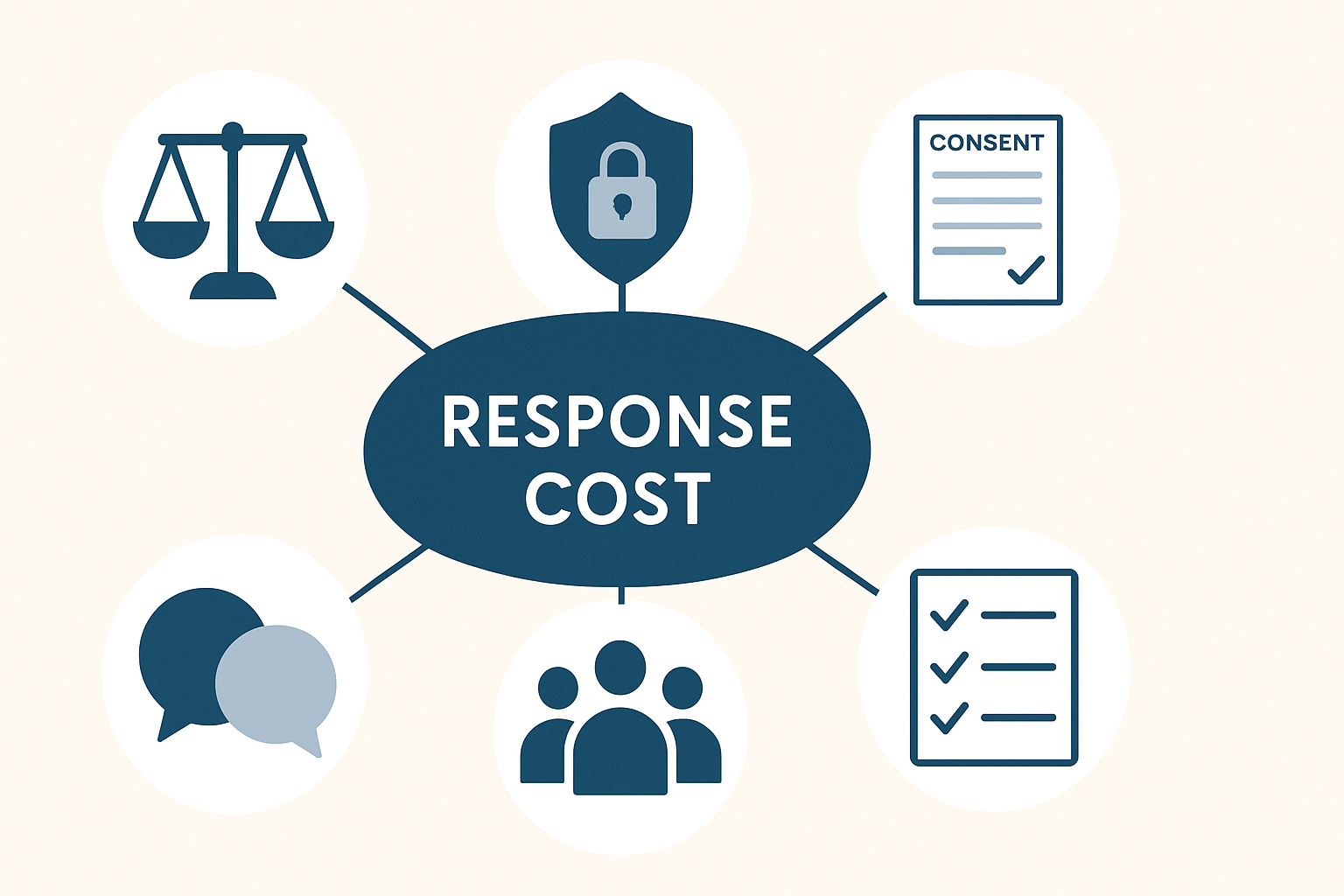
- Overlooking ethical requirements: Exam questions often include answer choices that violate ethical guidelines, such as implementing response cost without consent or in isolation from reinforcement strategies.
Ethical Implementation Checklist
Before implementing response cost, practitioners should verify several ethical considerations. This checklist aligns with BACB ethics codes and best practice standards.
- Informed consent obtained from client or guardian
- Reinforcer clearly established and valued through preference assessment
- Cost amount is specific, proportional, and not arbitrary
- Reinforcement-rich environment maintained with alternative behaviors reinforced
- Data collected on both effectiveness and potential side effects
- Procedure is part of a comprehensive behavior plan with reinforcement components
- Regular review scheduled to evaluate necessity and effectiveness
For more on ethical implementation of punishment procedures, see our guide on punishment ethics and side effects.
Summary and Key Takeaways
Response cost remains a valuable but carefully regulated tool in the ABA practitioner’s toolkit. When implemented ethically and systematically, it can effectively reduce problem behaviors while teaching appropriate alternatives.
- Response cost is a negative punishment procedure involving loss of specific reinforcers
- Requires pre-established, valued reinforcers that can be quantified or measured
- Most effective within structured systems like token economies or point systems
- Must be implemented with informed consent and as part of comprehensive behavior plans
- Common exam confusions include distinguishing from time-out and positive punishment
- Ethical implementation requires ongoing data collection and environmental richness
For further study on related concepts, explore our resources on negative punishment procedures and token economy systems. Remember that response cost, like all punishment procedures, should be used sparingly and always in conjunction with reinforcement-based strategies. The BACB provides additional guidance on ethical punishment implementation in their Professional and Ethical Compliance Code.
Complete BCBA Exam Prep
Turn this topic into exam-day practice
Practice concepts in context with five full-length 6th Edition mock exams, two bonus practice exams, a 6th Edition study guide, and key-term flashcards—all in one $120 USD package.
Get the $120 All-in-One Prep Pack
Review everything included on the product page before ordering. No pass guarantee is implied.



