
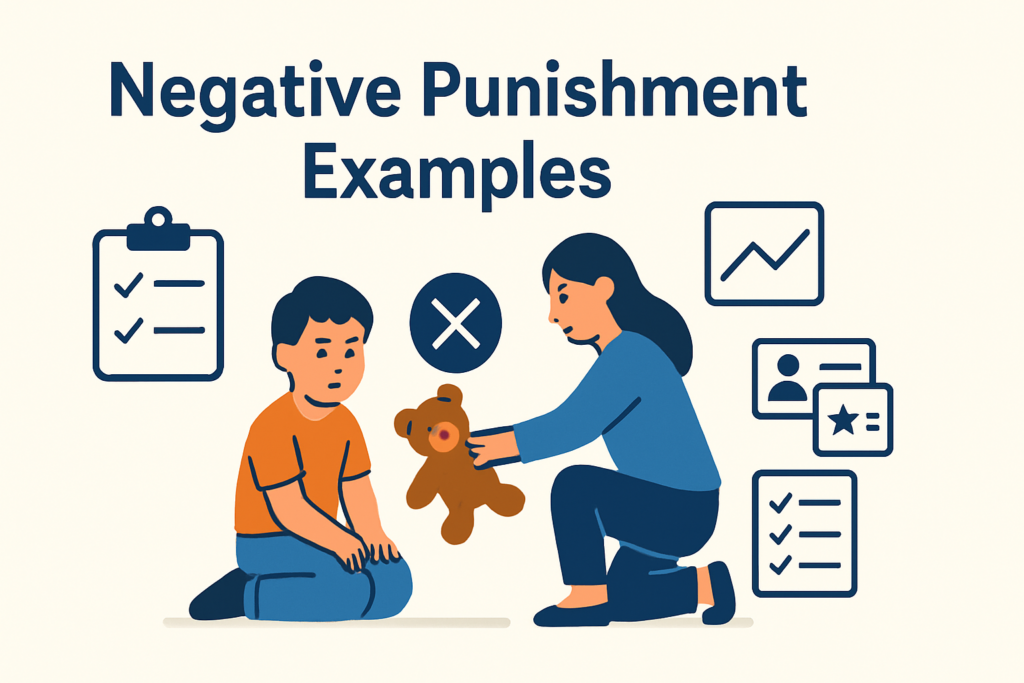
Understanding negative punishment is crucial for BCBA candidates, as it represents one of the four fundamental behavioral contingencies. This guide provides practical negative punishment examples that bridge theory with real-world application. You’ll learn to identify these procedures in clinical scenarios and avoid common exam pitfalls.
Table of Contents
- Negative Punishment Examples: What is Negative Punishment? A Behavioral Definition
- Applied Examples of Negative Punishment in ABA
- Exam Relevance and Common Traps for BCBA Candidates
- Ethical Application and a Quick Implementation Checklist
- References
Negative Punishment Examples: What is Negative Punishment? A Behavioral Definition
Negative punishment occurs when a stimulus is removed contingent on a behavior, resulting in a future decrease in that behavior. The term ‘negative’ refers to the removal of a stimulus, while ‘punishment’ indicates the decrease in behavior. This differs from positive punishment, which involves adding an aversive stimulus.
The Core Mechanism: Removal of a Stimulus
In negative punishment, the contingent removal of a valued stimulus weakens the behavior it follows. The stimulus removed must be something the individual finds reinforcing. This procedure requires careful implementation to ensure the stimulus removal actually functions as a punisher.
Negative Punishment vs. Positive Punishment & Extinction
Understanding these distinctions is essential for accurate identification:
- Negative punishment: Removes a stimulus to decrease behavior
- Positive punishment: Adds a stimulus to decrease behavior
- Extinction: Withholds reinforcement for previously reinforced behavior
Extinction differs because it involves withholding reinforcement rather than removing an existing stimulus. For more on reinforcement concepts, see our guide on reinforcement in ABA.
Applied Examples of Negative Punishment in ABA
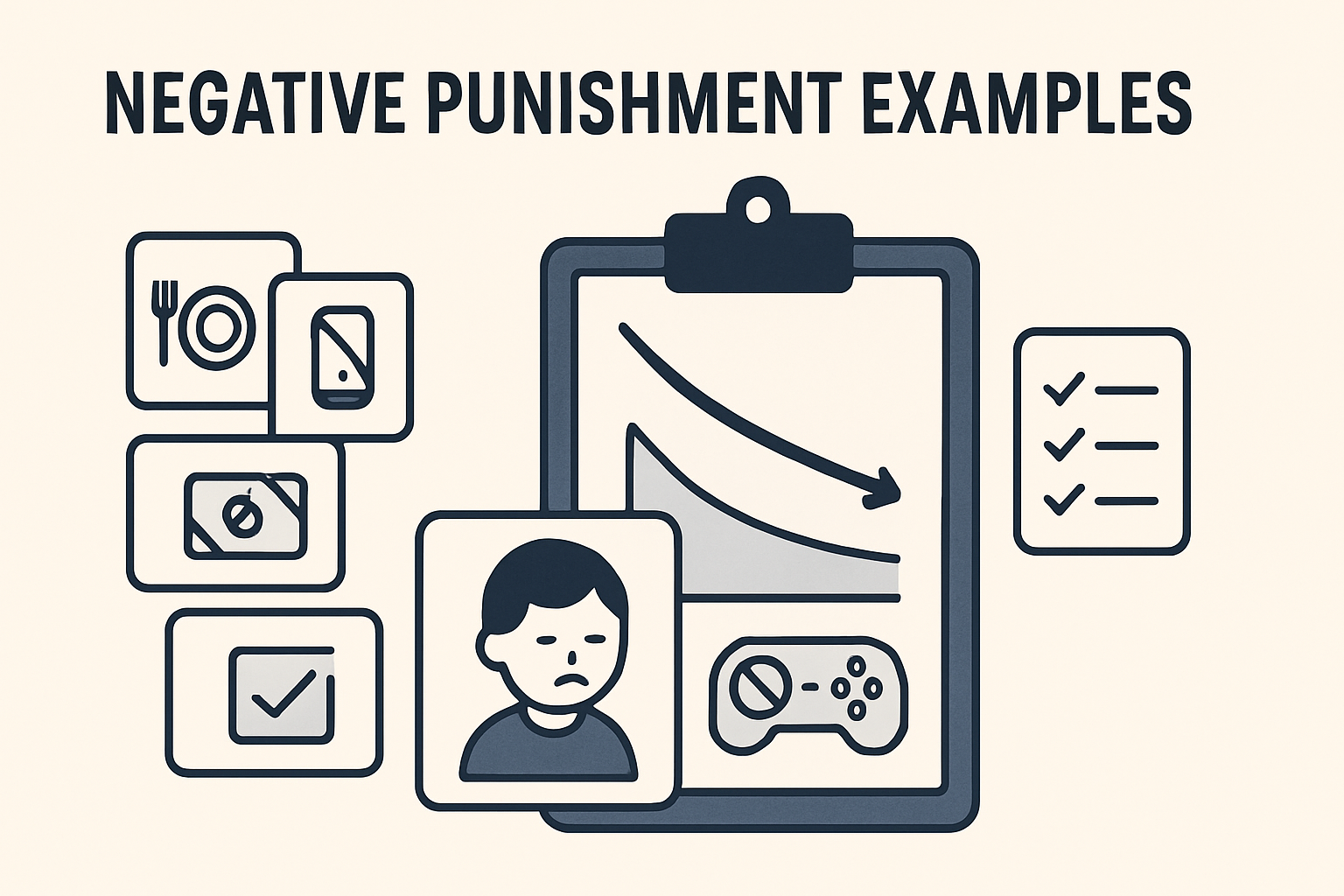
These practical scenarios demonstrate how negative punishment operates in real intervention settings. Each example follows the ABC framework (Antecedent-Behavior-Consequence) to clarify the contingency.
Example 1: Time-Out from Positive Reinforcement (Toy Removal)
A child engages in aggressive behavior when another child is playing with a preferred toy. The behavior analyst hypothesizes a tangible function. The intervention involves brief, contingent removal of the toy when aggression occurs.
- Antecedent: Another child playing with preferred toy
- Behavior: Aggression toward peer
- Consequence: Toy removed for 30 seconds
- Result: Future aggression decreases
Example 2: Response Cost (Token Removal)
In a token economy system, a client earns tokens for appropriate behavior. When the client engages in property destruction, one token is removed. The function appears to be attention-seeking.
- Antecedent: Therapist attending to another client
- Behavior: Throwing materials
- Consequence: One token removed from token board
- Result: Property destruction decreases over sessions
Example 3: Loss of Privileges (Tech Time)
A teenager consistently refuses to complete homework assignments. The behavior analyst identifies an escape function. The intervention involves loss of scheduled video game time contingent on non-compliance.
- Antecedent: Homework assignment presented
- Behavior: Refusal to begin work
- Consequence: 15 minutes of video game time removed
- Result: Homework completion increases
Exam Relevance and Common Traps for BCBA Candidates
Negative punishment questions frequently appear on the BCBA exam. Candidates must distinguish these procedures from similar concepts and identify the critical components in vignettes.
Spotting the Critical Components in Vignettes
When analyzing exam questions, look for three essential elements:
- Behavior occurrence: A measurable behavior must be present
- Stimulus removal: A valued stimulus is removed contingent on the behavior
- Behavior decrease: Data must show the behavior decreases in the future
Missing any component means it’s not negative punishment. For more exam strategies, check our BCBA exam prep guide.
Frequent Misidentifications to Avoid
Common exam traps include confusing negative punishment with other procedures:
- Time-out vs. extinction: Time-out removes access to reinforcement; extinction withholds reinforcement
- Response cost vs. fines: Response cost removes conditioned reinforcers; fines may not function as punishers
- Any removal: Not all stimulus removals are punitive without data showing behavior decrease
Ethical Application and a Quick Implementation Checklist
Ethical considerations are paramount when using punishment procedures. The BACB Ethics Code (Section 4) emphasizes using the least restrictive procedures and prioritizing reinforcement-based approaches.
Ethical Considerations Before Using Punishment
Before implementing negative punishment, consider these ethical requirements:
- Reinforcement first: Always attempt reinforcement-based interventions initially
- Client consent: Obtain informed consent from clients or guardians
- Least restrictive: Use the least restrictive effective procedure
- Ongoing assessment: Continuously monitor effectiveness and side effects
For comprehensive ethical guidance, review our ethics in ABA practice guide.
Negative Punishment Implementation Checklist
Use this checklist when planning negative punishment procedures:
- Identify reinforcer: Determine which stimulus to remove
- Ensure contingency: Apply removal immediately and contingently
- Collect data: Track behavior change systematically
- Pair with reinforcement: Teach and reinforce alternative behaviors
- Plan for fading: Develop a plan to reduce reliance on punishment
- Monitor side effects: Watch for emotional responses or aggression
Mastering negative punishment requires understanding both the technical definition and practical application. These real-world examples demonstrate how stimulus removal can effectively decrease behavior when implemented ethically and systematically. Remember that punishment procedures should always be part of a comprehensive treatment plan that emphasizes skill-building and positive reinforcement.



