
More time visual ABA usually means a visual way for a learner to communicate, “I need a little longer,” before an activity ends or a transition occurs. It can support functional communication and predictability, but it should not promise unlimited access, replace assessment, or turn a request for extra time into a forced-compliance routine.
Table of Contents
- What Is a More Time Visual in ABA?
- What Can the Visual Communicate?
- How Is It Different From Other Visual Supports?
- How Do You Choose an Accessible Format?
- How Do You Teach a More-Time Request?
- How Do You Set a Predictable Boundary?
- What Data Should You Collect?
- What Ethical Safeguards Matter?
- What Are the BCBA Exam Clues?
- What Mistakes Should You Avoid?
- More Time Visual ABA FAQ
- Sources and Date Check
- Take the Free BCBA Mock Exam
Ending a preferred activity can be difficult for many people. The challenge may involve an abrupt change, limited communication access, uncertainty about what happens next, fatigue, a task that is not meaningful, or a genuine need for more processing time.
What Is a More Time Visual in ABA?
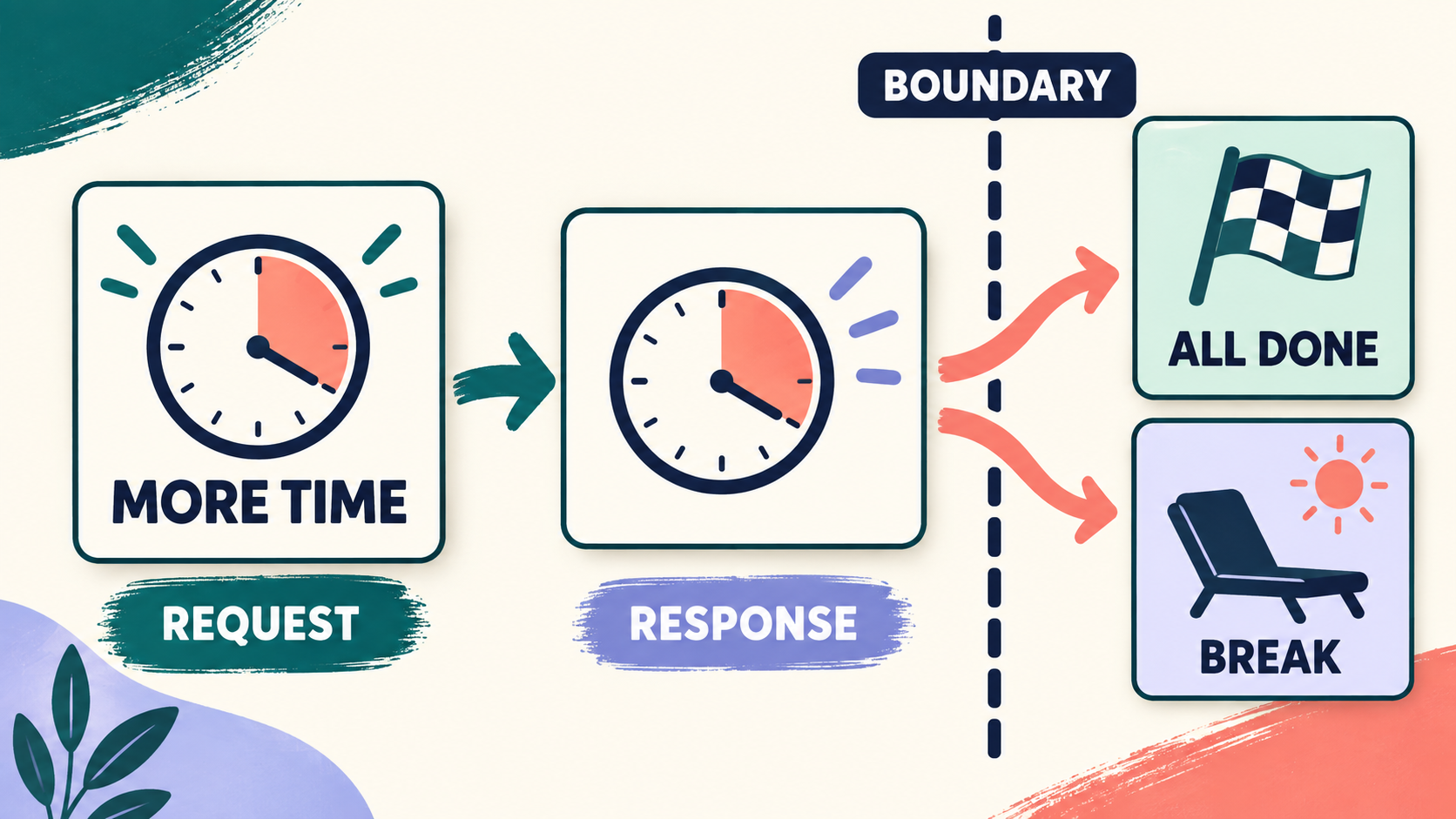
A more-time visual is a card, button, symbol, token arrangement, written message, object cue, or AAC option that represents a request for additional time. The request might mean “one more minute,” “finish this step,” “let me pause,” or “please explain what happens next.” The exact message must be defined for the individual and routine. “More time” is not one universal response topography.
The support has two sides. First, it gives the learner a usable way to communicate before the activity ends. Second, it tells the communication partner what will happen after the request: perhaps a short, agreed extension; perhaps a choice between finishing and stopping; perhaps a clear explanation that extra time is not available because of a safety or schedule constraint. If the adult never responds to the request, the visual teaches little functional communication.
A useful visual is not a promise that the learner will always get the preferred activity. It is a way to make the rule, choice, and boundary more predictable. A learner may also need ways to say “all done,” “break,” “help,” “not yet,” or “no.” Those messages should not disappear just because a team is teaching “more time.”
What Can the Visual Communicate?
Before choosing a design, identify the communication function. A learner who reaches for a tablet when the timer ends may be asking for continued access, protesting an abrupt change, seeking help with the next task, or communicating that the transition feels unsafe or overwhelming. Ask what the person needs to communicate in that moment:
- More access: “I want additional time with this activity.”
- More processing: “I need the direction, explanation, or next step again.”
- A pause: “I need a break before moving on.”
- A change: “The next activity, material, or demand is not accessible as presented.”
- Refusal or completion: “I am done,” “not now,” or “I do not want to continue.”
Functional communication training is strongest when the replacement response produces a meaningful, reliable change in the environment. That does not mean every request must be granted exactly as stated. It does mean the adult response should be predictable, respectful, and related to the request. If the learner asks for more time and the plan says the answer is “one minute, then transition,” the team should use that rule consistently enough for the communication to be worth using.
How Is It Different From Other Visual Supports?
A more-time visual can be part of a larger visual-support system, but it is not the same as every tool placed near a transition. Keeping the functions separate prevents a team from using a timer as if it were a communication response or a schedule as if it automatically taught requesting.
| Support | Primary message | What must be taught or checked? |
|---|---|---|
| More-time card or button | “I am requesting additional time or a related accommodation.” | The response form, available amount, adult response, and alternatives such as break or all done. |
| Token board | “A finite number of additional opportunities remains.” | What earns or exchanges a token, how tokens are accessed, and what happens at the boundary. |
| Visual timer | “Time is passing or the planned interval is ending.” | Whether the learner understands the display and has a way to request help or a change. |
| Visual schedule or first-then board | “Here is the sequence or the next relationship between activities.” | How the learner checks, transitions, handles changes, and communicates when the sequence is not workable. |
| AAC or multimodal message | “I can express more time, break, help, no, or another meaningful message.” | Motor access, symbol meaning, partner response, spontaneous use, and generalization across people and places. |
How Do You Choose an Accessible Format?
Start with the person’s current communication and access skills rather than with a trendy template. One learner may hand over a “more time” card. Another may press a message on AAC, point to a symbol, sign, write a phrase, use speech, or combine an approximate response with a gesture. The goal is a functional message, not a particular picture.
Check whether the visual is visible, reachable, discriminable, and meaningful during the actual transition. A tiny card may be hard to see. A symbol with too many decorative details may be difficult to interpret. A spoken prompt may be unavailable when the learner is already distressed. A device may be locked away at the moment it is needed.
Keep the initial arrangement simple enough to use. If the learner needs one message, start with one accessible message and an immediate way to see or experience the response. Add distinctions such as “more time,” “break,” “help,” and “all done” when the person can discriminate them and the team can honor them consistently.
How Do You Teach a More-Time Request?
Teach the response before the most difficult transition if possible. The learner should have practice when calm, motivated, and able to attend to the support. A BCBA or relevant communication professional should define the target response, the prompt plan, the consequence, and the conditions under which the request is available.
1. Arrange a safe practice opportunity: Choose a short, meaningful activity and a transition that can tolerate a small amount of flexibility. Show the visual and model the message before the ending cue. Do not wait until distress is high to introduce a communication system for the first time.
2. Prompt the usable response carefully: Use the least intrusive prompt that helps the learner access the message, such as pointing, a gesture, a model, or a brief verbal cue. Avoid repeatedly asking, “What do you want?” if that creates prompt dependence. Track the prompt level and plan how to fade it so independent requests become more likely.
3. Deliver the programmed response: If the request is available, provide the agreed extension or accommodation and make the new end point visible. If it is not available, acknowledge the message, explain the boundary in an accessible way, and offer the programmed alternative. Do not silently remove the visual after the person uses it.
4. Teach other meaningful messages: A complete communication system should not make “more time” the only successful answer. Teach or support “break,” “help,” “all done,” “no,” and clarification when those messages fit the learner’s needs. This reduces the risk that the visual becomes a narrow compliance tool.
How Do You Set a Predictable Boundary?
Extra time needs a clear boundary that adults can implement. That boundary might be one additional minute, one more turn, completion of a defined step, or a choice to return later. The correct amount is individualized and may depend on safety, the next obligation, the learner’s health, and the actual function of the request.
Use the visual to make the boundary concrete: one token left, a short timer, a “then” card, a finished marker, or a written agreement. A boundary should not be used to punish a request; it should help everyone know what happens next. If the adult changes the rule unpredictably, the arrangement becomes harder to understand and the communication may lose value.
There are also moments when the plan must prioritize safety or an urgent need. In those situations, the adult can acknowledge the request and provide the safest accessible explanation or alternative. That is different from using “no more time” as a routine excuse to ignore communication, distress, pain, or a mismatch between the demand and the learner’s abilities.
What Data Should You Collect?
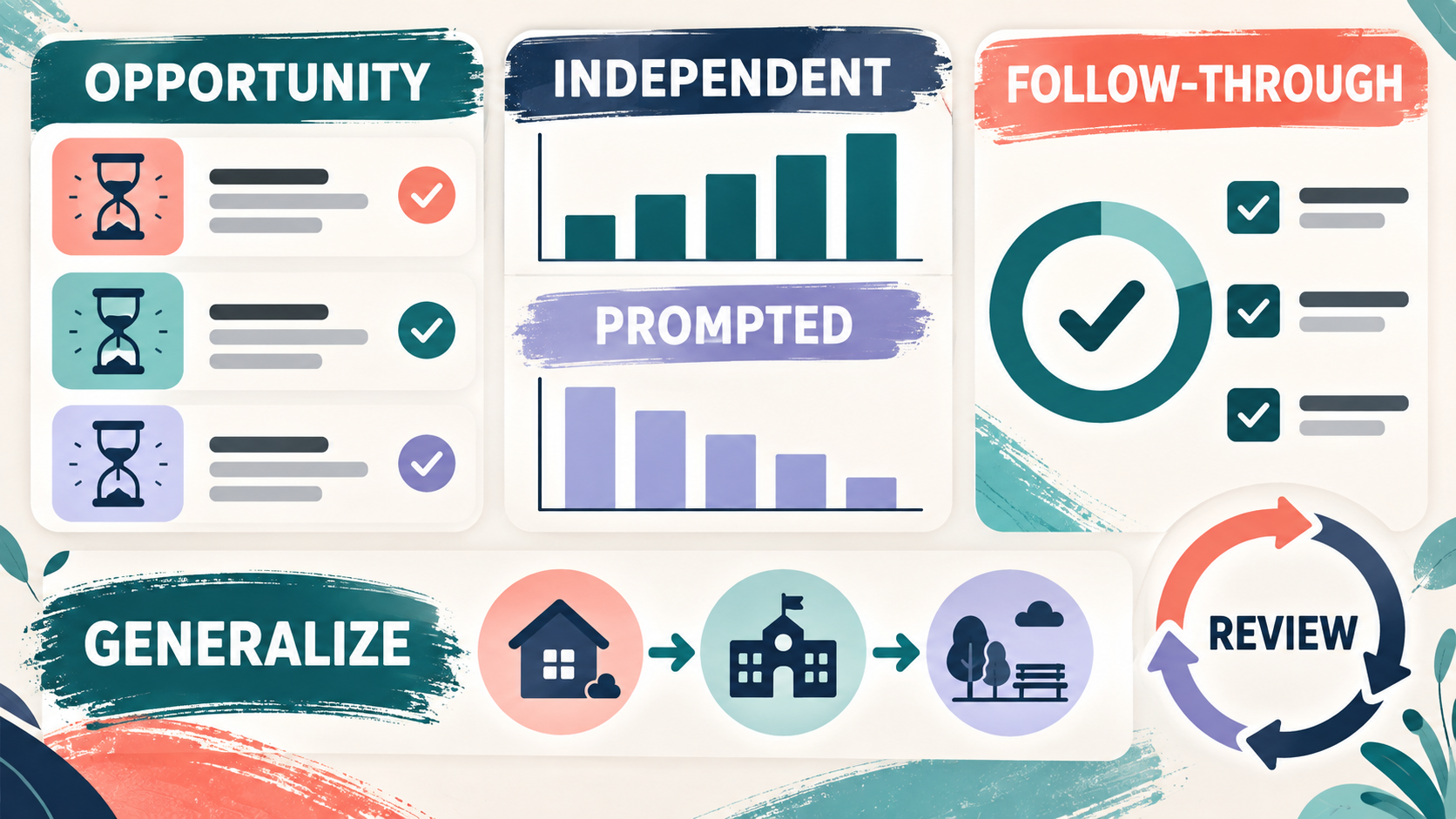
Measure the communication outcome, not merely whether the visual was present. A small data set can answer whether the support is helping:
- Opportunities: How many relevant transition or ending opportunities occurred?
- Response form: Did the learner use speech, AAC, a card, a gesture, a sign, or another agreed response?
- Independence: Was the response independent, prompted, or absent?
- Adult follow-through: Was the planned response delivered accurately and within the expected time?
- Outcome: Did the learner receive the planned extension, break, help, or explanation, and what happened next?
- Generalization: Does the request occur with different people, activities, places, and communication partners?
- Experience: Are distress, refusal, fatigue, pain, or other contextual variables changing the meaning of the data?
Do not report “the visual worked” from one calm practice trial. Look for independent use, reliable partner response, reduced communication breakdown, and meaningful transition outcomes across relevant contexts. If the learner stops using the visual, check whether the request is honored, whether the message is still accessible, and whether the person needs a different response rather than more prompting.
What Ethical Safeguards Matter?
A more-time visual should increase access to communication, not make a person appear compliant for adult convenience. The BACB Ethics Code provides the current professional anchor for client welfare, competence, dignity, and responsible intervention. A BCBA should consider whether the goal is socially meaningful, whether the support is within the team’s competence, and whether the learner’s communication and refusal are being respected.
Visual supports are not neutral if the surrounding contingency is coercive. A card that says “more time” but is removed whenever the learner protests does not create a meaningful communication option. A token system that allows adults to delay a learner’s access indefinitely is not a predictable boundary. The team should explain the rule, collect data, involve the learner and relevant caregivers, and revise the plan when the support is not working or creates an unacceptable cost.
Also consider culture, language, motor access, sensory needs, age, privacy, and the learner’s preferred communication system. A visual should be available where the transition happens, not only in a therapy binder that adults control.
What Are the BCBA Exam Clues?
On the BCBA exam, a question about a more-time visual may test functional communication, antecedent arrangements, prompting and fading, reinforcement, measurement, generalization, social validity, or ethics. Do not select an answer only because it uses a visual or token board. Identify the behavior, the function, the consequence, and the learner’s communication access.
- Best initial step: assess the transition, communication repertoire, preferences, context, and function before selecting the visual.
- Best replacement response: one that serves the relevant function and is accessible, efficient, and honored by the communication partner.
- Best measurement: independent versus prompted requests, partner follow-through, transition outcomes, and generalization—not just visual presence.
- Best ethical answer: protect dignity, assent, refusal, safety, and meaningful participation while using the least intrusive effective support.
For additional scenario practice, the free BCBA mock exam is an independent study aid. It is not an official BACB product and does not replace the current TCO, Ethics Code, supervision, or individualized assessment.
What Mistakes Should You Avoid?
- Using a generic printable without defining what “more time” means for this learner and routine.
- Teaching only “more time” while ignoring “break,” “help,” “all done,” “no,” or clarification.
- Promising extra time inconsistently or removing the support after the learner communicates appropriately.
- Assuming a visual timer teaches a request simply because the learner can see the countdown.
- Measuring only problem behavior and ignoring independent communication, partner response, and contextual variables.
- Using the visual to force harmless compliance instead of asking whether the transition or demand is meaningful and accessible.
More Time Visual ABA FAQ
Is a more-time visual the same as a visual timer? No. A timer communicates the passage or end of a planned interval. A more-time visual communicates a request for an extension or related accommodation. The two can work together, but they serve different functions. Does a learner have to say “more time” out loud? No. Speech is only one possible response form. A card, gesture, sign, AAC message, written phrase, or other accessible signal may be appropriate if it is meaningful and the communication partner responds consistently. Should every more-time request be granted?
Not necessarily. The plan should define when extra time is available and what happens when it is not. The learner should still receive acknowledgment and an accessible alternative, and the team should not use the boundary as a reason to ignore refusal, distress, pain, or an unsafe situation. How do I know whether the visual is helping? Track independent use, prompt level, adult follow-through, transition outcomes, and generalization across people and settings. Review whether the support improves communication and participation rather than only suppressing visible protest.
Sources and Date Check
This article was reviewed on September 29, 2026 against the BACB Ethics Code, the BCBA sixth-edition Test Content Outline, and visual-support and functional-communication resources including Visual Supports – Evidence-Based Practices and Supporting Functional Communication Skills. This is an educational guide, not an individualized behavior plan; a qualified professional should assess the person, communication access, safety, and context.
Take the Free BCBA Mock Exam
If you want a low-pressure way to check your recall, use the free practice resource below. Take the Free BCBA Mock Exam



