

Momentary time sampling (MTS) in ABA means recording whether a target behavior is occurring at a specific sample moment, usually at the end of a planned interval. The observer does not score every second of the interval. Instead, the observer checks the behavior when the timer signals the sample moment and marks yes or no according to the operational definition.
MTS is efficient when an observer must monitor several learners or behaviors, but it produces an estimate rather than a complete record of every occurrence. This guide explains the definition, formula, worked example, data-collection steps, differences from partial- and whole-interval recording, measurement-error limits, group use, and common BCBA exam traps.
What momentary time sampling measures
In MTS, the observation period is divided into equal intervals, and the observer looks at the target at one specified moment in each interval. The rule might be “score at the end of every 30-second interval” or “score when the electronic timer signals the sample.” The exact timing rule must be written before data collection begins.
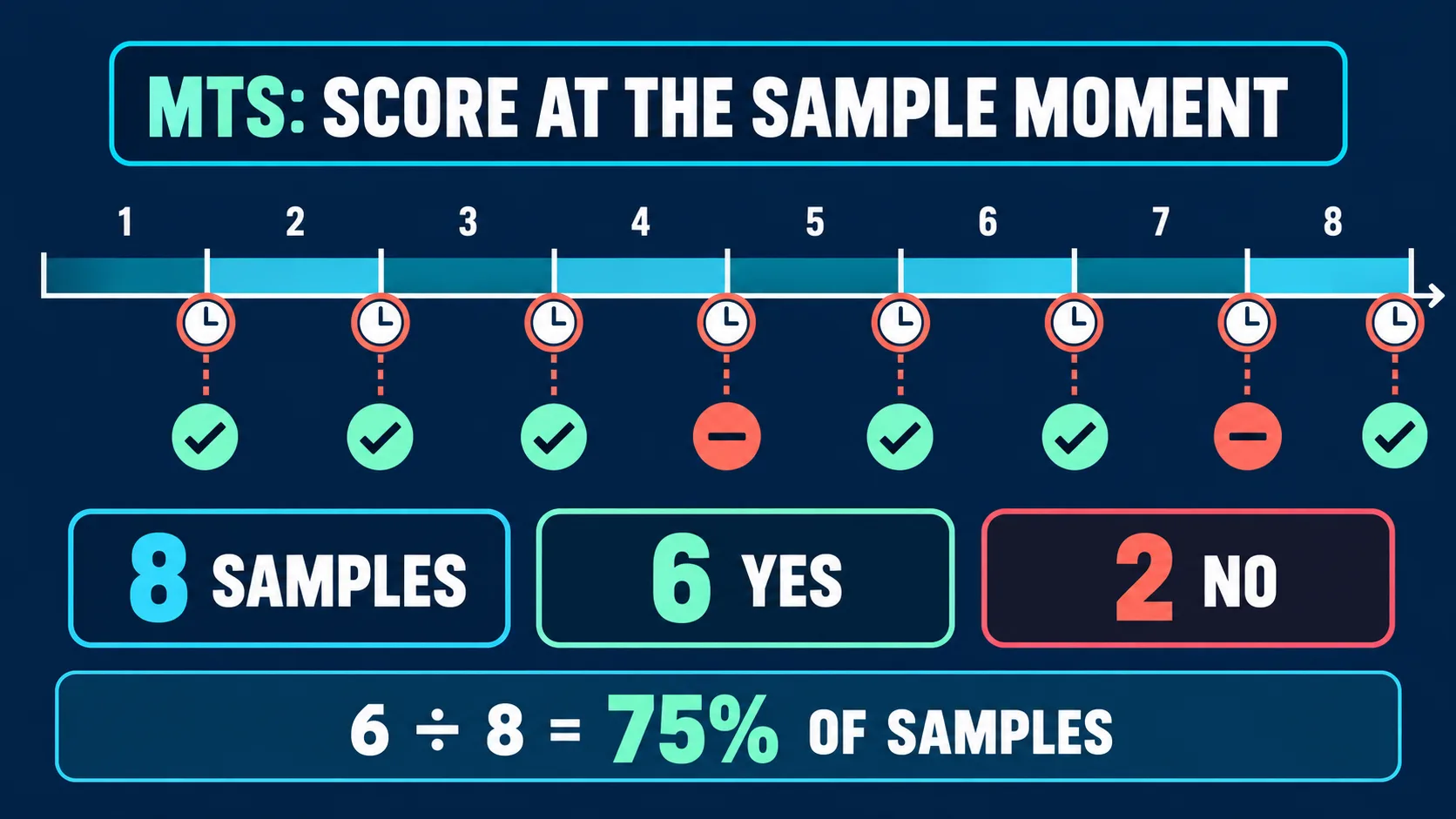
For example, suppose on-task behavior is observed for eight 30-second intervals. At the end of intervals 1, 2, 3, 5, 6, and 8, the learner is on task. At the end of intervals 4 and 7, the learner is not. The observer records six positive sample moments out of eight. MTS does not claim that the learner was on task for six complete intervals; it reports that the behavior was present at 75% of the sampled moments.
| Question | MTS answer | What it does not tell you |
|---|---|---|
| What is recorded? | Whether behavior occurs at each scheduled sample moment | The exact number of responses between sample moments |
| How is it summarized? | Positive samples divided by total sample moments | A complete duration or frequency record |
| Why use it? | It reduces the need for continuous vigilance | It does not remove sampling error |
The behavior definition still needs observable boundaries. “Engaged” is too vague unless the team specifies the posture, orientation, materials, response, or other observable indicators that count. A sampling procedure can be efficient and still produce weak data if observers do not agree on what they are scoring.
MTS formula and worked example
The usual MTS summary is:
Percentage of positive samples = positive sample moments ÷ total sample moments × 100
In the eight-interval example, six sample moments were positive:
6 ÷ 8 × 100 = 75%
That result is correctly labeled 75% of samples with behavior occurring or 75% MTS occurrence. It should not be casually relabeled “75% duration” unless the measurement plan and validation evidence support that interpretation. The same percentage from another measurement system can mean something different because each system uses a different scoring rule.
| Sample moments | Positive samples | Calculation | Report |
|---|---|---|---|
| 10 | 7 | 7 ÷ 10 × 100 | 70% of samples |
| 12 | 3 | 3 ÷ 12 × 100 | 25% of samples |
| 20 | 20 | 20 ÷ 20 × 100 | 100% of samples |
Use the same number of planned sample opportunities across comparable observations when possible. If a session ends early or some samples are missing, follow the written protocol: document the missing samples and do not silently count them as positive or negative. A denominator that changes without explanation can make a graph look like behavior changed when the observation procedure changed instead.
How to collect MTS data step by step
A clear MTS procedure separates the timing rule from the behavior definition. The observer should know exactly when to look, what to score, and how to handle an interval that is interrupted.
- Define the target behavior. Describe observable examples, nonexamples, onset, offset, and any response boundary. Decide whether the target is continuous activity, an event, or a state that can be judged at a moment.
- Choose the observation period and interval length. State the total session, the interval duration, and whether the sample occurs at the end, beginning, or another fixed point. Interval length should match the behavior and the reason for measuring it.
- Prepare one timing system. Use a timer, app, or audio signal that produces consistent sample moments. The observer should not choose a convenient moment after seeing the behavior.
- Observe only at the defined sample moment. At the signal, look at the target and mark yes if the behavior meets the definition at that moment; otherwise mark no. Do not turn the procedure into continuous observation or “any time in the interval” scoring.
- Record interruptions and missing samples. Note blocked visibility, transitions, competing duties, or a timer failure. Apply the protocol for resuming, omitting, or replacing a sample instead of inventing a score.
- Calculate the percentage and label it. Divide positive samples by total scored samples according to the data plan, multiply by 100, and report “percent of samples” or the exact approved label.
- Graph and review the estimate. Keep the sample interval and y-axis label visible. Compare the MTS pattern with other data when the clinical question depends on frequency or exact duration.
For group observations, the timer can cue the observer to scan each learner at the same sample moment. That makes MTS practical when continuous event recording for everyone would be unrealistic. The tradeoff is that each learner’s score remains a sample-based estimate, and a brief behavior may be missed between checks.
MTS vs. partial- and whole-interval recording
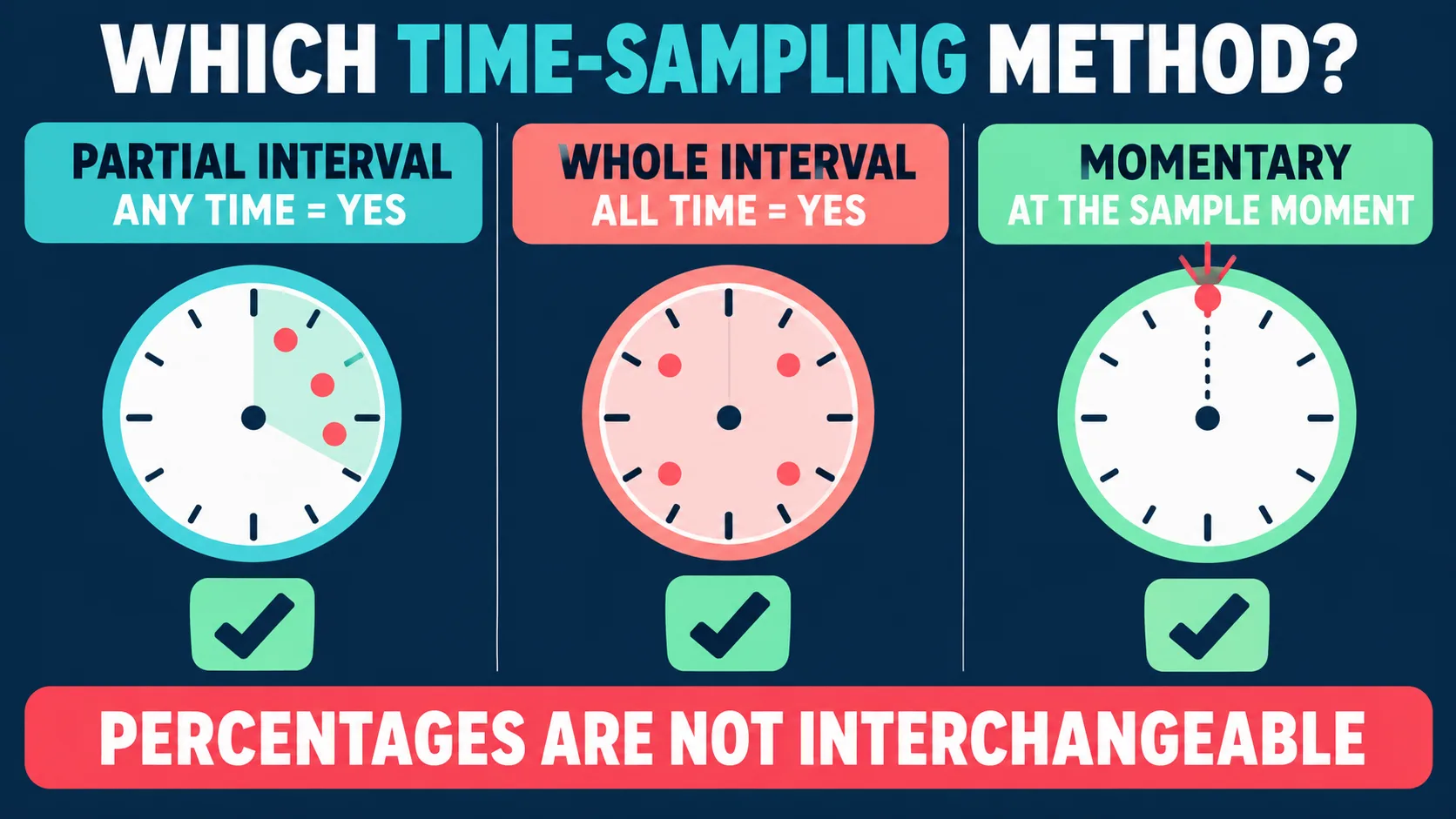
All three procedures divide an observation into intervals, but they answer different scoring questions. A positive percentage from one method is not interchangeable with the same percentage from another method.
| Procedure | Score yes when… | Typical interpretation | Common caution |
|---|---|---|---|
| Partial interval | Behavior occurs at any time during the interval | Percent of intervals with at least one occurrence | Can overstate time occupied by a brief response |
| Whole interval | Behavior occurs for the entire interval | Percent of intervals meeting the full-duration criterion | Can understate behavior when it stops briefly |
| Momentary | Behavior occurs at the specified sample moment | Percent of sample moments with behavior present | Can miss short events between samples |
The choice depends on the behavioral dimension and the logistics of observation. If the question is whether a response happened at least once in each interval, partial interval may fit. If uninterrupted engagement through an interval matters, whole interval may fit. If the observer needs periodic checks across multiple people or a continuous activity, MTS may be a practical option. None of these scores is a raw frequency count.
Does MTS overestimate or underestimate behavior?
The exam-safe answer is: MTS can overestimate or underestimate a continuous measure; it has no single error direction in every situation. The result depends on the interval length, the behavior’s frequency and duration, when episodes occur relative to the sample moments, and the dimension being estimated.
A short behavior that occurs between two sample moments can be missed, producing a lower MTS percentage than a continuous duration record. A behavior that tends to be present at the selected moments but absent for much of the surrounding intervals can produce a higher estimate. Longer intervals generally create more opportunity for the sample to miss what happens between checks, while very short intervals require more observer effort and may not be practical in a busy setting.
This is why “MTS always underestimates” and “MTS always overestimates” are both unsafe statements. Partial interval tends to overestimate the amount of time a behavior occupies because any occurrence makes the interval positive; whole interval tends to underestimate it because the behavior must last throughout. MTS is different: it samples a moment and may be reasonably accurate for some sustained behaviors under suitable interval choices, but it remains an estimate.
When accuracy matters, compare MTS with an occasional continuous-duration or event-recording sample, examine the pattern of the target behavior, and document the interval-selection rationale. A method should be judged against the clinical question, not just its convenience.
When MTS is a good fit—and when it is not
MTS is often useful for continuous or sustained behaviors such as on-task engagement, participation, appropriate posture, or group activity. It can also make it feasible to sample several learners during a classroom or group routine. Because the observer checks at scheduled moments instead of tracking every second, it can reduce the response burden.
MTS is a weaker choice when the target is brief, low-frequency, or important to count precisely. A single short aggression episode, elopement attempt, or communication response may happen between sample moments and leave no trace in the MTS data. For those targets, continuous event recording, rate, latency, duration, or another direct measure may answer the question better.
| If the team needs to know… | Consider first | Why |
|---|---|---|
| How many discrete responses occurred? | Frequency or rate | Counts each eligible response and preserves the time denominator when needed |
| How long did an episode last? | Duration | Captures onset-to-offset time rather than a sample estimate |
| Was the behavior present at periodic checks? | Momentary time sampling | Efficient for scheduled snapshots across a sustained activity |
Review the site’s continuous measurement guide, frequency guide, and duration guide for the neighboring measurement dimensions. For interval-method contrasts, see the partial-interval recording guide.
Reliability, graphing, and treatment decisions
Reliable MTS data require agreement on three things: the target definition, the sample timing, and the scoring rule. Two observers can use the same timer and still disagree if one scores behavior that happened one second before the sample while the other scores only what is happening at the signal.
For interobserver agreement, define the unit being compared. Point-by-point agreement can compare yes/no scores at each sample moment. A simple percentage is agreements divided by total scored samples multiplied by 100. If the team is concerned about rare positive samples, report the agreement procedure and the data pattern rather than relying on one summary number alone.
Label the graph precisely: percent of MTS samples with on-task behavior is clearer than “on-task percentage.” Keep the interval length, observation duration, and scoring rule stable across phases when possible. If the team changes from 30-second to 2-minute intervals, mark the procedural change because the resulting scores may not be directly comparable.
Interpret the direction against the goal. Increasing MTS engagement may be desirable, while increasing MTS problem behavior may not be. A change in the percentage can reflect behavior, opportunities, interval length, observer consistency, or the activity context. Combine MTS with functional assessment, treatment-fidelity checks, and another measure when a sample estimate alone cannot support a high-stakes decision.
BCBA exam traps and quick review
- Momentary means at the moment. Score whether the behavior is occurring at the scheduled sample point, usually the end of the interval.
- Do not score the whole interval. “Any time during the interval” is partial-interval recording; “the entire interval” is whole-interval recording.
- Use the correct formula. Positive samples divided by total samples, multiplied by 100, produces percent of samples.
- MTS is an estimate. It does not provide a complete frequency or duration record.
- Do not memorize one error direction. MTS can overestimate or underestimate depending on the behavior and interval arrangement.
- Match the method to the target. Brief, rare responses may require continuous event recording, rate, latency, or duration instead.
- Do not treat equal percentages as equal measures. A 60% MTS score and a 60% partial-interval score were produced by different rules.
- Name the denominator. Write “percent of samples” and preserve the interval length in the data record.
On a BCBA question, first identify the scoring rule, then the behavioral dimension the team needs, and finally the practical constraints. If the prompt says “at the end of each interval,” think MTS; if it says “at any time,” think partial interval; if it says “throughout,” think whole interval.
Further reading: The BACB task list places sampling procedures and measurement-system selection in the measurement domain. For a research-grounded discussion of MTS limits and interval selection, see the measurement-procedure model and the review of time-sampling measurement error.
Want more timed practice? Try the free BCBA mock exam to practice selecting a measurement procedure under exam conditions.



