

A worked, exam-ready guide to marking each snapshot, calculating the percentage, and choosing momentary time sampling for the question you actually need to answer. When you search for momentary time sampling ABA examples, the most useful answer is not another one-line definition. You need to see exactly when the observer looks, what counts as a yes, how the percentage is calculated, and what that percentage does not tell you.
Table of Contents
- Momentary Time Sampling ABA Examples: What the Method Measures
- A Complete 10-Interval ABA Example
- How to Calculate the Percentage
- Choose the Right Recording Method
- Interval Length and Data Quality
- Common Scoring Mistakes
- Turn the Example Into Exam Practice
- Frequently Asked Questions
- Quick Review Checklist
- Take the Free BCBA Mock Exam
Momentary time sampling (MTS) is a discontinuous measurement procedure. The observer divides an observation into equal intervals and checks whether the target behavior is occurring at one preselected moment, usually the end of each interval. The observer records a yes or no for that snapshot. MTS is therefore different from watching continuously or counting every second of behavior.
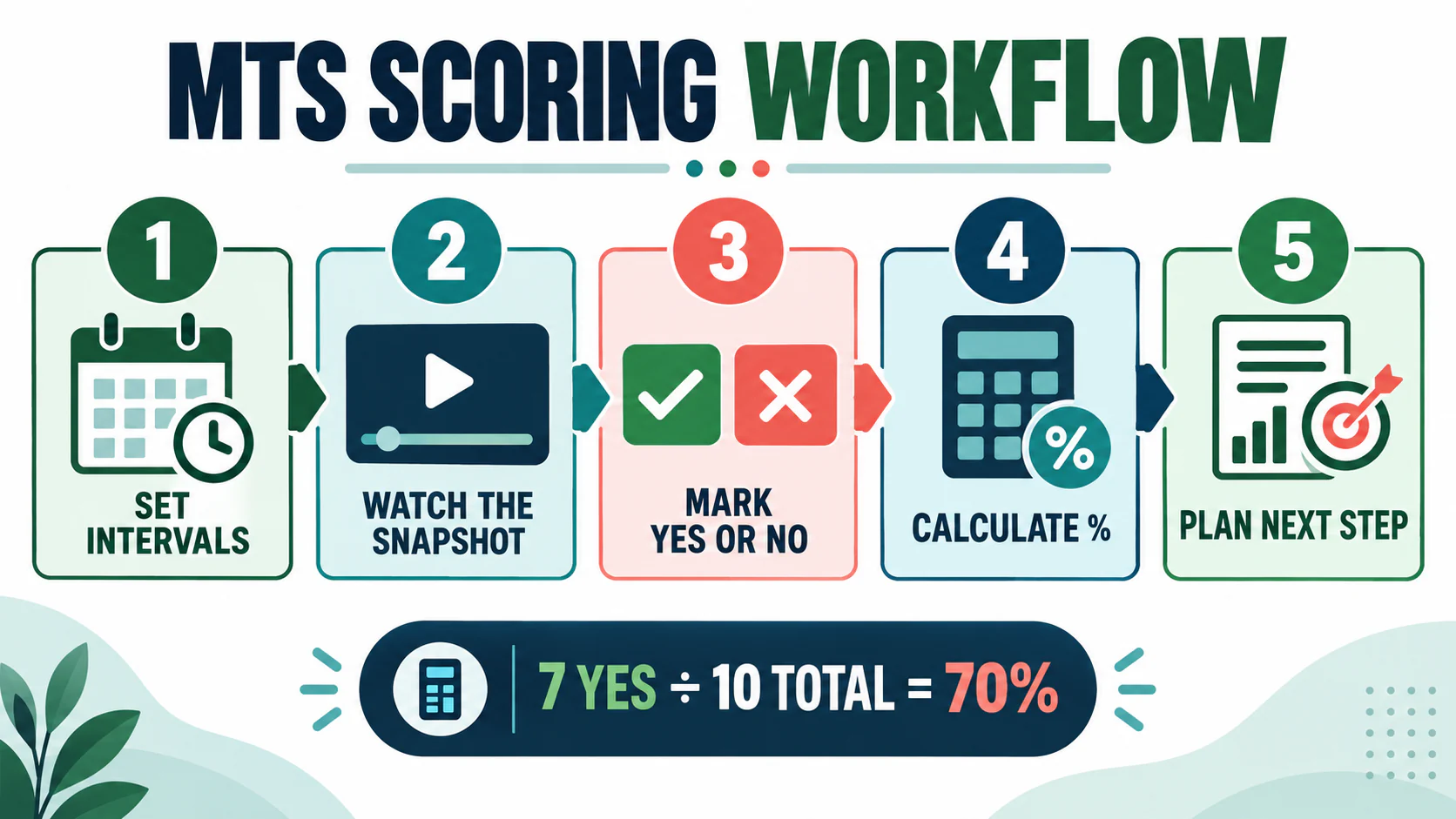
Quick answer: If a 10-interval observation contains 7 intervals in which the target behavior is occurring at the exact check moment, the MTS result is 7 ÷ 10 × 100 = 70%. That is the percentage of sampled moments with behavior, not automatically the percentage of total time in behavior.
Momentary Time Sampling ABA Examples: What the Method Measures
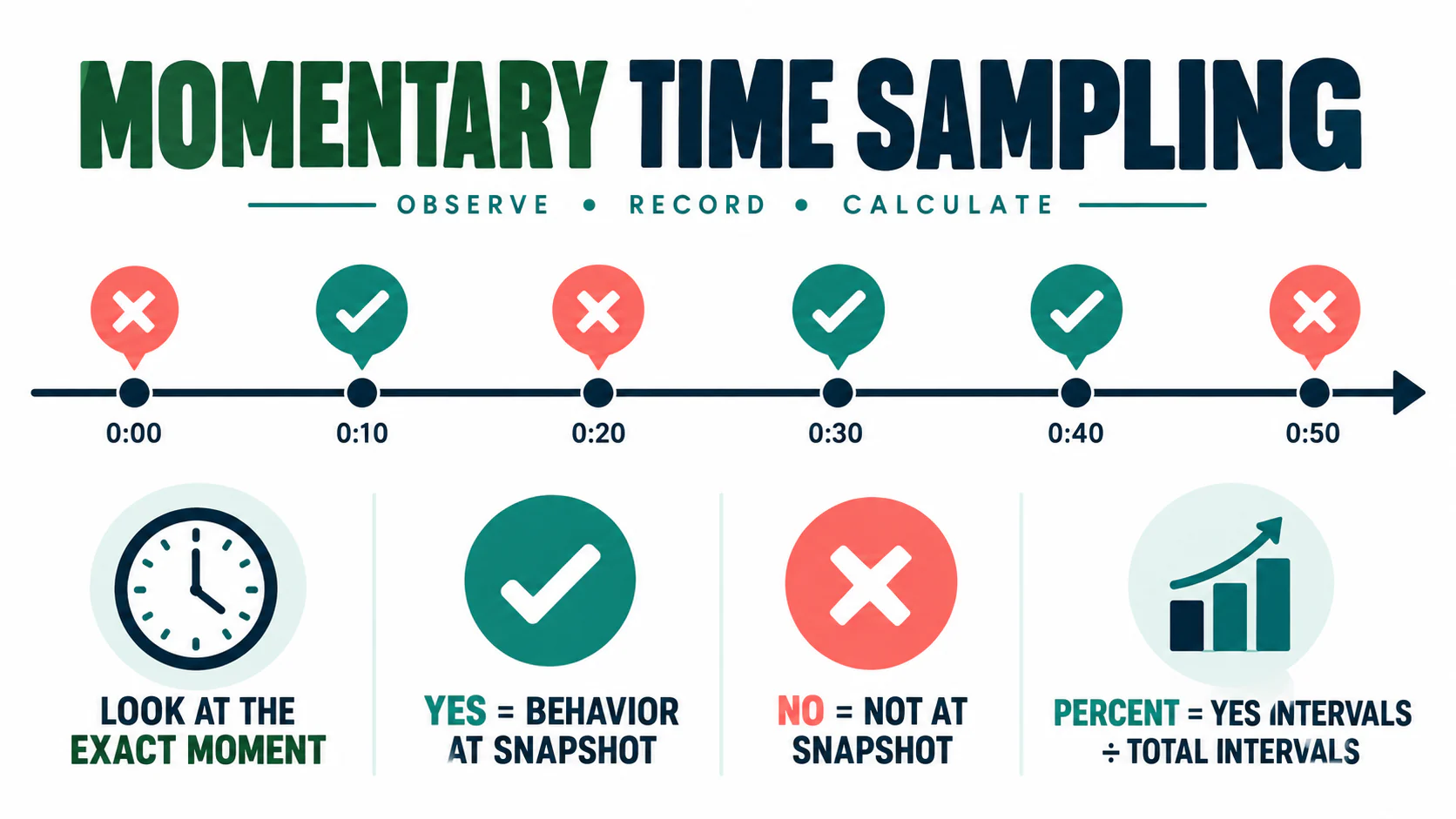
Start by writing an observable definition of the target behavior. For example, in a teaching example, “on-task” might mean that the learner is looking at the assigned materials, writing, typing, or following the stated task direction when the timer signals. The definition should not rely on an observer guessing what the learner is thinking.
Next, choose the observation length and divide it into equal intervals. If the observation lasts 10 minutes and you use 1-minute intervals, there are 10 checks. The observer does not score the entire minute. At the planned moment, the observer looks briefly and marks yes if the behavior is occurring at that instant or no if it is not.
This snapshot is the feature that makes MTS efficient. It can be useful when continuous recording would be difficult, especially when the observer must also support instruction or monitor several learners. The tradeoff is that a snapshot does not describe everything that happened between checks. The result should be interpreted as sampled occurrence, not as a perfect duration measurement.
A Complete 10-Interval ABA Example
Imagine a 10-minute independent-work period. The observer uses 1-minute intervals and checks at the end of each minute. The target is “engaged with the assigned task” according to the operational definition established before the observation begins. The learner can be engaged for part of a minute and still receive a no if the learner is not engaged at the exact check. The following is an original teaching example. It is designed to show the arithmetic clearly; it is not a universal clinical rule or a BACB-published cutoff.
| Interval | Check moment | At the snapshot | MTS mark |
|---|---|---|---|
| 1 | 1:00 | Writing the assigned response | Yes |
| 2 | 2:00 | Looking at the task materials | Yes |
| 3 | 3:00 | Away from materials | No |
| 4 | 4:00 | Typing the next answer | Yes |
| 5 | 5:00 | Reading the prompt | Yes |
| 6 | 6:00 | Talking about an unrelated topic | No |
| 7 | 7:00 | Writing | Yes |
| 8 | 8:00 | Looking away from the assignment | No |
| 9 | 9:00 | Using the assigned materials | Yes |
| 10 | 10:00 | Writing the final response | Yes |
There are seven yes marks: intervals 1, 2, 4, 5, 7, 9, and 10. There are three no marks. Notice that the table never tries to reconstruct the entire minute. It answers only the question, “Was the target occurring at the planned check moment?”
How to Calculate the Percentage
Use the same formula every time: MTS percentage = intervals scored yes ÷ total observed intervals × 100 For the example above:
- Count the yes intervals: 7.
- Count all observed intervals: 10.
- Divide: 7 ÷ 10 = 0.70.
- Convert to a percentage: 0.70 × 100 = 70%.
The correct interpretation is: the target behavior was observed at 70% of the sampled moments. Do not automatically rewrite that sentence as “the learner was engaged for 70% of the session.” A learner could engage for most of a minute but be away at the check, or briefly engage right before the check and receive a yes. The sampling design determines what the number can support.
For a second example, suppose an observer records 8 yes moments during a 12-interval observation. The result is 8 ÷ 12 × 100 = 66.7%, usually reported as 66.7% or 67% depending on the reporting convention. State your rounding rule if the number will be compared across observations.
Choose the Right Recording Method
Many BCBA exam questions become easier when you identify the measurement question before looking at the answer choices. Are you asking whether behavior is present at a sample moment, whether it happened at any time during an interval, or whether it lasted for the entire interval?
| Method | Score yes when | Best question | Common trap |
|---|---|---|---|
| Momentary time sampling | The behavior is occurring at the exact check moment. | Is the behavior present at sampled moments? | Treating a snapshot as continuous duration. |
| Partial-interval recording | The behavior occurs at any time during the interval. | Did the behavior happen at least once in the interval? | Assuming one brief occurrence means it filled the interval. |
| Whole-interval recording | The behavior occurs for the entire interval. | Did the behavior persist throughout the interval? | Scoring yes after only part of the interval. |
Interval Length and Data Quality
Interval length is not a decorative choice. Longer intervals create fewer checks and may miss short changes between observations. Very short intervals create more observations but may be harder to implement consistently. The appropriate choice depends on the target behavior, the setting, the observer’s workload, and the decision the data must support.
Keep the interval length and check rule stable when comparing observations. If one session uses 30-second intervals and another uses 5-minute intervals, the percentages are not automatically interchangeable. Record the observation length, interval length, number of intervals, target definition, and who collected the data.
Observer agreement also matters. Two observers should independently score the same planned moments when you are checking whether the definition and procedure are clear. Disagreement may signal an unclear target definition, a poorly timed signal, or a failure to look at the same moment. A percentage without its measurement context is difficult to interpret.
Common Scoring Mistakes
- Scoring the interval instead of the moment: The observer watches the whole minute and marks yes because the behavior occurred at some point. That is closer to partial-interval logic, not MTS.
- Moving the check: The observer looks when it is convenient rather than at the planned signal. That changes the sampling procedure and can bias the result.
- Changing the definition mid-session: If “on-task” begins as looking at the assigned material but later includes unrelated talking, the data no longer have one stable target.
- Confusing percentage with duration: Seven yes snapshots do not prove that the behavior occupied 70% of the session.
- Ignoring the denominator: Always report how many intervals were observed. “70%” is incomplete without knowing whether the denominator was 10, 20, or another number.
Turn the Example Into Exam Practice
Use a short error-analysis loop rather than memorizing the formula alone:
- Underline the phrase that describes when the observer looks.
- Write the operational target and the number of intervals before scoring.
- Mark each snapshot independently; do not let a previous yes influence the next check.
- Calculate the numerator, denominator, and percentage in separate steps.
- Explain why the other recording methods do not answer the same question.
For a low-risk readiness check after working through these examples, try the Free BCBA Mock Exam. Use the result to identify measurement and data-interpretation gaps, not as a promise that a practice score predicts the certification exam.
Frequently Asked Questions
What is an easy momentary time sampling ABA example?: Divide an observation into equal intervals, look at the exact planned moment at the end of each interval, and mark yes if the target behavior is occurring. If 6 of 10 snapshots are yes, the MTS percentage is 60%.
Does momentary time sampling measure duration?: No. It measures whether the behavior is present at sampled moments. It can provide a useful estimate for some decisions, but it should not automatically be described as the exact percentage of session time. How do I calculate MTS percentage?: Divide the number of yes intervals by the total number of observed intervals and multiply by 100. For example, 7 yes intervals out of 10 equals 70%.
What is the difference between MTS and partial-interval recording?: MTS asks whether the behavior is occurring at one exact check moment. Partial-interval recording asks whether the behavior occurred at any time during the interval. The scoring rule, not just the timer, makes the methods different.
Can MTS be used for BCBA exam study?: Yes. Practice identifying the check moment, calculating the percentage, and distinguishing MTS from partial- and whole-interval recording. Keep official BACB examination information and the current Test Content Outline as the boundary for current exam claims. Sources to recheck: BACB Test Content Outline, the BACB examination information page, and the site’s related time-sampling guide. The numbers in the worked tables are original teaching examples, not official BACB scoring thresholds. For targeted review, use our momentary time sampling aba examples practice questions to apply the concept in exam-style scenarios.
Quick Review Checklist
Use this final checklist to turn momentary time sampling aba examples into exam-ready reasoning. The goal is not to memorize a label in isolation; it is to identify the relevant evidence and explain why the best answer fits the scenario. Key ideas to review:
- State the central definition or decision point for momentary time sampling aba examples in your own words.
- Identify the detail that makes momentary time sampling aba examples different from its closest related ABA term.
- Separate the observable facts in a scenario from assumptions that are not supported by the facts.
- Write one example and one nonexample so you can recognize the concept in a new setting.
Exam application checks:
- Ask what the question is actually requesting before comparing the answer choices.
- Mark the antecedent, response, consequence, or other evidence that supports the selected answer.
- Look for a distractor that describes a related process but does not answer the specific question.
Final self-check:
- Explain how you would verify the interpretation with clear observations or data.
- Change one detail in the scenario and decide whether your answer should change.
- Give a one-sentence rationale that a supervisor or study partner could evaluate.
Take the Free BCBA Mock Exam
When you are ready to apply the idea, use the free practice resource below for additional feedback. Take the Free BCBA Mock Exam



