
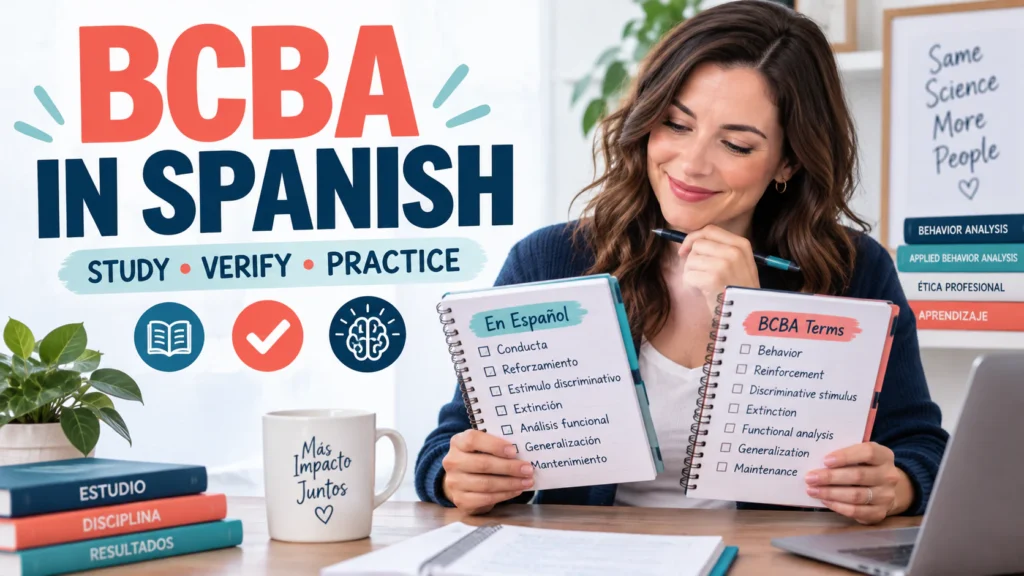
If you search for BCBA in Spanish, you may be asking three different questions: Can I learn ABA and BCBA concepts in Spanish? Is the official certification examination offered in Spanish? Or do I need Spanish study support while still preparing with English exam terminology? Those questions overlap, but they are not the same.
Table of Contents
- BCBA in Spanish: Separate the Three Meanings
- How to Verify the Official BCBA Examination Language
- What You Can Study in Spanish
- A Bilingual BCBA Study Workflow That Preserves Precision
- Build an English-Term Bridge, Not a Word-for-Word Translation
- Common Mistakes When Searching for BCBA in Spanish
- How to Check a Spanish BCBA Resource Before Relying on It
- Practice and Choose Your Next Step
- Quick Review Checklist
- Take the Free BCBA Mock Exam
This guide gives you a practical way to separate them. It explains how to verify the official language rule, how to use Spanish explanations without losing the English terms that appear in study materials, and how to decide whether a resource is current. The goal is clarity—not a promise that a translated resource changes BACB eligibility or predicts an exam result.
BCBA in Spanish: Separate the Three Meanings
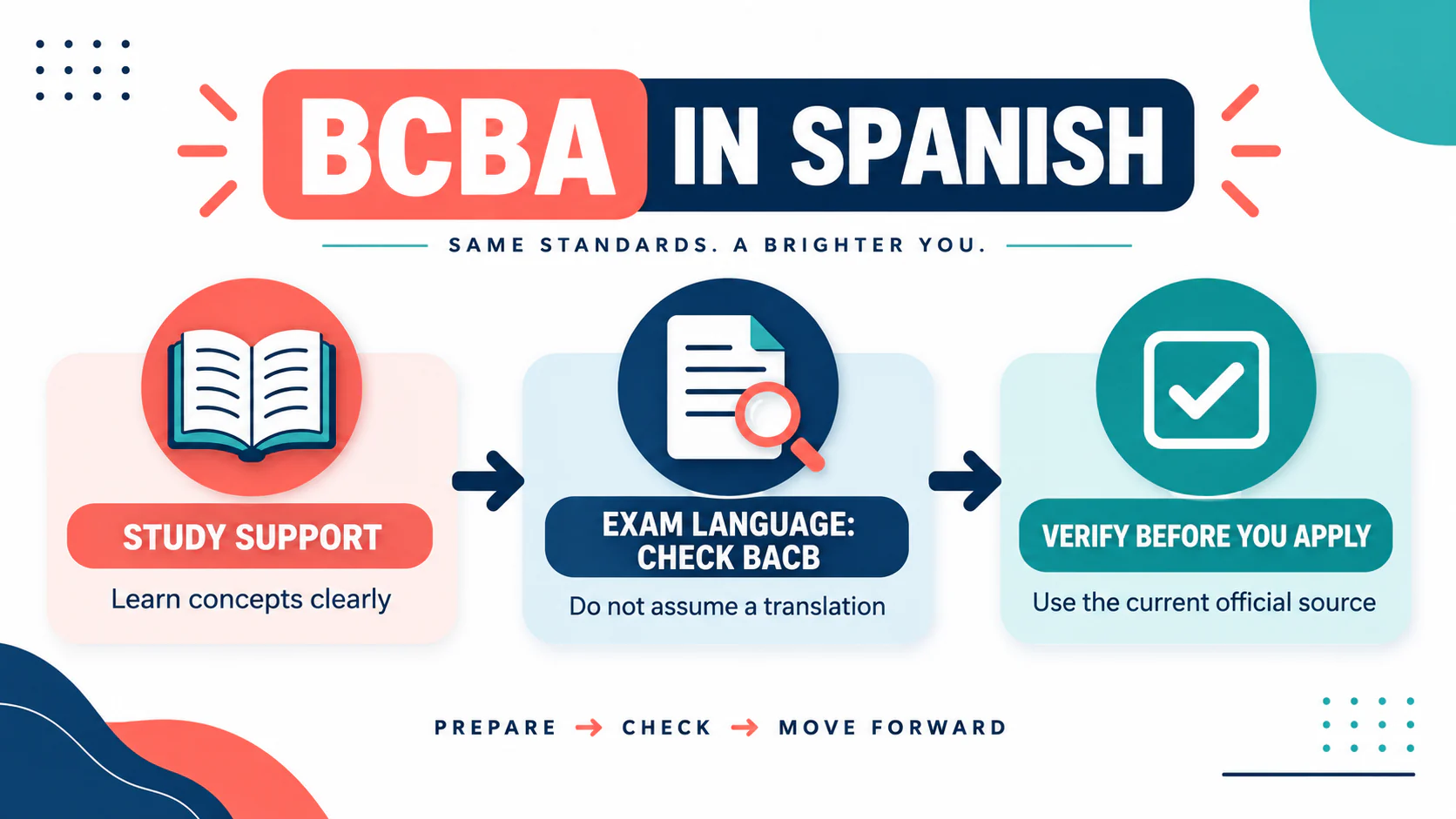
“In Spanish” can describe the language of an explanation, the language of a study resource, or the language of an official examination. Start by naming which layer you need. A Spanish explanation of reinforcement can help you understand the concept. It does not, by itself, prove that the certification test is translated. A bilingual glossary can help you recognize a term in both languages. It does not replace the current handbook or examination-information page.
For most candidates, the most useful approach is a two-column habit: understand the concept in the language that gives you the most precision, then keep the English term beside it. That way, Spanish can reduce the language burden during learning while English remains visible during exam preparation.
| What you mean | What it can provide | What it cannot prove |
|---|---|---|
| Spanish study support | Clear explanations, examples, and vocabulary practice. | That the official exam uses the same translation. |
| Spanish credential information | A way to understand eligibility steps and questions to verify. | That state or BACB rules changed because a page is translated. |
| Spanish examination | Only an explicit, current official BACB statement can establish availability. | A third-party course, video, or search snippet cannot establish it. |
How to Verify the Official BCBA Examination Language
Use the BACB examination-information page and handbook as your authority. A search result, a course sales page, or an old PDF may be useful clues, but they are not enough for a high-stakes language question. Check the date, the source owner, and whether the statement refers to the BCBA examination itself or to a preparation resource.
The saved BACB language reference used for this guide states the examination-language boundary that candidates should verify against the current official page. Because policies and delivery details can change, treat the current BACB site as the final checkpoint before scheduling, applying, or telling another candidate what language options exist.
A careful answer therefore sounds like this: “I can use Spanish study support, but I will verify the current official BCBA examination language directly with BACB.” That sentence is more useful than an absolute promise based on an unofficial translation. If you need an accommodation or have a question about scheduling, contact the organization that administers the credential process and save the answer with the date you received it.
What You Can Study in Spanish
Spanish can be especially helpful for first-pass comprehension, family-facing examples, ethical discussion, and reviewing why a measurement or intervention is appropriate. The key is to keep the concept precise. Translate the explanation, not the technical boundary. For example, an explanation of reinforcement should still preserve the contingency: a consequence follows a response and changes the future probability of that response. A pleasant-sounding Spanish phrase is not enough if it changes the behavioral relation.
Use existing Spanish resources for orientation, then cross-check high-stakes claims against the official English source. You can read a Spanish overview of requirements, write a Spanish summary, and keep the official English label beside it. This creates a bridge rather than two disconnected vocabularies.
| Study task | Spanish support can do | Keep in English too |
|---|---|---|
| Learn a definition | Explain the idea in familiar wording and add a concrete example. | The exact technical term and the feature that makes it distinct. |
| Analyze a scenario | Help you narrate the antecedent, behavior, consequence, and context. | The answer-choice language and the decision rule. |
| Review requirements | Turn a long policy page into questions you understand. | The current BACB wording, date, and source link. |
| Practice retrieval | Let you explain why an answer is correct before translating your reasoning. | The English term you must recognize quickly under exam conditions. |
A Bilingual BCBA Study Workflow That Preserves Precision
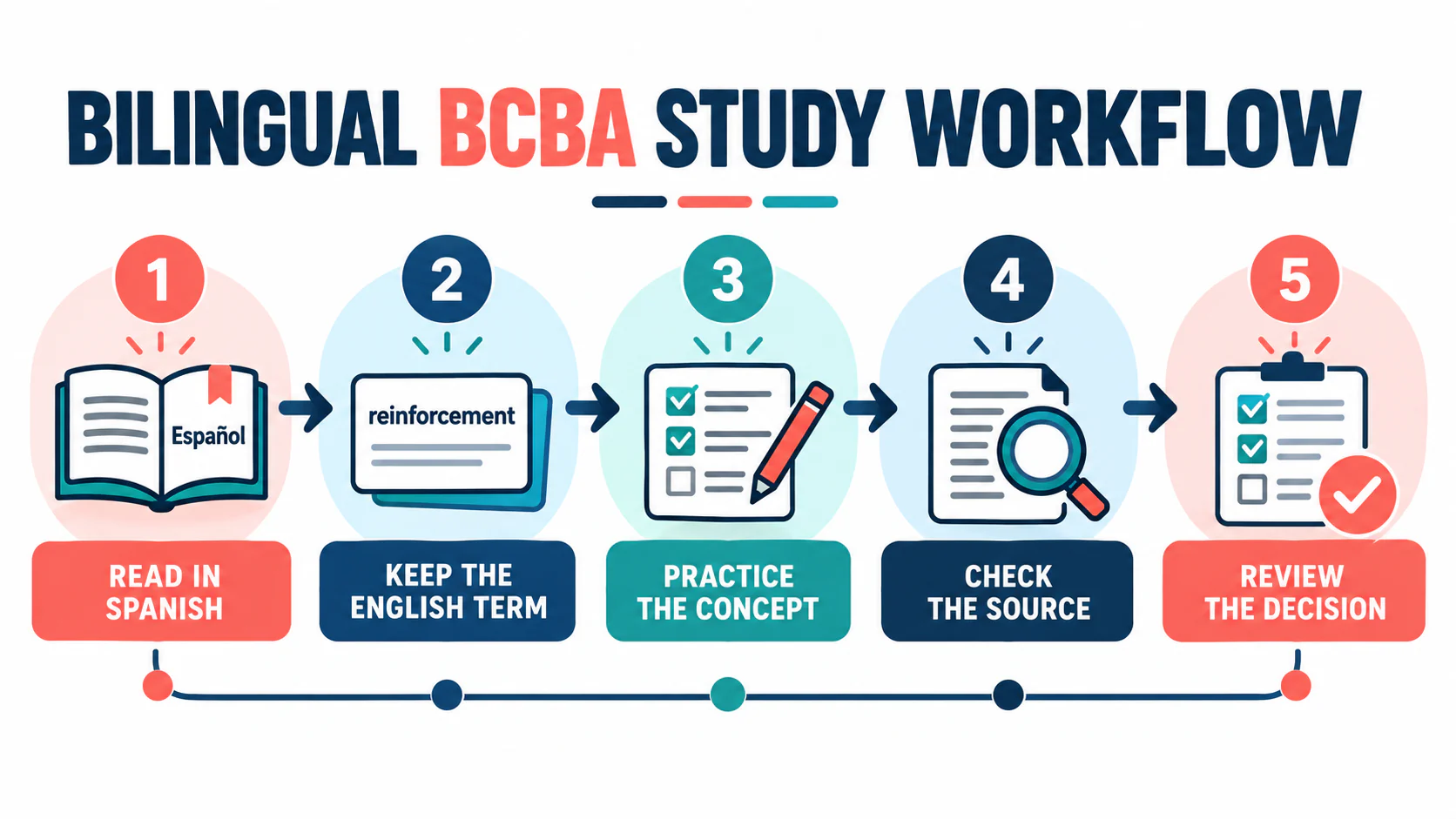
Use this five-step loop for each topic instead of reading a Spanish explanation once and moving on. The loop is deliberately simple because the goal is transfer: can you recognize the concept, explain it, and apply it when the wording changes?
- Read for meaning in Spanish. Write one sentence that explains the concept without copying a translation.
- Keep the English label. Put the English technical term beside your Spanish explanation. Do not wait until the last week to see it.
- Build one original example. Identify the relevant variables, not just the vocabulary. If the topic is measurement, name what is counted and when it is recorded.
- Retrieve in both directions. Look at the English term and explain it in Spanish; then look at the Spanish explanation and name the English term.
- Check the authority. For requirements, application rules, examination language, or ethics boundaries, return to the current official source and record its date.
This workflow also shows where a resource is weak. If it gives a fluent translation but no example, it may help with reading but not application. If it gives examples but hides the English term, it may help with comprehension but not recognition. Strong preparation does both.
Build an English-Term Bridge, Not a Word-for-Word Translation
Some Spanish equivalents are useful memory cues, but technical meaning lives in the full definition and example. Use a table like the one below as a personal bridge. Confirm the wording in the source you are studying, especially when the term appears in an official outline or handbook.
| English term | Useful Spanish cue | Study check |
|---|---|---|
| Antecedent | Antecedente | What happens before the response in this example? |
| Consequence | Consecuencia | What follows the response, and what changes later? |
| Reinforcement | Reforzamiento | Did the future probability of the response increase? |
| Measurement | Medición | What dimension is recorded: count, time, rate, latency, or something else? |
| Functional assessment | Evaluación funcional | What evidence supports the function hypothesis, and what is still unknown? |
The important part is the question in the final column. It forces you to apply the concept rather than memorize a pair of words. If a Spanish translation sounds natural but the example fails the study check, keep the English label and rebuild the explanation.
Common Mistakes When Searching for BCBA in Spanish
- Confusing a translated page with a translated examination: A Spanish article may explain the credential without changing the official testing language.
- Using an old language statement: Save the source date and return to the current BACB examination-information page before making a scheduling decision.
- Learning only synonyms: A vocabulary list cannot show whether a consequence increased future behavior or whether a measurement method fits the question.
- Hiding the English term until the end: If your intended study environment uses English terminology, introduce it from the first review.
- Assuming a practice score predicts certification: Practice identifies gaps. It does not guarantee eligibility, exam language, or a passing result.
How to Check a Spanish BCBA Resource Before Relying on It
Run a quick five-question audit before saving a course, PDF, video, or blog post:
- Who published it, and is that organization the authority for the claim?
- When was it updated, and does the page show a real date?
- Does it link to the current BACB examination or handbook page when discussing requirements?
- Does it distinguish a learning translation from an official policy or examination translation?
- Does it give an example that lets you test the concept rather than only repeat a definition?
Keep a small verification log: topic, English term, Spanish explanation, official source, date checked, and the question you still need answered. This prevents an old screenshot or social-media comment from quietly becoming your study plan.
Practice and Choose Your Next Step
If Spanish helps you understand the concept, use it. If English terminology is part of your study environment, keep it visible. The strongest bilingual preparation is not a word-for-word substitution; it is the ability to explain the same behavioral relation clearly in Spanish, recognize the English term, and choose an answer from the evidence in the scenario.
After you have built the vocabulary bridge, use the Free BCBA Mock Exam as a diagnostic practice step. Review missed questions in both languages: first explain why the answer is wrong in Spanish, then name the English term or decision rule you need to recognize next. Treat the score as feedback about your study plan, not as a guarantee about the certification examination.
Can I study BCBA concepts in Spanish?: Yes, Spanish explanations can be useful for learning and review. Keep the English technical term beside each concept if your preparation materials or testing environment use English, and verify credential or examination claims against the current official BACB source.
Does a Spanish BCBA guide prove the exam is in Spanish?: No. A guide can explain eligibility, vocabulary, or study strategies in Spanish without being an official statement about examination delivery. Check the current BACB examination-information page for the language rule.
Should I translate every ABA term?: Translate enough to understand the concept, but do not study isolated synonyms. Pair the English term with an example, a decision question, and the Spanish explanation that makes the relation clear.
How should I practice if I think in Spanish first?: Use two-direction retrieval: read the English term and explain it in Spanish, then read your Spanish explanation and name the English term. Finish with an English scenario so you practice the decision under realistic wording.
Quick Review Checklist
Use this final checklist to turn bcba in spanish into exam-ready reasoning. The goal is not to memorize a label in isolation; it is to identify the relevant evidence and explain why the best answer fits the scenario. Key ideas to review:
- State the central definition or decision point for bcba in spanish in your own words.
- Identify the detail that makes bcba in spanish different from its closest related ABA term.
- Separate the observable facts in a scenario from assumptions that are not supported by the facts.
- Write one example and one nonexample so you can recognize the concept in a new setting.
Exam application checks:
- Ask what the question is actually requesting before comparing the answer choices.
- Mark the antecedent, response, consequence, or other evidence that supports the selected answer.
- Look for a distractor that describes a related process but does not answer the specific question.
Final self-check:
- Explain how you would verify the interpretation with clear observations or data.
- Change one detail in the scenario and decide whether your answer should change.
- Give a one-sentence rationale that a supervisor or study partner could evaluate.
Take the Free BCBA Mock Exam
When you are ready to apply the idea, use the free practice resource below for additional feedback. Take the Free BCBA Mock Exam



