
BCBA autism is a broad search phrase, so it can represent several different questions: What does a BCBA do with autistic learners? Can a BCBA diagnose autism? Is ABA the same thing as autism treatment? Or how can someone become a BCBA who works in autism services? The answer depends on the task, the professional’s training and license, and the goals of the autistic person and family.
Table of Contents
- BCBA Autism: The Short Answer
- What a BCBA May Do in Autism Support
- Separate Diagnosis From Behavior-Analytic Assessment
- Choose Goals That Matter to the Autistic Person
- Build an Interdisciplinary Team
- Questions to Ask Before Choosing a BCBA
- If You Want to Become an Autism-Focused BCBA
- Frequently Asked Questions
- Sources for Further Study
- Quick Review Checklist
- Take the Free BCBA Mock Exam
A BCBA is a behavior analyst credentialed by the Behavior Analyst Certification Board. A BCBA may design, supervise, or evaluate behavior-analytic services, including services for autistic people, but the credential does not make every BCBA a diagnostician, speech-language pathologist, occupational therapist, physician, or mental-health provider. Good support starts by separating those roles and then coordinating them around meaningful outcomes, communication access, safety, autonomy, and quality of life.
BCBA Autism: The Short Answer
Many BCBAs work with autistic children, adolescents, or adults, but autism is not the only population or setting in behavior analysis. A BCBA’s job is to apply behavior-analytic assessment and intervention within their competence, document decisions, supervise implementation when applicable, and evaluate whether services are helping. The exact service may occur at home, school, work, a clinic, or another community setting.
That means “BCBA autism” should not be treated as a single treatment label. A family may be looking for help with functional communication, daily living, participation, safety, caregiver coaching, or a behavior that interferes with learning. A student may be searching for the career path. Someone concerned about developmental differences may need a diagnostic referral. Each question needs a different next step. The safest summary is: a BCBA may provide behavior-analytic support for an autistic person, in collaboration with the person and other professionals, but a BCBA credential alone does not answer every autism-related question.
What a BCBA May Do in Autism Support
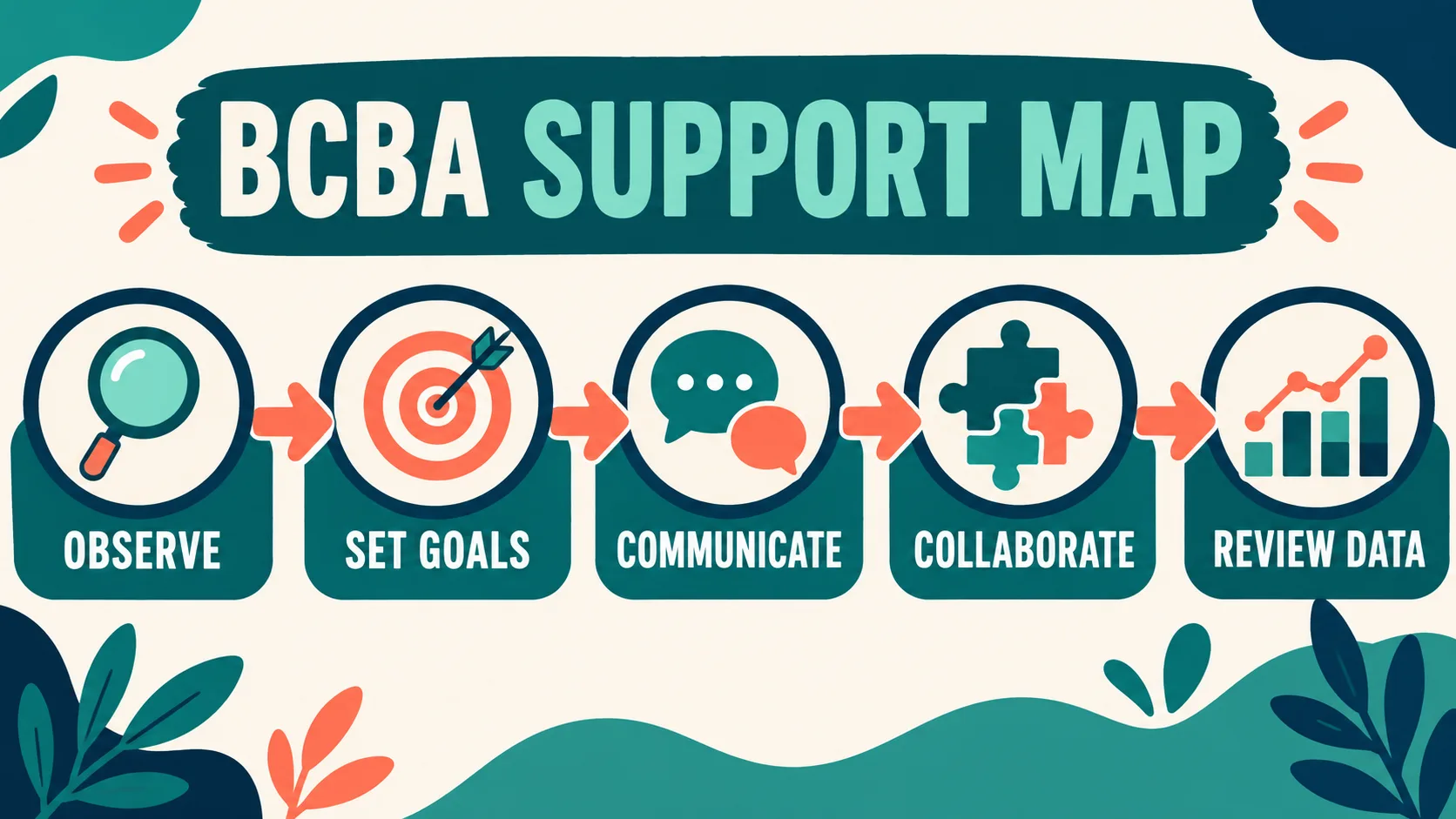
A BCBA may begin by listening to the autistic person and the people who support them, reviewing records, observing relevant routines, and identifying the practical function of a behavior or skill. The purpose is not to make a person look less autistic or to measure success only by compliance. The purpose is to understand what is happening, what matters to the person, what is safe, and what supports can make participation and communication more effective.
| Possible BCBA responsibility | What it may look like | Quality question |
|---|---|---|
| Behavior-analytic assessment | Define a target response, examine context and consequences, and review patterns across routines. | Does the assessment answer a practical question without claiming to diagnose autism? |
| Functional goals | Support communication, self-advocacy, daily living, safety, learning access, or participation. | Did the autistic person have a meaningful voice in choosing or rejecting goals? |
| Teaching and support | Arrange prompts, reinforcement, environmental supports, communication options, and practice opportunities. | Are supports building access and independence rather than suppressing harmless differences? |
| Caregiver and team coaching | Model strategies, share decision rules, and coordinate with family, school, and other providers. | Can the team use the plan consistently and respectfully in real routines? |
| Data and review | Track a useful measure, review progress, and change the plan when the data or person’s preferences call for it. | Does the measure reflect quality of life, communication, safety, and participation? |
The BCBA’s plan should explain what will be taught or changed, why the target matters, how the person can communicate refusal or request a break, and how the team will know whether the plan is helping. A plan that produces short-term task completion while reducing communication, increasing distress, or ignoring assent needs careful review.
Separate Diagnosis From Behavior-Analytic Assessment
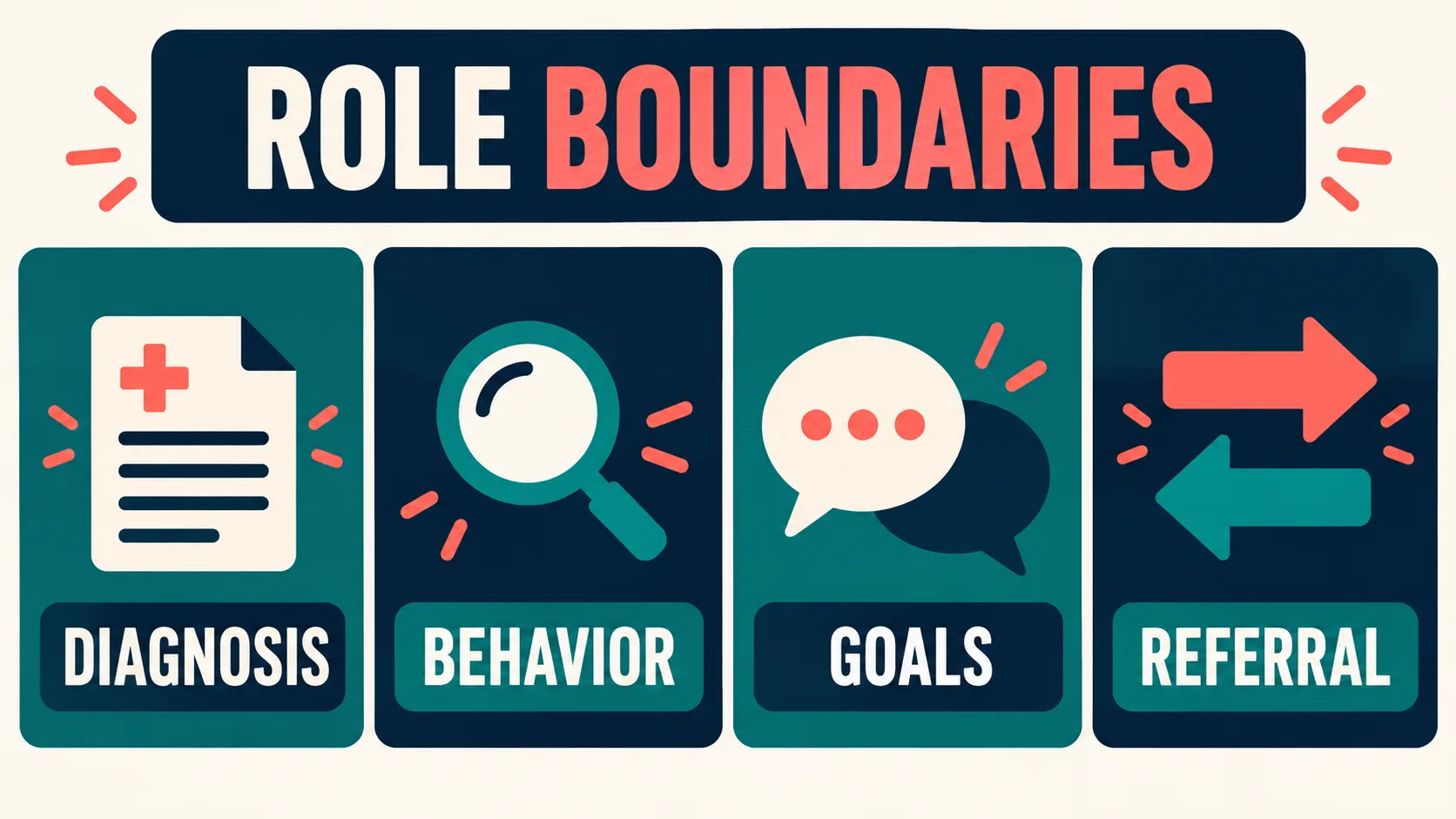
One of the most common misunderstandings in the broad query is treating an autism diagnosis and a behavior assessment as the same thing. They are not. The CDC describes autism diagnosis as a developmental and clinical process that may involve trained specialists, developmental history, caregiver information, observation, and standardized criteria. A behavior analyst may collect important information about behavior and skills, but a screening checklist or a functional assessment is not automatically an autism diagnosis.
| Question | Likely professional task | Boundary |
|---|---|---|
| Could this person meet autism diagnostic criteria? | Developmental or clinical diagnostic evaluation by appropriately trained professionals. | Do not treat a BCBA service assessment as a diagnostic conclusion. |
| What happens before, during, or after a behavior? | Behavior-analytic assessment of observable responses, context, function, and support needs. | The question is about behavior and support, not the person’s identity or diagnosis. |
| How can communication be supported? | A BCBA may collaborate on functional communication; an SLP may address speech, language, and communication scope. | Use the qualified professional for the specific communication question. |
| What about medication or medical concerns? | A physician or other licensed medical professional evaluates medical needs and medication. | A BCBA should coordinate and refer rather than practice outside competence. |
| What sensory, motor, or daily-living support is needed? | An occupational therapist or other qualified provider may be needed, with team coordination. | A BCBA does not replace another discipline because a behavior occurs during a routine. |
If you are worried about a child’s development, begin with a healthcare provider or developmental evaluation pathway rather than waiting for a behavior service to answer a diagnostic question. If the person already has a diagnosis and needs support with communication, safety, participation, or learning, a BCBA may be one member of the team.
Choose Goals That Matter to the Autistic Person
Autism support should not be reduced to making a person appear typical. A meaningful goal may involve requesting help, communicating “no,” tolerating a necessary change with a reliable break option, completing a self-care routine, staying safe in the community, accessing education, or participating in a preferred activity. The correct target depends on the person’s priorities and context.
- Ask what the person wants more access to: communication, relationships, activities, privacy, independence, comfort, learning, or safety.
- Protect communication: make speech, signs, AAC, gestures, visuals, and refusal responses available and meaningful when appropriate.
- Distinguish danger from difference: address genuine safety or access barriers without treating every unusual movement, interest, or communication style as a deficit to erase.
- Measure the right outcome: include independence, opportunities, stress signals, generalization, and quality of life—not only whether an adult’s instruction was followed.
Consent and assent processes vary by age, capacity, setting, and law, but a respectful team should pay attention to approach, withdrawal, refusal, distress, and requests for changes. When a goal is no longer meaningful or the person’s response changes, the plan deserves a fresh conversation.
Build an Interdisciplinary Team
A BCBA may work alongside a family, educator, speech-language pathologist, occupational therapist, physician, psychologist, social worker, or other provider. Collaboration does not mean every professional performs every task. It means the team shares relevant information, respects scope, and avoids giving the autistic person conflicting or unsafe instructions.
Before services begin, clarify who writes the behavior plan, who communicates with the school, who handles speech or AAC decisions, who responds to medical concerns, how privacy is protected, and how progress is reviewed. The family or autistic adult should know how to raise a concern and how to request a change.
Questions to Ask Before Choosing a BCBA
Provider fit matters as much as a credential. These questions help a family, autistic adult, or referring professional compare options without assuming that a marketing phrase such as “autism expert” tells you everything important.
| Ask about | Useful follow-up | Why it matters |
|---|---|---|
| Goals | How will the autistic person and family help choose, revise, or reject goals? | Shared goals are more meaningful than a generic checklist. |
| Communication | How will AAC, refusal, breaks, and other communication forms be supported? | A person needs an effective way to participate and say “stop.” |
| Data | What will be measured, how often will it be reviewed, and what would change the plan? | Data should guide decisions, not justify continuing an unhelpful plan. |
| Collaboration | How will the BCBA coordinate with SLP, OT, medical, school, and community teams? | Many autism-related needs cross professional boundaries. |
| Safety and concerns | Who do we contact if distress, risk, or a disagreement appears? | A clear feedback path protects the person and the relationship. |
If You Want to Become an Autism-Focused BCBA
For a student, an autism-focused BCBA career usually starts with the BCBA eligibility pathway, graduate-level education or the applicable current route, supervised fieldwork, and the BCBA examination. Autism experience is a professional development and competence question, not a substitute for the certification requirements. Not every BCBA works in autism services, and not every autism service is delivered by a BCBA.
Build competence deliberately: learn functional assessment and measurement, study ethics and scope, seek supervision from qualified professionals, listen to autistic people and self-advocates, and practice collaborating with other disciplines. A strong candidate can explain how they would protect communication, assent, dignity, safety, and meaningful outcomes—not only how they would reduce a behavior.
For targeted practice on assessment, ethics, measurement, and professional roles, the Free BCBA Mock Exam can help you find study gaps. It is a study diagnostic, not an autism assessment, clinical recommendation, certification decision, or guarantee of passing.
Frequently Asked Questions
What does a BCBA do for autism?: A BCBA may assess behavior and skill needs, design or supervise behavior-analytic services, teach communication or participation skills, coach caregivers and teams, and review data. The exact role depends on the person, setting, scope, supervision, and applicable law.
Can a BCBA diagnose autism?: Do not assume that a BCBA credential gives someone authority to diagnose autism. Autism diagnosis is a developmental or clinical process governed by professional training and applicable law. A BCBA may conduct a behavior-analytic assessment for service planning and should refer diagnostic questions to the appropriate qualified professionals.
Is ABA the same as autism?: No. ABA is a behavior-analytic science and service framework; autism is a neurodevelopmental diagnosis. ABA may be one support used by some autistic people, but it is not the only support and should not be treated as automatically appropriate for every person or every goal.
How do I choose a BCBA for an autistic child or adult?: Ask about meaningful goals, communication and refusal options, assent, safety, data, collaboration, experience with the person’s age and needs, and how concerns are handled. Compare the provider’s answers with the autistic person’s preferences and the family’s practical context.
Sources for Further Study
Review the BACB autism and developmental-disability resource, the official BCBA page, the BACB supervision and training resource, and the CDC autism screening and diagnosis guidance. This article is educational and does not diagnose a person, replace a clinical evaluation, or prescribe an individualized treatment plan.
Quick Review Checklist
Use this final checklist to turn bcba autism into exam-ready reasoning. The goal is not to memorize a label in isolation; it is to identify the relevant evidence and explain why the best answer fits the scenario. Key ideas to review:
- State the central definition or decision point for bcba autism in your own words.
- Identify the detail that makes bcba autism different from its closest related ABA term.
- Separate the observable facts in a scenario from assumptions that are not supported by the facts.
- Write one example and one nonexample so you can recognize the concept in a new setting.
Exam application checks:
- Ask what the question is actually requesting before comparing the answer choices.
- Mark the antecedent, response, consequence, or other evidence that supports the selected answer.
- Look for a distractor that describes a related process but does not answer the specific question.
Final self-check:
- Explain how you would verify the interpretation with clear observations or data.
- Change one detail in the scenario and decide whether your answer should change.
- Give a one-sentence rationale that a supervisor or study partner could evaluate.
Take the Free BCBA Mock Exam
When you are ready to apply the idea, use the free practice resource below for additional feedback. Take the Free BCBA Mock Exam



