
What Are Listener Responding and Intraverbal?
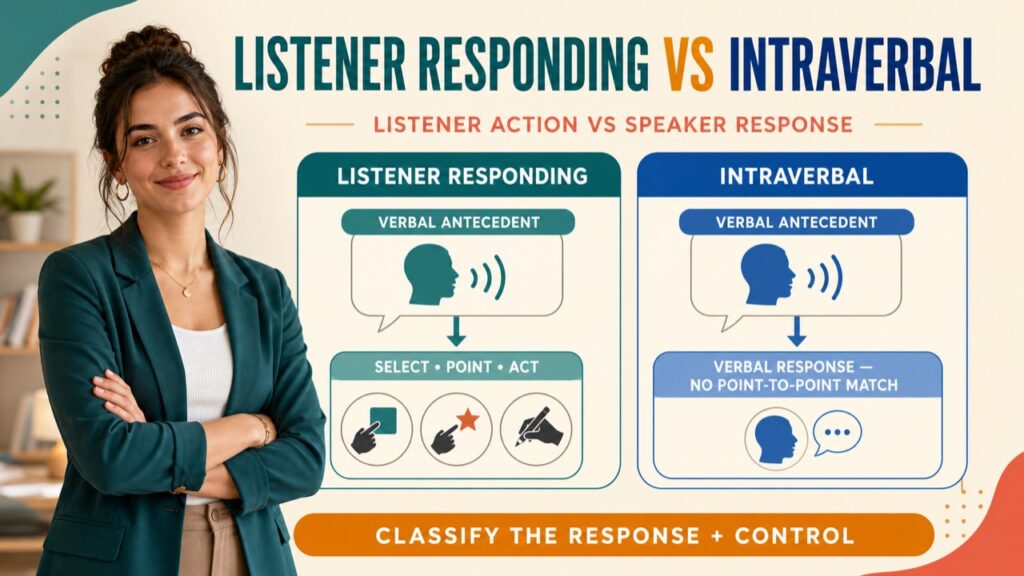
Listener responding and intraverbal describe different functional relations in a speaker-listener episode; they should not both be called verbal operants. In common instructional usage, listener responding is behavior under the control of a verbal antecedent produced by a speaker. The learner may select, point, move, follow a direction, or otherwise change the environment. If an instructor says “Show me the dog” and the learner points to the dog in an array, the observed response topography is a selection. The spoken instruction and array may jointly serve as controlling variables.
Table of Contents
- What Are Listener Responding and Intraverbal?
- Key Distinctions Between Listener Responding and Intraverbal
- Common Traps and Misconceptions
- Practical Examples in ABA
- A Functional Classification Sequence
- Study Checklist for Exam Review
- References and Official Sources
- Test Your Knowledge with a Free BCBA Mock Exam
An intraverbal is speaker behavior evoked by a verbal stimulus without point-to-point correspondence between the relevant parts of that antecedent and the response product. If someone asks “What is your favorite color?” and the learner says or signs “Blue,” the answer does not formally reproduce the question. Vocal sound is not the defining feature: signed or written responses can function as verbal behavior when their reinforcement is socially mediated and the other defining relations are present.
The people in the interaction do not determine the operant. In an ordinary conversation, one person asks a question and another person first participates as listener and then produces a speaker response. Self-generated verbal stimuli can also participate in control, but being one person or two people is not a classification shortcut. Identify what the learner did, what antecedent variables were present, what consequences historically established the relation, and whether correspondence exists.
| Feature | Listener Responding | Intraverbal |
|---|---|---|
| Functional focus | Listener action under speaker-produced verbal stimulus control | Speaker response evoked by a verbal stimulus |
| Common response form | Selecting, pointing, moving, or following a direction | Vocal, signed, or written verbal response |
| Relevant antecedents | Verbal instruction, sometimes with objects, pictures, or contextual stimuli | Verbal stimulus, reinforcement history, and possible multiple control |
| Correspondence test | Not the defining test for the nonverbal selection or action | Point-to-point correspondence with the verbal antecedent is absent |
| Person roles | Learner acts as listener in the episode | Learner produces speaker behavior after contact with a verbal antecedent |
| Evidence needed | Systematic change in the listener response with relevant verbal and contextual stimuli | Functional control of the verbal response, not the mere presence of a question |
Key Distinctions Between Listener Responding and Intraverbal
Response topography and controlling variables: Begin with the observable response. A point to an item, movement to a location, or completed direction is different from a spoken, signed, or written answer. Then test the relation rather than stopping at form. A signed response can be speaker behavior; a hand movement can instead be a selection response. Listener responding may be controlled by an instruction alone or by an instruction plus an array, object, or contextual stimulus. Intraverbal responding is commonly under multiple control as well: audience, topic, motivation, nonverbal context, and prior responses can affect what is said. “Verbal antecedent” therefore does not mean “sole controlling variable.”
Point-to-point correspondence: For an intraverbal, relevant units of the verbal response do not correspond one-for-one with units of the controlling verbal stimulus. “What does a cow say?” followed by “Moo” is a standard candidate example when the question controls the answer through an established verbal history. By contrast, an echoic relation includes point-to-point correspondence and formal similarity. Correspondence is not the classification test for touching a picture or completing a motor direction, because that listener response is not a verbal response product corresponding to the speaker’s words. The absence of correspondence identifies one boundary; it does not by itself prove all other parts of intraverbal control.
Speaker-listener relation: Speaker and listener are functional roles, not fixed identities. When a therapist asks “What did you eat for lunch?” and the learner answers “Sandwich,” the therapist produced the verbal antecedent and the learner produced the subsequent speaker response. In a selection condition, the therapist might say “Point to the sandwich,” and the learner acts on an array as listener. The same learner can move from listener to speaker within seconds. Classification turns on the response and its controlling relation, not a rule about whether the same person occupied both roles.
Common Traps and Misconceptions
When distinguishing these operants, avoid the following common errors. Each trap is based on the functional definition and not on surface features alone.
- Collapsing selection and speaker behavior: A point to a comparison stimulus and a spoken answer are different response classes even when the preceding words are identical.
- Classifying from the spoken antecedent alone: A verbal stimulus can precede a motor action, selection, echoic, intraverbal, or multiply controlled response. Observe and test the response relation.
- Using vocal sound as the verbal-behavior test: Signed or written responses may be verbal; a vocal response may belong to another operant. Modality is evidence about form, not a complete functional analysis.
- Using repetition as the listener criterion: Repeating relevant verbal units points toward an echoic relation when formal similarity and correspondence are present. Listener responding is commonly demonstrated through action or selection.
- Treating every answer as purely intraverbal: A visible item, current motivation, audience, or prior response can add tact, mand, or other control. Record plausible multiple control instead of forcing one label.
Practical Examples in ABA
Example 1: Matched Spoken Question, Different Conditions. A teacher asks, “Which animal lives in water?”
- Listener-response condition: With dog, fish, and bird pictures present, the learner points to the fish. The spoken question and visual array jointly control a nonverbal selection.
- Intraverbal condition: With the pictures removed, the learner says or signs “Fish.” If the established verbal relation controls that answer and the units do not correspond to the question, the response is intraverbal.
The speaker’s words can be held constant while response requirements and contextual stimuli change. That comparison shows why the response topography, array, correspondence, and reinforcement history must be specified. If the fish picture remains visible during the spoken answer, tact and intraverbal control may both be plausible.
Example 2: Following an Instruction. A therapist says, “Put the spoon in the cup,” and the learner completes that action. Reversing key words—“Put the cup beside the spoon”—and changing the objects helps test which verbal and contextual features control the response. If the learner instead says “cup,” do not classify from that single trial. The vocal response could reflect partial echoic control, intraverbal control, tact control from the visible cup, or several variables together.
Example 3: Conversation With a Context Check. A peer asks, “Where do you live?” and the learner answers “New York.” The question-answer history and absence of point-to-point correspondence support an intraverbal interpretation. If a map with New York highlighted is simultaneously shown, the nonverbal display may add tact-like stimulus control. The answer can still be useful, but a precise analysis records that possible multiple control rather than assuming the question operated alone.
A Functional Classification Sequence
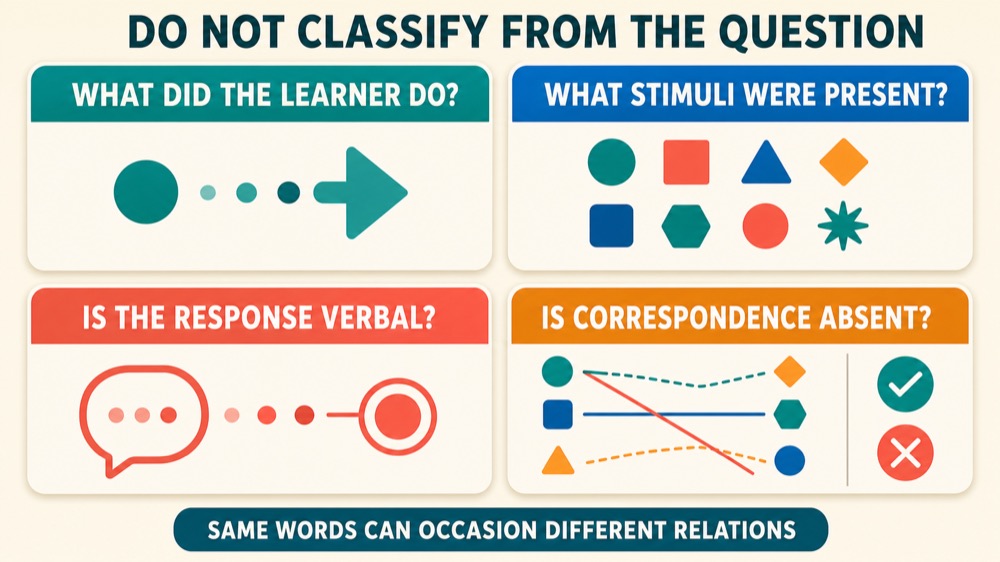
Use the following sequence when a scenario contains spoken words. It prevents a surface label from replacing analysis.
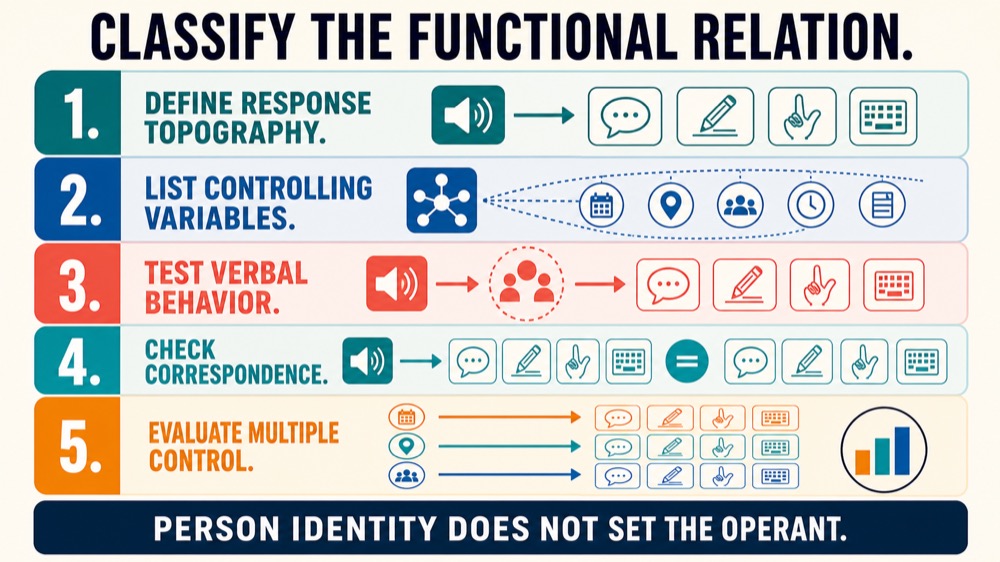
- Define the response: Write what the learner selected, moved, said, signed, or wrote. Avoid labels in this first step.
- List antecedent variables: Include the speaker’s words, visible materials, prior questions, audience, relevant motivation, and contextual features.
- Ask whether the response is verbal behavior: Determine whether its reinforcement is mediated through a listener according to community practices; do not equate verbal with vocal.
- Check correspondence and formal similarity: If a verbal response reproduces units of a verbal antecedent, compare echoic, textual, or transcription relations before choosing intraverbal.
- Evaluate multiple control: A picture, item, motivating operation, or prior response may share control with the question.
- Compare probe conditions: Change or remove the array, alter the instruction, and observe whether the response changes systematically.
A defensible classification names the controlling variable supported by the arrangement and data. It also states uncertainty when a single vignette does not provide enough history. This is more precise than deciding from the presence of a question mark, a spoken sentence, or a familiar response form.
Study Checklist for Exam Review
- Define listener responding as action under speaker-produced verbal stimulus control, commonly measured through selecting, pointing, moving, or following directions.
- Define an intraverbal as a verbal response evoked by a verbal antecedent without point-to-point correspondence.
- Describe the response topography before naming the relation; distinguish vocal, signed, written, selection, and motor responses without treating modality as decisive.
- List verbal, nonverbal, motivational, audience, and historical variables that may share control.
- Check correspondence and formal similarity before ruling out echoic, textual, or transcription relations.
- Treat speaker and listener as moment-to-moment roles rather than assuming that person identity determines the operant.
- Create matched probes in which the same spoken question occasions a selection with an array and a verbal answer without the array.
- Use the BACB BCBA Test Content Outline (6th ed.) to locate the current task on distinguishing verbal operants; the outline names the competency but is not a complete glossary of these relations.
References and Official Sources
The BACB BCBA Test Content Outline (6th ed.) identifies distinguishing verbal operants as a current competency. The functional definitions and examples in this article also reflect the broader behavior-analytic literature on verbal behavior; the outline should not be presented as if it supplies every definition used here. This topic concerns conceptual classification rather than a jurisdiction-specific practice rule. Every teaching scenario on this page was created for this article.
Test Your Knowledge with a Free BCBA Mock Exam
Ready to apply these concepts? Our Free BCBA Mock Exam offers practice questions with detailed feedback to sharpen your understanding of verbal behavior and other exam topics. The mock exam provides general practice and does not guarantee inclusion of this specific topic. Use it to gauge your readiness and identify areas for improvement.
Next step for BCBA exam prep
Turn this topic into exam-day practice
Use this topic as a focused review, then test it in exam-style conditions with a free mock before deciding whether five full-length mocks are the right next step.
Start the Free BCBA Mock ExamContinue with Five Full-Length Mocks — $99
Review the included materials and access details before ordering. No pass guarantee is implied.



