
Introduction: Understanding the Distinction
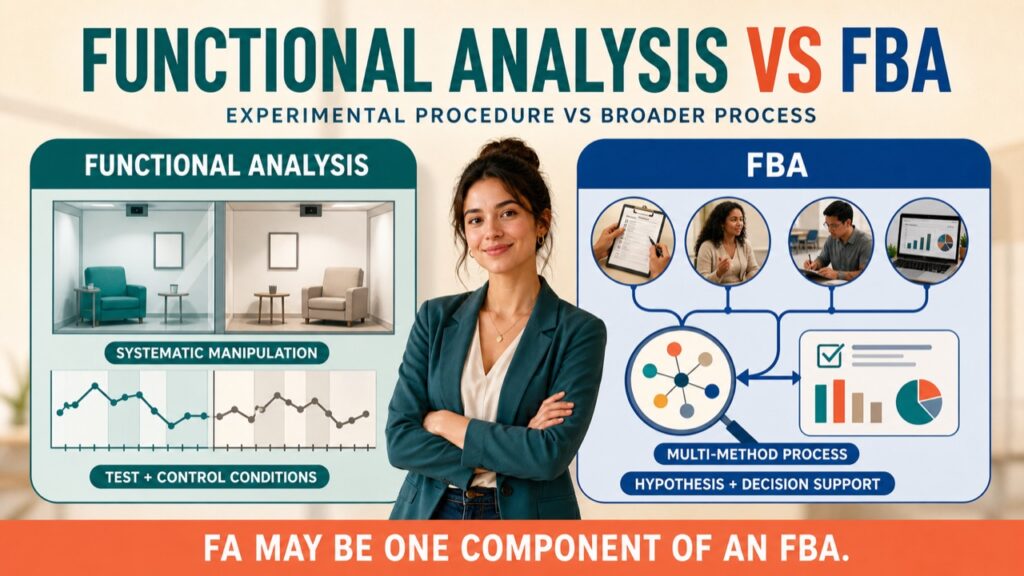
In Applied Behavior Analysis (ABA), the terms functional behavior assessment (FBA) and functional analysis (FA) are sometimes used interchangeably, but they represent distinct approaches. Understanding functional analysis vs functional behavior assessment aba is crucial for BCBA candidates and practicing behavior analysts. This article clarifies each concept, compares their methodologies, and provides decision-making examples. By the end, you will be able to describe the FBA process, the FA procedure, and how they relate within a comprehensive assessment.
Table of Contents
- Introduction: Understanding the Distinction
- What Is a Functional Behavior Assessment (FBA)?
- What Is a Functional Analysis (FA)?
- Key Differences Between FBA and FA
- The Role of Descriptive Assessment
- How Test and Control Conditions Work
- Common Traps and Misconceptions
- Decision-Making Examples
- Study Checklist for BCBA Candidates
- Conclusion: Integrating FBA and FA in Practice
Both FBA and FA help analysts evaluate variables that may maintain behavior, but they differ in scope, method, and strength of inference. An FBA is a broad, systematic process that integrates information from multiple sources to develop and refine a hypothesis about behavioral function. An FA is an experimental procedure that manipulates environmental conditions to test a functional relation. The BACB BCBA Test Content Outline (6th ed.) includes selecting, designing, and evaluating functional assessments. In practice, the choice of methods must fit the client, context, referral question, available safeguards, analyst competence, and consent or assent requirements.
What Is a Functional Behavior Assessment (FBA)?
A functional behavior assessment is a systematic process for identifying environmental variables that occasion and maintain problem behavior. It is not a single procedure but a family of methods designed to produce a defensible hypothesis about behavioral function. An FBA may include record review, interviews with stakeholders, direct observation in natural settings (descriptive assessment), and—when appropriate—experimental analysis. The goal is to develop a function-based intervention that addresses the behavior’s maintaining contingencies.
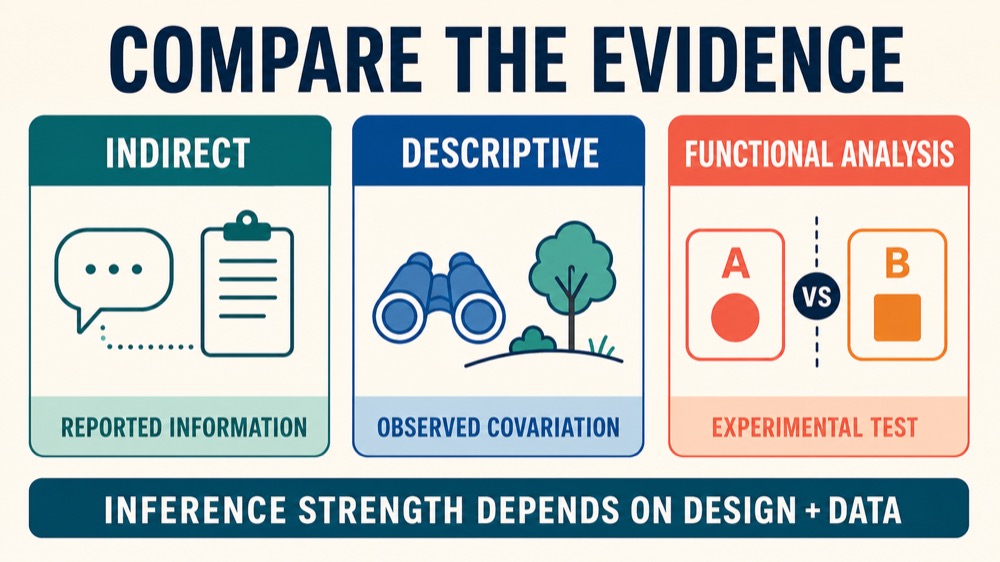
An FBA may draw on indirect assessment, descriptive assessment, and experimental assessment; these methods are not a mandatory one-size-fits-all sequence. Interviews, rating scales, and records can identify events worth examining. Direct observation in relevant settings can show when behavior and environmental events covary, but it does not demonstrate causation because the variables are not systematically manipulated. Analysts integrate the available evidence into a tentative, testable hypothesis and use ongoing treatment data to evaluate it. When the question remains consequential or uncertain, a functional analysis may provide stronger experimental evidence if it can be conducted competently and safely.
Common tools used in FBA include the Functional Assessment Interview (FAI) and the Functional Analysis Screening Tool (FAST). Descriptive assessment methods include scatterplots and ABC (antecedent-behavior-consequence) continuous recording. While ABC data can suggest functional relations, they do not prove that a particular consequence reinforces the behavior because unmeasured variables may be responsible. For example, a teacher’s attention always follows a student’s aggression, but that does not confirm attention is the reinforcer—escape, automatic reinforcement, or another variable could be operating. The strength of inference derived from descriptive assessment is weaker than that of an experimental analysis.
Key point: FBA is the broader process that may include multiple data sources. It is not equivalent to a functional analysis, nor is it limited to interviews or ABC charts. A well-conducted FBA integrates information from various assessments to form a cohesive hypothesis that drives intervention.
What Is a Functional Analysis (FA)?
A functional analysis (often called an experimental analysis) is a specific type of assessment within the FBA process. It involves systematic manipulation of relevant antecedents and consequences across test and control conditions to evaluate functional relations between environmental events and behavior. During an FA, the analyst arranges sessions in which specific variables are present or absent to isolate their effect on behavior. Common test conditions include contingent attention, contingent escape, alone (no social consequences), and tangible access. The control condition—typically a play or free-access condition—provides a baseline against which to compare behavior rates in test conditions.
The hallmark of FA is experimental manipulation: the analyst systematically arranges antecedents and consequences and compares responding across conditions. A replicated, differentiated pattern can provide experimental evidence that the manipulated contingency influences behavior. For example, consistently higher self-injury in a well-controlled escape test condition than in relevant comparison conditions would support an escape function under those arrangements. Analysts still examine procedural integrity, repeated observations, alternative explanations, and the limits of generalizing from the assessment context before acting on the result.
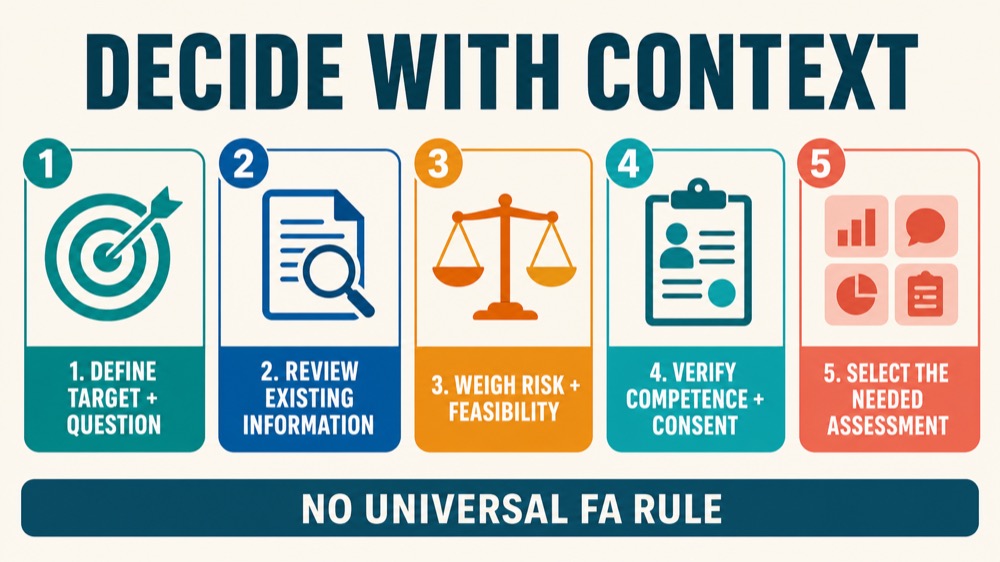
Functional analysis is not automatically feasible, necessary, or inappropriate. It requires relevant competence, resources, reliable measurement, and safeguards for any behavior the assessment could evoke. Before proceeding, the analyst should weigh the likely value of the result against risk, feasibility, stakeholder priorities, and consent or assent as applicable. Depending on the case, a team might use a brief, trial-based, latency-based, precursor, or other modified analysis, collect additional descriptive data, consult a specialist, or defer experimental testing. No single decision rule replaces individualized ethical and clinical judgment.
Key Differences Between FBA and FA
While related, FBA and FA differ in several critical dimensions. The following table summarizes the main contrasts.
| Dimension | FBA | FA |
|---|---|---|
| Scope | Broader multi-method assessment process | Specific experimental procedure that may be included in an FBA |
| Methods | May integrate indirect, descriptive, and experimental methods | Systematic experimental manipulation |
| Variables manipulated? | Depends on the component being used | Yes, across planned test and control conditions |
| Typical output | A hypothesis and assessment-informed action plan | Differentiated or undifferentiated response patterns under arranged conditions |
| Resources | Vary with the question and methods selected | Requires specialized competence, design, and monitoring |
| Risk | Depends on the target behavior and selected methods | Requires case-specific safeguards because target behavior may be evoked |
Components of an FBA can be remembered as follows:
- Indirect assessment (interviews, checklists, record review)
- Descriptive assessment (direct observation, ABC recording)
- Functional analysis (experimental manipulation, when needed)
The Role of Descriptive Assessment
Descriptive assessment is a key component of many FBAs. It involves direct observation of behavior in relevant natural contexts while antecedents and consequences occur without planned manipulation. These observations can identify correlations but cannot by themselves establish causation. For example, tantrums that often follow demands may be related to escape, attention delivered at the same time, task difficulty, or another variable. Descriptive data are still valuable for defining context, refining measurement, generating hypotheses, and planning next steps. When indirect and descriptive findings converge, a team may begin a carefully monitored function-matched intervention; unclear findings, poor treatment response, or high-consequence decisions may justify additional assessment.
How Test and Control Conditions Work
A functional analysis compares one or more test conditions with a relevant control condition. In a test condition, the analyst arranges an antecedent or motivating context and delivers the suspected reinforcer contingent on the target response. In a control condition, relevant establishing operations are minimized and reinforcement is freely or time-based available as appropriate to the design. Higher, replicated responding in a test condition relative to the control can support a functional relation between that contingency and behavior.
Test labels are not a fixed package. Conditions should be individualized to the assessment question, based on prior information, and implemented with procedural integrity. Undifferentiated results do not prove that behavior has no function; they may reflect weak motivating operations, an irrelevant test, interaction among variables, measurement problems, or a need for a different design. The analyst reviews those possibilities before changing the hypothesis or recommending treatment.
Common Traps and Misconceptions
- Collapsing the two labels. The umbrella assessment process and one experimental procedure differ in scope.
- Reducing the broader process to one indirect tool. Interviews can contribute useful information, but an FBA may integrate records, direct observation, experimental assessment, and treatment-response data.
- Overstating ABC observations. Temporally adjacent events can generate a hypothesis; without systematic manipulation, they cannot establish which contingency maintains behavior.
- Imposing a universal experimental requirement. The needed evidence depends on uncertainty, risk, feasibility, and how consequential the decision will be.
- Making a blanket safety judgment. Risk is case- and design-specific, and must be evaluated with concrete safeguards rather than a slogan.
- Underestimating implementation demands. Valid FA design and interpretation require training, measurement quality, procedural integrity, and ongoing safety monitoring.
Decision-Making Examples
Consider a student who engages in disruption during difficult math work. Interviews and repeated direct observations show a consistent relation among task difficulty, disruption, and task removal. The team may begin a function-matched, skill-building intervention while measuring both behavior and task engagement. Improvement would add practical support for the working hypothesis; weak or inconsistent response would prompt a review of implementation and the assessment plan, which could include an experimental test when its added value outweighs its costs and risks.
Now consider self-injury that occurs across settings with no clear descriptive pattern. Severity and uncertainty make stronger evidence valuable, but they do not create an automatic instruction to run an FA. A competent team first conducts a documented risk-benefit analysis, establishes safety criteria and consent, and asks whether the result will change treatment. If experimental assessment is justified, an individualized or modified design may help distinguish social from automatic variables. If it cannot be conducted safely or validly in the current setting, additional observation, consultation, medical coordination, or referral may be the appropriate next step.
Study Checklist for BCBA Candidates
- Define FBA as the broader process and FA as a specific experimental procedure that may be one component.
- Distinguish indirect reports, descriptive observation, and experimental manipulation by the evidence each can support.
- Explain why descriptive covariation does not establish a functional relation.
- Describe how a test condition differs from a control condition.
- Recognize differentiated and undifferentiated FA patterns without overclaiming what either result means.
- Evaluate the value of stronger evidence alongside risk, feasibility, competence, resources, and likely treatment impact.
- Confirm measurement quality, procedural integrity, safeguards, and consent or assent requirements.
- Use treatment-response data to revisit a working hypothesis rather than treating it as permanently proven.
Conclusion: Integrating FBA and FA in Practice
Both FBA and FA play essential roles in identifying the variables that maintain problem behavior. FBA provides a broad, comprehensive approach that typically includes indirect and descriptive methods. FA, when indicated, adds experimental rigor to confirm functional relations. The key is knowing when each is appropriate. For the BCBA exam, you must be able to compare and contrast these processes, articulate the advantages and limitations of each, and apply ethical decision-making. As you prepare, remember to focus on the functional analysis vs functional behavior assessment aba distinction. To reinforce your understanding, take our free BCBA mock exam for more practice questions on assessment.
For further reading, see the BACB BCBA Test Content Outline (6th ed.) and the seminal article on functional analysis methodology by Iwata et al. (1982/1994) available at PMC.
Next step for BCBA exam prep
Turn this topic into exam-day practice
Use this topic as a focused review, then test it in exam-style conditions with a free mock before deciding whether five full-length mocks are the right next step.
Start the Free BCBA Mock Exam
Continue with Five Full-Length Mocks — $99
Review the included materials and access details before ordering. No pass guarantee is implied.



