
What is Informed Consent in ABA?
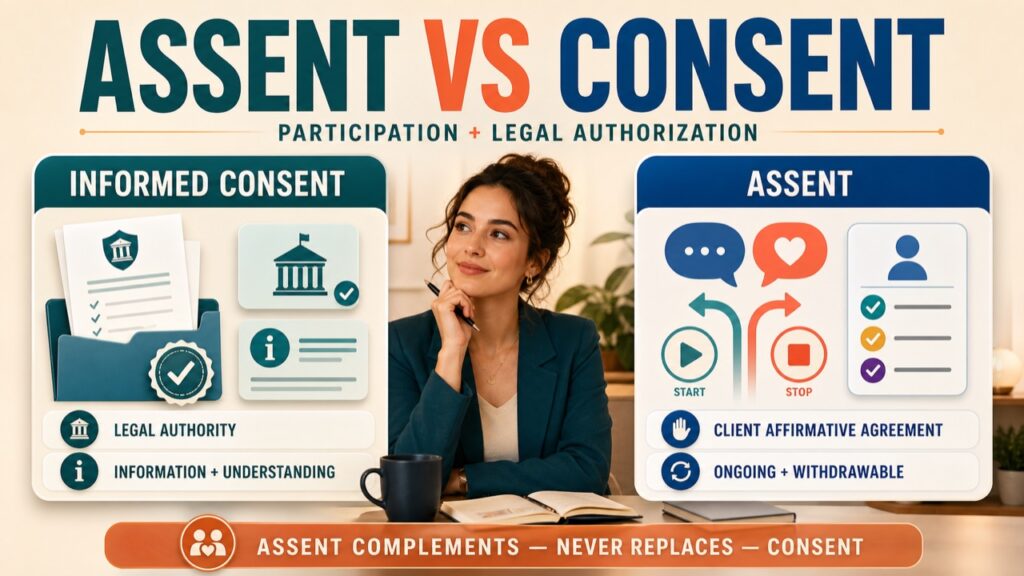
Informed consent is permission given by the individual who has the legal right to authorize participation in services or research, or the use or sharing of information. The person with legal decision-making authority may be the adult client or, when applicable law authorizes it, a parent, guardian, or other legally authorized representative. The BACB glossary describes a communication process that covers the purpose, expected time and procedures, the right to decline or withdraw, potential benefits and risks, limits to privacy, whom to contact, and an opportunity to ask questions. The behavior analyst must take appropriate steps to confirm understanding rather than treating delivery of a form as sufficient.
Table of Contents
- What is Informed Consent in ABA?
- What is Assent in ABA?
- Key Differences Between Assent and Consent
- Assent vs Consent: Practical ABA Examples
- Common Traps in Assent and Consent
- Study Checklist for BCBA Candidates
- Ethical and Practical Integration
- Take the Free BCBA Mock Exam
- References
- Turn this topic into exam-day practice
BACB Ethics Code Standard 2.11 requires behavior analysts to know when consent is required and to explain, obtain, reobtain, and document it under those conditions—for example, before initial implementation of assessments or behavior-change interventions, after substantial changes, or before certain releases of confidential information. The Code does not say that every instance must use one particular signature format. Applicable law, organizational policy, funder rules, the person’s capacity, and the decision at issue determine the valid process. Accessible language, communication supports, time for questions, and documentation of the decision are parts of an ongoing process, not substitutes for legal requirements.
What is Assent in ABA?
Assent is the client’s vocal or nonvocal affirmative indication of willingness to participate when the client cannot independently provide legally valid informed consent. BACB Standard 2.11 says to obtain assent when applicable; the Code contains no separate “2.11b” standard. Assent complements rather than replaces authorization from the legally appropriate decision-maker. Whether and how it is required depends on age, capacity, setting, service, research-review requirements, organizational parameters, and applicable law. A diagnosis or communication difference should not by itself be used to dismiss the person’s ability to express preferences.
Potential assent indicators—such as saying yes, touching a start icon, approaching materials, or initiating interaction—must be interpreted in context and defined for the individual. Potential withdrawal of assent indicators may include saying no or stop, selecting an all-done icon, moving away, turning from materials, or other individually identified behavior. No topography proves willingness in isolation. Silence, absence of resistance, task completion, and compliance are insufficient as affirmative agreement. Teams should offer understandable choices and ways to communicate both participation and withdrawal, then collect data on the opportunities offered and how practitioners responded.
Key Differences Between Assent and Consent
Understanding the distinctions between assent and consent is essential for ethical practice in ABA. The table below summarizes the main differences.
- Legal function: Informed consent authorizes a defined service, research activity, or information use under applicable requirements; assent is affirmative participation and does not supply missing legal authorization.
- Who responds: Consent comes from the person legally empowered for that decision. Assent comes from the direct recipient who cannot independently provide that legal consent.
- Information: Consent requires disclosure and steps to confirm understanding. Assent information should be adapted to the client’s communication and comprehension.
- Evidence: A signed form may document consent but does not make the process permanently valid. Assent requires individualized affirmative indicators, not mere nonresistance.
- Timing: Consent is revisited when required by changes or governing rules. Assent and withdrawal opportunities are monitored throughout relevant interactions.
- Response to withdrawal: Withdrawal of legal consent and withdrawal of assent have different legal effects, but each requires a documented, context-sensitive response rather than coercion or automatic continuation.
A guardian’s authorization does not erase the client’s role. When assent is applicable, the team should define how it will be invited, how withdrawal can be communicated, and how staff will respond. The exact obligations remain tied to the person, decision, service, setting, and governing requirements; this comparison is ethical education, not jurisdiction-specific legal advice.
Assent vs Consent: Practical ABA Examples
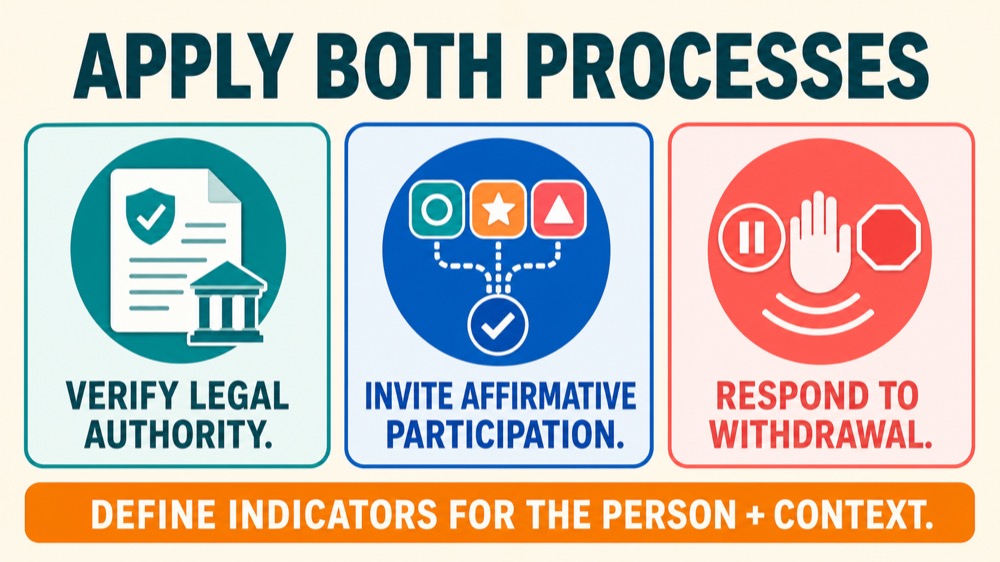
Example 1: Early Intervention for a 4-Year-Old Child. A parent with verified authority gives informed consent for in-home services after receiving the required information. The team and family identify accessible participation and withdrawal responses for this child—for example, touching start or all-done icons, approaching a selected activity, saying no, or moving away. Approaching while smiling may be relevant data, but it is not automatically coded as assent without the individualized definition and context. When withdrawal occurs, the practitioner ends or pauses the specific condition, offers communication and choice, checks for health or environmental variables, and documents the response. Patterns across sessions prompt review of goals, procedures, and risk-benefit balance.
Example 2: Adult with Intellectual Disability in a Vocational Setting. The team does not assume incapacity from disability status. It verifies who has legal authority for this particular decision and provides the adult with accessible explanations, pictures, questions, and supported choices. If a representative supplies required consent, the adult’s own affirmative agreement is still sought when applicable. A nod and reach may match the person’s established assent definition; looking away may trigger a check-in, but one ambiguous movement is not interpreted mechanically. The coach offers a break or task choice, confirms what the person is declining, and records both the client response and staff action.
Example 3: Adolescent in a School Setting. The school team follows applicable education law and policy for authorization while explaining goals and procedures directly to the student in an understandable format. The student’s yes and active participation are monitored as part of an ongoing process. Refusal to enter one room prompts the BCBA to pause that transition, ask what feature is being declined, offer alternatives, and assess possible health, safety, communication, or environmental variables. The response is individualized; it is neither forced participation nor an automatic permanent end to every service. Substantial plan changes trigger the consent process required for the setting and renewed assent opportunities.
Common Traps in Assent and Consent
- Trap 1: Equating silence with assent. Failure to object is not affirmative agreement. Provide an accessible opportunity to say yes, no, stop, or choose an alternative.
- Trap 2: Treating compliance as proof. Task completion describes performance, not the legal or ethical status of participation. Use individually defined assent measures and avoid guessing private causes.
- Trap 3: Treating one signature as permanent consent. Explain, obtain, reobtain, and document consent when governing conditions require it; substantial changes are a clear review point under Standard 2.11.
- Trap 4: Treating guardian consent as the end of participation review. Seek and monitor the client’s assent when applicable, while preserving the distinct legal role of the authorized decision-maker.
- Trap 5: Applying one automatic rule to every refusal. Respond promptly to the treatment condition being declined, the person’s communication plan, immediate risk, and applicable requirements. Do not infer that every transient refusal permanently ends every service, and do not use that caveat to ignore withdrawal.
Good practice separates three records: what information and authorization were provided, what assent or withdrawal opportunity the client received, and what the practitioner did next. That audit trail makes an ongoing process visible and supports later clinical, ethical, and legal review.
Study Checklist for BCBA Candidates
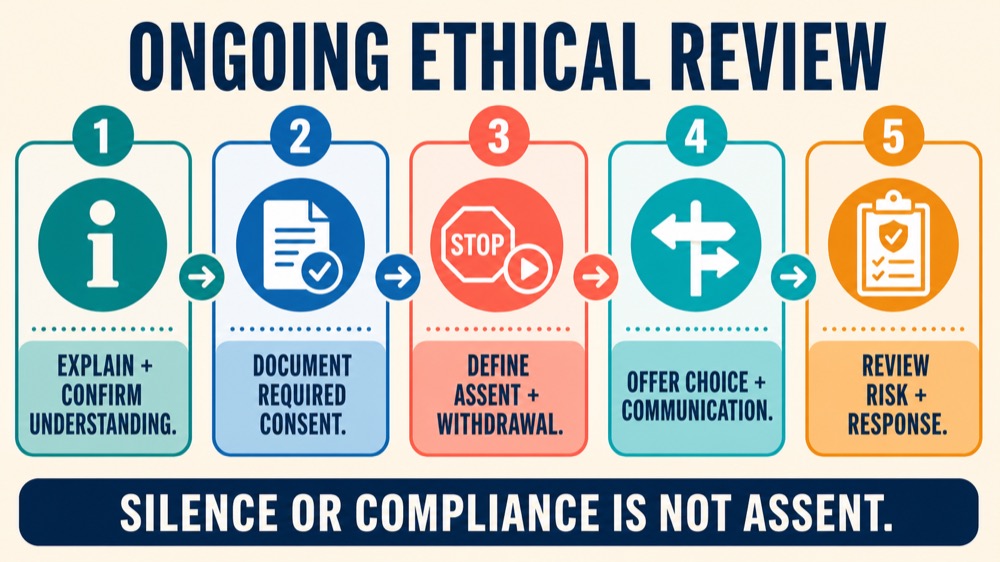
- Define informed consent and identify the person with legal decision-making authority for the specific decision.
- Explain why assent complements but cannot replace legally valid informed consent.
- Distinguish individually defined assent and withdrawal indicators from silence, nonresistance, or compliance.
- Describe how capacity, age, setting, service, research oversight, and applicable law affect the process.
- Connect the comparison to BACB Ethics Code Standard 2.11 and the glossary definitions; do not invent a “2.11b” standard.
- Plan ongoing communication, understandable choices, risk-benefit review, documentation, and responsiveness to withdrawal.
- Analyze original scenarios without assuming that every brief refusal requires permanent termination or that guardian consent permits coercion.
For more practice on ethics and other BCBA topics, try our Free BCBA Mock Exam for sample questions and feedback to help you prepare.
Ethical and Practical Integration
Integrating assent-based practice means designing participation and withdrawal into the service rather than measuring cooperation alone. Before implementation, define understandable ways to start, pause, stop, ask questions, and choose among feasible options. During services, monitor the person’s individualized indicators and practitioner behavior. After withdrawal, identify the particular treatment condition involved, remove or pause it when appropriate, reinforce functional communication, assess health and environmental variables, and revisit the plan with the legally authorized person and relevant team. Immediate safety duties, court or agency requirements, and essential care can create complex constraints, so use the least restrictive, contextually justified response and document the ethical decision process.
Risk-benefit review is also ongoing. Repeated withdrawal with one task, practitioner, setting, or procedure may reveal excessive difficulty, weak communication supports, a physiological need, poor social validity, or an avoidable aversive feature. Data should include opportunities to assent or withdraw, the client’s responses, latency or other relevant measures, and how staff responded—not merely the percentage of demands completed. Documentation should separately capture informed-consent communication, current authorization, assent definitions, withdrawal events, modifications, consultation, and follow-up. Laws and organizational rules vary, so this article is not legal advice; verify the requirements governing the actual service and jurisdiction.
Take the Free BCBA Mock Exam
Ready for more practice? Use the free mock exam to keep testing your accuracy with realistic BCBA-style items. Take the Free BCBA Mock Exam
References
- BACB Ethics Code for Behavior Analysts
- Assent in Applied Behaviour Analysis and Positive Behaviour Support (PMC)
Complete BCBA Exam Prep
Turn this topic into exam-day practice
Practice concepts in context with five full-length 6th Edition mock exams, two bonus practice exams, a 6th Edition study guide, and key-term flashcards—all in one $120 USD package. Get the $120 All-in-One Prep Pack Review everything included on the product page before ordering. No pass guarantee is implied.



