

What Is Discrete Trial Teaching? A BCBA Exam Definition
Discrete trial teaching (DTT) is a structured instructional method used in Applied Behavior Analysis to teach new skills. It breaks down complex behaviors into small, teachable units called trials. Each trial has a clear beginning and end, allowing for repeated practice and precise data collection.
Table of Contents
- What Is Discrete Trial Teaching? A BCBA Exam Definition
- How to Run a Discrete Trial: Step-by-Step Procedure
- Discrete Trial Teaching Examples with ABC Analysis
- Exam Relevance: Why DTT Matters on the BCBA Exam
- Quick Checklist for Discrete Trial Teaching
- Summary: Discrete Trial Teaching for BCBA Success
- Turn this topic into exam-day practice
- Take the Free BCBA Mock Exam
DTT is particularly effective for learners with autism and other developmental disabilities. It is grounded in the principles of positive reinforcement and prompt fading. The structured nature of DTT allows instructors to control the learning environment, minimize distractions, and maximize the number of learning opportunities per session. This precision makes DTT a cornerstone of early intensive behavioral intervention (EIBI) programs.
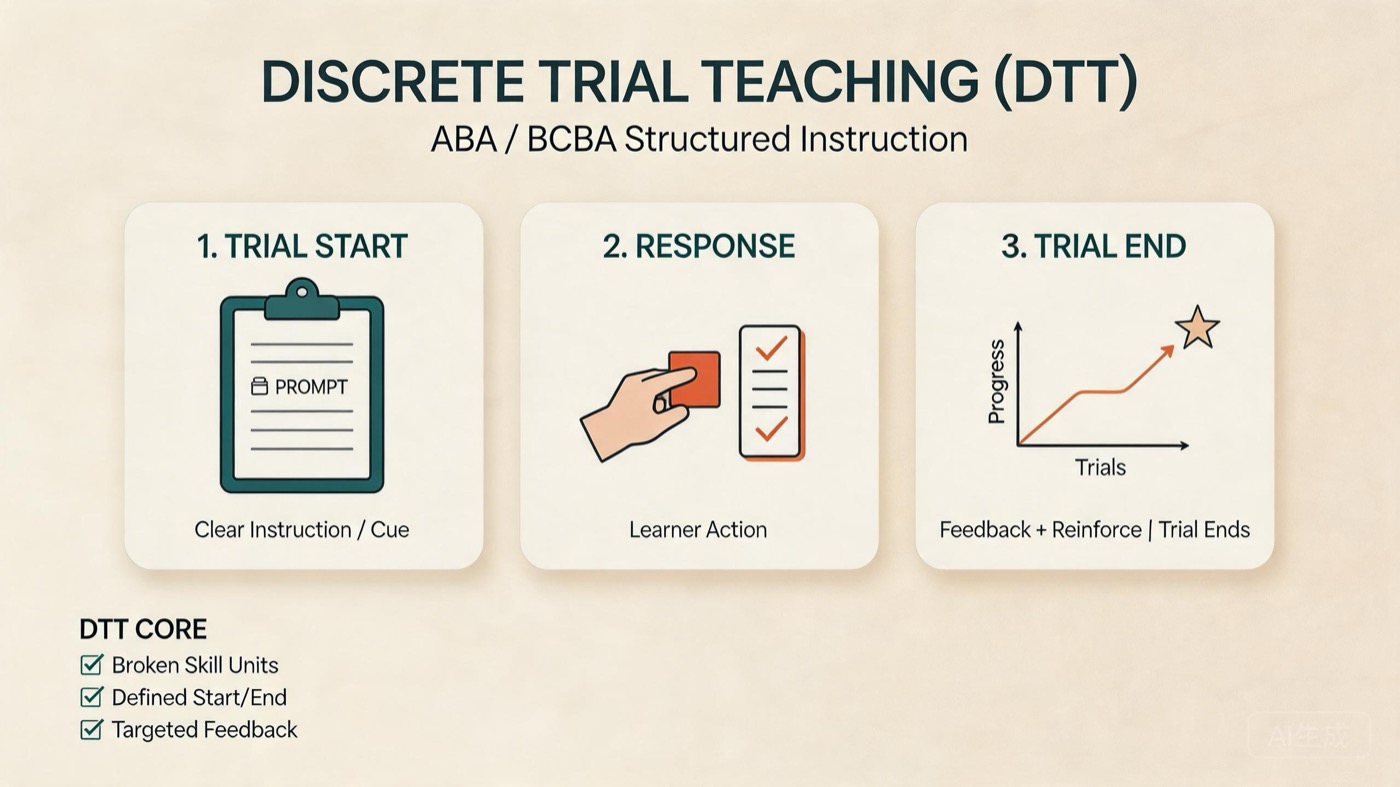 Key Components of a Discrete Trial: Use the points below as a quick study guide.
- Antecedent (SD): The discriminative stimulus that signals the opportunity to respond.
- Prompt: Additional cues to help the learner respond correctly.
- Response: The learner’s behavior (correct, incorrect, or no response).
- Consequence: Reinforcement for correct responses or error correction for mistakes.
- Inter-trial interval (ITI): A brief pause (1–5 seconds) between trials to reset attention.
How to Run a Discrete Trial: Step-by-Step Procedure
Implementing DTT requires careful planning and consistency. Follow these steps to ensure effective teaching. Each step builds on the previous one, and deviations can impact learning outcomes. Practitioners must also consider the learner’s current skill level and motivation when setting up trials.
Setting the Discriminative Stimulus (SD): The SD should be clear, concise, and presented in a neutral tone. For example, hold up a picture of a cat and say ‘Point to cat.’ Avoid extra words. The SD must be distinctive enough that the learner can discriminate it from other stimuli. For instance, if teaching colors, ensure the SD ‘Give me red’ is presented with only red and a distractor color initially.
Prompting and Prompt Fading: Use the least intrusive prompt necessary. Common types include full physical, partial physical, modeling, and gestural prompts. Fade prompts systematically to promote independence. A common fading method is most-to-least prompting, where you start with a full physical prompt and gradually reduce assistance over trials. Alternatively, least-to-most prompting begins with the least intrusive prompt and increases only if the learner makes an error. The exam often tests your ability to select the appropriate fading strategy based on the learner’s progress.
Consequences: Reinforcement and Error Correction: Deliver immediate reinforcement for correct responses (e.g., praise, token, edible). For errors, implement a correction procedure such as modeling the correct response and re-presenting the SD. Some error correction procedures include errorless learning (where prompts are used to prevent errors) or trial-and-error correction (where the learner is allowed to make errors and then receives corrective feedback). The key is to be consistent and to avoid reinforcing incorrect responses inadvertently.
Inter-trial Interval and Data Collection: After the consequence, pause briefly (ITI) before the next trial. Record data on each trial using a trial-by-trial data sheet to track progress. Data collection is critical for making data-based decisions. Common data formats include correct/incorrect tallies, percentage correct, or latency to respond. The duration of ITI should be just enough to clear the previous trial without losing the learner’s attention.
Discrete Trial Teaching Examples with ABC Analysis
Applying ABC analysis to DTT helps identify the function of behavior and guide reinforcement strategies. Understanding the ABC pattern also helps practitioners troubleshoot when a learner is not acquiring a skill. Example 1: Teaching a Child to Point to a Picture: Use the points below as a quick study guide.
- Antecedent: Therapist places two pictures on the table and says ‘Point to cat.’
- Behavior: Child points to the picture of the cat.
- Consequence: Therapist says ‘Great job!’ and gives a token. Function: Positive reinforcement (social approval).
In this example, the child learns to respond to the SD. If the child points to the wrong picture, the therapist might model the correct response and repeat the trial. Example 2: Teaching a Learner to Label Emotions: Use the points below as a quick study guide.
- Antecedent: Therapist shows a photo of a happy face and asks ‘How does she feel?’
- Prompt: Therapist gestures toward a ‘happy’ picture card.
- Behavior: Learner says ‘Happy.’
- Consequence: Therapist says ‘Yes! She is happy.’ Function: Positive reinforcement (social approval).
As the learner becomes more proficient, the gestural prompt can be faded entirely. This example illustrates how prompts are used initially and then removed. Example 3: Teaching a Client to Match Colors: Use the points below as a quick study guide.
- Antecedent: Therapist places a red card on the table and says ‘Match red.’
- Behavior: Client places another red card next to it.
- Error correction: If incorrect, therapist models matching and repeats the trial.
- Consequence: Therapist provides an edible reinforcer. Function: Positive reinforcement (edible).
This example shows how error correction is integrated. Note that the reinforcer (edible) is different from the previous examples, indicating that reinforcement should be individualized based on the learner’s preferences. Example 4: Teaching a Learner to Respond to Their Name: Use the points below as a quick study guide.
- Antecedent: Therapist says the learner’s name from a distance of 3 feet.
- Behavior: Learner turns head and makes eye contact.
- Consequence: Therapist claps and says ‘Nice looking!’ Function: Social reinforcement.
This example is common for early learners. If the learner does not respond, a tactile prompt (e.g., gentle tap on the shoulder) might be added.
Exam Relevance: Why DTT Matters on the BCBA Exam
DTT appears frequently on the BCBA exam under task list items related to skill acquisition, prompting, and data collection. Understanding the components and procedures is critical for success. The exam may ask you to identify the correct sequence of a trial, select an appropriate prompt fading procedure, or analyze data from a DTT session.
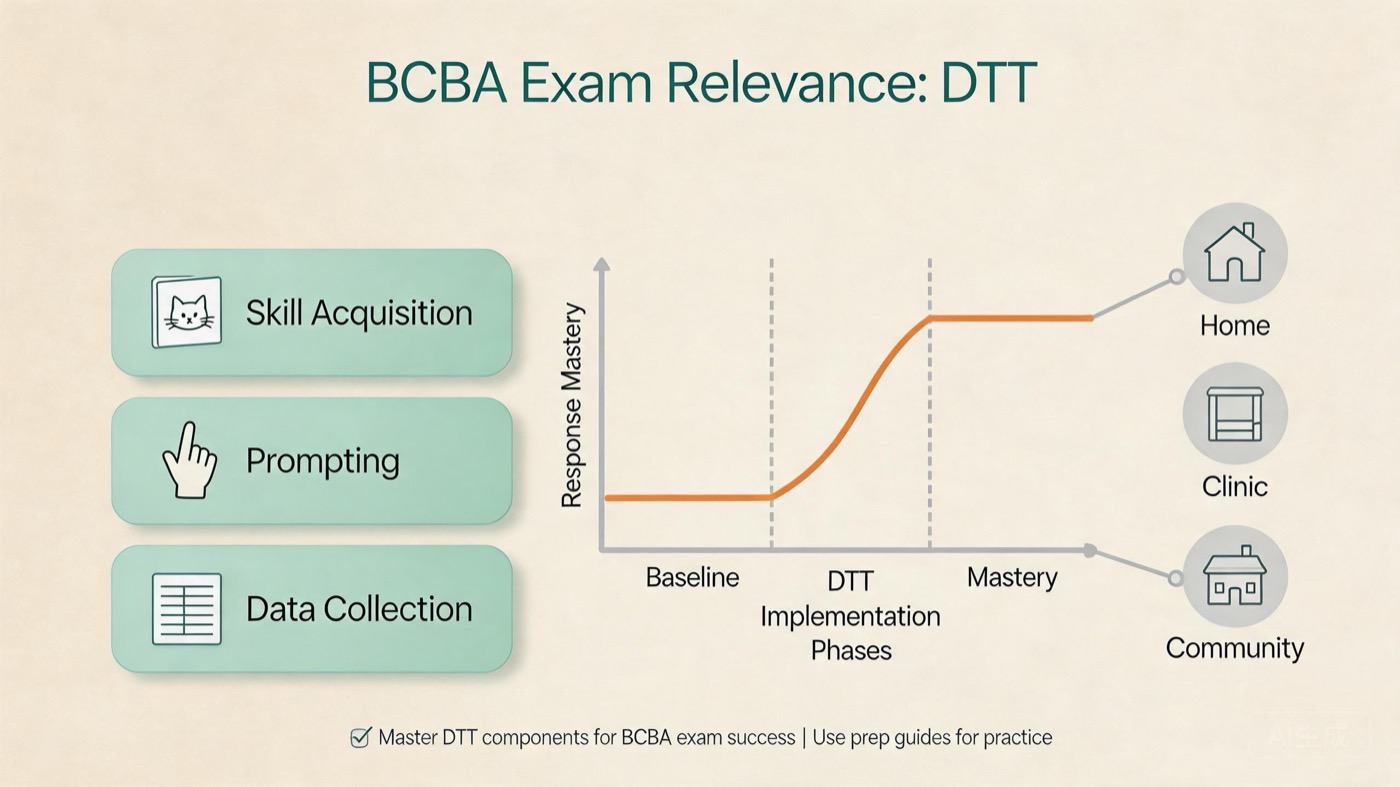 Common Exam Traps to Avoid: Use the points below as a quick study guide.
- Confusing ITI with inter-observer agreement (IOA): ITI is a pause between trials; IOA is a measure of reliability.
- Overusing prompts: The exam often tests whether you know to fade prompts to avoid prompt dependency.
- Misunderstanding errorless learning: Errorless learning uses heavy initial prompts to prevent errors, then fades; it is not the same as trial-and-error.
- Forgetting reinforcement delay: Reinforce immediately after the correct response to strengthen the association.
- Ignoring session pace: Too slow or too fast trials can affect learning. The exam may present a scenario where you need to adjust the ITI or number of trials.
For more practice, check out our BCBA exam prep guide for additional strategies. Understanding DTT also helps in other domains such as preference assessments and token economies, as these systems often incorporate DTT components.
Quick Checklist for Discrete Trial Teaching
Use this checklist to ensure fidelity during DTT sessions or to review for the exam.
- Present a clear SD without extra verbal cues.
- Use the least intrusive prompt and plan a fading schedule.
- Deliver immediate reinforcement for correct responses.
- Implement a consistent error correction procedure.
- Record data on each trial after the consequence.
- Maintain a brief inter-trial interval (1–5 seconds).
- Rotate targets to prevent boredom and promote generalization.
- Conduct preference assessments regularly to maintain reinforcer effectiveness.
Summary: Discrete Trial Teaching for BCBA Success
Discrete trial teaching is a foundational skill for BCBAs. By mastering the components, procedures, and common pitfalls, you can effectively teach new behaviors and ace related exam questions. Review the checklist regularly and apply the examples to real-world scenarios. For further reading, consult the BACB’s official resources and research articles on DTT. Remember, practice with real or simulated trials will solidify your understanding.
Complete BCBA Exam Prep
Turn this topic into exam-day practice
Practice concepts in context with five full-length 6th Edition mock exams, two bonus practice exams, a 6th Edition study guide, and key-term flashcards—all in one $120 USD package. Get the $120 All-in-One Prep Pack Review everything included on the product page before ordering. No pass guarantee is implied.
Take the Free BCBA Mock Exam
Ready for more practice? Use the free mock exam to keep testing your accuracy with realistic BCBA-style items. Take the Free BCBA Mock Exam



