
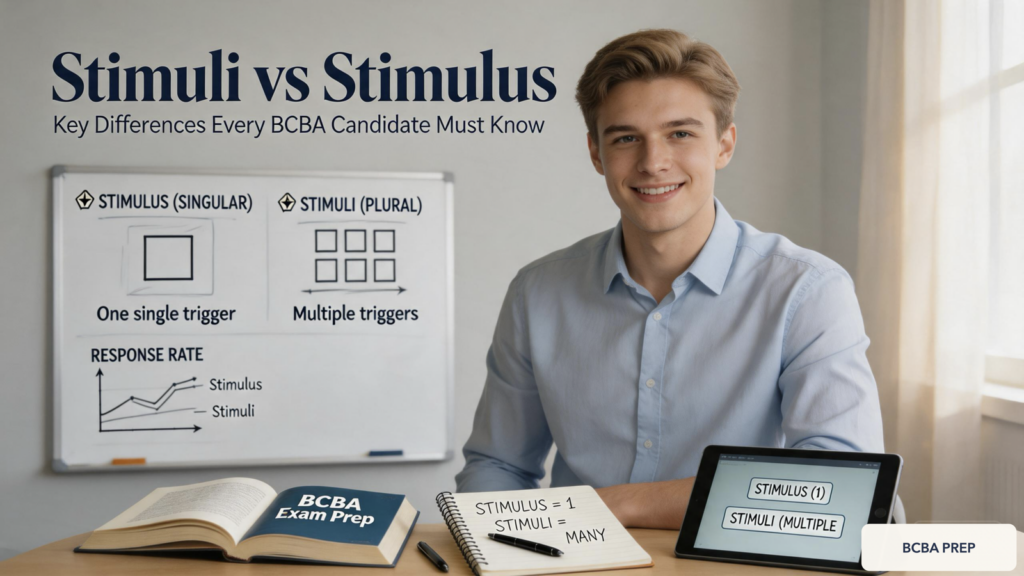
What Is a Stimulus vs What Are Stimuli?
In applied behavior analysis, the terms stimulus and stimuli appear constantly. Understanding the difference between them is foundational for the BCBA exam and for accurate ABA practice. Let’s break it down.
Table of Contents
- What Is a Stimulus vs What Are Stimuli?
- Why This Distinction Matters for the BCBA Exam
- Stimulus and Stimuli in Practice: ABC Examples
- Quick Checklist: Master These Key Points
- References
Stimulus Defined
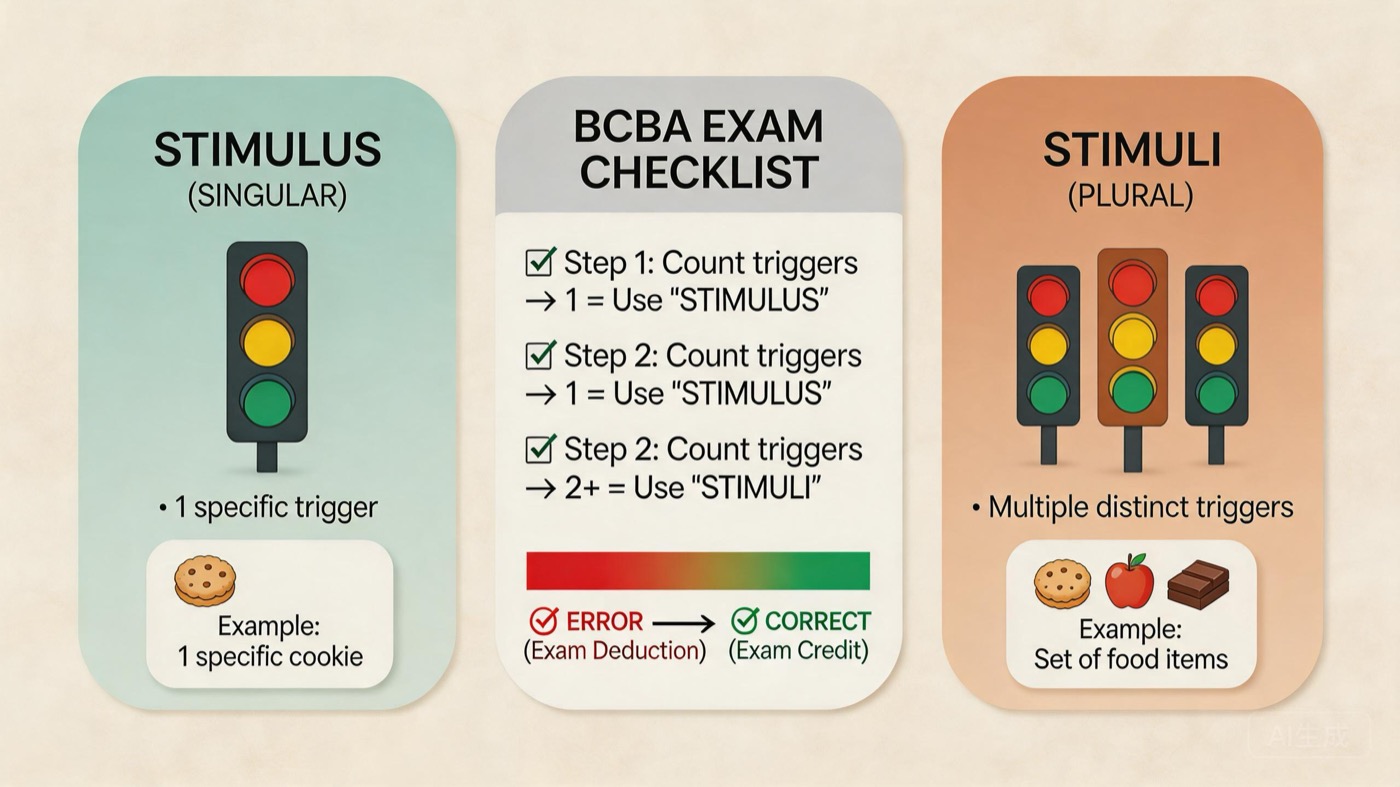
A stimulus (singular) is any environmental event that can evoke or change behavior. It can be a light, a sound, a verbal instruction, or even the absence of something. In ABA, stimuli are the building blocks of the three-term contingency (antecedent-behavior-consequence). For instance, a stop sign is a stimulus for a driver to apply the brakes. In a clinical setting, a therapist’s instruction “touch red” serves as a stimulus for the client to respond. The key is that a stimulus always refers to a single event or object that influences behavior. On the BCBA exam, you may encounter questions asking you to identify the stimulus in a given scenario, so it’s crucial to pinpoint exactly one environmental event that triggers or changes a response.
Stimuli Defined
Stimuli (plural) refers to multiple stimuli. In ABA, you often work with groups of stimuli, such as a set of pictures in a discrete trial or various social cues in a natural environment. Recognizing the plural form is crucial for documentation and communication. For example, when conducting a preference assessment, you might present a variety of toys—each toy is a stimulus, but together they form stimuli. Another common example is a stimulus class, which includes multiple stimuli that share a common function, such as all red objects that evoke the same response. On the exam, be careful not to write “stimulus” when you mean multiple. For instance, saying “the stimulus were presented” is a grammatical error that could confuse readers and exam scorers. Instead, use “the stimuli were presented.” This distinction might seem minor, but precision in terminology reflects a deeper understanding of behavioral principles.
Moreover, the BACB Task List explicitly includes “stimulus” and “stimulus class” as key concepts (e.g., Task List items B-10, B-11). Mastering the singular-plural distinction helps you answer questions about stimulus equivalence, stimulus generalization, and stimulus control more accurately. For example, stimulus equivalence involves the emergence of untrained relations among multiple stimuli, so you must be comfortable with the plural form. Similarly, stimulus generalization occurs when a response is evoked by stimuli that share similar features with the original training stimulus. Understanding these concepts begins with a solid grasp of what a stimulus is versus what stimuli are.
Additionally, the distinction between stimulus and stimuli appears in everyday ABA documentation. Behavior intervention plans often list antecedents that are single stimuli (e.g., a specific instruction) or multiple stimuli (e.g., a noisy classroom). When writing ABC data, you need to decide whether the antecedent is one event or a set of events. This choice affects how you analyze patterns and develop interventions. For example, if a child’s tantrum occurs only when the teacher says “time to clean up” (a single stimulus), the intervention is different than if it occurs when the teacher gives any instruction (multiple stimuli). Such precision is essential for effective behavior change.
Why This Distinction Matters for the BCBA Exam
The BCBA exam tests your precision in using behavioral terminology. Confusing stimulus and stimuli can lead to errors in data recording and analysis. Here are common traps.
Common Mistakes Candidates Make
- Writing ‘stimulus’ when describing multiple antecedents (e.g., ‘the stimulus were presented’ should be ‘the stimuli were presented’).
- Misidentifying a single discriminative stimulus (S^D) versus a stimulus delta (S-delta) in a multiple-choice scenario.
- Confusing stimulus class (a group of stimuli that share a common effect) with individual stimuli.
- Forgetting that a stimulus can be internal (e.g., a thought or feeling) as well as external. While the exam focuses on observable events, some newer questions touch on private events as stimuli.
How Exam Questions Test This
Typical exam items ask you to identify whether a described event is a stimulus or a set of stimuli. For example: ‘During a DTT session, the therapist shows a red card, a blue card, and a green card. These are examples of ________.’ The correct answer is stimuli (plural). Another common question: ‘What is the antecedent stimulus that increases the likelihood of a correct response?’ That is a discriminative stimulus (singular). Additionally, questions may ask about stimulus control: “Which stimulus is controlling the behavior?” Here, you need to identify the single stimulus that most directly influences the response. For example, if a child always says “ball” when shown a red ball but not a blue ball, the red ball (single stimulus) is the discriminative stimulus. Practicing these types of questions will sharpen your ability to distinguish singular from plural in exam contexts.
Another critical area is the concept of stimulus equivalence, which involves multiple stimuli that become interchangeable. On the exam, you may be asked to identify whether a relation is reflexive, symmetric, or transitive—all of which involve pairs of stimuli. To answer correctly, you must recognize that you are working with multiple stimuli (plural). For instance, if training includes A→B and B→C, and the learner demonstrates C→A, that is a relation among three different stimuli. Each is a stimulus, but together they form a network of stimuli. Without a solid understanding of the singular-plural distinction, you might misinterpret the question.
Furthermore, data collection in ABA often involves counting stimuli presented during a trial. For example, in a multiple-stimulus without replacement (MSWO) preference assessment, you present several stimuli and remove the chosen one each trial. You need to document the array of stimuli presented. Using correct terminology here ensures clear communication with supervisors and peers. The exam may ask about the procedural details of MSWO, which involves “multiple stimuli”—not “multiple stimulus.”
Stimulus and Stimuli in Practice: ABC Examples
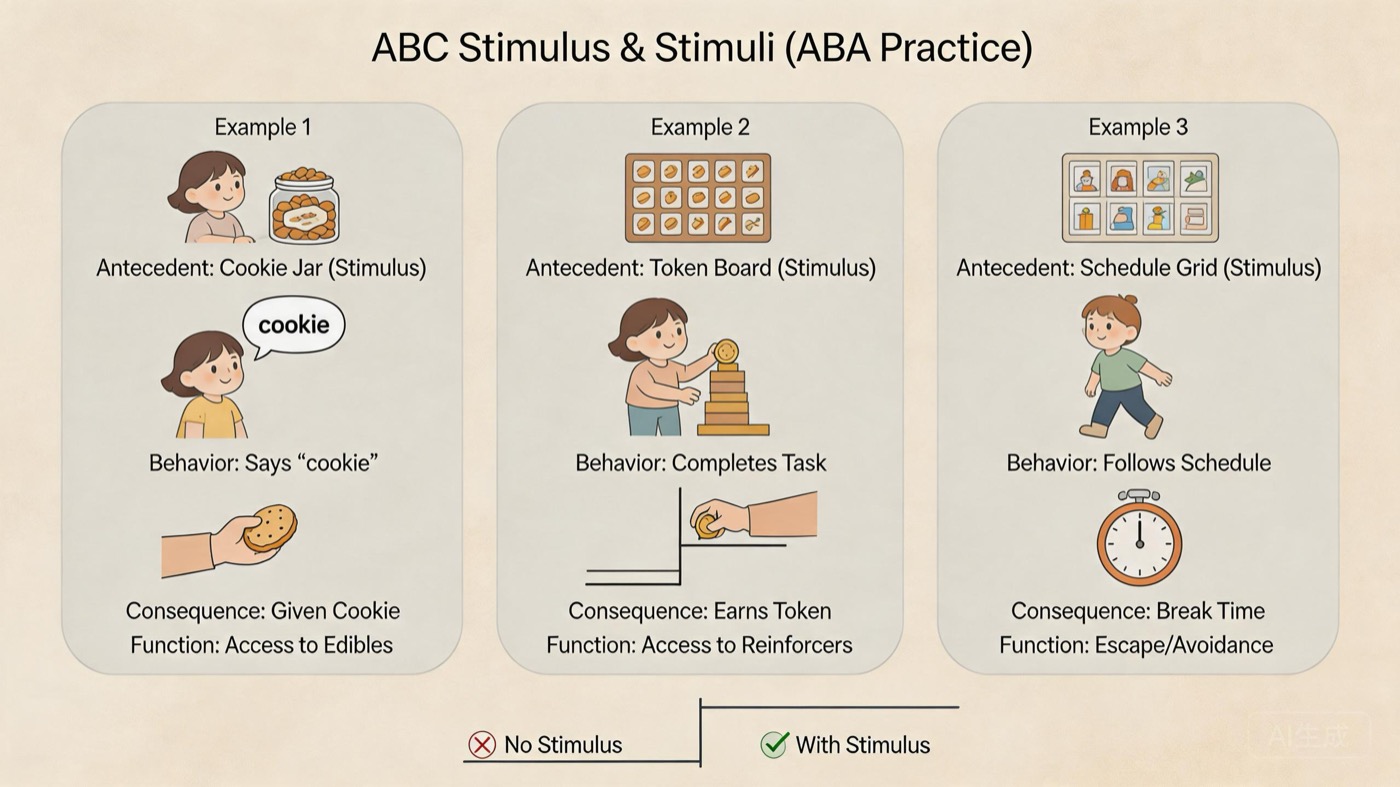
Let’s explore four practical examples that illustrate how stimulus and stimuli appear in ABC data collection. Each includes a hypothesized function.
Example 1: Discriminative Stimulus (S^D)
A child sees a cookie jar (antecedent stimulus) and says ‘cookie.’ The parent gives a cookie (consequence). The hypothesized function is positive reinforcement. Here, the cookie jar is a single stimulus that signals availability of reinforcement.
Example 2: Stimulus Delta (S-Delta)
The teacher says ‘no talking’ (S-Delta). The student remains quiet and avoids a reprimand. The hypothesized function is negative reinforcement (avoidance). The teacher’s instruction is a single stimulus that signals non-reinforcement for talking.
Example 3: Multiple Stimuli in One Session
During DTT, the therapist presents three cards (red, blue, green) – these are multiple stimuli. The child selects the correct color and receives praise. Function: positive reinforcement. Note: the cards are a set of stimuli, not a single stimulus.
Example 4: Stimulus Generalization
A student learns to say ‘thank you’ when a teacher gives a sticker (single stimulus). Later, the student says ‘thank you’ when given a pencil or a high-five (multiple stimuli). The response generalized across different stimuli. In ABC data, you would record each antecedent as different stimuli that evoke the same behavior. The function remains positive reinforcement, but the antecedents are multiple stimuli. This example highlights how a single stimulus can expand into a class of stimuli over time.
Quick Checklist: Master These Key Points
- Use stimulus when referring to one environmental event.
- Use stimuli when referring to two or more events.
- In ABC data, label the antecedent and consequence correctly as singular or plural.
- Know the difference between S^D (stimulus that signals reinforcement) and S-delta (stimulus that signals extinction).
- Practice identifying stimulus classes on your own data sheets and exam questions.
- Remember that stimuli can be internal (thoughts, feelings) but for the exam, focus on observable environmental events unless specified.
- Double-check your written responses for grammatical agreement: singular verbs with singular subjects, plural verbs with plural subjects.
For additional practice, explore our stimulus control guide and discriminative stimulus article. Also refer to the BACB Task List for more details on stimulus-related content.
References
Complete BCBA Exam Prep
Turn this topic into exam-day practice
Practice concepts in context with five full-length 6th Edition mock exams, two bonus practice exams, a 6th Edition study guide, and key-term flashcards—all in one $120 USD package.
Get the $120 All-in-One Prep Pack
Review everything included on the product page before ordering. No pass guarantee is implied.



