
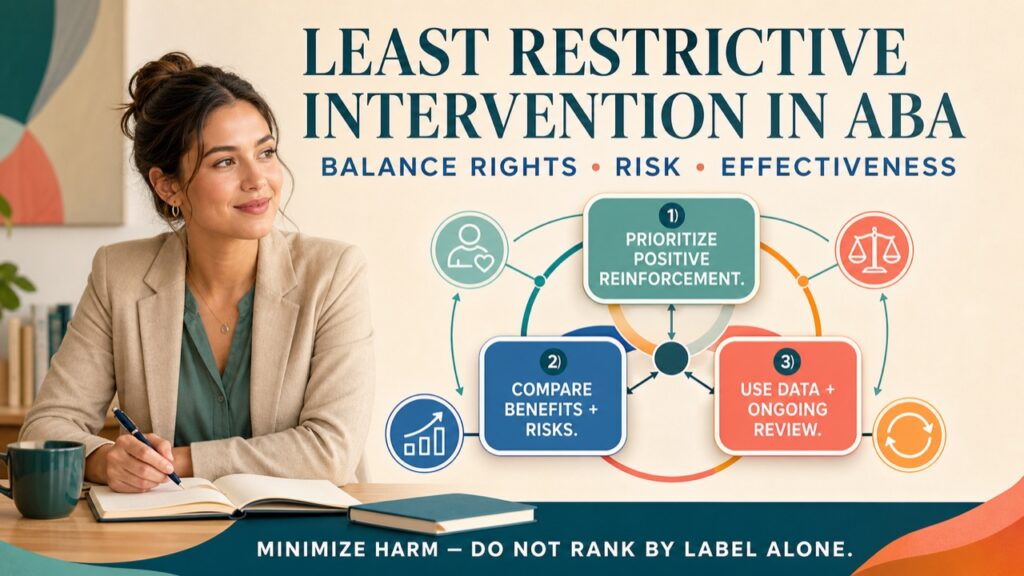
Least restrictive intervention in ABA is best understood as a contextual ethical consideration, not a rule that can be applied without looking at outcomes. Treatment selection should protect client rights and dignity while also considering effectiveness, risk, preferences, setting, available resources, and ongoing data. The current BACB Ethics Code for Behavior Analysts requires behavior analysts to prioritize positive-reinforcement procedures when selecting interventions (2.14) and to minimize risk when restrictive or punishment-based procedures are considered (2.15). This guide explains how those duties fit with least-restrictive decision making without treating “least restrictive” as a stand-alone slogan.
Table of Contents
- What Is Least Restrictive Intervention in ABA?
- Ethical Obligations and Client Rights
- Distinguishing Restrictiveness, Intrusiveness, and Effectiveness
- Common Traps in Least Restrictive Decision-Making
- Risk-Benefit Analysis Example
- Integrating Effectiveness and Ongoing Review
- Study Checklist and Key Takeaways
What Is Least Restrictive Intervention in ABA?
The phrase least restrictive asks how a choice affects freedom, access, participation, dignity, and quality of life relative to its likely benefits and risks. In its position statement on restraint and seclusion, the Association for Behavior Analysis International defines least restrictiveness through the overall risk-to-benefit relationship, including the probability and timing of success, distress caused by the procedure, and distress or lost opportunity caused by the behavior itself. That source addresses a high-risk clinical context; it should not be read as a general how-to guide for restrictive procedures.
This framing prevents a common error: ranking procedures by appearance alone. A low-effort option that leaves serious behavior unchanged and prevents learning or community participation may produce a worse overall restriction than a more intensive but safe, reviewed, and effective intervention. At the same time, effectiveness never erases the duties to protect rights, minimize harm, involve the client and stakeholders, obtain informed consent when appropriate, and comply with applicable review processes. The decision is a documented comparison of viable options in context, followed by data-based evaluation.
Ethical Obligations and Client Rights
Several current BACB standards work together. Standard 2.13 governs assessment selection and requires scientific, behavior-analytic assessments that fit the client’s needs, context, and resources while maximizing benefit and minimizing harm. Standard 2.14 governs behavior-change interventions: they must be evidence based, assessment based, conceptually consistent, individualized, and designed to prioritize positive reinforcement. It also requires consideration of risks, benefits, side effects, preferences, implementation efficiency, cost effectiveness, and maintenance under natural conditions.
Standard 2.15 focuses on minimizing risk. Restrictive or punishment-based procedures may be recommended or implemented only after desired results have not been obtained through less-intrusive means, or when an existing intervention team determines that the risk posed by the behavior outweighs the intervention risk. Required review processes must be followed, and effectiveness must be continually documented. This is not a shortcut around assessment, consent, competence, or applicable law and policy.
Standards 2.16 through 2.18 add the implementation safeguards: describe objectives, procedures, timelines, and the review schedule in writing; explain necessary conditions and obtain informed consent when appropriate; collect and use data for decisions; and continually evaluate the intervention. Together, these duties protect client rights by requiring both meaningful benefit and an accountable process.
Key BACB standards to keep separate:
- 2.13: Select and design assessments that fit the client and minimize risk.
- 2.14: Select evidence-based, assessment-based interventions that prioritize positive reinforcement and fit the client’s context.
- 2.15: Minimize intervention risk and apply extra limits, review, documentation, and evaluation to restrictive or punishment-based procedures.
- 2.16–2.18: Describe the plan, obtain informed consent when appropriate, use data, and conduct ongoing review.
Distinguishing Restrictiveness, Intrusiveness, and Effectiveness
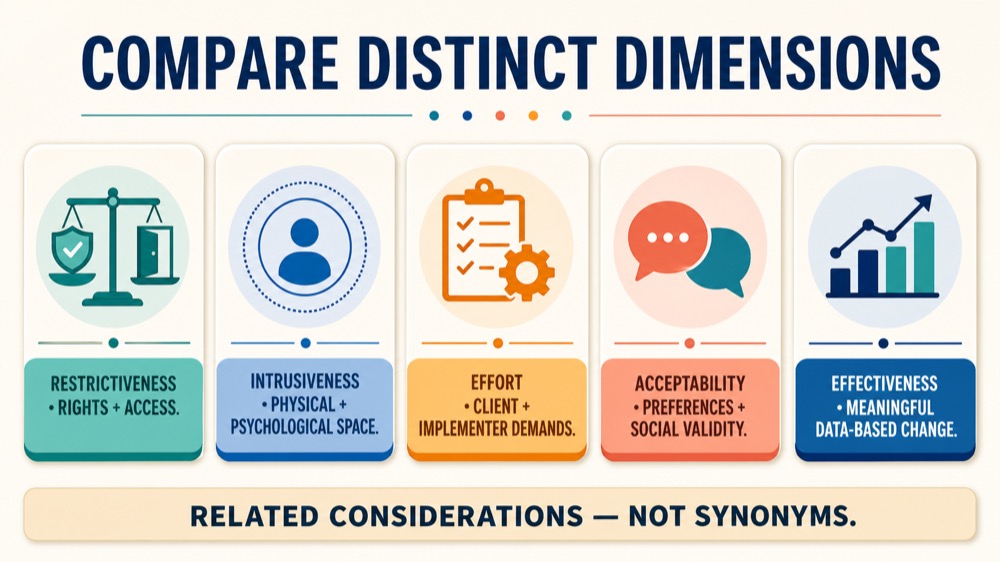
These dimensions overlap, but they are not synonyms. Restrictiveness concerns limits on rights, choice, access, participation, or ordinary environments. Intrusiveness concerns how much a procedure enters a person’s physical or psychological space. Effort concerns what the client and implementers must do. Acceptability concerns social validity and stakeholder judgment. Effectiveness concerns whether data show socially meaningful change. A procedure can score differently on each dimension, so one label cannot substitute for a full comparison.
A sound risk-benefit analysis compares plausible benefits, risks, side effects, implementation demands, preferences, delays to improvement, and consequences of no effective change. It also asks whether the proposed plan can be implemented competently and monitored well in the actual setting. Positive-reinforcement procedures receive priority under Code 2.14, but they still require assessment, individualization, treatment-integrity checks, and outcome data. Conversely, a demonstrated effect is only one part of an ethical decision; effectiveness alone does not resolve questions about consent, dignity, risk, or review.
A useful decision record makes that comparison observable. It identifies the socially significant outcome, the assessment evidence supporting each option, the client’s preferences and communication, foreseeable benefits and harms, implementation requirements, and the data that will trigger continuation, revision, or discontinuation. The record should also distinguish what is known from what is uncertain. For example, research may support a procedure in general while the team still lacks evidence that it fits this client, implementer, or setting. A time-limited review point helps prevent an intervention from continuing merely because it was approved once. When risk is elevated, consultation and any required human-rights, clinical, organizational, or legal review should occur before implementation, not after a problem appears. These safeguards do not replace clinical judgment; they make the reasoning, responsibilities, and follow-up testable.
Comparison of Key Terms: Use the points below as a quick study guide.
- Restrictiveness: How much the intervention limits access to reinforcers, activities, or choices.
- Intrusiveness: Degree of physical or psychological invasion (e.g., physical prompts, restraints).
- Acceptability: How comfortable the intervention is for clients, families, and stakeholders.
- Effectiveness: Degree of socially significant behavior change produced.
Common Traps in Least Restrictive Decision-Making
- Ranking by label alone: “Nonintrusive” does not automatically mean low risk, acceptable, or effective. Compare the full context and likely outcomes.
- Ignoring effectiveness: A nominally gentle option that does not produce meaningful benefit may prolong harm or unnecessarily restrict participation.
- Using effectiveness as the only test: Outcome data do not cancel duties involving dignity, consent, competence, client preference, or risk.
- Collapsing distinct dimensions: Restrictiveness, intrusiveness, effort, acceptability, and effectiveness must be analyzed separately.
- Skipping reinforcement-based options: Code 2.14 gives positive reinforcement priority, while Code 2.15 places strict conditions on restrictive or punishment-based procedures.
- Treating approval as permanent: Consent, review, treatment integrity, side effects, and outcomes need continuing attention as circumstances change.
Risk-Benefit Analysis Example
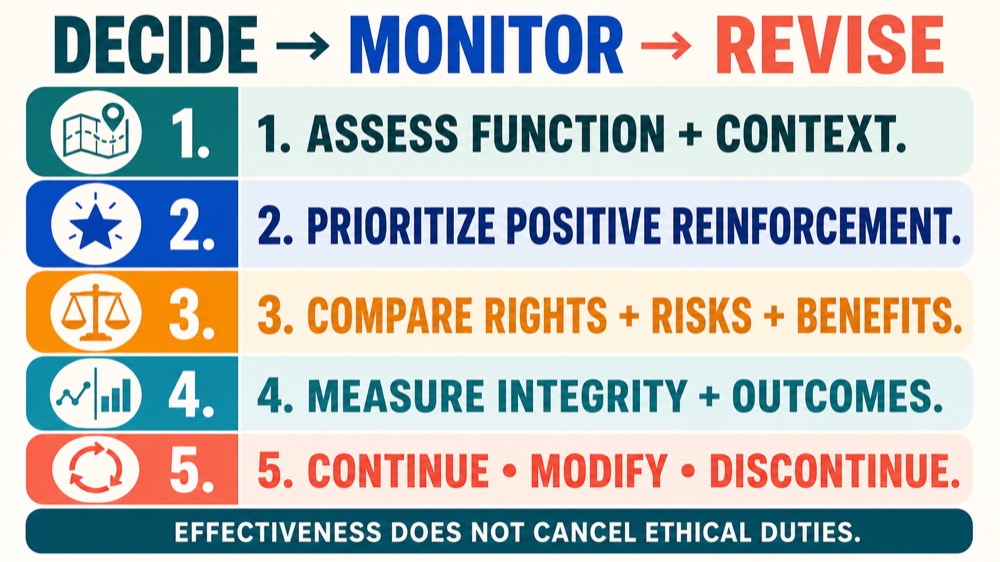
Consider an original, low-risk study scenario. During difficult independent work, a learner drops materials and stops participating. Assessment data support escape from tasks as the likely maintaining variable. The team compares two reinforcement-based plans: one teaches a clear request for help or a brief pause while adjusting task difficulty; the other keeps the original workload but offers a delayed reward for completion. The first plan may better protect choice and produce faster access to a functional communication response, but it also requires the team to define how work will be resumed so that learning opportunities are not lost.
Before selecting a plan, the behavior analyst documents the target outcome, evidence, client and stakeholder preferences, likely benefits and burdens, staff competence, implementation demands, and the consequences of delayed improvement. The team then collects treatment-integrity and outcome data and reviews them on a prespecified schedule. If the first plan is implemented accurately but does not improve meaningful participation, the next step is not an automatic jump to punishment. The analyst reassesses the function and context, repairs implementation problems, and compares revised evidence-based options. If a separate situation involves imminent safety risk, decisions require an appropriately constituted team, informed consent when appropriate, applicable review processes, and the safeguards in Code 2.15; this educational example does not prescribe a restrictive procedure.
Integrating Effectiveness and Ongoing Review
The least restrictive analysis is not completed when a plan is signed. Code 2.17 requires data to support decisions about continuing, modifying, or terminating services, and Code 2.18 requires continual monitoring and corrective action when desired outcomes are not being realized. Code 2.15 adds specific documentation and timely modification or discontinuation requirements for restrictive or punishment-based procedures when they are ineffective. Review should therefore cover both client outcomes and possible costs: treatment integrity, adverse effects, preference or assent-related information when relevant, access to valued activities, generalization, maintenance, and quality of life. A plan that becomes unnecessary, ineffective, poorly implemented, or disproportionately burdensome should be changed through the same accountable decision process used to select it.
Study Checklist and Key Takeaways
- Explain why least restrictiveness is a contextual risk-benefit judgment, not a single ranking based on appearance.
- Keep Code 2.13 assessment duties separate from Code 2.14 intervention-selection duties.
- Remember that Code 2.14 prioritizes positive reinforcement and Code 2.15 governs minimization of risk.
- Distinguish restrictiveness, intrusiveness, effort, acceptability, and effectiveness.
- Include client rights, preferences, informed consent when appropriate, setting constraints, and likely maintenance in the comparison.
- Specify how treatment integrity, outcomes, side effects, and quality of life will receive ongoing review.
- Use the current Ethics Code and authoritative position statement linked above rather than memorizing a slogan.
Test Your Knowledge: Use our Free BCBA Mock Exam for independently written practice and feedback across behavior-analytic content. It does not reproduce live BACB exam items, guarantee that this exact topic appears, or replace the current Ethics Code and professional judgment.



