
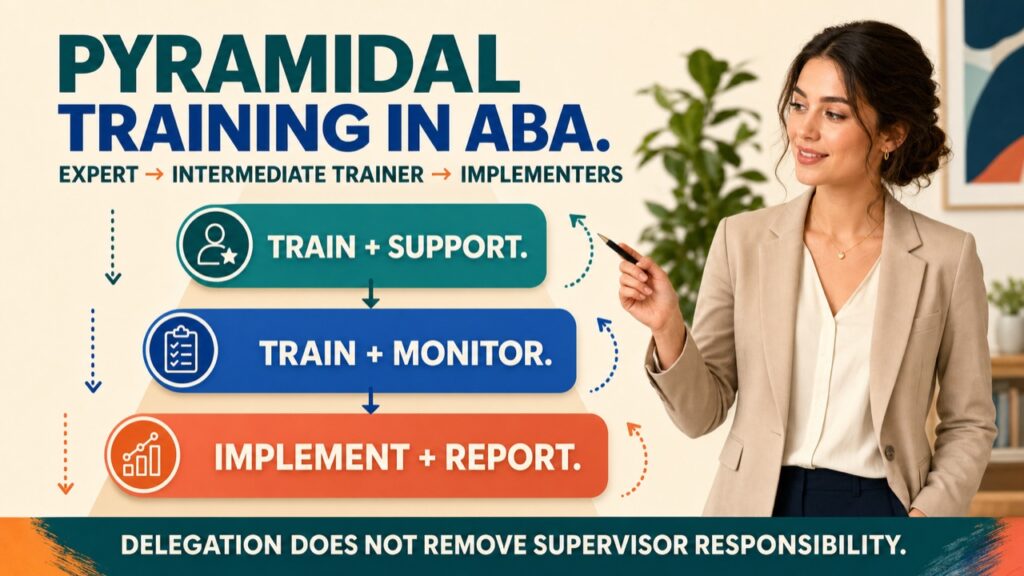
Pyramidal supervision in ABA, often discussed in the research as pyramidal training, is a tiered training arrangement. An expert trains and supports an intermediate trainer or supervisor, who then trains and monitors additional implementers. The arrangement can extend consistent instruction across staff while preserving observable performance criteria, competency checks, treatment-integrity measurement, and a feedback loop back to the expert. It is not a chain of command that transfers accountability away from the credentialed supervisor.
Table of Contents
- What Is Pyramidal Supervision in ABA?
- Key Components of Pyramidal Supervision
- Supervisor Responsibility and Ethical Accountability
- Practical Example of Pyramidal Supervision
- Common Misconceptions and Traps
- Study Checklist for BCBA Candidates
- Test Your Knowledge with Our Free BCBA Mock Exam
- References
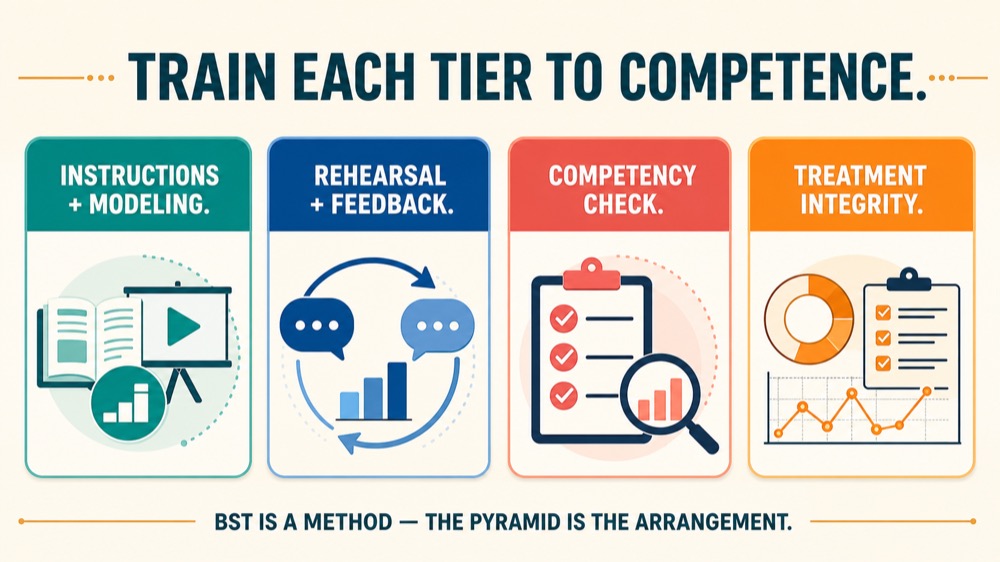
Keep the arrangement separate from behavioral skills training (BST). Pyramidal training describes who trains whom; BST is a teaching procedure that may be used at each tier through instructions, modeling, rehearsal, and feedback. Under the BACB Ethics Code, the relevant boundaries include supervisory competence (4.02), supervisory volume (4.03), accountability for supervisory practices and activities within the supervisory relationship (4.04), performance monitoring and feedback (4.08), delegation only after competence is confirmed (4.09), and evaluation of supervision and training effects (4.10). Delegation therefore changes who performs a training task, not the BCBA’s supervisor responsibility within the formal supervisory relationship.
What Is Pyramidal Supervision in ABA?
Pyramidal supervision, also referred to as pyramidal training, is a service-delivery model in which a highly trained professional (Tier 1) trains an intermediate trainer or supervisor (Tier 2), who then trains and oversees direct-care staff (Tier 3). This tiered training structure addresses the shortage of qualified supervisors by systematically building supervisory capacity without compromising quality. The model relies on evidence-based practices at every level: Tier 1 uses behavioral skills training (BST) to teach Tier 2 supervisors how to train others; Tier 2 then applies BST to train Tier 3 implementers. Each tier includes competency checks to verify mastery before moving to the next phase. For example, a BCBA may train a senior RBT to conduct BST sessions with new hires, while the BCBA periodically observes and provides feedback to the senior RBT.
It is crucial to distinguish the organizational arrangement from the teaching procedure. BST consists of instruction, modeling, rehearsal, and feedback; a pyramidal model identifies the tiers through which that or another validated training procedure is delivered. A chain of command, by contrast, primarily routes authority and decisions. A sound pyramid routes training, observation, performance data, feedback, and escalation. It does not automatically authorize an intermediate trainer to perform credentialed supervision, make clinical decisions, or accept tasks outside that person’s competence or formal role. The responsible behavior analyst must define those roles, confirm competence before delegation, review treatment-integrity and client-outcome data, and adjust the system when the evidence shows a problem.
Key Components of Pyramidal Supervision
Effective pyramidal supervision requires several interdependent components. Each component serves a distinct function and contributes to the overall integrity of the model. Below are the essential elements:
Tiered Training and Competency Checks: Tiered training ensures that each level of the pyramid is equipped to perform its role. The BCBA (Tier 1) trains the intermediate supervisor (Tier 2) on how to train direct implementers (Tier 3). Training at each tier includes:
- Explicit instructions on the target skills and performance criteria.
- Modeling of correct implementation by the trainer.
- Rehearsal (role-play) opportunities for the trainee.
- Feedback from the trainer until the trainee meets predetermined mastery criteria.
Competency checks are formal assessments that verify an individual can perform a skill to criterion. For Tier 2, this might involve demonstrating the ability to deliver BST to a mock implementer. For Tier 3, it could mean implementing a behavior intervention plan with 90% integrity during a role-play. Competency checks are not one-time events; they are conducted periodically to ensure skills are maintained.
Treatment Integrity Measures: Treatment integrity, also called fidelity, refers to the degree to which an intervention is implemented as designed. In pyramidal supervision, integrity must be measured at multiple levels:
- Implementer integrity: Direct observations or permanent product reviews assessing whether Tier 3 staff implement procedures correctly.
- Supervisor integrity: Assessments of whether Tier 2 supervisors deliver training and oversight as planned.
- System integrity: Regular data reviews to ensure the entire pyramidal system produces desired outcomes for clients.
Measurement frequency and mastery criteria must be selected for the procedure, risk, setting, and learner; neither “weekly” nor 90% is a universal pyramidal-training rule. Define the critical implementation steps, the observation method, who records each measure, and the locally justified performance criterion before training begins. Graph or otherwise summarize repeated measures so the team can detect drift rather than relying on a completion certificate. When performance falls below the defined criterion, respond promptly in proportion to client risk and the observed deficit.
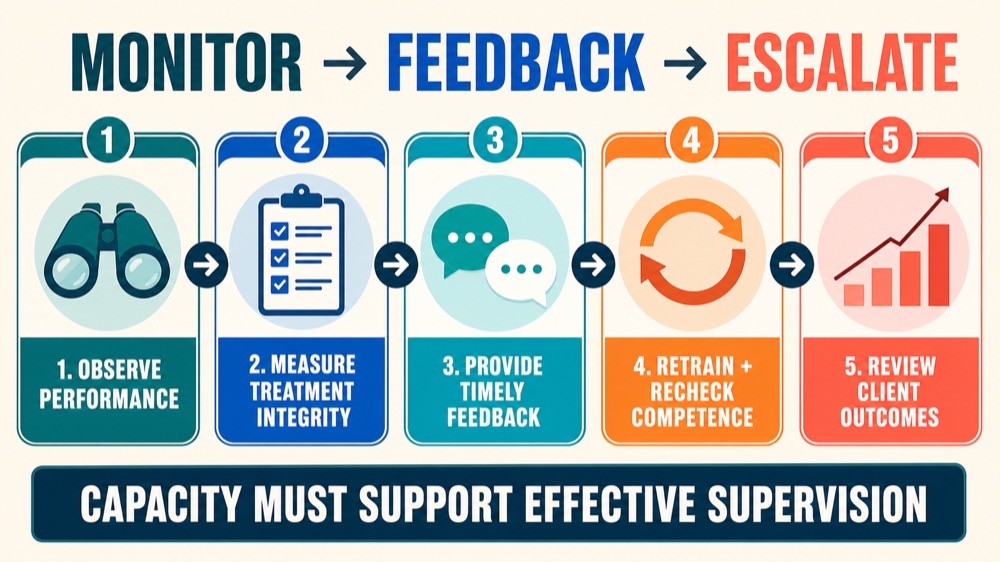
Feedback Loops and Escalation Procedures: A feedback loop moves performance information in both directions. The expert reviews the intermediate trainer’s training-integrity and implementer data and provides specific, timely feedback. The intermediate trainer observes implementers, delivers praise and corrective feedback, and sends unresolved problems or adverse trends back to the expert. This is more than a reporting hierarchy: the loop must change training or oversight when the data warrant it. Ethics Code 4.08 requires ongoing evidence-based monitoring and timely feedback in formal supervision, including an improvement plan when performance problems arise.
- Define the discrepancy between observed performance and the written criterion.
- Check whether the problem reflects unclear instructions, insufficient modeling or rehearsal, weak feedback, missing resources, or another barrier.
- Retrain the relevant skill and repeat the competency check.
- Increase observation or direct oversight when indicated by risk and performance.
- Pause or reassign a delegated task when competent performance has not been demonstrated.
- Review client outcomes as well as staff implementation and revise the training system when needed.
For example, if an intermediate trainer omits corrective feedback, the expert can model that component, arrange rehearsal, observe a new training trial, and use a competency check before the trainer continues independently. If client safety could be affected, the responsible clinician should restrict implementation or provide direct oversight while the deficit is corrected.
Supervisor Responsibility and Ethical Accountability
Delegation does not remove the credentialed supervisor’s ethical obligations. Ethics Code 4.04 makes behavior analysts accountable for their supervisory practices and for professional activities of supervisees or trainees that occur as part of the supervisory relationship. Code 4.09 permits delegation only after competent performance is confirmed and when the delegation complies with applicable requirements. The practical duties include:
- Assign only tasks that fit the individual’s competence, credential, role, and applicable rules.
- Use evidence-based, individualized supervision and training procedures.
- Confirm performance with direct observation or another valid competency check rather than attendance alone.
- Monitor implementation and client outcomes, provide timely feedback, and document formal feedback.
- Develop and evaluate an improvement plan when performance problems arise.
- Evaluate the effects of the entire supervision and training system and adjust it when indicated.
There is no universal numeric ratio in the cited BACB page that makes a pyramid ethical by itself. Ethics Code 4.03 instead requires a behavior analyst to accept only the number of supervisees or trainees that still permits effective supervision and training, considering client demands, current caseloads, time, logistics, and other applicable requirements. The BACB Supervision and Training page also distinguishes formal supervision roles from tasks that may be delegated to qualified and proficient assistants with oversight. Capacity must therefore be demonstrated by actual monitoring and response, not inferred from the shape of an organization chart.
Practical Example of Pyramidal Supervision
Consider an original school-based example. A BCBA is responsible for a small instructional program and identifies two experienced lead teachers as intermediate trainers. The teachers are not presented as BACB supervisors and do not make independent clinical changes. First, the BCBA uses BST to teach each lead teacher how to train a written classroom-transition procedure: review the task analysis, model the procedure, arrange rehearsal, score a training-integrity checklist, and deliver feedback. Each lead teacher must meet a defined competency criterion across repeated practice before training three paraprofessionals.
At the next tier, the lead teachers use the same BST sequence with the paraprofessionals. They record performance on the approved checklist and route the data to the BCBA. The BCBA samples both the trainers’ use of BST and the implementers’ treatment integrity, reviews client-transition data, and provides feedback to both tiers. If an implementer misses a critical safety step, that implementation is paused or directly supported while retraining and a new competency check occur. If a lead teacher’s training integrity declines, the BCBA increases direct observation and retrains the teacher rather than merely asking the teacher to pass the message downward.
The numbers in this example are illustrative, not a staffing formula. Before adding people or cases, the BCBA must decide whether current client needs, risk, travel, observation time, documentation, and feedback demands still permit effective supervision. The tiered arrangement expands training capacity only while the required monitoring and supervisor responsibility remain feasible.
Common Misconceptions and Traps
- Myth: Pyramidal supervision removes supervisor responsibility. Correction: The responsible behavior analyst remains accountable for supervisory practices and supervised professional activities within the relationship.
- Myth: One supervisor can oversee unlimited staff. Correction: Capacity is limited by the conditions required for effective supervision; the Code gives a functional capacity rule, not an unlimited allowance or one universal ratio.
- Myth: Training completion proves competence. Correction: Demonstrated performance against an observable criterion is needed before a task is delegated.
- Myth: Feedback is optional. Correction: Ongoing monitoring, timely feedback, and improvement planning are explicit supervision responsibilities.
- Myth: Pyramidal training is a chain of command. Correction: It is a tiered training arrangement with performance data and feedback loops; an authority chart alone is not pyramidal training.
Study Checklist for BCBA Candidates
- Define pyramidal supervision and distinguish it from BST and chain of command.
- Explain the role of competency checks in each tier.
- Describe how treatment integrity is measured at multiple levels.
- Identify the BCBA’s responsibilities under the BACB Ethics Code.
- Understand escalation procedures when performance falls below criterion.
- Recognize common misconceptions (e.g., delegation removes responsibility).
- Apply the model to a novel scenario, specifying roles and monitoring strategies.
Test Your Knowledge with Our Free BCBA Mock Exam
Use our Free BCBA Mock Exam for independently written practice and feedback across behavior-analytic content. It does not reproduce a live BACB examination form, promise that this exact topic appears, or replace the current Ethics Code and supervision resources linked here.
References
- BACB Supervision and Training
- BACB Ethics Code for Behavior Analysts
- Teaching Practitioners to Conduct Behavioral Skills Training
Professional review date: 2026-07-29



