
Lag schedules of reinforcement are reinforcement arrangements in which the current response must differ from one or more previously reinforced responses before reinforcement is delivered. They are used to study or strengthen behavioral variability. The number after “Lag” indicates how many recent responses the current response must differ from, although exact notation can vary by procedure.
Table of Contents
- What are lag schedules of reinforcement?
- Why reinforce behavioral variability?
- How do Lag 0, Lag 1, Lag 2, and Lag 3 differ?
- What is a lag schedule example in ABA?
- How is a lag schedule different from DRA?
- What data should be collected?
- What does the research show?
- How is this tested on the BCBA exam?
- Lag schedule FAQ
- Quick Review Checklist
- Take the Free BCBA Mock Exam
For example, under a Lag 1 schedule, a learner might receive reinforcement for giving a response that differs from the immediately preceding reinforced response. Under Lag 2, the response must differ from the two relevant prior responses. The purpose is not to make responding random. It is to arrange reinforcement for an observable, useful dimension of variation while still requiring the response to be appropriate for the situation. This guide explains the definition, shows a simple verbal-behavior example, compares Lag 0 through Lag 3, and gives BCBA candidates a way to distinguish a lag schedule from ordinary differential reinforcement, prompting, or extinction. Table of Contents
What are lag schedules of reinforcement?
A lag schedule is a variation of differential reinforcement in which reinforcement depends on the relation between the current response and prior responses. The programmed criterion is usually a form of difference: a different topography, sequence, word, answer, movement, or other defined response dimension. The analyst must specify what “different” means before interpreting the schedule.
The key feature is not that reinforcement is delayed or delivered after a random amount of time. “Lag” refers to the number of recent responses used as the comparison point. A Lag 1 arrangement typically compares the current response with the immediately previous relevant response. A Lag 2 arrangement compares it with the previous two relevant responses. If the current response meets the difference criterion and is otherwise acceptable, reinforcement is delivered according to the programmed arrangement. Before calling a procedure a lag schedule, ask three questions:
- What response dimension must vary: form, sequence, wording, location, or something else?
- How many previous responses are included in the comparison?
- What happens when the response is appropriate but does not meet the variation criterion?
Why reinforce behavioral variability?
Some learners have an established repertoire but repeatedly emit one response even when several appropriate responses are available. For instance, a learner may answer every social question with the same memorized phrase, use one play action despite other taught actions, or produce the same request form across contexts. If the instructional goal includes flexible or varied responding, reinforcing only one response can strengthen a dominant pattern rather than expand the repertoire.
A lag schedule makes variability a measurable response dimension. It does not automatically teach new skills, make a response socially appropriate, or guarantee generalization. The learner still needs a repertoire from which to vary. A clinician may first teach multiple appropriate responses, arrange prompts or models, and make sure the task is understandable. The lag criterion is then added only when the team can define and measure the target variation.
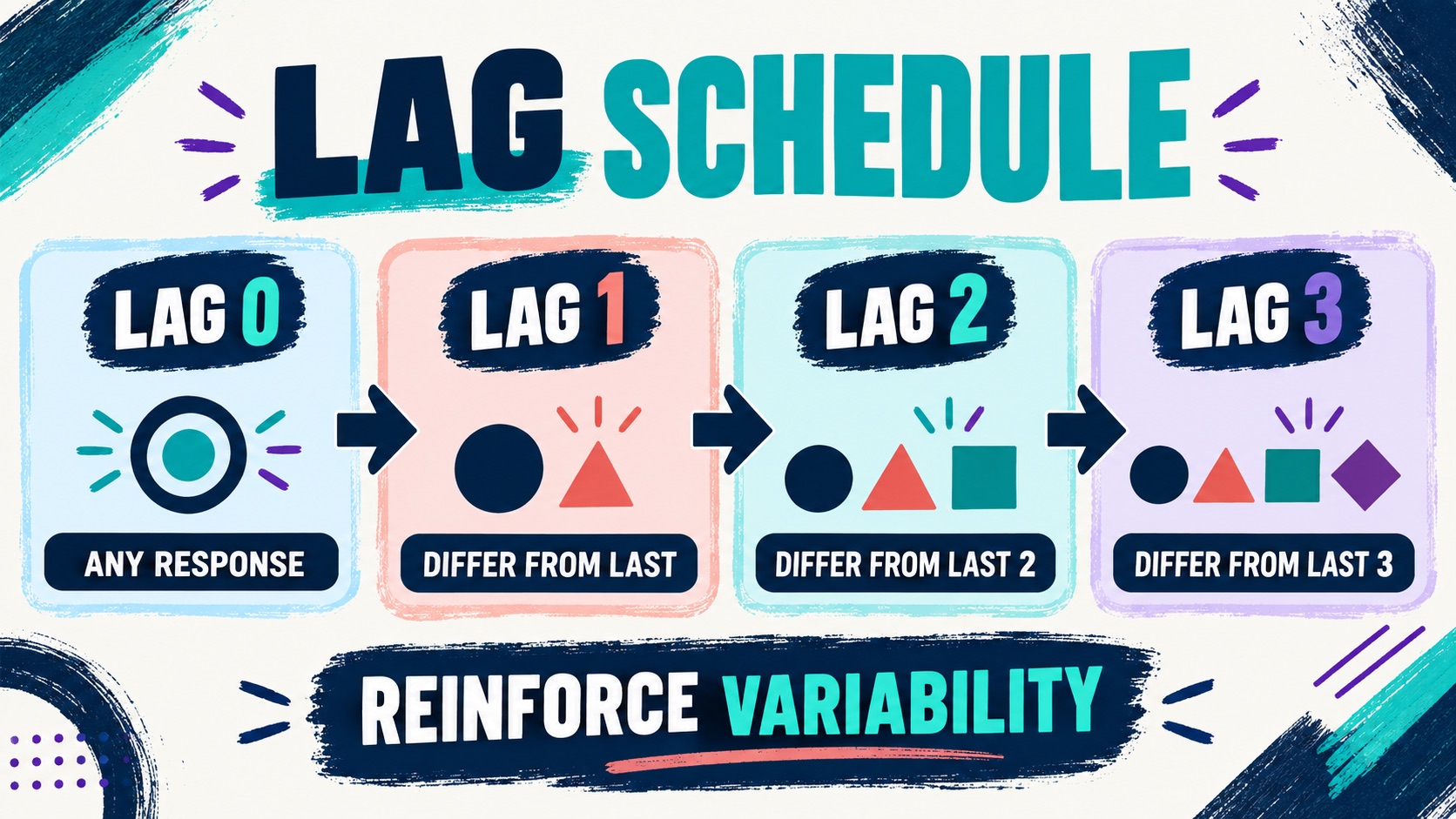
How do Lag 0, Lag 1, Lag 2, and Lag 3 differ?
| Schedule | Common comparison rule | Exam interpretation |
|---|---|---|
| Lag 0 | No difference requirement; the response can contact reinforcement when it meets the ordinary response criterion. | Useful as a baseline or comparison condition, not a variability requirement. |
| Lag 1 | Current response differs from the immediately previous relevant response. | A response can be reinforced for being different from the last reinforced response. |
| Lag 2 | Current response differs from the two comparison responses identified by the procedure. | The criterion is more demanding; track both variation and appropriate responding. |
| Lag 3 | Current response differs from the three comparison responses specified by the arrangement. | A larger comparison window can increase the variation requirement and response effort. |
The table is a study shorthand, not a substitute for the procedure definition. Some studies use a rolling comparison, while others define the relevant response history differently. The exam clue is the same: reinforcement is contingent on a difference from a specified number of prior responses.
What is a lag schedule example in ABA?
Suppose a learner is practicing answers to the question, “What did you do today?” The learner has been taught several appropriate answers, such as “I played outside,” “I read a book,” and “I helped cook.” Under a Lag 1 schedule, the response may contact reinforcement when it is appropriate and differs from the immediately preceding reinforced answer.
If the learner says “I played outside” on Trial 1, the response may be reinforced under the current teaching arrangement. If the learner says the same phrase again on Trial 2, it would not meet a Lag 1 difference criterion, unless the written procedure defines a different comparison or the team uses another consequence for an appropriate but repeated response. If the learner says “I read a book,” that answer may meet the variation criterion. The program should not withhold communication, safety, or needed support simply because the answer is repeated.
Data might include the number of opportunities, whether the response was appropriate, whether it was novel relative to the comparison window, whether a prompt was used, and whether reinforcement was delivered. This separates “different” from “better.” A bizarre or incorrect answer is not automatically a successful varied response.
How is a lag schedule different from DRA?
Differential reinforcement of alternative behavior (DRA) reinforces a defined alternative response while withholding or changing reinforcement for a target response, according to the plan. A lag schedule can be combined with DRA, but it adds a history-based variation criterion. In the research literature, a Lag 1 requirement has sometimes been added to reinforcement for appropriate verbal responding to increase varied responding.
Lag reinforcement is also not the same as extinction. Extinction concerns discontinuing reinforcement for a previously reinforced response under specified conditions. A lag arrangement may fail to reinforce a repeated response because it does not meet the variation criterion, but the procedure still needs to define what occurs next and how appropriate communication is supported. Calling every nonreinforced trial “extinction” would miss the programmed comparison rule.
What data should be collected?
At minimum, the data system should make the schedule visible. Record the opportunity, the response, the comparison history, whether the response met the difference criterion, whether it was appropriate, the prompt level, and the consequence. If the target is verbal variability, also record the number of unique responses and whether they are functional in the relevant context. Review at least four outcomes:
- Variation: Are different responses occurring more often?
- Appropriateness: Are the responses still accurate, safe, and relevant?
- Repertoire expansion: Is the learner using previously unobserved responses, or only cycling through a small set?
- Generalization: Does variability occur with other people, materials, questions, and settings?
If the criterion produces frustration, rote guessing, long pauses, or irrelevant responding, the team should examine the response effort, teaching history, reinforcer, prompt strategy, and definition of difference. Increasing Lag 1 to Lag 2 or Lag 3 is not automatically the best next step.
What does the research show?
Research has examined lag schedules as a way to reinforce variability in verbal and nonverbal responding. A Journal of Applied Behavior Analysis study indexed by PubMed evaluated Lag 1 arrangements with appropriate verbal responding for children with autism and reported increased varied responding for some participants. A later study of lag schedules and functional communication training examined persistence of mands and relapse of problem behavior during schedule thinning.
A more recent home-setting study also illustrates why context matters: a procedure tested in one setting and with one learner cannot be treated as a universal prescription. The evidence supports studying and measuring variability under defined contingencies; it does not mean that every learner needs a lag schedule or that a higher Lag number is inherently better.
How is this tested on the BCBA exam?
On a BCBA exam question, look for the clue that reinforcement depends on whether the current response differs from a specified number of recent responses. Then identify the response dimension and the comparison window. If the question only says that a replacement response is reinforced, think about DRA. If it says reinforcement is delivered for a response that differs from the previous response, think Lag 1.
- Identify the response that contacts reinforcement.
- Ask whether the criterion is correctness, function, absence of behavior, or variation.
- Count the prior responses included in the comparison.
- Check whether “different” is operationally defined.
- Reject an answer that treats novelty alone as sufficient when the response must also be appropriate.
For extra practice distinguishing schedules and procedures in applied vignettes, use the free BCBA mock exam as an unofficial study checkpoint. It is not a clinical protocol and does not replace supervision or individualized decision-making.
Lag schedule FAQ
What does Lag 1 mean?: Lag 1 usually means that the current response must differ from the immediately previous relevant response before reinforcement is delivered. The procedure should define the comparison and what counts as different.
Does a lag schedule reinforce random behavior?: No. It reinforces a defined dimension of difference, and the response may still need to be appropriate, accurate, or functional. Random or irrelevant responding is not automatically a treatment success.
Is a lag schedule the same as a variable-ratio schedule?: No. A variable-ratio schedule varies the number of responses required for reinforcement. A lag schedule makes reinforcement depend on the current response differing from prior responses. Why is response variability important?: Variation can support flexible communication, problem solving, play, and generalization when several appropriate responses are available. The goal should be meaningful variability, not novelty for its own sake.
The central idea behind lag schedules of reinforcement is simple: define the response dimension, compare the current response with the required response history, and reinforce meaningful variation when the criterion is met. For BCBA exam reasoning, focus on that contingency—not merely on the word “lag” or on the presence of intermittent reinforcement.
Quick Review Checklist
Use this final checklist to turn lag schedules of reinforcement into exam-ready reasoning. The goal is not to memorize a label in isolation; it is to identify the relevant evidence and explain why the best answer fits the scenario. Key ideas to review:
- State the central definition or decision point for lag schedules of reinforcement in your own words.
- Identify the detail that makes lag schedules of reinforcement different from its closest related ABA term.
- Separate the observable facts in a scenario from assumptions that are not supported by the facts.
- Write one example and one nonexample so you can recognize the concept in a new setting.
Exam application checks:
- Ask what the question is actually requesting before comparing the answer choices.
- Mark the antecedent, response, consequence, or other evidence that supports the selected answer.
- Look for a distractor that describes a related process but does not answer the specific question.
Final self-check:
- Explain how you would verify the interpretation with clear observations or data.
- Change one detail in the scenario and decide whether your answer should change.
- Give a one-sentence rationale that a supervisor or study partner could evaluate.
Take the Free BCBA Mock Exam
When you are ready to apply the idea, use the free practice resource below for additional feedback. Take the Free BCBA Mock Exam



