
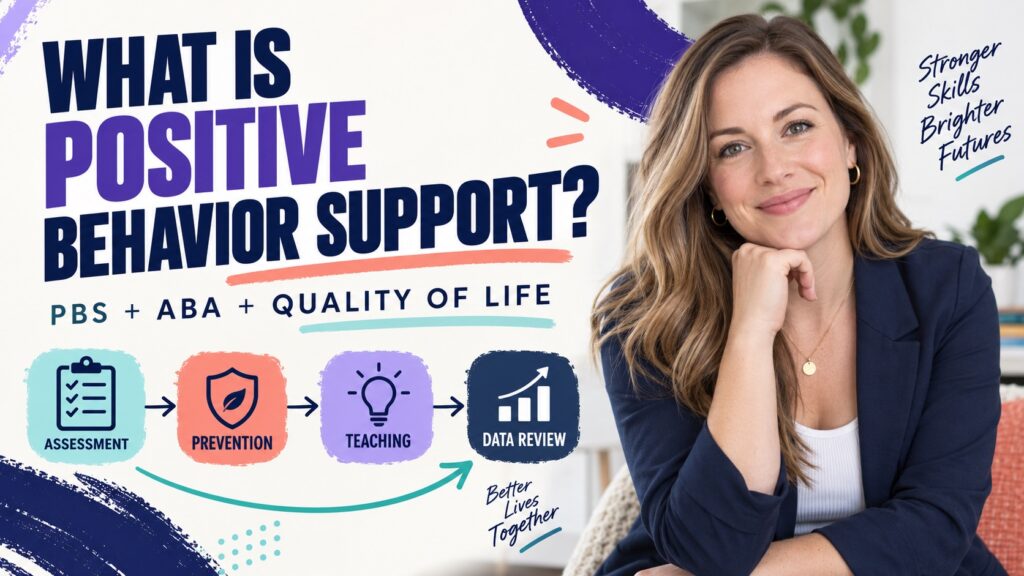
What is positive behavior support? Positive behavior support (PBS) is a person-centered, assessment-based framework for improving quality of life, teaching useful skills, and reducing challenging behavior by changing the environment and the supports around a person. It uses behavioral and other relevant evidence, values the person’s preferences and participation, and relies on data to decide whether a plan is helping.
Table of Contents
- What is positive behavior support?
- How is PBS related to ABA?
- What are the core parts of a PBS framework?
- What does a PBS process look like?
- How is PBS different from PBIS and a BIP?
- How do data and ethics shape PBS?
- How can you reason through a PBS BCBA exam question?
- Positive behavior support FAQ
- Quick Review Checklist
- Take the Free BCBA Mock Exam
PBS is often discussed alongside applied behavior analysis (ABA), but the labels are not interchangeable. ABA provides important behavioral science and procedures; PBS is a broader support framework that also emphasizes valued outcomes, prevention, social validity, collaboration, and changes to routines or systems. A strong PBS plan is not simply “being positive,” offering rewards, or trying to suppress a behavior without understanding its function.
This guide explains the definition in plain language, shows how PBS relates to ABA and school-wide PBIS, and gives BCBA candidates a practical way to analyze a PBS question without treating a slogan or a single intervention as the answer. Table of Contents
What is positive behavior support?
Positive behavior support is an evidence-informed approach to supporting behavior in everyday settings such as home, school, work, and community life. The goal is not only to decrease a challenging response. The team also asks what would make the person’s life more effective, meaningful, safe, connected, and self-directed, then teaches skills and changes conditions that make success more likely.
The Institute on Community Integration at the University of Minnesota describes PBS as combining valued outcomes, behavioral and biomedical science, validated procedures, and systems change to improve quality of life and reduce problem behavior. The Home and Community Positive Behavior Support Network similarly emphasizes individualized, assessment-based support, proactive teaching, and ongoing monitoring. That definition has several practical implications:
- Start with a valued outcome. A reduction in problem behavior matters, but the person also needs access to communication, participation, relationships, independence, or another meaningful alternative.
- Understand the context. Look at routines, tasks, communication partners, sensory conditions, health factors, and consequences instead of assigning blame to the person.
- Prevent and teach. Make the environment more predictable and teach a response that works more effectively than the challenging behavior.
- Use evidence and feedback. Select support strategies that have a defensible rationale, measure outcomes, and revise the plan when data or stakeholder feedback show a problem.
How is PBS related to ABA?
PBS grew in part from applied behavior analysis and uses many ABA concepts, including functional assessment, reinforcement, prompting, skill acquisition, generalization, and continuous measurement. ABA helps a practitioner ask functional questions: what events precede behavior, what follows it, and which environmental variables change its probability?
PBS adds an explicit focus on quality of life, person-centered planning, participation, social validity, and systems change. A PBS team may use behavioral procedures, but it should also ask whether the goal is meaningful, whether the person’s communication and assent are respected, whether the plan fits daily life, and whether the intervention creates unnecessary restriction or burden.
| Term | Primary emphasis | What the label does not prove |
|---|---|---|
| ABA | Behavioral science and professional practice that applies behavioral principles to socially significant behavior. | That every service is person-centered, comprehensive, or intensive. |
| PBS | Quality of life, prevention, teaching, environmental support, stakeholder participation, and data-informed adjustment. | That any strategy called positive is effective or that assessment is unnecessary. |
| PBIS | A school-wide or multi-tiered implementation of positive behavioral supports across a system. | That it is the same as an individual behavior plan or a clinical diagnosis. |
What are the core parts of a PBS framework?
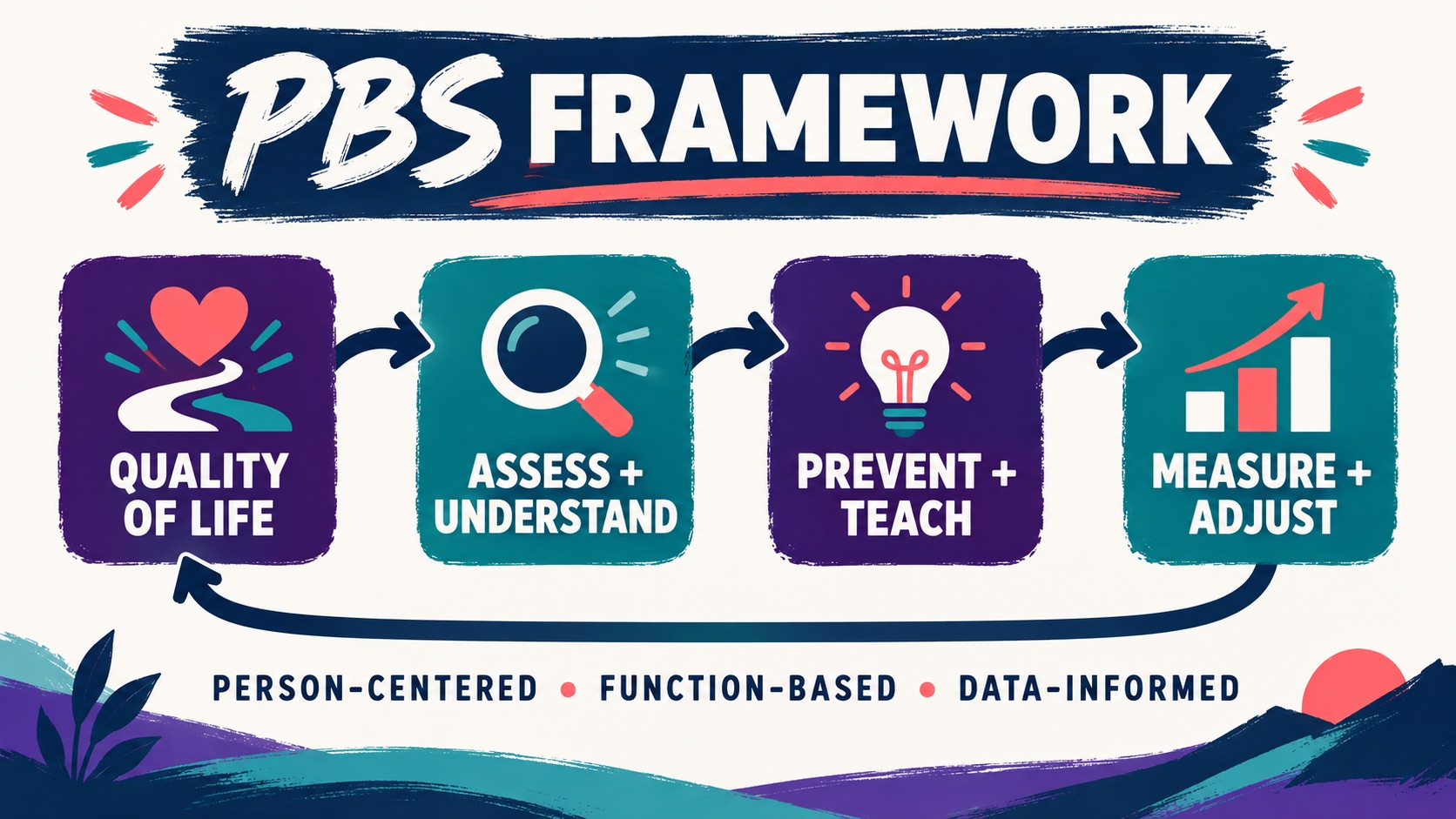
A useful way to remember PBS is as a repeating cycle rather than a one-time behavior-reduction program. The Global Positive Behavior Support Coalition’s 2025 brief describes PBS as values-driven, preventive, person-centered, and connected to quality of life. In practice, the cycle can be organized into four questions:
- What matters to the person? Identify valued outcomes, communication priorities, preferences, relationships, participation, safety, and the person’s own perspective whenever possible.
- What is happening now? Define the behavior and collect information about routines, antecedents, consequences, setting events, skill deficits, and environmental barriers. A functional assessment may be part of this process.
- What should we change or teach? Modify triggers and task demands, increase choice and predictability, teach a functional replacement response, and arrange reinforcement for useful behavior.
- Is the plan improving life? Review direct data and stakeholder feedback. Check whether the new skill generalizes, whether the challenging behavior changes, and whether the plan is acceptable and sustainable.
What does a PBS process look like?
Imagine a student frequently leaves a group activity when the instructions become difficult. A weak response would simply demand that the student stay seated or add a consequence after leaving. A PBS-oriented process asks what the student is communicating or avoiding and what support would make participation more successful.
The team might define the behavior precisely, review when it occurs, interview the student and relevant adults, and examine task difficulty, communication demands, noise, transitions, and the consequences that follow leaving. If the data suggest an escape function, the team might teach a brief break request, adjust the task into smaller steps, provide a predictable way to ask for help, and reinforce returning or completing a reasonable portion of the activity. The team would still measure whether those changes improve participation and reduce unsafe or disruptive episodes.
This example does not mean that every instance of leaving has the same function. The function must be assessed rather than guessed. It also does not mean that a break request should be withheld until a person complies with an arbitrary demand. The support has to be safe, functional, and responsive to the person’s communication and needs.
How is PBS different from PBIS and a BIP?
Positive behavior support can describe an individual, family, organization, or community framework. Positive Behavioral Interventions and Supports (PBIS) is commonly used for a tiered, school-wide system that teaches expectations, uses data, and organizes supports across universal, targeted, and intensive levels. An individual PBS plan may exist inside a school system, but it is not automatically the same thing as the school’s PBIS framework.
A Behavior Intervention Plan (BIP) is a written plan for responding to identified behavior, often based on functional assessment. A BIP can be one component of a PBS approach, but a PBS framework is broader because it includes quality-of-life outcomes, prevention, skill building, participation, and system-level changes. The document title matters less than the actual goals, procedures, measurement, and stakeholder involvement.
How do data and ethics shape PBS?
Data prevent a well-intended plan from becoming a collection of assumptions. Define the target response, select a measurement system that fits the behavior, establish a baseline when possible, and decide how progress and adverse effects will be reviewed. Track replacement skills and meaningful participation, not only the absence of challenging behavior.
Data also need interpretation. A drop in behavior could reflect improvement, illness, reduced opportunity, a change in staff, or a measurement problem. A new skill might appear during one-to-one teaching but fail to generalize to home or community settings. Review level, trend, variability, context, fidelity, and the person’s experience before declaring success.
The BACB Ethics Code is relevant to BCBA exam reasoning because behavior analysts are expected to work within competence, use scientifically supported procedures, protect clients from harm, obtain appropriate consent, and evaluate the effects of services. In PBS, ethical quality is not an extra paragraph added after the plan. It affects the choice of goals, how restrictions are handled, how the person participates, and whether the plan is producing socially meaningful benefit.
How can you reason through a PBS BCBA exam question?
When a question uses the phrase positive behavior support, do not choose an answer merely because it sounds kind or optimistic. Look for the answer that connects function, prevention, teaching, meaningful outcomes, measurement, and stakeholder input.
- Define the behavior and the outcome. Separate a vague label such as “noncompliance” from an observable response and identify what successful participation would look like.
- Use assessment before intervention. Ask what the data, interview, observation, or functional assessment show about environmental variables.
- Teach an effective alternative. The replacement response should contact a relevant outcome and be feasible for the learner to use.
- Change the context. Consider antecedent supports, choice, predictability, task design, communication access, and reinforcement—not only consequences after the behavior.
- Check quality of life and data. The answer should include ongoing measurement, generalization, social validity, and a plan to revise the support if it is ineffective or burdensome.
For additional practice with applied BCBA reasoning, use the free BCBA mock exam as an unofficial study checkpoint. It cannot assess an individual or replace supervision, clinical judgment, or a personalized support team.
Positive behavior support FAQ
Is positive behavior support the same as positive reinforcement?: No. Positive reinforcement is a behavioral process in which a consequence increases future behavior. PBS is a broader framework that includes assessment, prevention, teaching, quality-of-life outcomes, collaboration, and data-based review. Reinforcement may be one part of a PBS plan.
Does PBS mean ignoring challenging behavior?: No. PBS means understanding behavior, preventing avoidable problems, teaching useful alternatives, and responding safely and consistently. Immediate safety needs still matter, and the plan should include an appropriate response to risk. Is PBS only for schools?: No. PBS can be used with individuals, families, classrooms, agencies, workplaces, and community systems. School-wide PBIS is one important implementation context, but it is not the entire PBS field.
What is the key BCBA exam takeaway?: PBS is not a single technique or a promise that behavior will improve because the plan sounds positive. The strongest answer is assessment-based, proactive, skill-building, data-informed, person-centered, and tied to meaningful outcomes.
In short, positive behavior support connects behavioral science with quality of life. It asks teams to understand behavior in context, improve the environment, teach useful skills, include the person and important supporters, and use data to keep adjusting the plan. That combination—not a label, reward, or punishment by itself—is what makes the support positive and behaviorally defensible.
Quick Review Checklist
Use this final checklist to turn what is positive behavior support into exam-ready reasoning. The goal is not to memorize a label in isolation; it is to identify the relevant evidence and explain why the best answer fits the scenario. Key ideas to review:
- State the central definition or decision point for what is positive behavior support in your own words.
- Identify the detail that makes what is positive behavior support different from its closest related ABA term.
- Separate the observable facts in a scenario from assumptions that are not supported by the facts.
- Write one example and one nonexample so you can recognize the concept in a new setting.
Exam application checks:
- Ask what the question is actually requesting before comparing the answer choices.
- Mark the antecedent, response, consequence, or other evidence that supports the selected answer.
- Look for a distractor that describes a related process but does not answer the specific question.
Final self-check:
- Explain how you would verify the interpretation with clear observations or data.
- Change one detail in the scenario and decide whether your answer should change.
- Give a one-sentence rationale that a supervisor or study partner could evaluate.
Take the Free BCBA Mock Exam
When you are ready to apply the idea, use the free practice resource below for additional feedback. Take the Free BCBA Mock Exam



