
Is the BCBA exam harder than the bar? There is no scientifically fair single ranking. The BCBA exam is a four-hour, application-focused certification test, while a bar exam is a jurisdiction-dependent, broader licensing process that may run across multiple days. The useful comparison is not “which person suffers more,” but which demands you must prepare for.
Table of Contents
- Is the BCBA Exam Harder Than the Bar? The Short Answer
- How Do the Two Exams Differ in Scope and Format?
- What Does “Harder” Actually Mean?
- What Makes the BCBA Exam Feel Difficult?
- What Makes a Bar Exam Feel Difficult?
- Can You Compare Pass Rates?
- How Should a BCBA Candidate Prepare?
- BCBA Exam vs. Bar Exam FAQ
- Quick Review Checklist
- Take the Free BCBA Mock Exam
That distinction matters because the comparison can lead candidates in two opposite directions. Some people see the BCBA exam’s narrower subject area and underestimate the depth of the questions. Others see a first-time pass rate that looks lower than many bar-exam headlines and assume the numbers are directly comparable. Neither shortcut is reliable.
This guide uses current official information from the BACB handbook, the BACB examination information page, and the NCBE’s UBE overview. It compares the exams without treating a general UBE description as the rule for every state. Table of Contents
Is the BCBA Exam Harder Than the Bar? The Short Answer
It is not responsible to say that the BCBA exam is universally harder than the bar, or that the bar is universally harder than the BCBA exam. They test different professions, different bodies of knowledge, and different forms of performance.
If “harder” means breadth and multi-day endurance, a bar exam will often feel more demanding because it can combine several legal subjects, essays, performance tasks, and multiple-choice questions. If “harder” means making precise behavior-analytic decisions under time pressure, the BCBA exam can be extremely demanding even though its content is concentrated in one professional discipline.
Your background also changes the answer. A behavior analyst may find the BCBA vocabulary familiar but struggle with novel scenarios, ethics, data interpretation, or pacing. A law graduate may be comfortable with legal analysis but have no useful foundation for behavior-analytic concepts. Personal preparation is therefore part of the difficulty equation.
How Do the Two Exams Differ in Scope and Format?
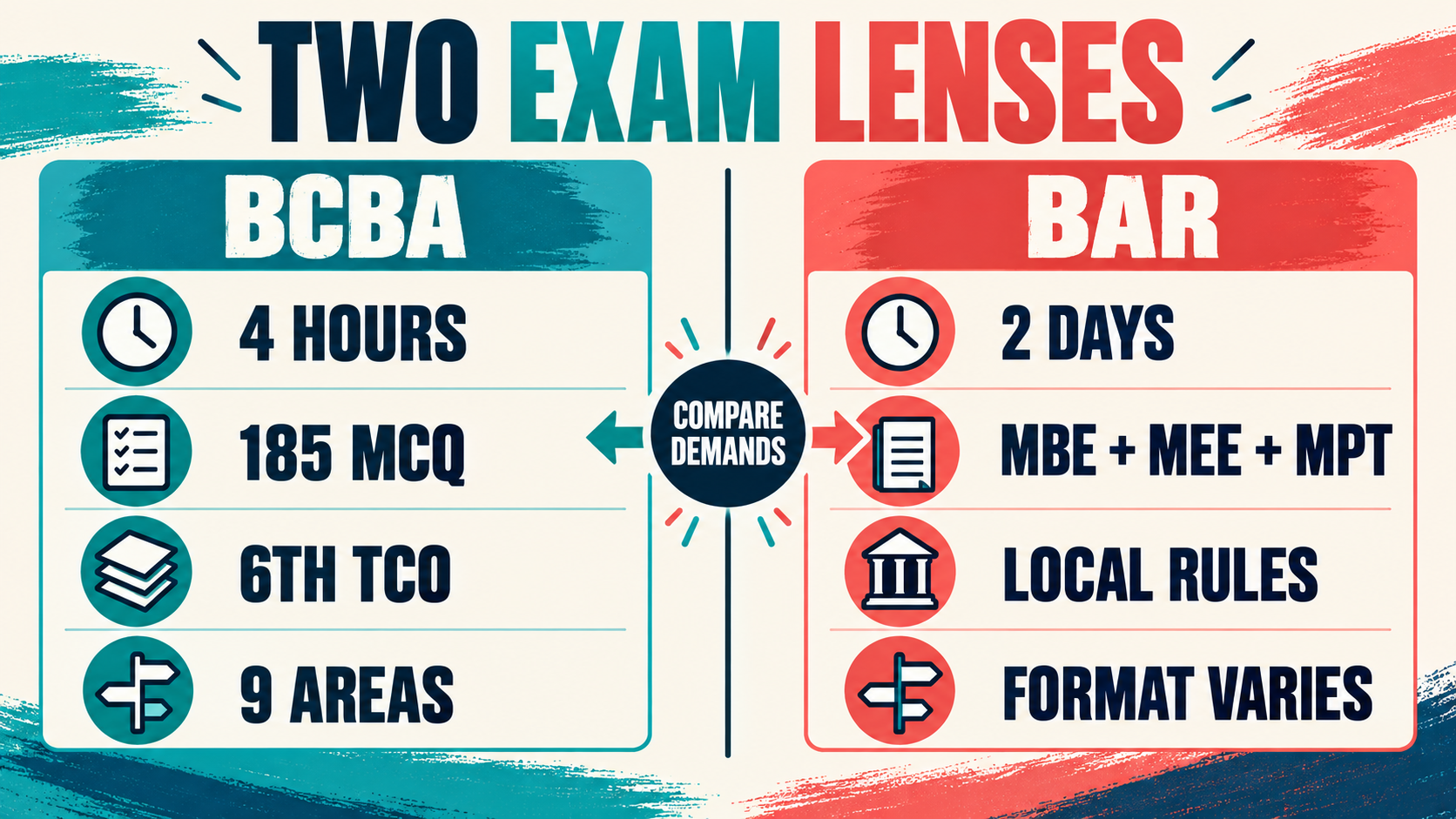
The current BCBA exam is a standardized certification examination. The BACB states that it contains 185 multiple-choice questions, including 175 scored questions and 10 unscored questions, and gives candidates four hours. Each question has four answer choices and one correct answer. The blueprint is the BCBA Test Content Outline (6th ed.), organized into nine content areas.
A bar exam is not one identical test across all jurisdictions. The NCBE’s Uniform Bar Examination, for example, combines the Multistate Bar Examination, the Multistate Essay Examination, and two Multistate Performance Test tasks. The UBE is administered over two days, and jurisdictions may also add local requirements. The NCBE also notes that most jurisdictions are scheduled to transition from the legacy UBE to the NextGen UBE between July 2026 and July 2028, so a candidate must verify the rules for the jurisdiction and administration they will actually take.
| Dimension | BCBA exam | Bar exam example |
|---|---|---|
| Purpose | Certifies entry-level behavior-analytic knowledge and skills. | Supports admission to legal practice under a jurisdiction’s rules. |
| Typical format | Computer-based, in-person, multiple-choice questions. | For the UBE, multiple-choice, essays, and performance tasks. |
| Time structure | Four hours for 185 questions, with breaks on the candidate’s time. | The UBE is administered over two days; local schedules and components vary. |
| Content frame | Nine BCBA content areas in the current test content outline. | Broad legal subjects plus jurisdiction-specific requirements. |
The practical takeaway is that the bar can impose more format variety and total endurance, while the BCBA exam concentrates its difficulty in applied precision, conceptual discrimination, and sustained pacing. That is a comparison of demands, not a universal ranking.
What Does “Harder” Actually Mean?
Before comparing study plans, define the dimension you are worried about. A candidate who asks whether the BCBA exam is harder than the bar may really be asking one of four questions:
| Difficulty lens | What to ask yourself | BCBA preparation response |
|---|---|---|
| Content breadth | How many distinct domains must I recall? | Map every task-list area; do not study only the topics you enjoy. |
| Depth of application | Do I recognize a definition, or can I select the best action in a scenario? | Use scenario questions and explain why distractors are weaker. |
| Endurance | Can I keep accuracy and judgment stable late in the test? | Practice timed blocks and protect review time rather than cramming one long day. |
| Preparation context | How much training have I already had in the tested field? | Use coursework and fieldwork to find gaps, not as proof that every task is mastered. |
What Makes the BCBA Exam Feel Difficult?
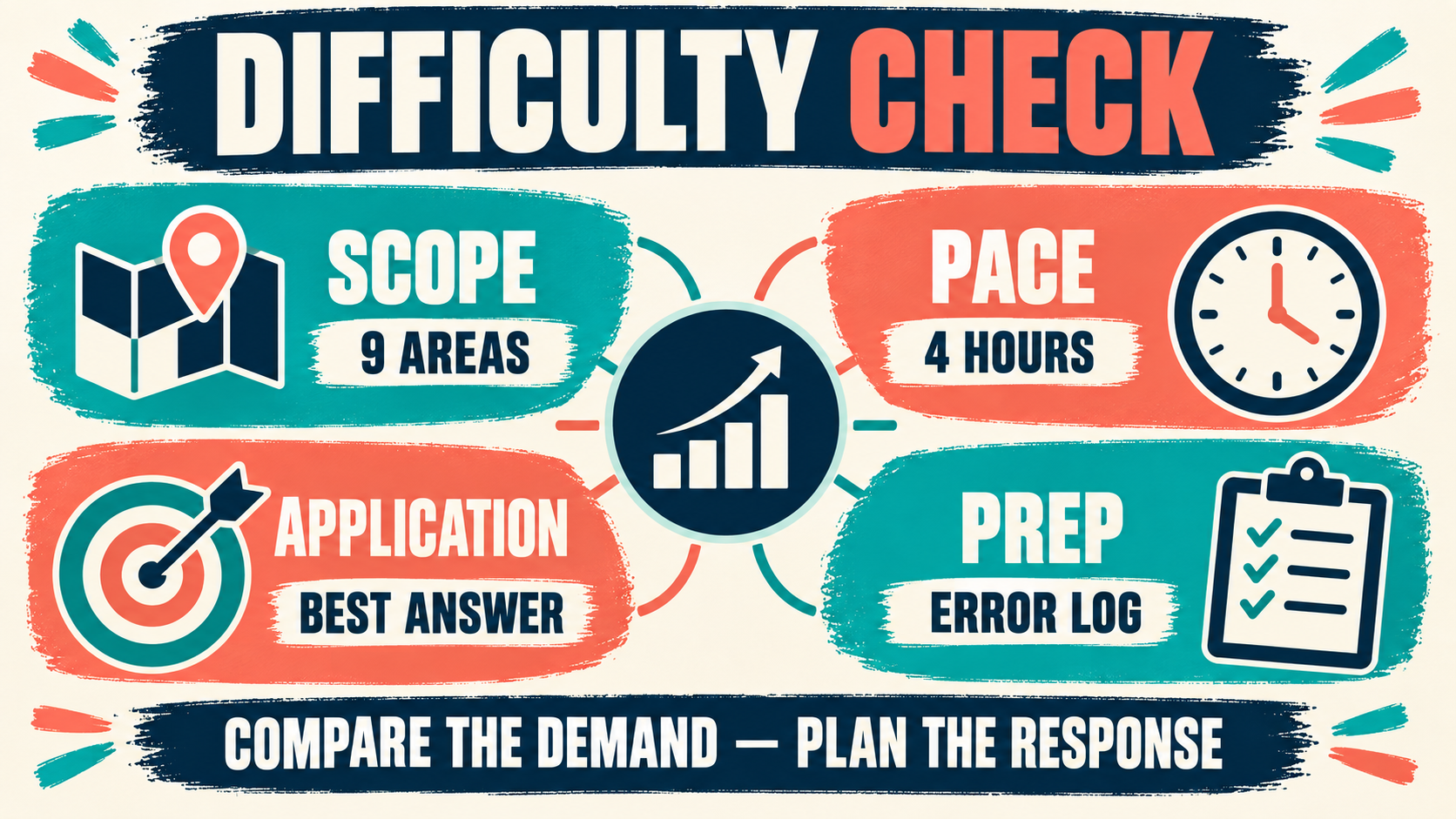
The BCBA exam’s subject area is narrower than the legal universe, but “narrower” does not mean simple. The current handbook says the exam assesses the BCBA Test Content Outline at an entry-level behavior analyst standard. That means a candidate must connect concepts to professional decisions rather than merely recognize vocabulary. Several features create pressure:
- Close distractors: More than one answer may sound helpful, but only one best matches the stated function, data, ethics, or intervention logic.
- Applied reading: A question may hide the important variable in a setting detail, measurement definition, consequence, or supervision relationship.
- Cross-domain reasoning: A scenario can require concepts, measurement, assessment, intervention, and ethics in the same decision.
- Four-hour pacing: You need enough time to read carefully without turning every item into a ten-minute debate.
- Current standards: The handbook, task list, ethics code, and application rules can change. Old notes can create false confidence.
The exam is therefore difficult for a specific reason: it asks you to make defensible decisions repeatedly, under a fixed clock, across a broad professional blueprint.
What Makes a Bar Exam Feel Difficult?
The bar exam’s challenge is different. In a UBE jurisdiction, the candidate may need to move between multiple-choice legal analysis, timed essays, and performance tasks. The content is distributed across legal subjects, and local requirements may add another layer. The two-day schedule adds fatigue and recovery demands that do not map neatly onto the four-hour BCBA session.
The comparison should also account for preparation context. Most bar candidates prepare after a multi-year legal education designed around legal analysis, while BCBA candidates arrive through different academic and fieldwork routes. That does not make one profession’s training easy; it means the baseline knowledge and study environment differ.
Do not import bar-exam tactics wholesale into BCBA preparation. Essay writing and performance-task practice are central for many bar formats. For the BCBA exam, scenario discrimination, data interpretation, ethical decision-making, and precise use of the task-list language deserve the center of your plan.
Can You Compare Pass Rates?
You can compare published numbers descriptively, but you should not use them as a universal difficulty scoreboard. The BACB reports that 51% of first-time BCBA candidates passed in 2025, while 23% of retake candidates passed. That is an official BCBA statistic, but a bar pass rate may describe a particular jurisdiction, administration, candidate population, or component weighting. The denominators and testing conditions may differ.
Pass rates also reflect more than item difficulty. They can reflect who is eligible to sit, how candidates were trained, whether the result is first-time or repeat performance, the timing of a curriculum change, and how each profession’s exam is scored. A lower published percentage can signal a serious preparation challenge, but it cannot prove that every candidate experiences that exam as harder. Use the numbers to set your preparation intensity, not to predict your personal result. Your own timed performance, error patterns, and ability to explain the correct answer are more actionable than a headline comparison.
How Should a BCBA Candidate Prepare?
If your real question is “How do I prepare for a BCBA exam that feels as serious as a bar exam?”, use a measurable plan:
- Start with the current blueprint. Download the current BCBA Test Content Outline and list each content area. Mark what you know, what you can apply, and what you have not reviewed recently.
- Build a diagnostic baseline. Take a mixed set under a time limit. Record the task or concept, why your answer was tempting, what the question actually asked, and what evidence would change the decision.
- Study by error type. Separate definition errors, discrimination errors, data errors, ethics errors, and pacing errors. Each requires a different remedy.
- Practice in blocks. Begin with focused sets, then combine domains and increase the length. Include review under realistic time pressure.
- Protect decision quality. Practice identifying the target behavior, relevant variable, measurement, consequence, and ethical constraint before looking at the choices.
- Re-test weak areas. Do not count a topic as fixed because you read the explanation once. Return to it with a new scenario and require yourself to justify the distractors.
A free BCBA mock exam can serve as one diagnostic checkpoint. Use it to identify the decisions you miss, not simply to collect a percentage. Practice questions are supplements; the current BACB handbook, test content outline, ethics code, and your training remain the controlling preparation sources.
BCBA Exam vs. Bar Exam FAQ
Is the BCBA exam harder because the pass rate is lower?: Not automatically. Pass rates are useful context, but they depend on the candidate population, administration, scoring system, and eligibility rules. They do not put both exams on a shared difficulty scale.
Is the BCBA exam easier because it is multiple choice?: No. Multiple-choice questions can require careful application, discrimination among close answers, and sustained pacing. The format changes the skill being tested; it does not remove difficulty.
Does the bar exam always take two days?: No single schedule applies everywhere. The UBE is administered over two days, but jurisdictions can have different exams, local components, and transition dates. Verify the rules for the jurisdiction where you plan to seek admission.
What should I use as my BCBA difficulty benchmark?: Use the current blueprint, timed mixed-question performance, recurring error types, and your ability to explain why the best answer is best. Those measures tell you what to fix far more clearly than a comparison with a different profession’s exam.
The fairest answer to “is the BCBA exam harder than the bar?” is that the exams are hard in different ways. The bar may demand greater breadth, format variety, and multi-day endurance. The BCBA exam demands precise behavior-analytic judgment across 185 questions in four hours. Once you identify the demand that applies to you, your preparation becomes concrete: map the blueprint, practice application, analyze errors, and build stamina on the current exam standard. For targeted review, use our is the BCBA exam harder than practice questions to apply the concept in exam-style scenarios.
Quick Review Checklist
Use this final checklist to turn is the BCBA exam harder than into exam-ready reasoning. The goal is not to memorize a label in isolation; it is to identify the relevant evidence and explain why the best answer fits the scenario. Key ideas to review:
- State the central definition or decision point for is the BCBA exam harder than in your own words.
- Identify the detail that makes is the BCBA exam harder than different from its closest related ABA term.
- Separate the observable facts in a scenario from assumptions that are not supported by the facts.
- Write one example and one nonexample so you can recognize the concept in a new setting.
Exam application checks:
- Ask what the question is actually requesting before comparing the answer choices.
- Mark the antecedent, response, consequence, or other evidence that supports the selected answer.
- Look for a distractor that describes a related process but does not answer the specific question.
Final self-check:
- Explain how you would verify the interpretation with clear observations or data.
- Change one detail in the scenario and decide whether your answer should change.
- Give a one-sentence rationale that a supervisor or study partner could evaluate.
Take the Free BCBA Mock Exam
If you want a low-pressure way to check your recall, use the free practice resource below. Take the Free BCBA Mock Exam



