

If you are searching for BCBA scholarships, the short answer is yes: funding can come from university merit awards, autism and behavior-analysis foundations, grant-funded training cohorts, employer partnerships, graduate assistantships, and exam-preparation awards. The harder part is separating a real opportunity from an outdated page, a program-specific discount, or an award that helps with study costs but does not pay tuition.
Table of Contents
- How BCBA Scholarships and Funding Paths Differ
- Current Opportunities Worth Checking
- Eligibility, the BACB Pathway, and the 2027 Checkpoint
- A Four-Step Application Workflow
- How to Avoid Stale Listings and Risky Applications
- Build an Exam Budget After Funding Is Confirmed
- Final Takeaway
- Quick Review Checklist
- Take the Free BCBA Mock Exam
This guide is a practical starting point for future BCBAs and current ABA graduate students. It explains what to look for, how to compare an award with your actual certification path, and how to verify eligibility before you submit transcripts, essays, or financial information. Scholarship terms and deadlines can change, so use each linked provider page as the controlling source on the day you apply.
How BCBA Scholarships and Funding Paths Differ
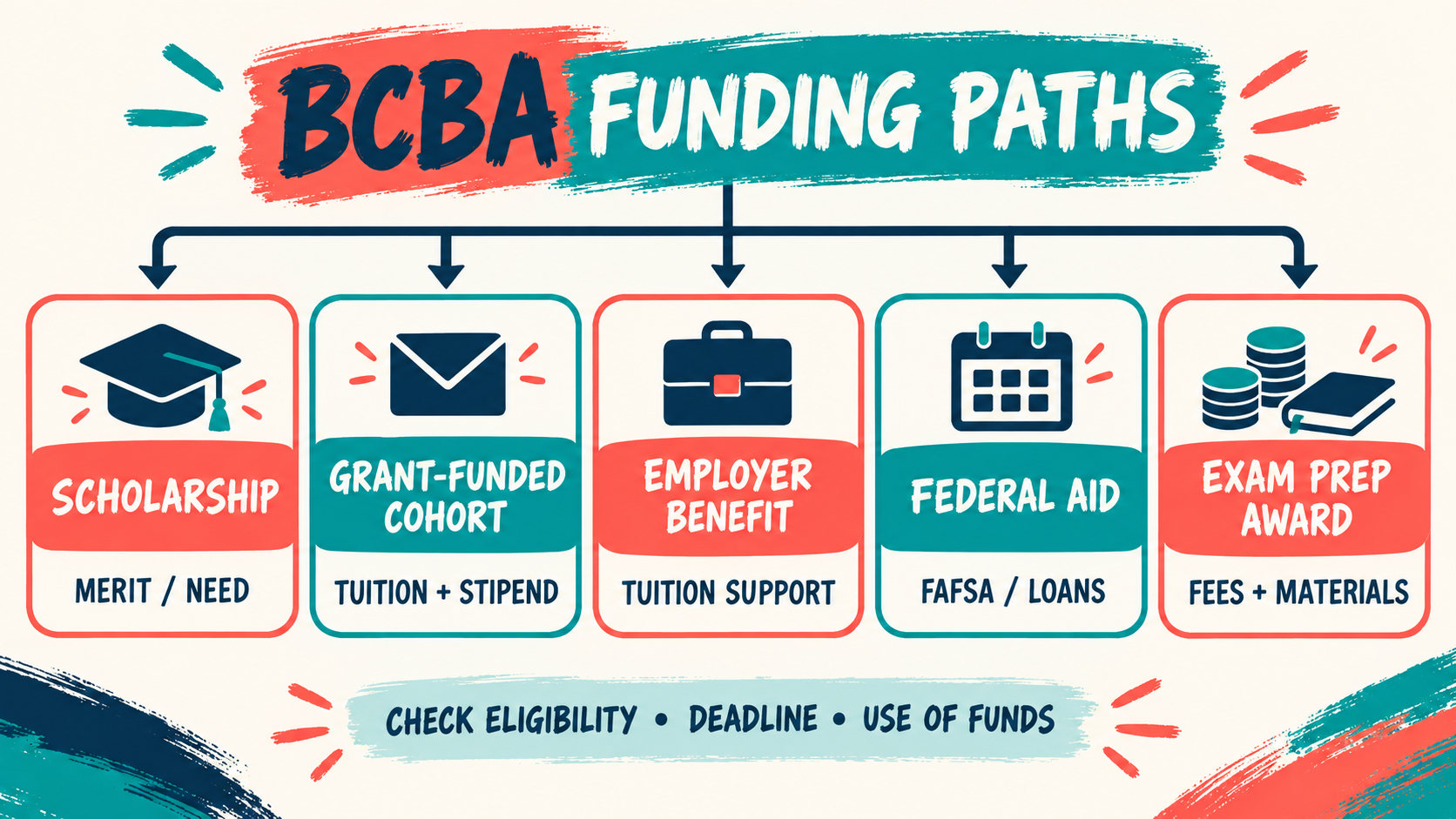
“Scholarship” is often used as an umbrella term. One award may reduce tuition at a particular university; another may reimburse a certification fee; a third may be a grant-funded cohort with a stipend, supervision, or travel support. These options can all help, but they are not interchangeable. Before comparing dollar amounts, identify what the money can actually be used for and who controls the award. A useful first pass is to classify the opportunity into one of these five buckets:
| Funding type | What it may cover | What to verify first |
|---|---|---|
| University scholarship | A tuition reduction attached to a specific ABA, special-education, psychology, or related program. | Admission status, program enrollment, award renewal rules, and whether it can be combined with other aid. |
| Foundation award | A payment sent to the school or student for eligible coursework, often with a geographic or mission-based focus. | Eligible degree or certificate, enrollment proof, deadline, and payment method. |
| Grant-funded cohort | Tuition plus a stipend, insurance, books, travel, supervision, or a structured training experience. | Required job, location, service commitment, cohort dates, and whether funding is contingent on a grant. |
| Employer benefit | Tuition reimbursement, a partner-school discount, paid study time, or exam-fee support. | Employment status, repayment clause, approved program list, and whether payment comes before or after the expense. |
| Exam or study award | Exam fees, supervision, preparation materials, a workshop, or a small cash award. | Whether you must already be enrolled, what expenses qualify, and whether the award is paid directly to a provider. |
Current Opportunities Worth Checking
The following examples were checked on September 29, 2026. They are included to show the range of funding models, not to promise that every reader will qualify. Read the linked page again before applying because cycle dates, available seats, and funding sources can change.
Foundation and mission-based awards: The Foundation for Empowering Citizens with Autism scholarship page says its recipients have pursued graduate degrees in special education and BCBA certification. The page displays a 2025–2026 academic-year cycle and lists fall and spring receipt deadlines. That makes it a useful lead for applicants whose goals fit the foundation’s mission, but the displayed cycle must be confirmed before you treat it as an open 2026–2027 opportunity.
Mission fit matters. An award may prioritize autism services, underserved communities, school-based practice, a particular state, or a specific student population. If your application does not explain that connection, a high grade point average alone may not make you competitive.
Program-based tuition awards: William James College’s ABA Positive Outcomes Scholarship is an example of a university-linked award. Its page says applicants to the Master of Arts in Applied Behavior Analysis are considered for a $10,000 merit scholarship and that qualified students are notified in the admission letter. The award is tied to that school and program; it should not be read as a portable BCBA scholarship that can be used at any university.
Some schools also offer partner-organization discounts, certificate awards, Yellow Ribbon benefits, assistantships, or grant-supported field education. Compare the award with the full cost of attendance, not only the headline number. A scholarship that covers one portion of tuition may still leave fees, books, fieldwork travel, and exam costs.
Grant-funded preparation and cohort programs: Texas A&M’s Project SUCCESS page describes a fully funded M.Ed. in Special Education for a defined group of special educators in the Brazos Valley. The page describes full tuition, a $7,500 annual stipend, insurance if needed, and additional support for travel, textbooks, and learning materials. It also specifies teaching experience, location, recommendations, GPA, and an application statement. This is a strong example of why “funding for a BCBA path” is not the same as “a scholarship open to every BCBA candidate.”
For a more exam-adjacent opportunity, the Bierman Rising Clinician Scholarship page displays a $2,000 award, three recipients, a September 1–30, 2026 application window, and eligibility requiring at least eight completed graduate credits in an ABA master’s program. It states that funds may be used for tuition, certification, supervision, and exam fees. This kind of award can be valuable when you are already in graduate training, but it is not a substitute for an accredited or otherwise qualifying degree and fieldwork plan.
University grant pages and assistantships: Do not search only for the exact phrase “BCBA scholarship.” Graduate assistantships, special-education grants, autism personnel-preparation programs, and school-based fellowships may be more valuable than a small standalone award. For example, the UMass Lowell autism studies page describes a fully paid two-year COAST opportunity with additional assistance for coursework, travel, books, and materials, while noting that funding is contingent on availability. Search each school’s financial-aid and department pages, then ask the program to confirm whether the funding is currently active.
Eligibility, the BACB Pathway, and the 2027 Checkpoint
A scholarship can reduce your cost, but it does not by itself make you eligible for BCBA certification. The current BCBA Handbook describes eligibility pathways that involve a qualifying degree, behavior-analytic content, supervised fieldwork, and passing the certification examination. The BACB examination information page explains that applicants must first meet the applicable eligibility requirements and receive an approved determination before scheduling the exam. That distinction changes how you evaluate an award:
- A scholarship for an ABA certificate may cover coursework but may not provide the degree required by your chosen pathway.
- A special-education grant may include ABA content and supervision, but you still need written confirmation that the program fits your intended BACB route.
- An employer’s tuition benefit may pay for classes without guaranteeing qualifying fieldwork, supervision, or an application outcome.
- An exam-prep award can help with practice materials or fees after eligibility is established; it does not replace the eligibility application.
The 2027 transition adds another reason to check dates carefully. The BACB’s updated handbook includes the 2027 eligibility overview and tells applicants to follow the requirements in effect for their application and examination timeline. A funding decision should therefore be made alongside a pathway timeline: program start date, expected graduation, coursework completion, fieldwork documentation, application date, and exam preparation. Do not choose a program solely because its scholarship page uses the word “BCBA.” Ask how the program maps to the current BACB materials.
A Four-Step Application Workflow
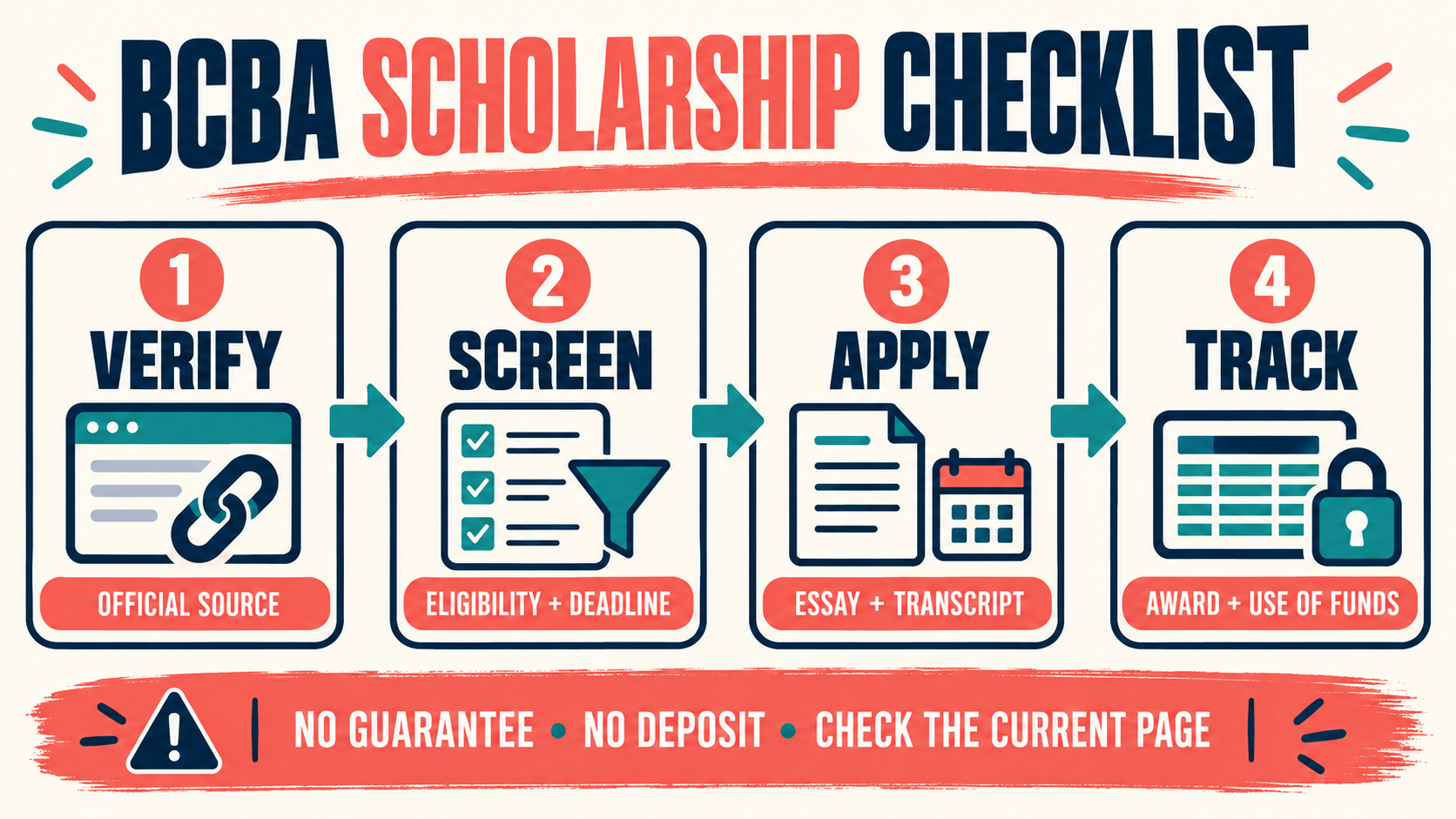
Once you find an opportunity, treat the application like a small evidence project. Save the current page as a PDF or note the access date, then keep a simple tracker for requirements and deadlines.
- Verify the source. Start from the school, foundation, employer, or grant administrator’s own page. Check the organization name, current cycle, contact method, and whether the page links to an official application. An old blog post or a search snippet is a lead, not proof that the award is open.
- Screen eligibility before writing. Check degree level, graduate-credit threshold, state or employer restriction, program enrollment, GPA, work status, service commitment, and citizenship or residency language when applicable. If one required condition is missing, do not spend hours polishing an essay before asking the provider.
- Prepare evidence that answers the rubric. Keep the essay specific: what you are studying, the population or setting you hope to serve, the behavior-analytic skills you are building, and how the funding changes your feasible plan. Use a current transcript, enrollment letter, recommendations, and a budget only when the provider requests them. Remove client-identifying information.
- Track the award after submission. Record the submission date, confirmation email, decision date, award amount, payment destination, tax language, and allowed use of funds. If the award is paid to a school, ask the bursar how it is applied. If it is paid to you, ask whether receipts are required and keep them.
How to Avoid Stale Listings and Risky Applications
Search results can surface genuinely helpful pages that are no longer current. The Autism Recovery Foundation page that appears for “BCBA scholarships,” for example, is an acceptance form for a Spring 2021 program. It may explain the organization’s history, but it should not be treated as a current application without a new announcement from the organization. Use this quick audit before uploading anything:
- Is the cycle year or application window visible?
- Does the page name the award administrator and provide a domain-based contact?
- Does the eligibility language match your program, location, and training stage?
- Does the page explain where funds go and what expenses are allowed?
- Are you being asked for a reasonable application rather than a fee, deposit, gift card, or payment to “release” the award?
- Can the provider explain how it protects transcripts, tax information, and identity documents?
Be especially careful with guarantees. A legitimate scholarship can offer an award amount and selection criteria; it cannot guarantee BCBA certification, a passing score, a job, or a particular exam outcome. When a listing makes those promises, leave it out of your funding plan and verify the opportunity independently.
Build an Exam Budget After Funding Is Confirmed
After you know what tuition support actually covers, build a second budget for the certification process. Include application and examination costs, supervision, required books or coursework, transportation to a testing center, practice materials, and time away from work. The BACB says its certification examinations are scheduled and paid for through the candidate’s Pearson VUE account after eligibility approval, so do not assume a school award automatically includes the exam appointment.
For your study budget, reserve a small recurring block for timed practice and error review. A free BCBA mock exam can help you preview the format and identify which task-list domains need more review. It is a study tool, not an official BACB product and not a promise of a passing result.
Final Takeaway
The best BCBA scholarships search is not a hunt for the largest number. It is a verification process: find the current provider page, classify the funding type, check the eligibility and deadline, map the award to your BACB pathway, and track exactly how the money may be used. Start with university financial-aid pages, autism and behavior-analysis foundations, grant-funded special-education cohorts, employer benefits, and exam-preparation awards. Then apply only when the source, timeline, and certification plan line up.
If you are deciding between two programs, compare the net cost, fieldwork access, supervision plan, and funding renewal rules together. A smaller award attached to a qualifying program may be more useful than a larger award that leaves the pathway unclear.
Quick Review Checklist
Use this final checklist to turn BCBA scholarships into exam-ready reasoning. The goal is not to memorize a label in isolation; it is to identify the relevant evidence and explain why the best answer fits the scenario. Key ideas to review:
- State the central definition or decision point for BCBA scholarships in your own words.
- Identify the detail that makes BCBA scholarships different from its closest related ABA term.
- Separate the observable facts in a scenario from assumptions that are not supported by the facts.
- Write one example and one nonexample so you can recognize the concept in a new setting.
Exam application checks:
- Ask what the question is actually requesting before comparing the answer choices.
- Mark the antecedent, response, consequence, or other evidence that supports the selected answer.
- Look for a distractor that describes a related process but does not answer the specific question.
Final self-check:
- Explain how you would verify the interpretation with clear observations or data.
- Change one detail in the scenario and decide whether your answer should change.
- Give a one-sentence rationale that a supervisor or study partner could evaluate.
Take the Free BCBA Mock Exam
If you want a low-pressure way to check your recall, use the free practice resource below. Take the Free BCBA Mock Exam



