
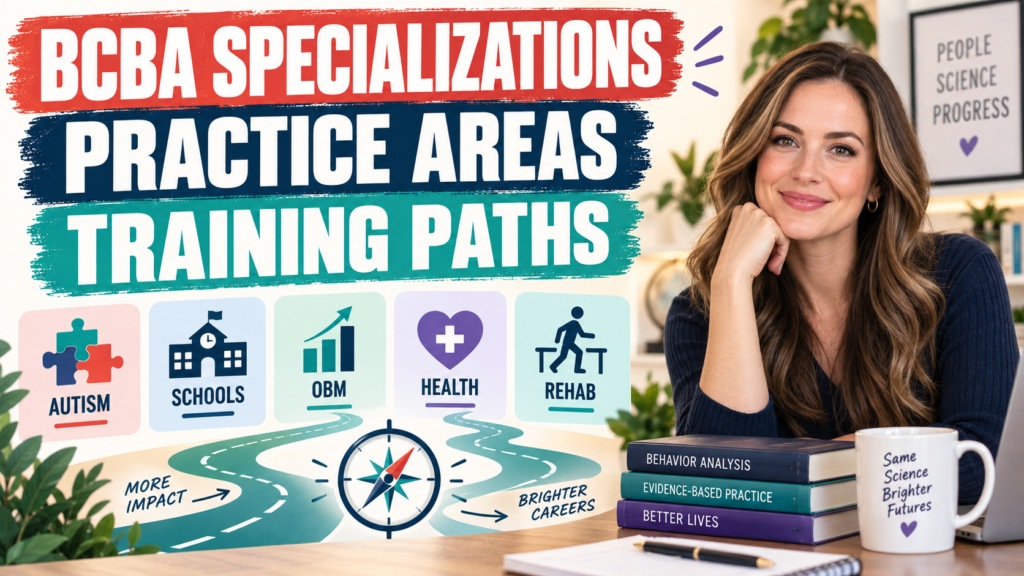
BCBA specializations are focused areas of behavior-analytic practice, not a shortcut around core certification requirements. The right choice depends on the population, setting, problems you want to solve, supervision you can access, and competence you can document.
Table of Contents
- Are BCBA Specializations Official Credentials?
- What Practice Areas Can BCBAs Explore?
- How Do You Choose a BCBA Specialization?
- What Training Should You Add?
- How Do Fieldwork and Supervision Fit In?
- How Do You Avoid Overclaiming Competence?
- What Does This Mean for BCBA Exam Study?
- BCBA Specializations FAQ
- Take the Free BCBA Mock Exam
If you are comparing autism services, education, behavioral health, organizational behavior management, or another practice area, start with a boundary: becoming a BCBA does not automatically make someone competent in every setting where behavior analysis can be applied. A specialization is a direction for building education, supervised experience, mentorship, and ethical scope—not a decorative label for a résumé.
This guide maps common BCBA practice areas, shows how to choose one responsibly, and connects the decision back to BCBA exam preparation. The BACB’s About Behavior Analysis resources describe multiple ABA subspecialty areas, while its respecialization guidance explains how to research and plan a new practice area. The BACB also warns that additional training or credentials may be needed in some jurisdictions. Requirements and state rules can change, so verify current details with the BACB, your licensing authority, and qualified supervisors. Table of Contents
Are BCBA Specializations Official Credentials?
Usually, the phrase BCBA specialization describes a focused practice area rather than a separate BACB specialty certificate. The BCBA credential establishes a graduate-level certification and an entry-level professional scope. Your later focus should be supported by relevant education, supervised experience, consultation, and demonstrated competence. That distinction matters because a web page, course title, or employer job label can make a focus sound more formal than it is. Before treating a “specialization” as a credential, ask:
- Who issues it, and is that organization a licensing or certification authority?
- What training, assessment, supervised practice, and renewal requirements does it actually include?
- Does your state or employer recognize it for the work you want to perform?
- Does the work require another professional license or discipline-specific qualification?
The BACB’s practice-area resources are useful for exploring the field, but they do not turn every listed area into an endorsement or an automatic permission to practice. Read a specialty label as a research question: what competence must I build before I offer this service?
What Practice Areas Can BCBAs Explore?
Behavior analysis is used in more settings than one standard job title suggests. The areas below are not a ranking. They are a starting map for comparing populations, environments, data questions, and additional preparation.
| Practice area | Typical questions | Preparation to investigate |
|---|---|---|
| Autism and developmental disabilities | How can communication, adaptive skills, safety, or participation improve in daily routines? | Functional assessment, communication systems, caregiver collaboration, assent, and culturally responsive practice. |
| Education and school-based practice | How can instruction, classroom routines, teacher behavior, or peer participation be improved? | School systems, consultation, instructional design, education law, and collaboration with teachers and families. |
| Behavioral health and clinical behavior analysis | How can behavior-analytic methods support health routines, coping, or treatment participation? | Population-specific clinical training, team-based care, referral boundaries, and applicable licensure rules. |
| Organizational behavior management | How can workplace systems, safety, performance, or process outcomes be improved? | Organizational assessment, measurement of performance, stakeholder consent, and business or human-resources context. |
| Behavioral gerontology, brain injury, or rehabilitation | How can behavior support independence, health routines, rehabilitation, or quality of life? | Age- and condition-specific knowledge, interdisciplinary practice, risk management, and medical referral limits. |
| Behavioral sports, health, fitness, or public health | How can measurable routines and environments support performance, prevention, or population outcomes? | Domain expertise, outcome measurement, consent, privacy, and clear limits on nonbehavioral services. |
The same credential can lead to very different daily work. Compare the actual client, setting, decision-maker, risk level, data system, and team—not just the specialty name.
How Do You Choose a BCBA Specialization?
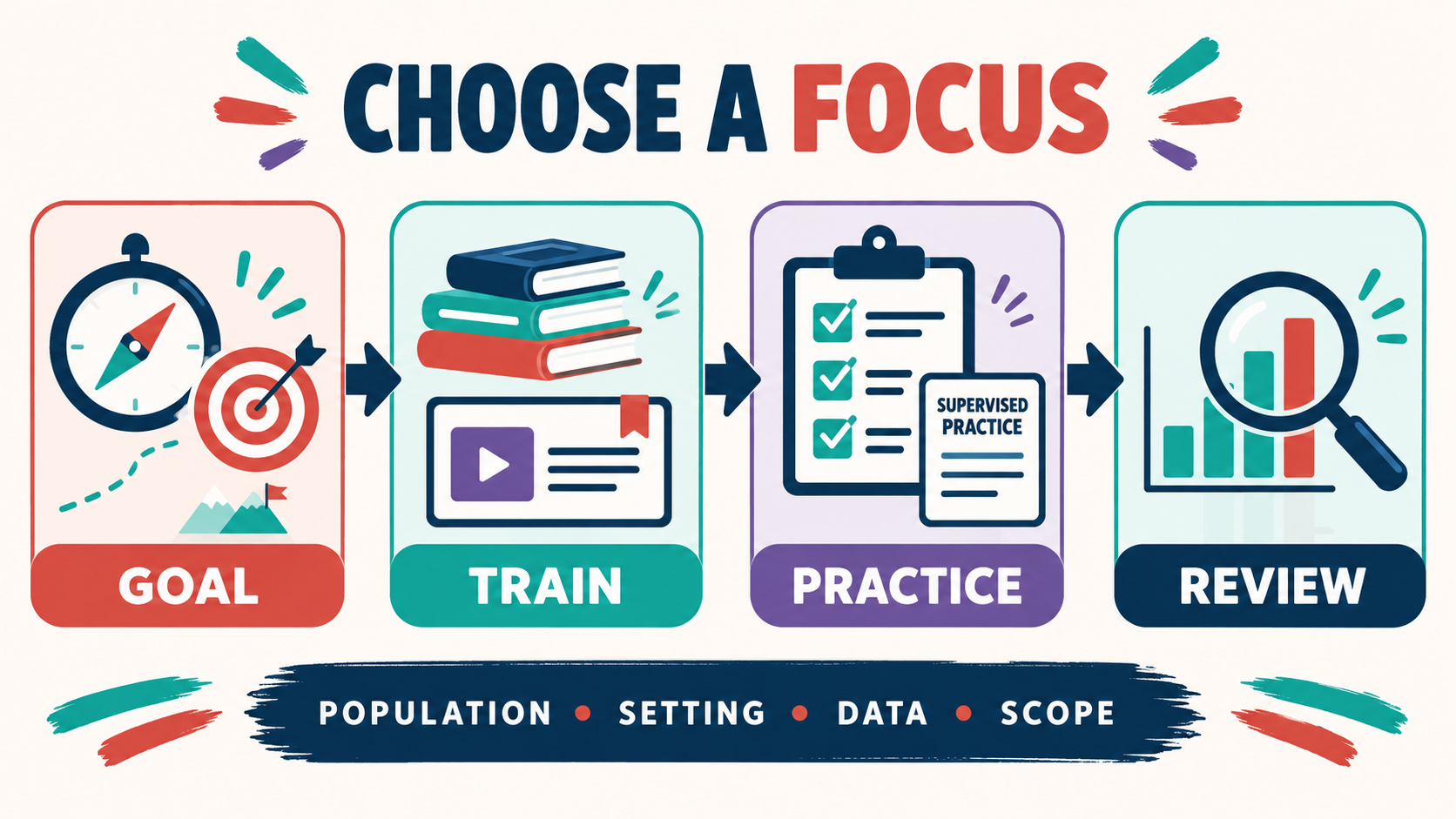
Choose a practice area by testing the fit between your goals and the competence pathway. A high-demand label is not automatically a good match, and a personally interesting topic is not automatically within your current scope.
- Define the population and setting. Write down who you want to serve and where the work occurs. “Children” or “healthcare” is too broad to guide training; specify the age range, environment, and stakeholders.
- Describe the behavior-analytic problem. Are you measuring skill acquisition, treatment participation, workplace performance, safety, caregiver implementation, or something else? The problem determines the data and consultation needs.
- Map your current competence. List the education, supervised opportunities, procedures, and feedback you already have. Separate direct experience from reading about a topic.
- Find a supervised bridge. Look for a supervisor, mentor, practicum, internship, or team that can provide feedback in the actual practice area. A course alone may not establish competence.
- Check legal and employer constraints. State licensure, payer rules, facility policies, and other professional credentials can change what services are allowed or reimbursed.
- Choose measurable next steps. Convert the interest into a six- to twelve-month learning plan with training, observation, supervised practice, and a way to review progress.
Use a simple scorecard rather than choosing from a list of glamorous titles. Rate each possible area on access to supervision, fit with your preferred population, quality of available training, ethical and legal clarity, and the kind of work you want to do every week.
What Training Should You Add?
The answer depends on the area and your starting point. The goal is not to collect certificates; it is to build usable, observable competence.
- Core behavior analysis: Strengthen measurement, assessment, intervention, ethics, data interpretation, and supervision concepts.
- Population or setting knowledge: Learn the communication, medical, educational, organizational, or cultural context of the people and systems involved.
- Applied practice: Observe experienced practitioners, practice under supervision, receive feedback, and document what you can and cannot do independently.
- Interdisciplinary collaboration: Learn when to consult or refer to speech-language pathologists, physicians, teachers, occupational therapists, psychologists, or other professionals.
- Professional communication: Practice writing operational definitions, presenting data, explaining uncertainty, and discussing goals with stakeholders in plain language.
A good specialization plan answers, “What will I be able to do more safely and accurately after this training?” If the answer is only “I will have a badge,” the plan needs a stronger competence measure.
How Do Fieldwork and Supervision Fit In?
Fieldwork is where knowledge becomes performance. If you are moving into a new area after certification, do not assume that general BCBA experience automatically transfers without adjustment. The BACB’s respecialization guidance recommends research, planning, self-assessment, and a deliberate action plan for building competence. Ask a potential supervisor how they will support the transition:
- What cases, settings, and procedures will you actually observe?
- How will they evaluate your decisions and documentation?
- What risks require another professional or a higher level of oversight?
- How will you know when you are ready to work more independently?
Keep certification, licensure, employment, and specialization in separate columns in your notes. A graduate degree may meet one requirement; a BCBA credential may meet another; a state license or clinical credential may be required for a particular service. The columns should not be collapsed into one promise.
How Do You Avoid Overclaiming Competence?
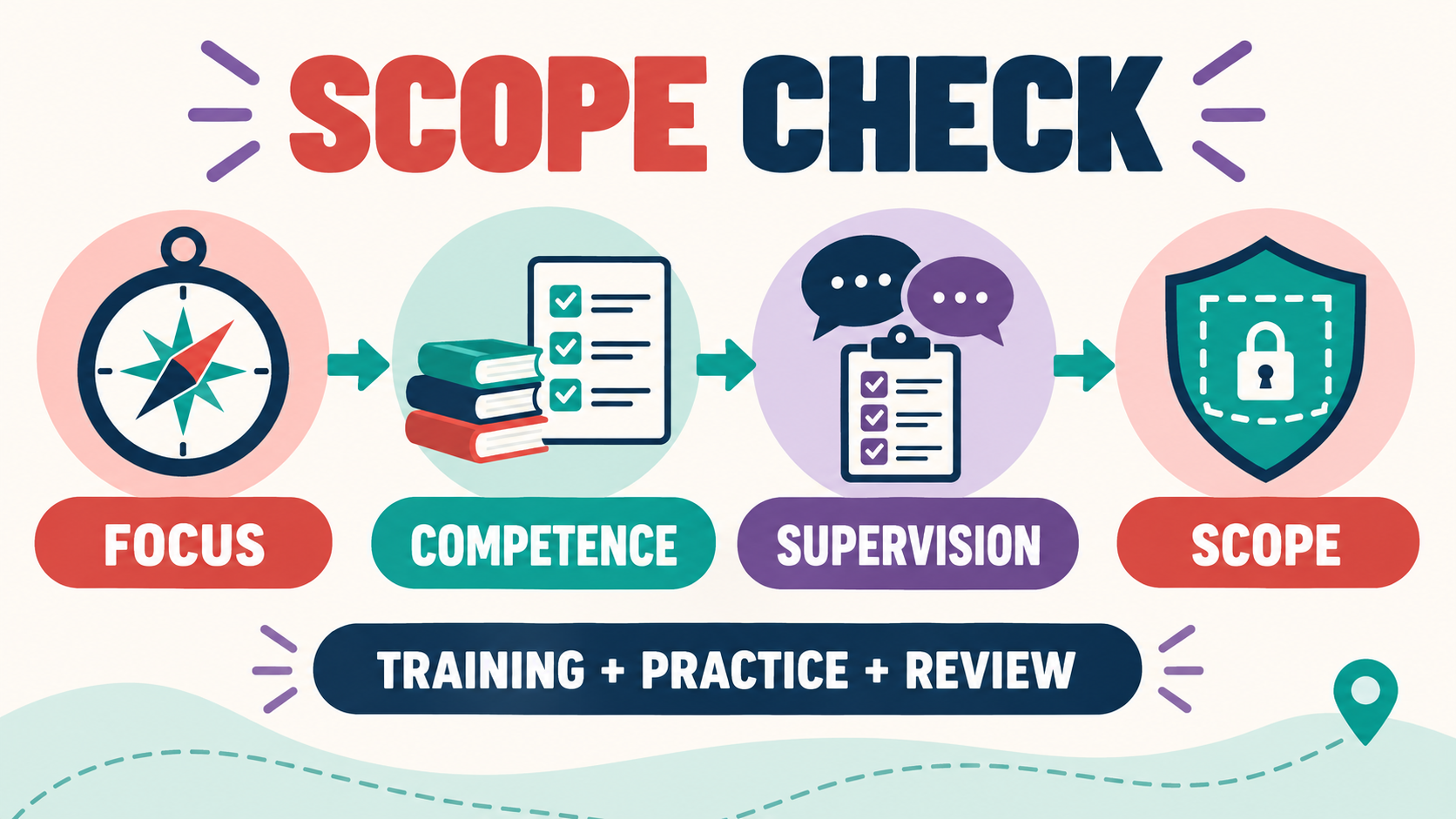
Overclaiming usually begins with a vague label. Saying “I specialize in behavioral health” could mean coursework, supervised practice, a job title, or years of independent experience. A more accurate description names the evidence:
| Weak claim | More defensible description |
|---|---|
| “I specialize in brain injury.” | “I am building supervised experience in behavior-analytic services for adults with brain injury and consult with the interdisciplinary team.” |
| “My certificate qualifies me for any clinical case.” | “My certificate supports my BCBA role; the case-specific scope depends on training, competence, supervision, law, and referral needs.” |
| “I can practice independently in every state.” | “I will verify the current state requirements and employer or payer rules before offering services.” |
Use client-informed goals, assent, confidentiality, cultural responsiveness, and least-intrusive decision-making as part of the specialization plan. A narrow area of practice still requires broad professional judgment about whether the service is appropriate and when to refer.
What Does This Mean for BCBA Exam Study?
The current BCBA Test Content Outline is the exam anchor. It tests entry-level knowledge and skills across areas such as concepts and principles, measurement, assessment, behavior-change procedures, ethics, and supervision. It does not require you to memorize a private list of “approved BCBA specializations.” Specialization questions can still appear indirectly in scenarios. When a question describes a new population or setting, identify the decision the BCBA must make:
- Is the proposed action supported by assessment data and an operational definition?
- Does the practitioner have the competence, training, and supervision needed for the procedure?
- Are the client’s rights, assent, culture, privacy, and safety addressed?
- Should the BCBA consult, collaborate, modify the plan, or refer?
- What measurement would show whether the service is helping?
For exam prep, study the general principles deeply enough to transfer them to unfamiliar populations. A candidate who memorizes only autism-clinic examples may miss the same measurement, assessment, ethics, or supervision logic when the scenario moves to a school, workplace, hospital, or community setting.
BCBA Specializations FAQ
Does the BACB offer a separate certification for every BCBA specialization?: No. Practice-area labels and certificates from other organizations are not automatically BACB credentials. Check the issuer, requirements, jurisdiction, and scope before describing a focus as a formal certification.
What is the most common BCBA specialization?: Autism and developmental-disability services are widely associated with BCBA work, but “most common” does not mean “only” or “best.” Education, behavioral health, organizational behavior management, rehabilitation, gerontology, public health, and other areas may require different preparation and supervision.
Can I change BCBA practice areas later?: Yes, but a change should be planned. Research the new area, identify competence gaps, obtain relevant education and supervised experience, consult qualified professionals, and verify legal and employer requirements before taking on new responsibilities.
Should I choose a specialization before taking the BCBA exam?: You can explore interests before the exam, but do not let a specialty label replace core preparation. Start with the current BCBA Test Content Outline, then use your preferred practice area to create meaningful examples and application practice.
Strong BCBA specializations are built through evidence, not just labels. Choose an area that matches your goals, map the competence you still need, build supervised experience, and keep the boundaries between certification, licensure, employment, and focused practice clear. When you are ready to test your core concepts across varied scenarios, use the free BCBA mock exam as an independent study tool—not as BACB material or a guarantee of certification.
Take the Free BCBA Mock Exam
If you want a low-pressure way to check your recall, use the free practice resource below. Take the Free BCBA Mock Exam



