

Introduction: The Question Every ABA Student Asks
If you’ve started studying verbal behavior for the BCBA exam, you’ve likely encountered the question “is please a mand?” At first glance, it seems like a simple yes or no. But behavior analysis rarely deals in surface-level answers. The word “please” can function differently depending on the context, the speaker’s motivation, and the consequences that follow.
Table of Contents
- Introduction: The Question Every ABA Student Asks
- What Is a Mand in Verbal Behavior?
- Breaking Down ‘Please’: A Closer Look
- ABA Example Scenarios: Analyzing ‘Please’ with ABC
- Exam Relevance and Common Traps
- Quick Checklist for Identifying a Mand
- Summary and Final Thoughts
- Take the Free BCBA Mock Exam
In this guide, we’ll break down the concept of the mand, analyze “please” from a behavioral perspective, and walk through real-world examples. You’ll also learn how to spot common exam traps so you can approach questions about verbal operants with confidence. By the end, you’ll know exactly why the function of “please” matters more than its form.
What Is a Mand in Verbal Behavior?
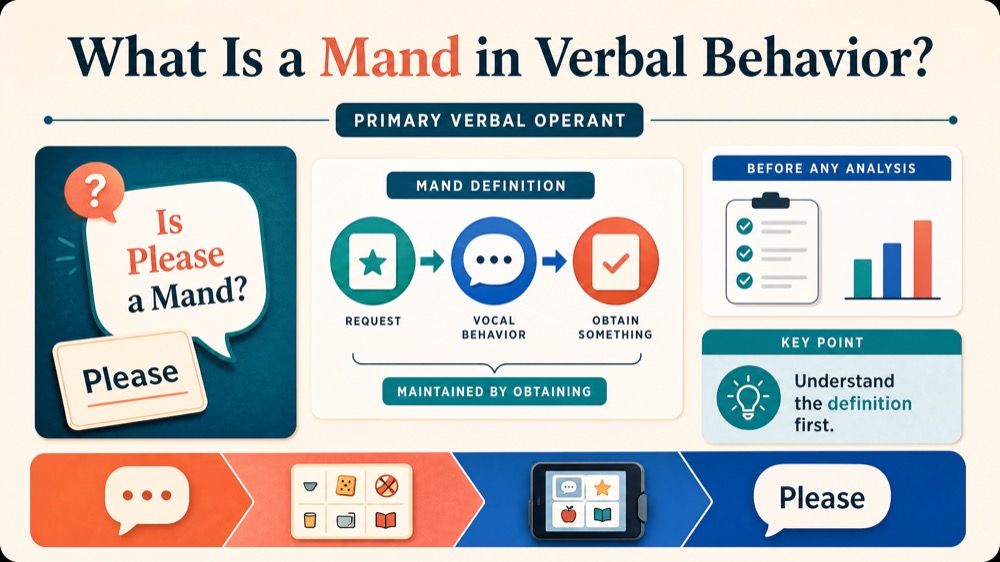
In B.F. Skinner’s analysis of verbal behavior, a mand is one of the primary verbal operants. It’s essential to understand this definition before analyzing any specific word. A mand is a verbal response controlled by an establishing operation (EO) and maintained by a specific reinforcer. In simpler terms, it’s a request that states what the speaker wants or needs at that moment.
For example, when a child says “cookie” because they want a cookie, the word is under the control of deprivation or desire. The consequence of receiving a cookie strengthens that response. The mand is unique because it directly benefits the speaker by delivering the specified reinforcer. This is different from other verbal operants we’ll explore next. The Definition of a Mand: Think of a mand as a “demand” or a “request” that specifies its own reinforcement. The key components are:
- Controlled by an establishing operation (EO) that momentarily increases the value of a reinforcer.
- The response form often names the desired item or action.
- Maintained by specific reinforcement that matches the stated request.
So, if a learner says “juice” because they are thirsty, and they receive juice, that is a classic mand. The motivation (thirst) is the EO, and the specific reinforcer (juice) maintains the response.
Examples of Mands vs Other Verbal Operants: To see the difference clearly, compare a mand to other verbal operants like the tact and the intraverbal. A tact is a label under the control of a nonverbal stimulus, like saying “dog” when you see a dog. An intraverbal is a response controlled by another verbal stimulus, like saying “four” when you hear “two plus two.” Here are a few quick examples:
- Mand: Saying “water” because you’re thirsty and want a drink.
- Tact: Saying “ball” when you see a ball on the floor.
- Intraverbal: Saying “red” when someone asks, “What color is an apple?”
- Echoic: Repeating “apple” after a therapist says “apple.”
The critical distinction is the controlling variable. For a mand, it’s the EO and specific reinforcement. For a tact, it’s a nonverbal antecedent. For an intraverbal, it’s a verbal antecedent. Always ask yourself: What is controlling this response?
Breaking Down ‘Please’: A Closer Look
Now let’s apply that framework to the word “please.” In everyday language, “please” is a politeness marker often used to soften requests. Behaviorally, its function is not fixed; it depends entirely on the controlling variables. In some situations, “please” might function as a mand, and in others, it might not.
To analyze whether “please” is a mand, you must examine the motivating operations and the consequences. If a child says “please” because they want access to a preferred toy, and they receive the toy, then that “please” is functioning as a mand. The response is reinforced by the specific item, not by social praise or attention.
The Literal Definition of 'Please': According to common definitions, “please” is used as a polite adverb to make a request more polite. It is not a noun or a verb that names an item. However, in ABA, we focus on the function of the response, not its grammatical category. A single word can serve many functions depending on the context.
For example, a child might say “please” after a therapist models the phrase “say please” when requesting. In that case, the immediate antecedent was a verbal prompt. The child’s response might be an echoic (repeating the word) or an intraverbal (part of a conversational exchange), not necessarily a mand. So, the literal meaning is less relevant than the behavioral function.
When 'Please' Functions as a Mand: When “please” is used as a request under the control of an EO, it can be considered a mand. Consider a scenario where a child wants a turn on a swing. The child approaches the swing and says “please” while looking at the adult. If the adult gives the child a turn, and the child’s future “please” increases in similar situations, then that response is a mand.
Here, the establishing operation is the desire to swing, the response is “please,” and the specific reinforcement is the swinging. The word “please” serves as a request for the reinforcer. In this context, it functions exactly like any other mand such as “swing” or “I want swing.”
When 'Please' Is Not a Mand: Conversely, there are times when “please” is not a mand. Suppose a child says “please” in response to the instruction “Say please” during a social skills lesson. The antecedent is a verbal demand, not an EO. The child’s response is more likely an intraverbal or a tact of a social rule. The reinforcement might be teacher praise or a token, not the specific item requested.
Another example: a learner says “please” as part of a rote phrase like “pretty please” without any clear motivation. If there is no EO and no specific reinforcement, then the response does not meet the definition of a mand. The form alone does not determine the operant; the function does.
ABA Example Scenarios: Analyzing ‘Please’ with ABC
To solidify your understanding, let’s examine three practical scenarios using the ABC (Antecedent-Behavior-Consequence) framework. This is exactly the kind of analysis you’ll need to perform on the BCBA exam. Remember: the antecedent includes everything that happens before the behavior, including the presence of an EO. The consequence is what follows the behavior. By identifying the controlling variables, you can determine if “please” is a mand. Example 1: Requesting a Preferred Item: Antecedent: A child sees a favorite toy on a high shelf, out of reach. The child has a history of receiving that toy when they ask for it. Behavior: The child says, “Please!” while pointing to the toy. Consequence: The adult gives the toy to the child.
In this case, the child’s response is under the control of the EO (desire to play with the toy) and is reinforced by access to the toy. Therefore, “please” functions as a mand. The response specifies the reinforcer (even if implicitly) and is maintained by it. Example 2: Asking for Help: Antecedent: A student is struggling with a puzzle and cannot complete it independently. They see an adult nearby. Behavior: The student says, “Please” (meaning “please help me”). Consequence: The adult comes over and helps the student finish the puzzle.
Here, the mand is for assistance. The EO is the inability to complete the puzzle, making help valuable. The response is reinforced by the adult’s help. Again, the word “please” is functioning as a request for a specific form of help, so it is a mand. Example 3: Using 'Please' as Part of a Request: Antecedent: A child is thirsty and wants juice. They see a cup of juice nearby. Behavior: The child says, “I want juice, please.” Consequence: The caregiver hands the child the juice.
In this longer utterance, “please” is part of a larger mand phrase. The entire phrase is controlled by the EO (thirst) and reinforced by juice. The presence of “please” does not change the fact that the response is a mand. Whether the child says just “j” or “juice please,” the function remains the same.
Exam Relevance and Common Traps
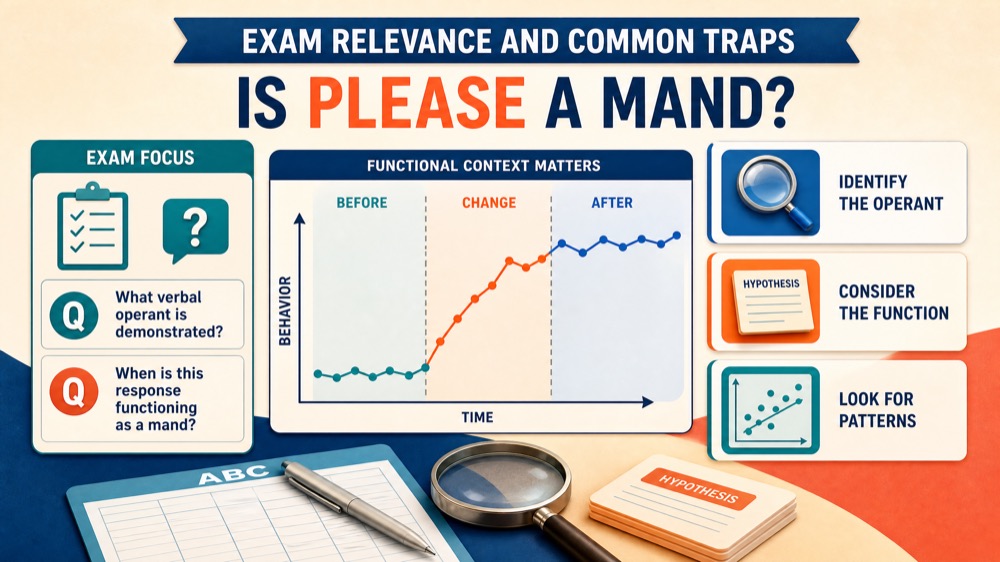
The BCBA exam frequently tests your ability to identify verbal operants based on functional definitions. You may see scenarios that ask, “What verbal operant is demonstrated?” or “When is this response functioning as a mand?” Understanding the nuance of words like “please” can be the difference between a correct and incorrect answer. Here are some common traps that students fall into, along with tips to avoid them.
- Trap 1: Assuming that any polite request with “please” is a mand. Always check for the EO and specific reinforcement.
- Trap 2: Confusing form with function. Remember that the same word can be a mand, tact, or intraverbal depending on the context.
- Trap 3: Overlooking the role of prompts. If the response was prompted, it may not be a pure mand.
To eliminate wrong answers, follow these steps:
- Identify the antecedent. Is there an EO present?
- Determine the consequence. Is the consequence specific to the request?
- Ask yourself: Is the response under control of motivation or a verbal stimulus?
If you can answer these, you’ll be able to classify the operant accurately. For further practice, check out resources on verbal behavior exam prep.
Quick Checklist for Identifying a Mand
When you’re in the heat of the exam, use this quick checklist to confirm whether a response is a mand. Apply it to any scenario, including those with “please”.
- Is the response under the control of an establishing operation (i.e., momentary motivation)?
- Does the response specify the reinforcer (even indirectly)?
- Is the reinforcer delivered specifically because of that response?
- Would the response occur without the EO? If no, it’s likely a mand.
If you answer “yes” to all four, the response is a mand. This checklist will help you quickly analyze scenarios and avoid overthinking.
Summary and Final Thoughts
So, is “please” a mand? The answer is: it depends. In behavior analysis, we never classify a verbal response by its form alone. The word “please” is a mand only when it is controlled by an establishing operation and maintained by a specific reinforcer. In other contexts, it might be an intraverbal or a polite habit.
For the BCBA exam, focus on understanding the function of the response rather than memorizing definitions. Use the ABC framework to analyze scenarios, and always ask what antecedent and consequence are at play. By mastering verbal operants, you’ll be well-prepared for questions on this topic.
For more study tips and practice questions, visit BCBA Mock Exam and explore our comprehensive prep materials. Also, you can review the BACB’s official task list at bacb.com to ensure you cover all exam content areas. Remember, behavior analysis is all about function, not form. Keep that principle in mind, and you’ll navigate verbal behavior questions with confidence. Good luck with your studies!
Take the Free BCBA Mock Exam
Ready for more practice? Use the free mock exam to keep testing your accuracy with realistic BCBA-style items. Take the Free BCBA Mock Exam



