
Introduction
Every BCBA candidate knows that experimental control is the backbone of applied behavior analysis. But when you sit for the exam, questions about extraneous vs confounding variables can quickly separate those who truly understand internal validity from those who don’t. This guide breaks down the definitions, key differences, and practical ABA examples so you can tackle these questions with confidence.
Table of Contents
- Introduction
- What Are Extraneous and Confounding Variables?
- Key Differences Between Extraneous and Confounding Variables
- ABA Examples: Applying the Distinction in Behavior Analysis
- Why This Matters for the BCBA Exam
- Conclusion and Summary
- References
What Are Extraneous and Confounding Variables?
To compare and contrast extraneous variables with confounding variables, you first need a clear definition of each. Both are unwanted variables that can threaten the validity of a study, but they differ in how they relate to the independent variable (IV).
Extraneous Variables Defined
An extraneous variable is any variable other than the IV that could potentially influence the dependent variable (DV). For example, in a study measuring the effect of a token economy on on-task behavior, the time of day sessions are conducted is an extraneous variable. If not controlled, it could affect results, but it does not necessarily change with the IV.
Confounding Variables Defined
A confounding variable is a specific type of extraneous variable that systematically varies with the IV. This means you cannot determine whether changes in the DV are due to the IV or the confound. For instance, if the token economy is always implemented in the morning but baseline is always in the afternoon, the time of day becomes a confound because it co-varies with the intervention.
Key Differences Between Extraneous and Confounding Variables
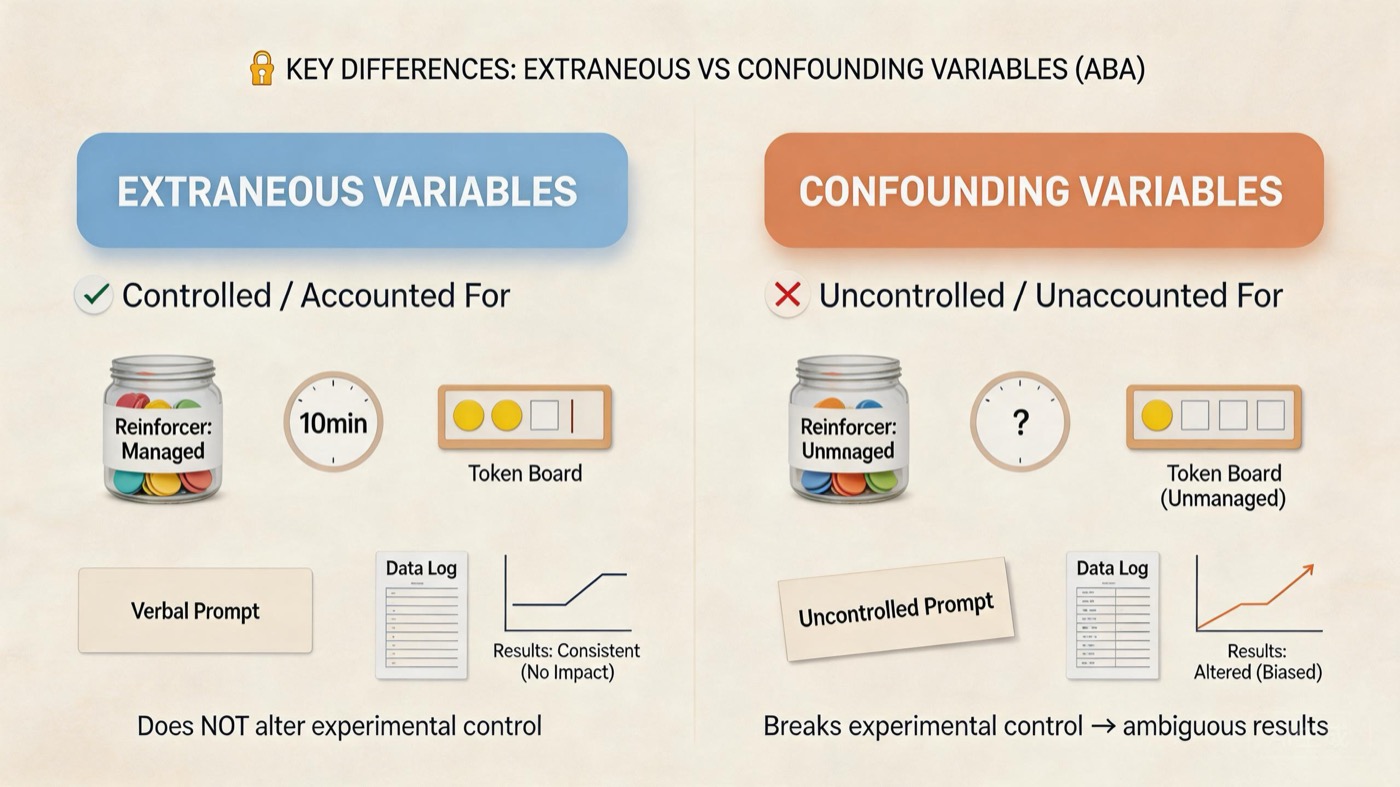
The table below highlights the critical distinctions. Remember: all confounding variables are extraneous, but not all extraneous variables are confounding. The key is whether the variable changes predictably with the IV.
- Control: Extraneous variables can be controlled through randomization or constant conditions; confounding variables require experimental design changes (e.g., counterbalancing).
- Impact on Validity: Extraneous variables add noise but can be managed; confounding variables directly threaten internal validity by offering alternative explanations.
- Measurability: Extraneous variables are often measurable and can be statistically controlled; confounding variables may be unmeasured or unrecognized.
- Relationship with IV: Extraneous variables are independent of the IV; confounding variables co-vary with the IV, creating a systematic confound.
ABA Examples: Applying the Distinction in Behavior Analysis
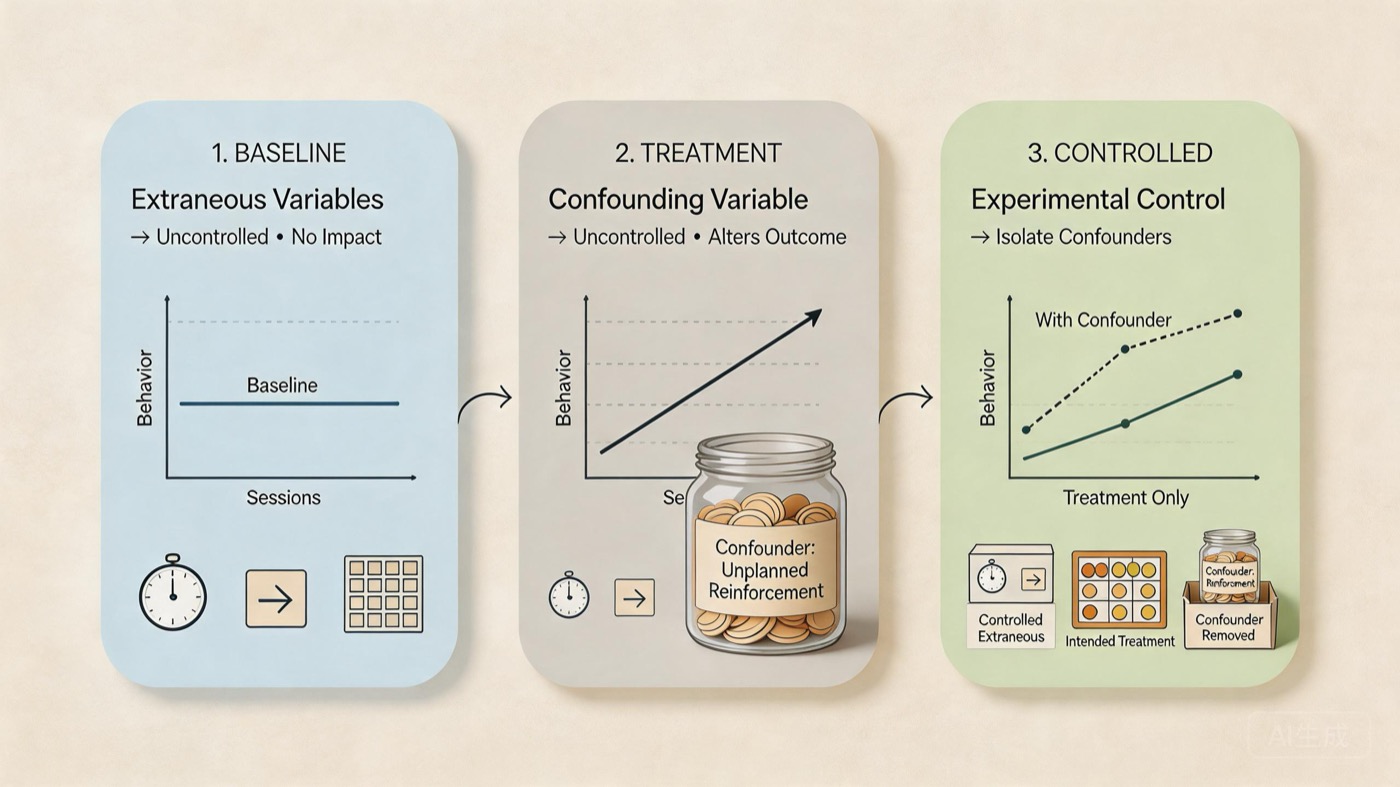
Let’s walk through three real-world ABA scenarios to see how these variables play out in practice.
Example 1: Token Economy in a Classroom
A BCBA implements a token economy to increase academic engagement. The token system is used during math class (10am), while baseline data were collected during reading (9am). The time of day is an extraneous variable, but it becomes a confounding variable because it always coincides with the token economy. To fix this, the BCBA could counterbalance the order of conditions across days.
Example 2: Functional Communication Training (FCT)
Two therapists deliver FCT to reduce aggressive behavior. Therapist A is more experienced and uses fewer prompts, while Therapist B is newer. If the study does not assign therapists randomly, the therapist experience becomes a confounding variable: you cannot tell if improvements are due to FCT or the therapist’s skill. If therapist assignment is randomized, experience is merely an extraneous variable that adds variability.
Example 3: DRA for Aggression
In a study using differential reinforcement of alternative behavior (DRA) to reduce aggression, the presence of preferred toys in the environment varies across sessions. If sessions with DRA always include toys and baseline sessions do not, the toys become a confounding variable. If toys are present in both conditions but unequally distributed, they remain extraneous but should be controlled.
Why This Matters for the BCBA Exam
The BCBA task list (6th edition) emphasizes measurement, experimental design, and internal validity. Questions on extraneous vs confounding variables often appear in scenarios asking you to identify threats to validity or suggest improvements. For more on experimental control, see our guide on independent and dependent variables in ABA.
Common Exam Traps
Candidates frequently confuse when a variable is merely extraneous versus when it becomes confounding. The critical test is whether the variable varies with the levels of the IV.
- Trap 1: Assuming any uncontrolled variable is automatically confounding. Remember, an extraneous variable only becomes confounding if it systematically changes with the IV.
- Trap 2: Overlooking confounds in within-subject designs, such as order effects or carryover effects that can become confounds.
- Trap 3: Misidentifying a confound when the variable is actually irrelevant to the DV. Always ask: could this variable plausibly affect the DV?
Quick Checklist to Differentiate
Use this mental checklist when you encounter a variable in an exam scenario:
- Step 1: Identify if it is a variable other than the IV. If no, it is not extraneous.
- Step 2: Determine if it could potentially affect the DV. If no, it is irrelevant.
- Step 3: Ask: does this variable change systematically with the levels of the IV? If yes, it is a confounding variable; if no, it is extraneous.
Conclusion and Summary
Mastering the difference between extraneous and confounding variables is essential for passing the BCBA exam and for conducting sound research in practice. To review: extraneous variables are any variables besides the IV that might influence the DV; confounding variables are a subset that co-vary with the IV, directly threatening internal validity. The key distinction is whether the variable is systematically linked to the IV. Practice applying the checklist above to sample questions. For additional exam prep, check out our BCBA mock exams and the BACB’s own resources on experimental design.
References
Next step for BCBA exam prep
Turn this topic into exam-day practice
Use this topic as a focused review, then test it in exam-style conditions with a free mock before deciding whether five full-length mocks are the right next step.
Start the Free BCBA Mock Exam
Continue with Five Full-Length Mocks — $99
Review the included materials and access details before ordering. No pass guarantee is implied.



