
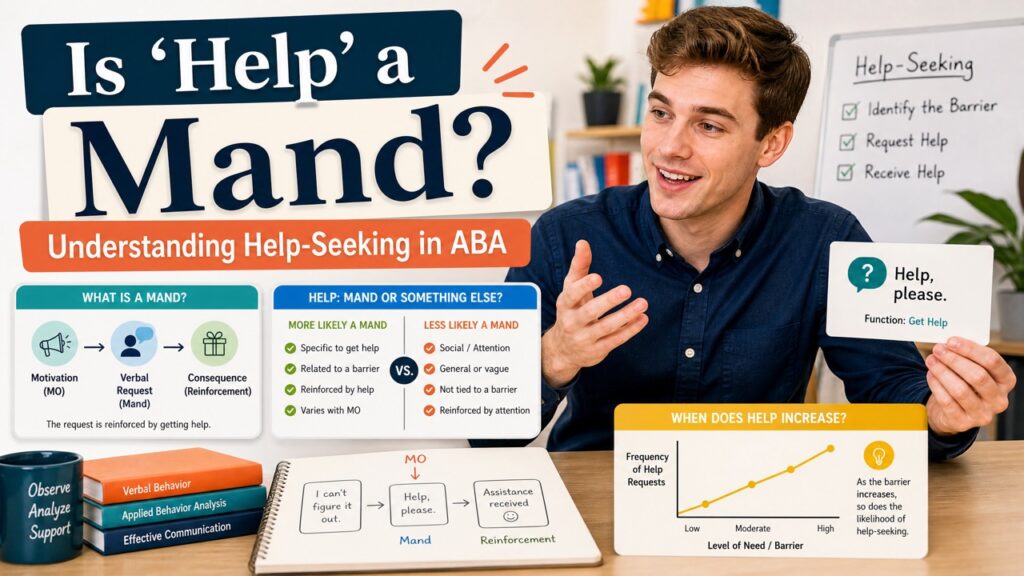
What Does ‘Mand’ Mean in ABA?
In applied behavior analysis, a mand is a type of verbal operant where a speaker requests something they need or want. The term comes from the word “command” and “demand,” reflecting its function: the response specifies its own reinforcer. Technically, a mand is controlled by motivating operations (MOs) and is reinforced by a specific consequence that is directly related to the request.
Table of Contents
- What Does ‘Mand’ Mean in ABA?
- Is ‘Help’ a Mand? Key Examples and Analyses
- Exam Relevance: How Mands Appear on the BCBA Exam
- How to Teach Mands Like ‘Help’ in Practice
- Quick Checklist: Is It a Mand?
- Summary and Next Steps for Exam Prep
- Quick Review Checklist
- Take the Free BCBA Mock Exam
- References
For example, if a child says “cookie” and receives a cookie, that utterance is a mand because it specifies the reinforcer (the cookie). The strength of the response depends on how valuable that reinforcer is at that moment. This foundational definition is crucial for BCBA exam prep because it distinguishes mands from other verbal operants like tacts, intraverbals, and echoics.
Why Saying 'Help' Fits the Definition: When you say “help,” you are requesting assistance, which is a specific reinforcer: the completion of a task or the removal of an obstacle. The word “help” specifies exactly what kind of assistance is needed, making it a classic example of a mand. The value of that help is heightened by the current motivating operation—if you genuinely need assistance, the mand is more likely to occur.
Consider a child struggling to open a jar. They say “help,” and an adult opens it. The child’s response was reinforced by the jar being opened, which was the specific consequence they requested. This fits the mand definition perfectly: the response specifies its reinforcer and is under MO control. Understanding this basic example helps clarify why “help” is a mand in ABA.
Is ‘Help’ a Mand? Key Examples and Analyses
To directly answer the query: yes, saying “help” is a mand in most clinical contexts. However, the function of the response can vary depending on the situation. Below are three practical examples with ABC breakdowns to illustrate different functions and how they all qualify as mands.
Example 1: Requesting Help to Escape a Task: Imagine a student working on a challenging math worksheet. The antecedent is the difficult task presented. The behavior is the student raising their hand and saying, “Help, please.” The consequence is that the teacher comes over and assists, partially completing a problem. The hypothesized function here is escape from task, which is a form of negative reinforcement.
Why is this a mand? The response “help” specifies the exact assistance needed, and the reinforcer is the removal of the aversive task demands. Even though the immediate result is help, the maintaining consequence is escape. On the BCBA exam, you may see scenarios like this, and recognizing the function is key to identifying it as a mand.
Example 2: Requesting Help to Gain Access to a Tangible: Another scenario: a child sees a toy on a high shelf and says “help” while reaching for it. The antecedent is the toy being out of reach. The behavior is the vocal request. The consequence is that an adult retrieves the toy and hands it to the child. The hypothesized function is access to a tangible, a form of positive reinforcement.
Here, “help” specifies the action needed to obtain the desired item. The reinforcer is the toy itself, not just the assistance. This distinction is important because it shows that mands can be maintained by various types of reinforcement—escape, tangibles, attention—while still meeting the definitional criteria.
Example 3: Requesting Help as Attention-Seeking: Sometimes “help” is used to gain attention rather than genuine assistance. For instance, a child who can independently complete a puzzle says “help” whenever an adult is nearby. The adult responds by kneeling down and giving praise, even though the child didn’t need help. The hypothesized function here is access to attention.
Despite not needing actual help, the response is still a mand because it specifies a reinforcer: social attention. The child’s request is under the control of an MO (need for attention) and is reinforced by the adult’s attention. This example highlights how the same response can have different functions, but in all cases, it qualifies as a mand as long as it specifies its reinforcer.
Exam Relevance: How Mands Appear on the BCBA Exam
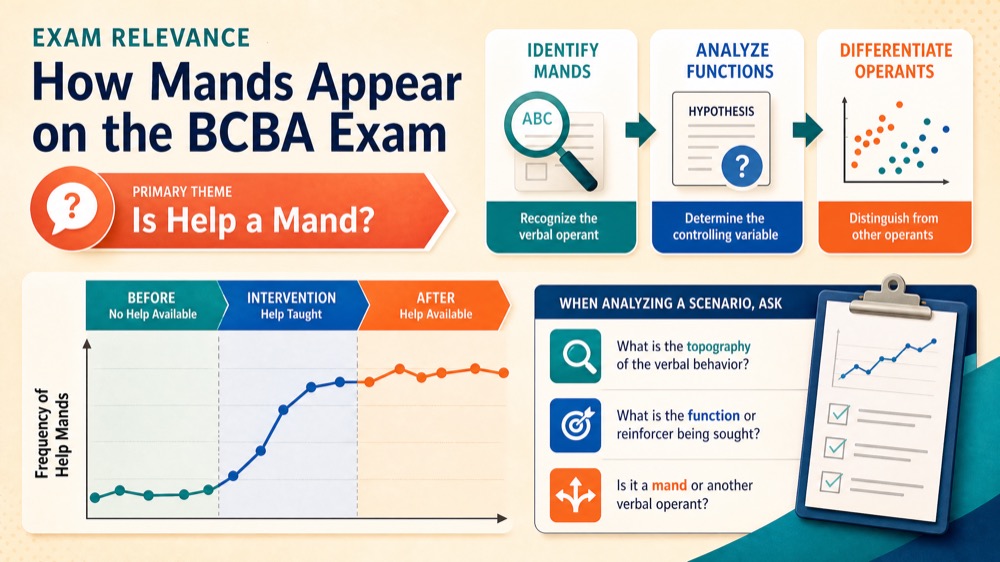
On the BCBA exam, you will encounter questions that ask you to identify mands, analyze their functions, or differentiate them from other verbal operants. Understanding the technical definition is essential, but you also need to apply it to novel scenarios. Here are some common ways mands appear on the exam, along with traps to avoid.
When analyzing a scenario, ask yourself: Does the response specify its reinforcer? Is it under MO control? If yes, it’s a mand—regardless of whether it’s a full sentence or a single word. This definitional approach will help you navigate tricky questions.
Common Traps and Misconceptions: One common trap is assuming a mand must be grammatically complete. In ABA, efficiency is more important than grammar. A child pointing and grunting may be manding if the response is reinforced by access to a specific item.
- Trap 1: Believing any request is a mand. A request must specify its reinforcer. For example, saying “more” is a mand only if it specifies what is wanted (e.g., more juice).
- Trap 2: Confusing mands with tacts. A tact labels an object, but it is not under MO control in the same way. A child saying “ball” when seeing a ball is a tact, not a mand, unless they are requesting the ball.
- Trap 3: Overlooking that ‘help’ can have multiple functions. As shown in the examples, ‘help’ can be maintained by escape, tangibles, or attention. You must analyze the consequence to determine the function.
Study Strategies for Verbal Operants: To master mands and other verbal operants, use a mnemonic like “Mands get you what you want” to remember their core function. Practice with flashcards that include real-life examples, and observe children or peers to identify mands in natural settings. Revisit the verbal behavior taxonomy regularly, and use verbal prompting guides to deepen your understanding of how mands are taught.
Another effective strategy is to create your own scenarios and break them down using the ABC format. This not only reinforces the definition but also prepares you for exam questions that require you to identify the function of a response. For more exam prep tips, check out our article on 5 things you need to know about the BCBA exam.
How to Teach Mands Like ‘Help’ in Practice
Teaching mands is a critical skill for BCBAs, especially when working with individuals with limited verbal abilities. The goal is to help learners request what they need, reducing frustration and challenging behavior. Here are evidence-based strategies to teach the mand “help.”
Behavioral Teaching Sequence: Start by capturing natural opportunities where the learner is motivated to request help. For example, present a task that is slightly too difficult and wait for a prompt. Use errorless teaching by providing a vocal prompt like “say help” before the learner becomes frustrated. Once the learner correctly says “help,” provide immediate assistance to reinforce the mand.
Gradually fade the prompts until the learner independently says “help” when needed. This process is called prompt fading and is essential for promoting independence. Remember to reinforce every attempt, even if it is imperfect. This is a key component of mand training and is often tested on the exam.
Using AAC and PECS for Mands: For non-vocal learners, mands can be taught using augmentative and alternative communication (AAC) systems, such as picture exchange communication (PECS) or speech-generating devices. The same principles apply: the response must specify the reinforcer. For example, a learner might hand over a picture of “help” to request assistance.
Ensure that the AAC system is always available and that communication partners consistently honor the mand. This builds trust and increases the likelihood of independent requesting. This practice is not only ethical but also aligned with the BACB’s guidelines on client dignity and autonomy.
Quick Checklist: Is It a Mand?
Use this checklist when analyzing any verbal response to determine if it qualifies as a mand. This is especially useful for exam questions and for evaluating intervention targets in practice.
- Response specifies a reinforcer: Does the utterance identify what is wanted or needed?
- Under MO control: Is the response more likely when the reinforcer is valuable (e.g., when the person is deprived of it)?
- Reinforced by specific consequence: Is the consequence directly related to the request?
- Can be a single word or gesture: Does it need to be a full sentence? No, as long as the reinforcer is specified.
- Function may vary: Is the response maintained by escape, access, attention, or automatic reinforcement? All are valid mands if the above criteria are met.
If the answer to all these questions is yes, then you are likely looking at a mand. Practice applying this checklist to real-life scenarios to solidify your understanding.
Summary and Next Steps for Exam Prep
In summary, saying “help” is a mand because it specifies a reinforcer (assistance) and is controlled by motivating operations. We explored three examples with different functions—escape, tangible, and attention—all of which meet the definition of a mand. Understanding this concept is vital for the BCBA exam, as it tests your ability to identify and analyze verbal operants.
To deepen your grasp, review the verbal behavior taxonomy and practice with scenario-based questions. Use our matching law guide to explore related concepts, and consider reading about attention extinction to see how mands can be affected by extinction procedures. Keep practicing, and you’ll be well-prepared for any mand-related question on the exam. For authoritative definitions, refer to the BACB’s resources and peer-reviewed literature on verbal behavior, such as Skinner’s classic work. These sources provide the theoretical foundation you need for both the exam and professional practice.
Quick Review Checklist
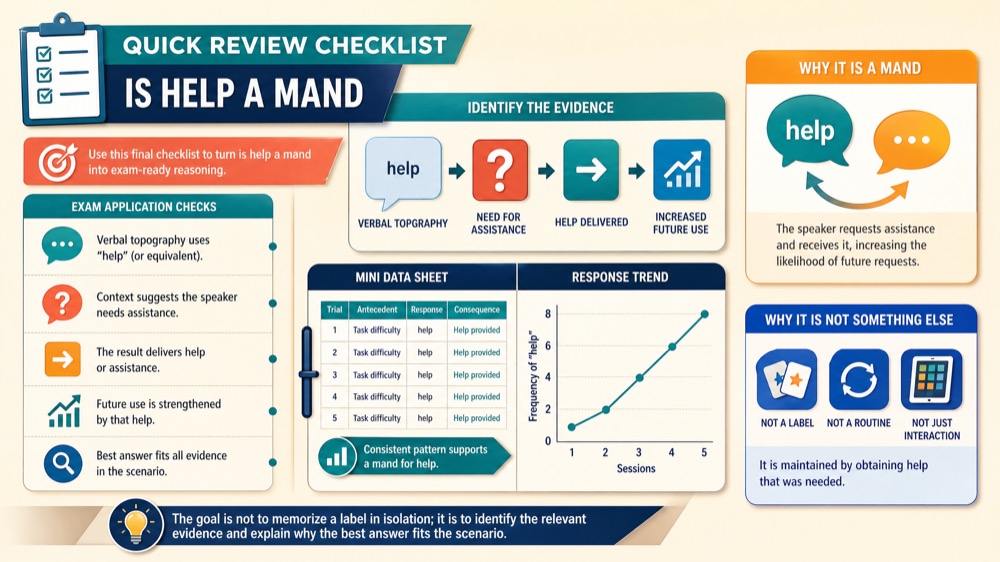
Use this final checklist to turn is help a mand into exam-ready reasoning. The goal is not to memorize a label in isolation; it is to identify the relevant evidence and explain why the best answer fits the scenario. Key ideas to review:
- State the central definition or decision point for is help a mand in your own words.
- Identify the detail that makes is help a mand different from its closest related ABA term.
- Separate the observable facts in a scenario from assumptions that are not supported by the facts.
- Write one example and one nonexample so you can recognize the concept in a new setting.
Exam application checks:
- Ask what the question is actually requesting before comparing the answer choices.
- Mark the antecedent, response, consequence, or other evidence that supports the selected answer.
- Look for a distractor that describes a related process but does not answer the specific question.
Final self-check:
- Explain how you would verify the interpretation with clear observations or data.
- Change one detail in the scenario and decide whether your answer should change.
- Give a one-sentence rationale that a supervisor or study partner could evaluate.
Take the Free BCBA Mock Exam
Ready for more practice? Use the free mock exam to keep testing your accuracy with realistic BCBA-style items. Take the Free BCBA Mock Exam



