

A BCBA practice exam is most useful when it behaves like a diagnostic tool, not a score generator. The point is to practice applying behavior-analytic concepts to new scenarios, identify the reason an answer is correct, and use the result to choose the next study task. A high percentage without careful review can create false confidence; a lower baseline score can be valuable if it reveals exactly what to fix.
This guide explains how to choose a practice test, build a realistic baseline, read rationales, organize an error log, and turn repeated misses into a focused study plan. It uses the current BCBA Test Content Outline (6th ed.) as the coverage map. Practice materials are independent study resources, not official BACB examinations, and no practice score guarantees a certification result.
What Should a BCBA Practice Exam Actually Measure?
A useful practice exam asks you to do more than recognize a definition. The stem may describe a learner, a response pattern, a consequence, and a measurement problem; you must determine which concept controls the answer and which details are irrelevant. That is different from memorizing that one term is “positive” and another is “negative.” The signs describe whether a stimulus is added or removed, while reinforcement and punishment describe the effect on future behavior.
Strong practice questions therefore include applied discrimination. They ask you to distinguish an establishing operation from an SD, a motivating operation from a prompt, extinction from punishment, or a functional relation from a correlation. They also require a reasoned choice when more than one answer sounds plausible. A good explanation should tell you why the correct option fits the stated contingency and why the distractors fail.
| Practice feature | What it trains | What to check |
|---|---|---|
| Scenario-based stems | Application and stimulus control | Does the question require you to identify a relation, not merely repeat a definition? |
| Answer rationales | Discrimination among close alternatives | Does every option receive a functional explanation? |
| Domain labels | Study planning | Can you tell whether the miss reflects measurement, assessment, ethics, or intervention? |
| Timed sets | Pacing and decision-making | Can you reproduce the intended length and conditions without looking up answers? |
| Review history | Retention and error correction | Can you compare first attempts with later attempts without counting memorized answers as mastery? |
Use the 6th-Edition TCO as Your Coverage Map
The BACB’s 6th-edition TCO describes 104 tasks across nine domains and states that the examination contains 175 scored questions plus 10 unscored pilot questions. The domain percentages are a planning guide, not a promise that every individual form will feel identical. Still, a practice exam that ignores measurement, ethics, assessment, or supervision is not a complete preparation tool.
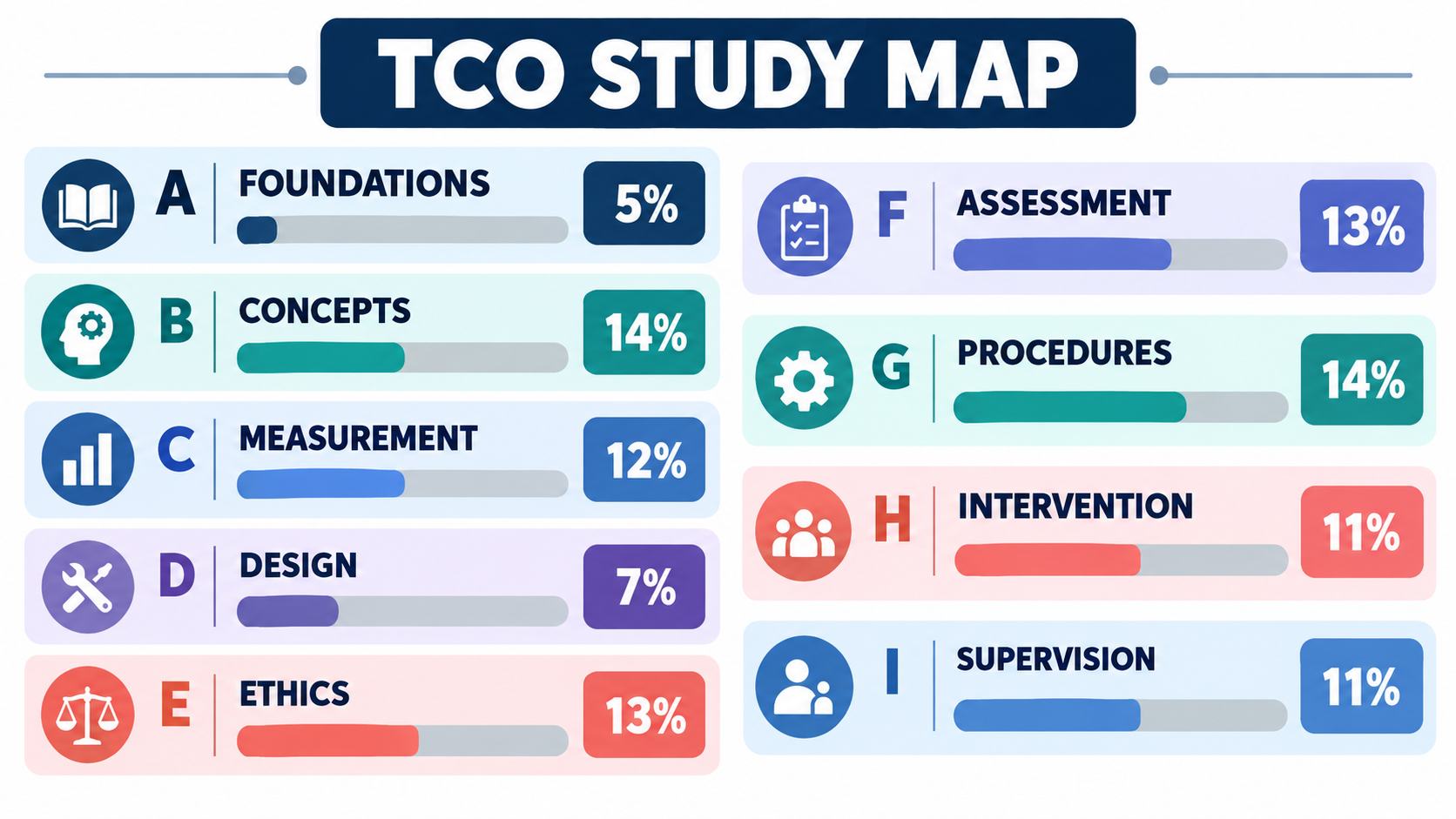
| Domain | Official TCO weight | Practice emphasis |
|---|---|---|
| A. Behaviorism and Philosophical Foundations | 5% | Assumptions, goals of science, dimensions, and radical behaviorism |
| B. Concepts and Principles | 14% | Reinforcement, punishment, schedules, stimulus control, MOs, verbal behavior, and generalization |
| C. Measurement, Data Display, and Interpretation | 12% | Definitions, dimensions, displays, IOA, and interpretation of data patterns |
| D. Experimental Design | 7% | Logic, threats to validity, and selection of appropriate designs |
| E. Ethical and Professional Issues | 13% | Ethical decision-making, documentation, client rights, and professional boundaries |
| F. Behavior Assessment | 13% | Preference assessment, descriptive assessment, functional analysis, and data-based hypotheses |
| G. Behavior-Change Procedures | 14% | Teaching, reinforcement procedures, prompting, shaping, chaining, and generalization |
| H. Selecting and Implementing Interventions | 11% | Intervention selection, social validity, risk, monitoring, and modification |
| I. Personnel Supervision and Management | 11% | Training, performance feedback, competency, and supervision systems |
When a provider claims broad coverage, compare its blueprint with this map. The goal is not to make every study session look like the exam; it is to prevent a narrow bank of familiar concept questions from becoming your entire preparation strategy.
How to Choose a BCBA Practice Exam
Start with the purpose of the next attempt. A diagnostic set should sample many domains and reveal weak areas. A teaching set can concentrate on one cluster and provide slower, more detailed feedback. A final simulation should be timed, uninterrupted, and reviewed only after you finish. Using the same type of test for all three purposes makes the score harder to interpret.
| Selection question | Why it matters | Red flag |
|---|---|---|
| Does the blueprint follow the current TCO? | It prevents study time from drifting toward obsolete or unbalanced content. | The page names an old task list but gives no update or domain map. |
| Are the rationales functional? | They let you correct the reasoning process, not just the letter choice. | The explanation says “B is correct” without identifying the contingency or data. |
| Are questions original and varied? | Novel wording tests generalization of the concept. | The bank repeats one sentence pattern or rewards memorizing a cue word. |
| Can you track domains and error types? | A raw score cannot tell you what to study next. | Only a total percentage is shown. |
| Is the resource clearly independent? | It prevents confusion with official BACB materials. | Marketing language implies endorsement or a guaranteed pass. |
Take a Baseline Before You Change Your Study Plan
Choose a set you have not seen before. Read the instructions, set a realistic time boundary, remove notes and search tools, and answer every item before checking the key. Mark questions you guessed on even when the answer is correct. A correct guess is useful information: it may indicate a fragile concept that deserves a second look.
Record more than the final percentage. At minimum, note the number attempted, correct, guessed, skipped, and changed. If the resource identifies TCO domains, record performance by domain. Then separate a content error from a test-taking error. For example, a learner may understand IOA but misread “total count” as “exact count”; the next intervention should target wording discrimination rather than rereading the entire measurement chapter.
| Baseline signal | Likely interpretation | Next action |
|---|---|---|
| Low accuracy and low confidence | Foundational content or terminology is not yet stable. | Study the concept, write an example and nonexample, then retest with new wording. |
| High accuracy with low confidence | You may know the idea but lack retrieval fluency. | Use brief mixed sets and explain the answer aloud without notes. |
| Low accuracy with high confidence | A persistent misconception or cueing error may be driving choices. | Compare the chosen option with the rationale and create a contrast pair. |
| Accuracy falls sharply when timed | Pacing, attention, or decision rules need work. | Practice smaller timed blocks and use a skip-and-return rule. |
| One domain is consistently weak | The issue is concentrated rather than global. | Build a short domain plan and keep one mixed review set each week. |
Use the Practice-Exam Review Loop
The review is where most of the study value is created. Do it soon enough that you remember your reasoning, but not while the answer key is open. For every incorrect, guessed, or changed item, write one sentence explaining what the stem was testing. Then write the smallest correction that would change your answer next time.
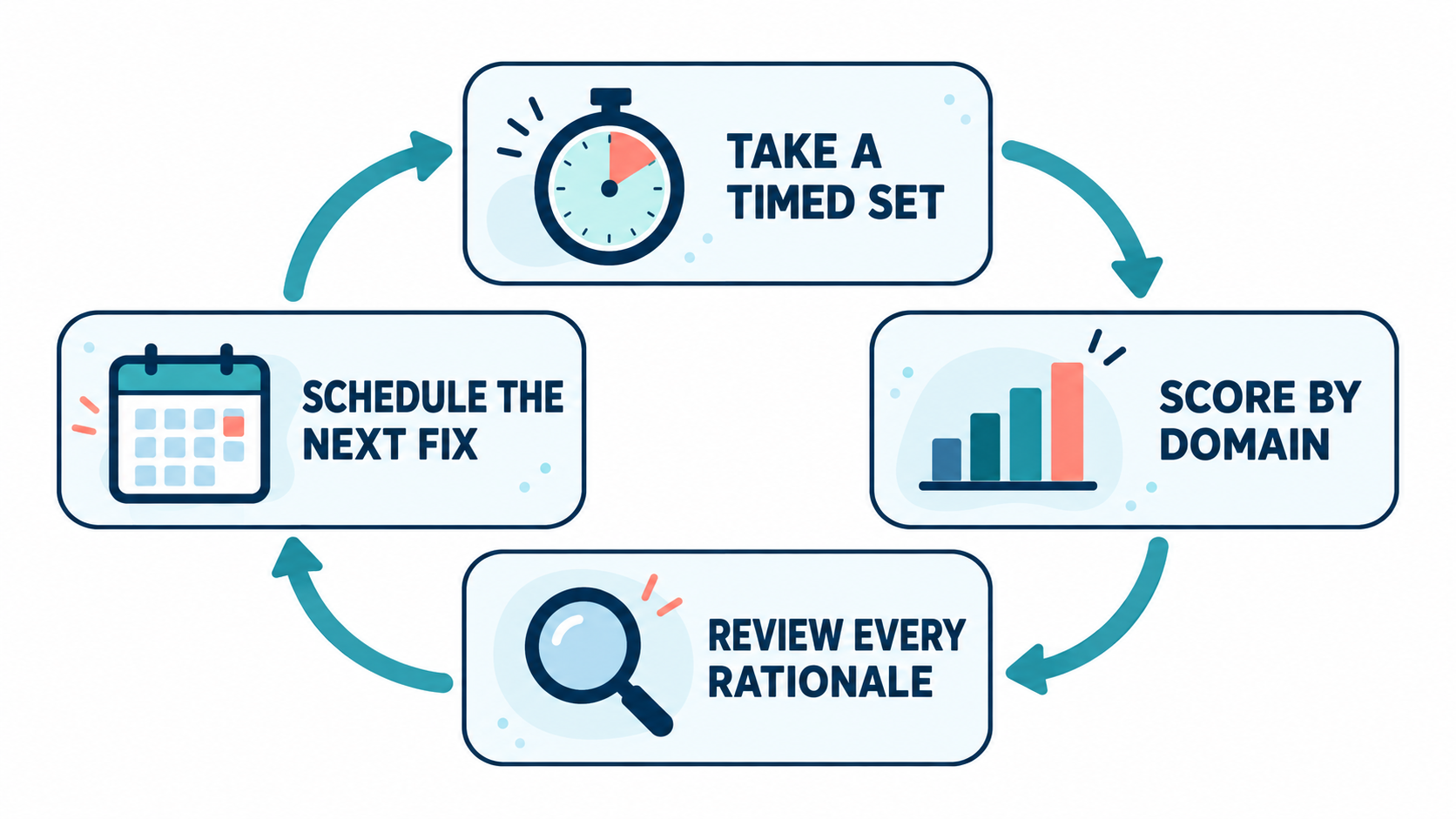
- Take a timed set. Use new items and record guesses instead of looking up a term mid-test.
- Score by domain. Keep the total score, but also identify where the misses cluster.
- Review every rationale. Include correct answers that were guesses or required a last-second change.
- Schedule the next fix. Turn the error into a measurable task, such as “calculate total-count IOA from three examples” rather than “study measurement.”
Do not immediately retake the same questions and call the result mastery. A repeated score may reflect recognition of the answer wording. Instead, use a parallel set, explain the concept in a new example, or solve a slightly altered scenario. Return to the original item later to check retention.
Build an Error Log That Explains the Miss
A practical error log is short enough to maintain and specific enough to guide action. Do not copy the whole question. Record the domain, the concept, your selected answer, the best answer, the missed cue, and the next practice task. If you miss the same concept twice for different reasons, keep both entries; the pattern may show that content knowledge and discrimination need separate interventions.
| Error type | Example | Repair task |
|---|---|---|
| Definition confusion | Calling an SD an MO because both appear before behavior | Write a contrast pair that identifies availability versus consequence value. |
| Calculation or measurement | Using a frequency formula when the question asks for rate | Complete three worked examples and label the denominator and observation time. |
| Assessment logic | Choosing a descriptive observation when the stem asks for experimental analysis | Match the question to the assessment purpose and control arrangement. |
| Ethical judgment | Choosing a convenient intervention without considering risk or client rights | State the ethical principle, the stakeholder, and the least-restrictive next step. |
| Reading or pacing | Missing a qualifier such as “most appropriate” or “first” | Underline the task verb and qualifiers before comparing answer choices. |
Study in Phases Instead of Chasing a Perfect Score
A sustainable plan moves from diagnosis to repair to simulation. The exact number of questions can vary with your schedule; consistency and review quality matter more than a heroic one-day volume. Keep a mixed set in the plan so that improved performance in a single domain does not hide weak generalization.
| Phase | Primary goal | Typical session |
|---|---|---|
| Diagnostic | Find the highest-impact gaps | One mixed set, domain breakdown, and an error log |
| Repair | Change the reasoning behind repeated misses | Focused concept review, worked examples, and a short parallel set |
| Integration | Generalize across topics and wording | Mixed timed blocks with deliberate review of guessed items |
| Simulation | Practice stamina and decision rules | Full-length conditions followed by a planned recovery and review block |
Use performance data to move between phases. If a focused set improves but a mixed set falls apart, the next task is integration, not another isolated lecture. If scores remain low across every domain, reduce the set size and rebuild prerequisite knowledge before adding more timed pressure.
Handle Scenario Questions with a Consistent Decision Rule
When two options seem plausible, return to the exact question being asked. First identify the target: behavior, consequence, measurement, assessment, intervention, or professional decision. Next identify the evidence in the stem: the learning history, contingency, data pattern, or ethical constraint. Finally remove choices that require facts the stem never provided.
| If the stem asks about… | Read for… | Common trap |
|---|---|---|
| What maintains behavior | Consequence immediately following the response and the function supported by assessment data | Choosing the most noticeable antecedent |
| Which measurement to use | Whether the target is countable, timed, distributed across time, or defined by opportunities | Picking the familiar measure instead of the dimension requested |
| What to do first | Safety, assessment, baseline, consent, and the sequence stated by the scenario | Jumping to an intervention before the prerequisite information exists |
| Which design fits | Reversibility, ethical feasibility, control, and the decision the design must answer | Choosing a design by memorized acronym alone |
| How to respond professionally | Client rights, competence, documentation, supervision, and data-based action | Choosing the fastest or most convenient option |
What a BCBA Practice Exam Cannot Tell You
A practice score is a sample of performance under particular questions, conditions, and scoring rules. It is not a BACB result, not a substitute for the current handbook or TCO, and not proof that a person is ready to practice independently. Be especially cautious with resources that promise a guaranteed pass, sell recalled exam content, or encourage memorizing answer keys.
Use practice data responsibly. Do not share confidential client information in an explanation, invent a case history to justify an answer, or treat a study question as permission to implement an intervention without individualized assessment and appropriate supervision. The most useful preparation keeps exam accuracy and professional judgment connected.
Take the Free BCBA Mock Exam
Ready to test your baseline? Try the free BCBA mock exam, record your guessed items, and review every rationale before choosing the next study fix. Then return to this page and use the TCO map and error-log categories to organize the follow-up.
For current exam structure and content, use the BACB examination information page and the official BCBA Test Content Outline (6th ed.). This article is an independent study guide and should be checked against the current official materials when policies or exam documents change.



