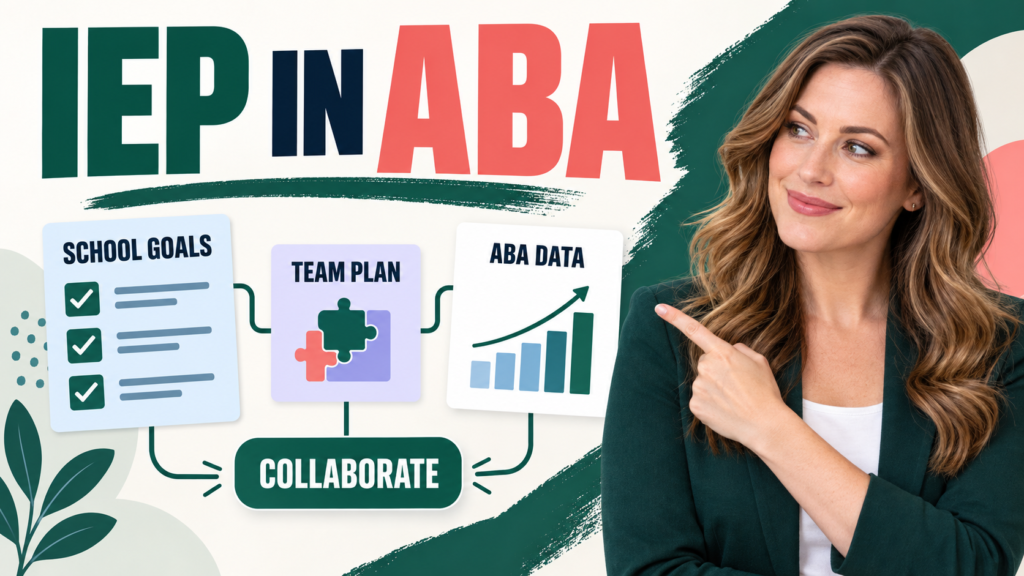
IEP in ABA usually means understanding how a school-based Individualized Education Program can connect with ABA goals, data, and supports without treating the IEP and an ABA treatment plan as the same document. This guide explains the boundary, the collaboration workflow, and the questions a BCBA or family can bring to the team.
Table of Contents
- IEP in ABA: The Short Answer
- What Does IEP in ABA Mean?
- IEP vs. ABA Treatment Plan
- How Can ABA Support IEP Goals?
- What Can a BCBA Bring to an IEP Meeting?
- How to Connect IEP and ABA: A Practical Workflow
- How Do You Translate ABA Data Into IEP Information?
- Can ABA Be Included in an IEP?
- What Mistakes Should Teams Avoid?
- What Are the BCBA Exam Clues?
- IEP in ABA FAQ
- Sources and Date Check
- Take the Free BCBA Mock Exam
IEP in ABA: The Short Answer
When people search for “IEP in ABA,” they are often asking how a child’s school plan relates to ABA therapy, behavior goals, or BCBA recommendations. An IEP is a legally defined education document developed by a school team. ABA is a science and a set of services or procedures that may be used in different settings, including school, home, clinic, or community programs.
The practical connection is alignment: an ABA team can describe observable behavior, useful measurement, environmental supports, and skill-acquisition strategies that help a student access instruction. The school team decides what belongs in the IEP under applicable law and district procedures. A private ABA provider may contribute information, but the provider does not unilaterally rewrite the school’s legal document or guarantee that a requested service will be added.
What Does IEP in ABA Mean?
Under the Individuals with Disabilities Education Act, an IEP is a written statement for an eligible child with a disability. Federal regulations describe required components such as present levels of academic achievement and functional performance, measurable annual goals, the services and supports to be provided, and how progress will be measured. The U.S. Department of Education regulation at 34 CFR §300.320 is the authoritative place to check the required content. In an ABA context, the phrase can refer to several different tasks:
- Explaining how a behavior or skill affects participation in school routines.
- Translating ABA measurement into language the IEP team can use to monitor educational progress.
- Coordinating a behavior intervention plan, classroom support, communication system, or generalization plan with IEP goals.
- Clarifying whether a recommendation is a school service, a private treatment service, a consultation, or a family-supported strategy.
That last distinction matters. A clinical treatment plan may target skills across home, clinic, and community. An IEP is focused on the child’s access to education and progress in the school context. The two plans can inform one another, but they have different decision makers, legal purposes, and implementation boundaries.
IEP vs. ABA Treatment Plan
Families and new practitioners often use “goal” as if it means the same thing in every document. The goal may be similar, but the question being answered is different. An IEP asks what educational support the student needs to receive a free appropriate public education. An ABA treatment plan asks what socially meaningful behavior changes are being assessed, taught, strengthened, or reduced within the authorized service.
| Question | IEP lens | ABA lens |
|---|---|---|
| Primary purpose | Plan special education, related services, supports, and measurable educational goals. | Assess and change socially significant behavior using individualized behavioral principles and data. |
| Context | School participation, learning, access, communication, independence, and educational progress. | The authorized service setting and the routines where the target behavior or skill is assessed and taught. |
| Decision process | The IEP team, including required school participants and the parent or guardian, follows applicable IDEA and state procedures. | The BCBA and service team use assessment, stakeholder input, supervision, authorization, and ethical practice requirements. |
| Progress question | Is the student making progress toward educational goals with the listed services and supports? | Is the defined behavior changing under the current teaching or intervention arrangement, and should the plan be adjusted? |
A strong collaboration does not copy one plan into the other. It identifies the shared functional problem, states the context clearly, and assigns each team member a realistic responsibility. For related background, see the site’s guide to behavior intervention plans and BIPs.
How Can ABA Support IEP Goals?
ABA can support IEP goals when the behavioral description clarifies how the student can participate, communicate, learn, or function more independently at school. For example, “improve classroom behavior” is too broad to guide measurement. A more useful discussion might define the student’s observable response: beginning a routine within a specified interval, requesting a break with an available communication system, remaining in a group activity for a meaningful duration, or completing a clearly defined task sequence with fewer prompts.
The ABA contribution should include the conditions under which the response is expected, what counts as success, the measurement system, the level of prompting, and the plan for generalization. It should also explain what the student gains from the skill. A target is stronger when it increases access to communication, instruction, relationships, choice, or independence instead of merely making the student appear more compliant.
Do not assume that every ABA target belongs in an IEP. A goal may be clinically important but not a school responsibility, or it may need to be reframed around educational access. The team should discuss the student’s needs and the setting rather than adding a list of clinic targets without context.
What Can a BCBA Bring to an IEP Meeting?
A BCBA can make a meeting more useful by bringing concise, interpretable information rather than a long data dump. Before the meeting, organize the most relevant observations around the school routine, the target response, the consequence or support, and the student’s current level of independence. Include limitations: data collected in a clinic may not generalize to a noisy classroom, and a short sample cannot establish a universal conclusion. Useful contributions may include:
- An operational definition of the target behavior or skill that different staff can apply consistently.
- A baseline summary with the observation context, number of opportunities, and measurement system.
- A description of antecedent supports, communication options, reinforcement, prompting, and fading.
- A generalization plan that names the people, materials, locations, and routines that should be tested.
- Questions about assent, student preferences, sensory context, dignity, and whether the intervention is producing meaningful benefit.
The BCBA should also clarify role boundaries. A private clinician can share records with appropriate permission and collaborate with the school, but the school team remains responsible for school decisions. A recommendation should be presented as data-informed input, not as a legal demand or a promise of a particular method.
How to Connect IEP and ABA: A Practical Workflow
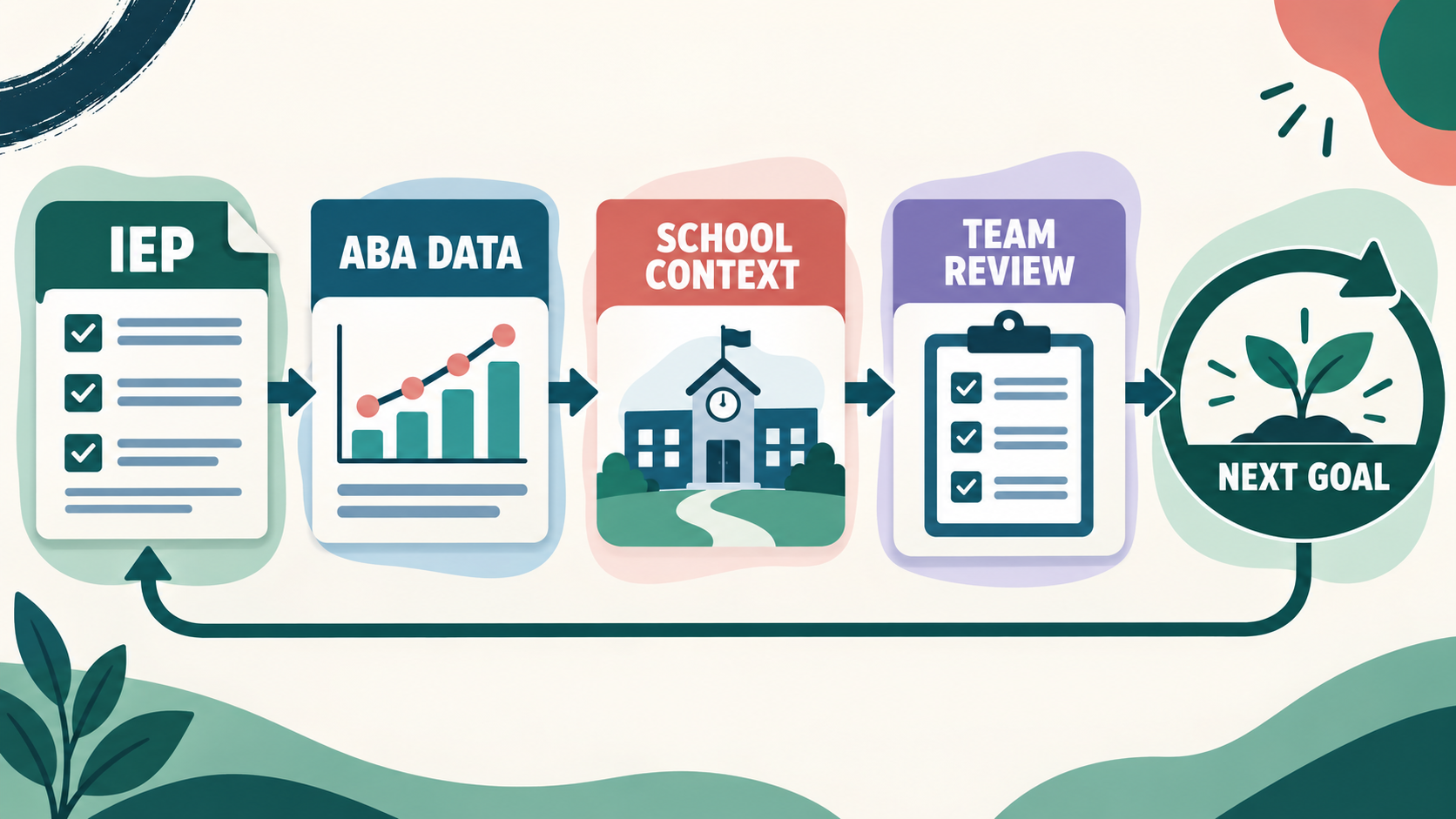
Use this sequence when a family, BCBA, or school team wants to connect plans without creating duplicate goals. The exact process depends on the student, district, state, service agreements, and permissions for sharing information.
- Start with the school participation problem: name the routine, activity, or access barrier instead of starting with a preferred ABA label.
- Define the observable response: describe what the student does, says, selects, initiates, completes, or communicates. Avoid internal labels such as “unmotivated” or “noncompliant” as the only explanation.
- Review current data: identify the measurement system, observation conditions, opportunities, prompts, and missing context. Ask whether clinic data and school data answer the same question.
- Map supports to the routine: decide which antecedent adjustments, communication supports, teaching steps, reinforcement, or environmental changes can be used during the school activity.
- Assign ownership: record who will teach, who will collect data, who will supervise, who will communicate with the family, and who will review progress.
- Define a review point: choose the progress indicator and a date or condition for reviewing it. Do not wait until a crisis to learn that the team was measuring different behaviors.
- Test generalization and student choice: vary reasonable people, materials, and settings while preserving accessible communication, breaks, and meaningful participation.
How Do You Translate ABA Data Into IEP Information?
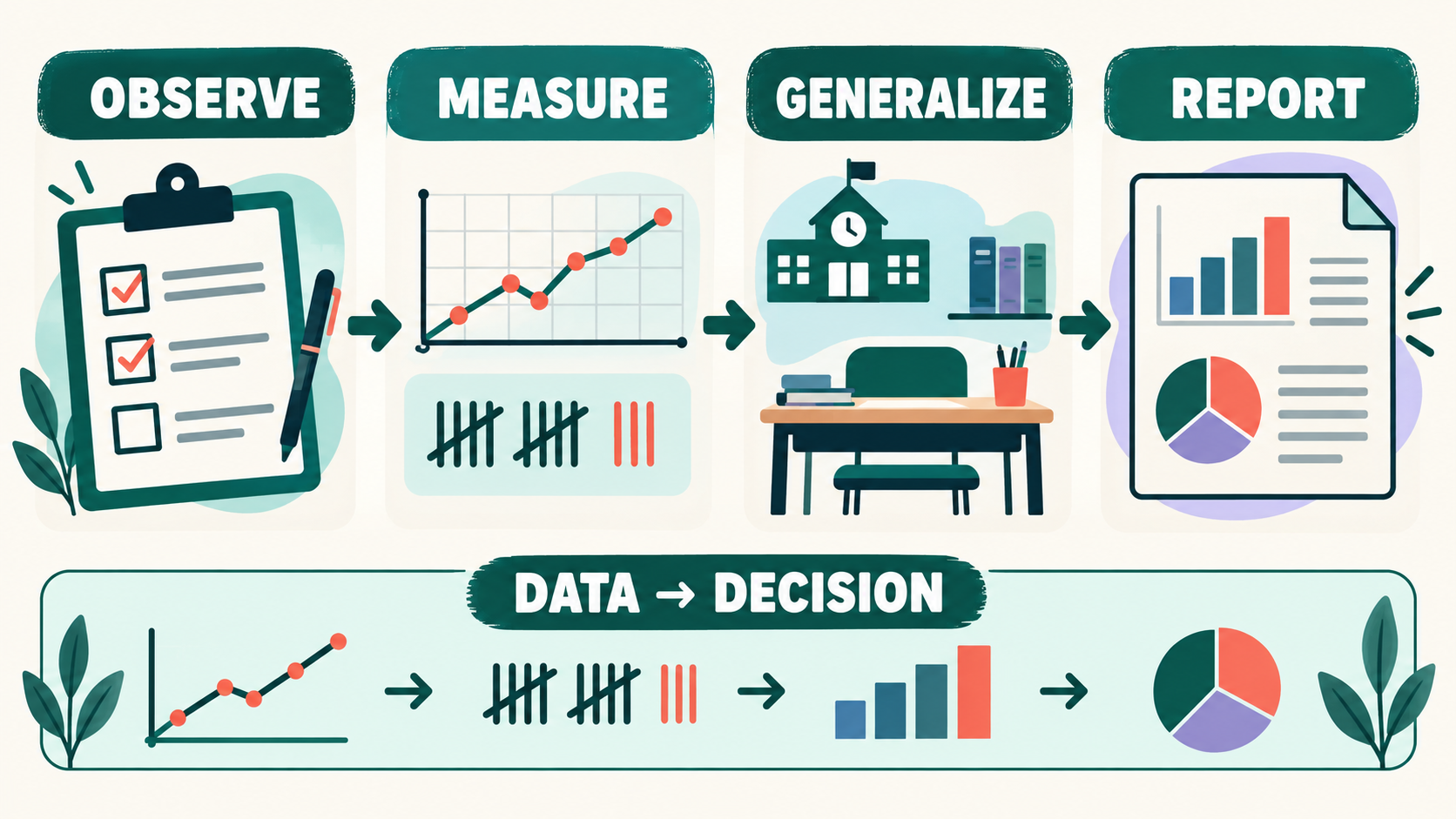
Translation is not just replacing ABA vocabulary with school vocabulary. It means explaining what the data show, where they were collected, and why the change matters for education. A useful summary could say: “During small-group reading, the student independently used the break card in 4 of 5 opportunities across three observations, compared with 1 of 5 at baseline. The team will check whether this response occurs with the classroom teacher and during math.”
That sentence contains the response, context, opportunity count, baseline comparison, and generalization question. It does not claim that one data point proves a function or that improvement in one setting automatically transfers to another. The team can use the same logic for academic engagement, transitions, communication, self-management, social participation, or safety-related replacement skills.
When a graph is shared, label the axes, dates, phases, and measurement system. Explain any changes in staff, schedule, medication, attendance, materials, or prompting that could affect interpretation. The school team needs enough context to make a reasonable educational decision, not a visually impressive graph with an unclear denominator.
Can ABA Be Included in an IEP?
ABA-informed goals, supports, consultation, or behavioral services may be included in a school plan when the IEP team determines that they are needed for the student to receive appropriate educational access and make progress. The federal IDEA framework does not mean that every child who receives private ABA is automatically entitled to a specific ABA provider, schedule, or named method in the IEP. Whether a service is included depends on the student’s educational needs and applicable federal, state, and district rules.
The U.S. Department of Education’s IDEA overview describes the IEP as a primary vehicle for providing a free appropriate public education and emphasizes individualized needs. Families should ask the school team to explain the proposed service, its educational purpose, who will deliver it, how progress will be measured, and how the support will be reviewed. State-specific procedural questions may require an education advocate or attorney.
What Mistakes Should Teams Avoid?
- Confusing documents: treating the IEP, ABA treatment plan, behavior intervention plan, and insurance authorization as interchangeable.
- Using vague behavior labels: writing “be compliant” or “reduce defiance” without an observable response and a meaningful educational context.
- Importing clinic data without boundaries: assuming a therapy-room result predicts classroom performance without checking generalization.
- Assigning goals without ownership: writing a target without identifying who teaches it, who records it, and who reviews the data.
- Overlooking communication and assent: treating refusal, a break request, or sensory distress as a behavior to suppress instead of information about the arrangement.
- Promising a required service: presenting one method, provider, or number of hours as automatically guaranteed by the word ABA.
The most useful correction is usually to return to the student’s actual routine: what is happening before the response, what the student is trying to access or avoid, what support is available, and whether the target increases meaningful participation. That keeps the conversation practical and protects the student from a plan that measures adult convenience rather than educational benefit.
What Are the BCBA Exam Clues?
On a BCBA-style question, IEP in ABA may test measurement, functional assessment, behavior intervention, collaboration, ethics, or generalization. Look for the answer that separates the school’s educational responsibility from a private service plan, defines observable behavior, uses data from the relevant context, and protects client welfare. A strong answer does not assume that a diagnosis, a private ABA schedule, or a caregiver request alone determines what belongs in the IEP.
For exam preparation, connect the scenario to the current BCBA Test Content Outline and the current BACB Ethics Code. The free BCBA mock exam is an independent study aid, not an official BACB product, and it cannot replace supervision or individualized legal guidance.
IEP in ABA FAQ
Is an IEP the same as an ABA treatment plan? No. An IEP is a school-based legal education document, while an ABA treatment plan guides assessment and intervention within an authorized behavioral service. They may share goals or data, but their purposes and decision processes differ.
Can a BCBA attend an IEP meeting? A BCBA may participate when the family and school arrange it and appropriate permission is in place. The BCBA can explain behavioral data and recommendations, while the school team remains responsible for decisions governed by the IEP process.
Does having ABA guarantee ABA in an IEP? No. The school team evaluates educational need under applicable law. Private ABA treatment, insurance coverage, and school-based services can overlap in goals without being the same entitlement or delivery system.
What should an ABA provider share with the school? Share the minimum relevant information with proper authorization: observable definitions, context, measurement, current supports, progress, limitations, and generalization questions. Avoid sending an unexplained data dump or assuming clinic results automatically apply to school.
Sources and Date Check
This article was reviewed on September 30, 2026 against the IDEA IEP regulation, the U.S. Department of Education IDEA overview, the BACB Ethics Code, and the BCBA Test Content Outline. School rules and procedural rights can vary, so readers should confirm state or district details with the responsible team or a qualified education professional.
Take the Free BCBA Mock Exam
If you want a low-pressure way to check your recall, use the free practice resource below. Take the Free BCBA Mock Exam