

How to pair ABA means learning how to make a therapist, setting, or teaching interaction predict safe, meaningful, and individualized reinforcement before placing heavy instructional demands. This guide gives a practical workflow while keeping learner choice, assent, data, and professional judgment at the center.
Table of Contents
- How to Pair in ABA: The Short Answer
- What Does Pairing Mean in ABA?
- How Is Therapist Pairing Different From Stimulus Pairing?
- How to Pair in ABA: A Step-by-Step Workflow
- How Do You Know Pairing Is Working?
- When Should You Add Instructional Demands?
- How Do Assent and Choice Affect Pairing?
- When Should You Re-Pair With a Learner?
- What Pairing Mistakes Should You Avoid?
- What Are the BCBA Exam Clues?
- How to Pair ABA FAQ
- Sources and Date Check
- Take the Free BCBA Mock Exam
Pairing is often described casually as “building rapport,” but that phrase is too broad to guide a session. A useful ABA definition identifies what the practitioner does, what the learner can freely access, what changes in the learner’s behavior, and how the team decides whether to continue, adjust, or pause. Pairing is not a promise that a learner will always want to participate, and it is not a license to override refusal.
How to Pair in ABA: The Short Answer
To pair in ABA, first observe what the learner approaches, chooses, repeats, or signals as enjoyable. Then arrange repeated, low-pressure opportunities in which the therapist delivers or joins those preferred activities without immediately turning every interaction into a demand. Over time, the therapist and the teaching context may become associated with reinforcement, making voluntary engagement more likely.
The process is individualized. One learner may prefer movement, another may prefer music, sensory materials, conversation, a predictable routine, or time alone near a trusted adult. The practitioner should use preference information rather than assume that eye contact, conversation, touch, praise, food, or a particular toy is reinforcing. Pairing is successful when the learner’s observable approach, engagement, and willingness improve—not simply when the adult feels friendly.
What Does Pairing Mean in ABA?
In therapist–learner pairing, a previously neutral or unfamiliar person, place, material, or instructional routine is repeatedly associated with experiences the learner values. The goal is not to make the learner dependent on one therapist. The goal is to create a safe and reinforcing context in which the learner can participate, communicate preferences, and contact useful teaching opportunities.
Pairing can occur at the beginning of services, at the start of a session, after a break, after a staffing change, or whenever the learner’s approach and participation decline. It may involve following the learner’s lead, sharing preferred activities, narrating without interrupting, offering choices, and delivering reinforcement without attaching a hidden requirement to every item. The team should still plan for generalization across people, settings, materials, and routines.
How Is Therapist Pairing Different From Stimulus Pairing?
The phrase “pairing in ABA” can refer to more than one concept. Therapist pairing is a service-delivery process in which the practitioner or teaching context becomes associated with reinforcement. Stimulus-stimulus pairing is a conditioning concept in which one stimulus is repeatedly presented with another event so that the function of the first stimulus may change. Those concepts can be related, but they are not interchangeable search intents.
The site’s existing stimulus-stimulus pairing guide covers the conditioning terminology. This page stays focused on what a BCBA, RBT, caregiver, or student should observe and do when building a respectful therapist–learner relationship. Avoid using a conditioning label to skip assessment, consent, assent, choice, or ongoing progress monitoring.
How to Pair in ABA: A Step-by-Step Workflow
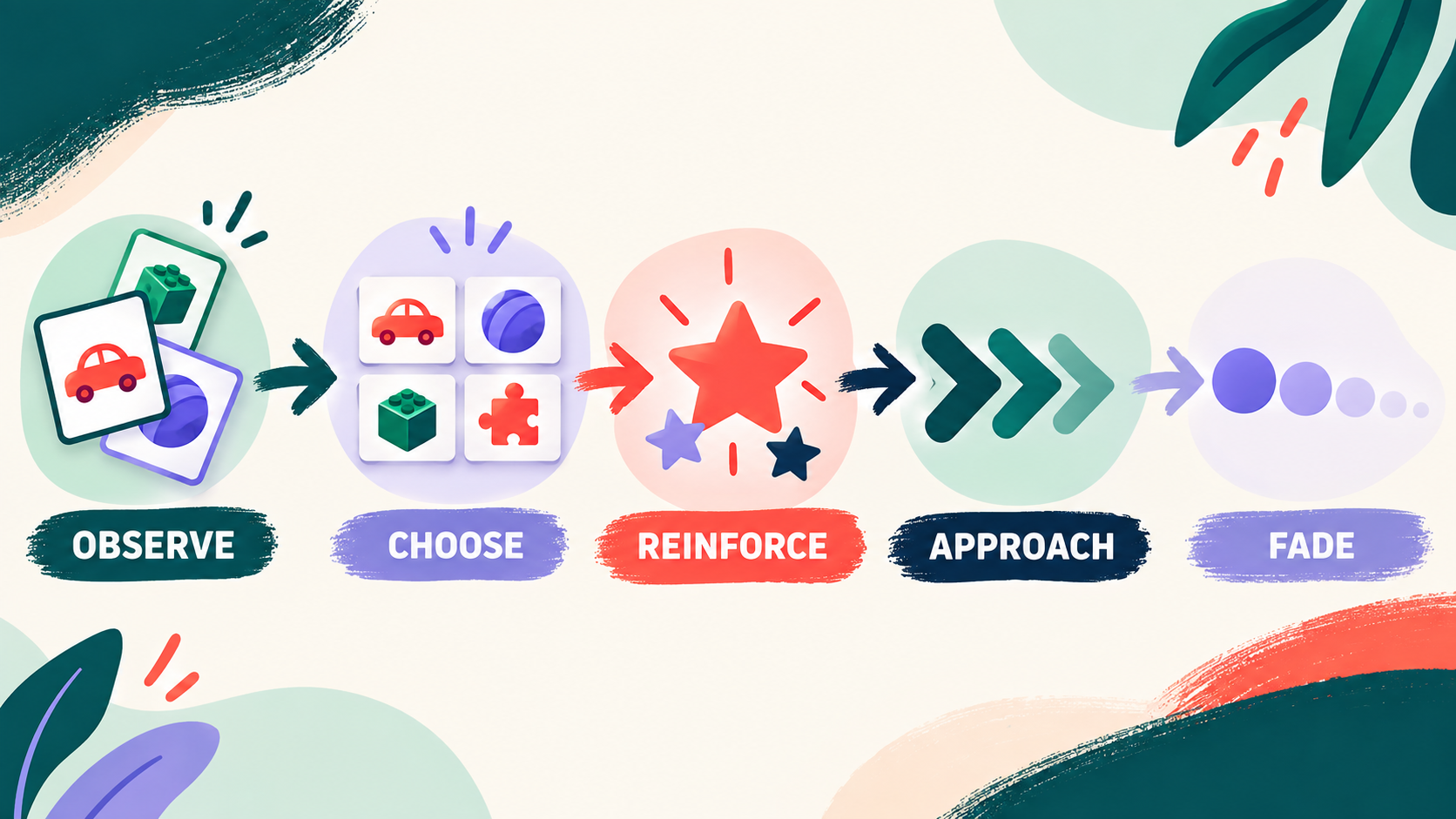
Use the following as a decision framework, not a rigid script. A supervising BCBA should adapt the plan to the learner’s communication, sensory needs, medical context, goals, preferences, and assent signals. The practitioner should also know which activities are safe, permitted, culturally appropriate, and available in the service setting.
- Prepare the environment: reduce unnecessary demands, make preferred materials available when appropriate, and arrange enough space for the learner to approach or move away safely.
- Observe before directing: record what the learner approaches, selects, rejects, watches, requests, repeats, or leaves. Ask caregivers and team members for context, but test preferences rather than treating a report as permanent proof.
- Join without taking over: imitate the learner’s play when appropriate, narrate briefly, share materials, or place yourself near the activity without blocking access or requiring a response.
- Deliver valued events freely: let the learner contact preferred activities without attaching an immediate instruction to every item. The therapist should become a predictable source of good options, not a gatekeeper who controls every second.
- Offer choices: present reasonable options, honor a selection or rejection, and use the learner’s communication system. Choice can include the activity, location, duration, partner, materials, or whether to pause.
- Check approach and withdrawal: look for voluntary proximity, orientation, initiation, relaxed engagement, sustained participation, or communication for continuation. Also record leaving, pushing materials away, distress, avoidance, or other withdrawal signals.
- Introduce small teaching opportunities: once the learner is approaching and participating, add brief, achievable interactions while preserving access to reinforcement and an easy way to pause. Return to pairing when the interaction becomes aversive or participation drops.
- Plan for fading and generalization: gradually vary activities, people, locations, and reinforcement while keeping the learner’s control and communication meaningful. Do not make one person or one item the only route to success.
How Do You Know Pairing Is Working?
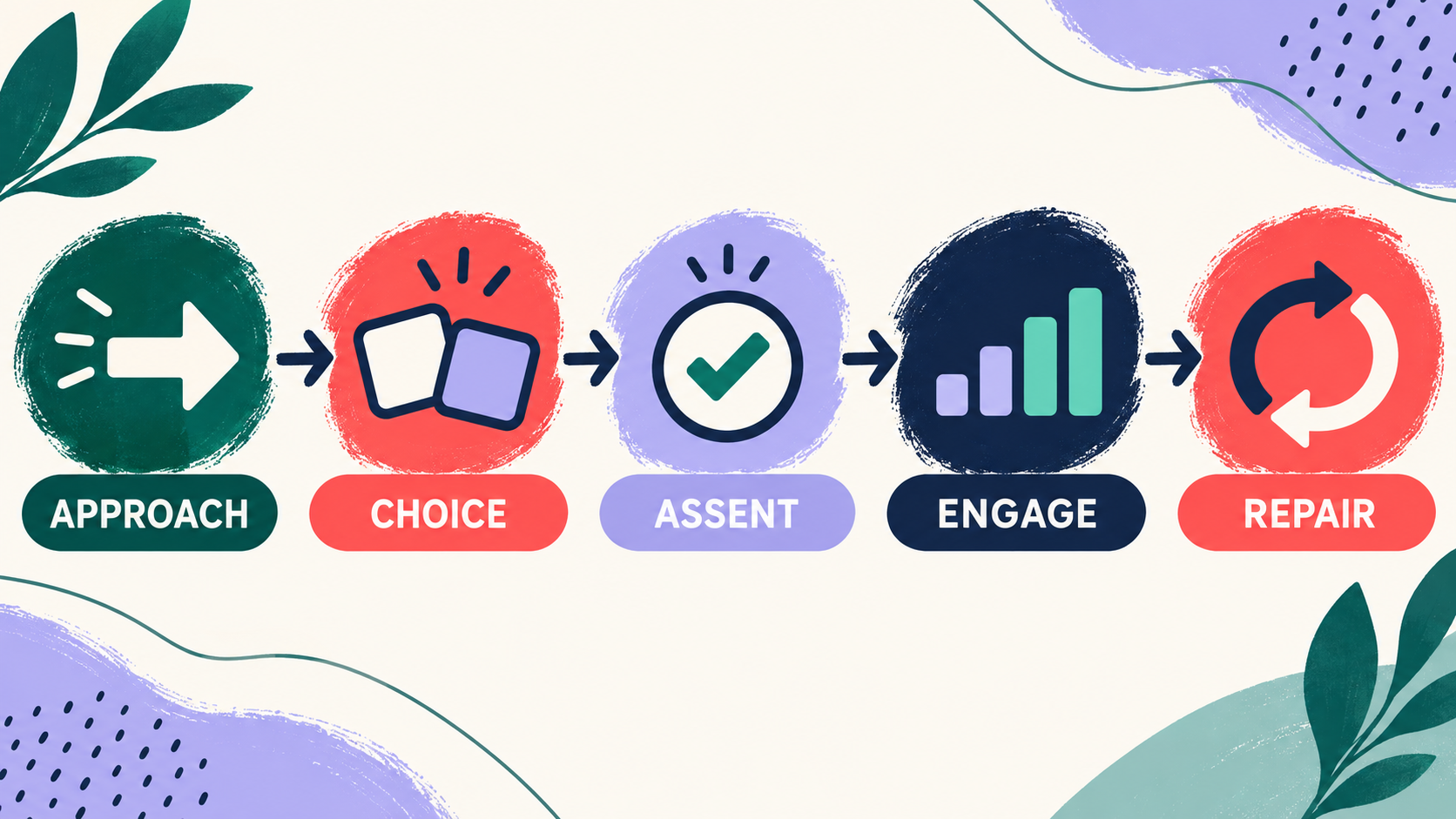
Pairing should produce observable information, not just a positive impression. The team can define a small set of behaviors that matter for the learner: approaching the therapist, remaining nearby, initiating interaction, accepting a choice, returning after a brief pause, communicating “more” or “break,” or engaging with materials while the therapist is present. The definition should be appropriate for that individual.
| Pairing step | Observable action | Data signal and adjustment |
|---|---|---|
| Preference observation | Learner approaches, selects, repeats, requests, or rejects an item or activity. | Use current observations and caregiver information; do not assume yesterday’s favorite remains reinforcing. |
| Free interaction | Therapist joins or delivers preferred experiences without frequent instructions. | If approach or engagement decreases, reduce intrusiveness and reassess the activity or context. |
| Choice and assent | Learner selects, continues, pauses, declines, or communicates a change. | Honor withdrawal signals; do not count forced proximity as successful pairing. |
| Brief instruction | Learner contacts a small, achievable teaching opportunity and can return to valued activity. | Increase demands only when participation remains stable; step back when avoidance or distress rises. |
| Generalization | Learner engages with more than one person, material, location, or routine. | Vary one dimension at a time and monitor whether the learner still has meaningful control. |
Data do not need to be elaborate to be useful. A brief event record, duration of engagement, number of approach initiations, choice responses, and withdrawal signals may be enough to guide the next session. The BCBA should define the behavior, decide what counts as an observation opportunity, and review patterns instead of making a decision from one difficult moment.
When Should You Add Instructional Demands?
Pairing is not a promise that instruction will never occur. It is a way to establish a context in which instruction can be contacted with less unnecessary friction. Start with small, clear, achievable requests that have a reasonable chance of success, preserve choices, and deliver the planned consequence quickly. The first demand should not consume the entire preferred activity or abruptly remove control.
Use a gradual sequence: observe free engagement, join, offer a choice, add one brief response opportunity, reinforce participation, and return to a preferred activity. If the learner declines, provide the planned communication response or break rather than escalating through repeated commands. A learner who says “no,” moves away, or uses a break card is providing important information about the current arrangement.
How Do Assent and Choice Affect Pairing?
Consent from a legal decision maker and assent from the learner are related but different. The current BACB Ethics Code addresses informed consent and obtaining assent when applicable. Pairing cannot be used as a friendly-looking way to make refusal impossible. The practitioner should identify the learner’s available assent and withdrawal signals, explain the plan in an accessible way, and involve the learner and relevant stakeholders throughout services.
Honoring assent may mean pausing, changing the activity, reducing demands, offering a different communication response, moving to a safer space, or reviewing the treatment arrangement with the supervising BCBA. A learner’s lack of eye contact or quiet behavior is not automatically assent, and physical proximity is not proof of comfort. Use individualized indicators and document what was observed and how the team responded.
When Should You Re-Pair With a Learner?
Re-pair when a new therapist starts, a learner returns after a long break or illness, the setting changes, a difficult procedure has affected participation, preferences shift, or the learner begins to avoid the therapist or teaching area. Re-pairing is also useful when the interaction has become a predictable chain of instructions, corrections, denied requests, or demands with too little access to valued activity.
- Begin with observation and a low-pressure activity instead of immediately testing mastered targets.
- Restore choices and make the learner’s communication response efficient and effective.
- Check whether the therapist is accidentally blocking access, talking too much, or delivering reinforcement only after compliance.
- Review the data with the supervising BCBA and change the plan if the learner’s withdrawal continues.
- Reintroduce teaching gradually, then vary people and settings so the relationship supports generalization rather than dependency.
What Pairing Mistakes Should You Avoid?
- Assuming a preferred item, food, game, or type of social attention is reinforcing for every learner.
- Using “pairing” to justify unrestricted control over items, forced proximity, physical guidance, or ignored refusal.
- Attaching an instruction to every preferred activity so the learner learns that approaching the therapist immediately produces demands.
- Measuring therapist friendliness instead of the learner’s approach, choice, engagement, communication, and withdrawal.
- Staying in pairing indefinitely without defining a reasonable teaching progression and reviewing data with the BCBA.
- Failing to re-pair after a staffing change, break, difficult interaction, or meaningful change in preference.
What Are the BCBA Exam Clues?
On a BCBA-style question, pairing may be tested through conditioned reinforcement, preference assessment, motivating operations, assent, stimulus control, or ethical intervention selection. The best answer usually starts with assessment and observable behavior rather than assuming that a generic “rapport-building activity” works for everyone. The current BCBA Test Content Outline remains the exam anchor.
- If a new therapist is not approached: observe preferences and arrange low-pressure reinforcement before adding frequent demands.
- If a learner withdraws: treat the behavior as data about the arrangement, honor the communication, and review the intervention.
- If the stem mentions a conditioned reinforcer: distinguish therapist pairing from stimulus-stimulus conditioning and identify the relevant learning history.
- If two procedures seem possible: choose the least intrusive, assessment-based, effective option that protects client welfare and participation.
For more scenario practice, the free BCBA mock exam is an independent study aid. It is not an official BACB product and does not replace individualized supervision, assessment, or the current Ethics Code.
How to Pair ABA FAQ
What is pairing in ABA therapy? Pairing is the planned process of associating a therapist, setting, or teaching interaction with experiences the learner values, so voluntary engagement and instructional readiness can become more likely. How long should pairing take? There is no universal number of days or sessions. The pace depends on the learner, context, preferences, communication, history, and assent. Use observable data and the supervising BCBA’s individualized plan rather than a fixed schedule copied from another case.
Should pairing have no demands? Early pairing often uses low-demand or demand-free interactions to establish value, but the long-term plan must support meaningful learning and independence. Introduce small achievable opportunities gradually and step back when participation or assent declines.
What if a learner will not pair with a therapist? Reduce pressure, review preference information, check sensory and medical context, honor withdrawal, and ask the supervising BCBA to reassess the environment and plan. Do not force proximity or make access to basic needs contingent on appearing friendly.
Is pairing the same as stimulus-stimulus pairing? No. Therapist pairing focuses on the service relationship and context. Stimulus-stimulus pairing is a conditioning concept involving repeated relations among stimuli. Related terms should be separated when interpreting an exam question or writing a treatment plan.
Sources and Date Check
This article was reviewed on September 30, 2026 against the BACB Ethics Code, the BCBA Test Content Outline, the peer-reviewed study on pairing procedures to establish praise as a reinforcer, and peer-reviewed assent guidance. Pairing plans must be individualized, supervised, and updated when preferences, communication, safety, or participation changes.
Take the Free BCBA Mock Exam
If you want a low-pressure way to check your recall, use the free practice resource below. Take the Free BCBA Mock Exam



