

Quick answer: If the question is how to collect baseline data ABA, first define the target response and its opportunity, then select a matching measurement system. Observe and record performance before the new teaching or behavior-change procedure begins, document prompts and context, and review level, trend, and variability. Baseline is a defensible starting picture for comparing later performance with what happened before the planned change.
Table of Contents
- What Is Baseline Data in ABA?
- How to Collect Baseline Data ABA: A Step-by-Step Workflow
- What Should You Define Before Collecting Baseline Data?
- What Should a Baseline Data Sheet Include?
- How Do You Collect Baseline Data for Skill Acquisition?
- How Do You Collect Baseline Data for Behavior Reduction?
- How Much Baseline Data Is Enough?
- Baseline Data vs. a Baseline Probe
- What Are Common Baseline Data Collection Mistakes?
- FAQ
- Quick Review Checklist
- Take the Free BCBA Mock Exam
The process depends on the goal. A skill-acquisition baseline may test independent performance, while a behavior-reduction baseline may measure frequency, duration, latency, or intensity. Do not turn the observation into unplanned teaching; keep safety, assent, access, and required supports in place.
What Is Baseline Data in ABA?
Baseline data are measurements collected before a planned intervention or programmed change is introduced. The data describe the learner’s current performance under specified conditions. They can show the starting level of a behavior, the amount of variability, the opportunities available, and whether the response is already changing before treatment begins.
Baseline does not mean “no one does anything.” Ordinary routines and existing supports continue. The important boundary is that the new procedure being evaluated has not yet been implemented, or that the comparison condition is clearly labeled. Record existing supports instead of calling the condition “untreated.”
For BCBA exam preparation, connect baseline to measurement and experimental design. The BACB BCBA Test Content Outline includes selecting measurement systems, interpreting data, and evaluating behavior-change procedures. Baseline helps establish the comparison needed for those decisions, but baseline alone does not prove that a later intervention caused change.
| Baseline question | What to define | Useful record |
|---|---|---|
| What is happening now? | The response form, start and stop rules, and observation context. | Direct count, duration, latency, rate, or trial data. |
| How much opportunity is available? | The instruction, task, routine, or naturally occurring event. | Opportunity count, denominator, setting, and communication partner. |
| Is the pattern ready for comparison? | Level, trend, variability, and any changes to the context. | Session-by-session graph and notes about unusual events. |
How to Collect Baseline Data ABA: A Step-by-Step Workflow
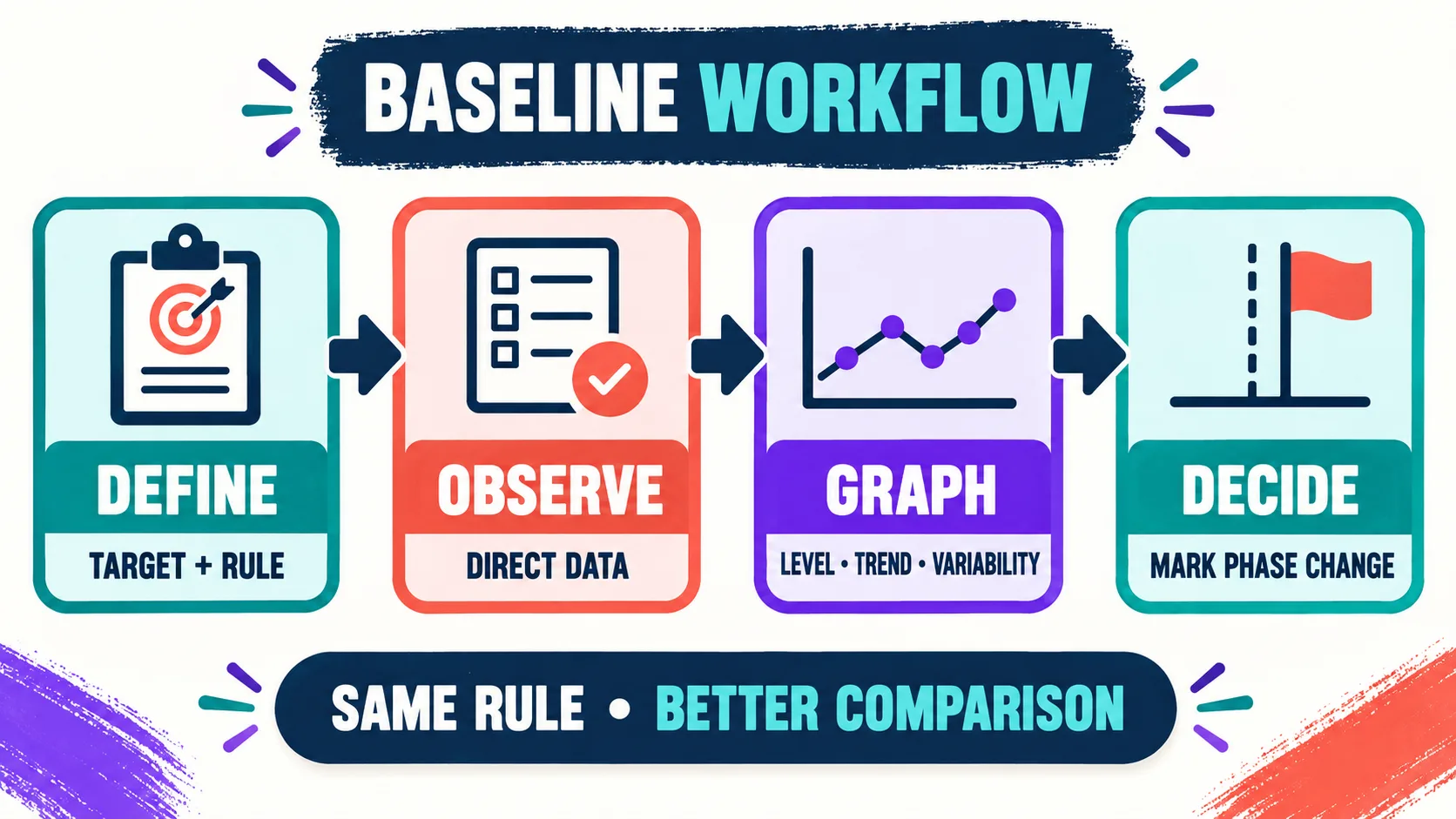
A reliable baseline begins before the observer starts the timer. Know what decision the data will support and which conditions must remain consistent. This workflow fits both skill-acquisition and behavior-reduction programs:
- State the decision. Write what the team needs to know, such as where instruction should begin or whether a behavior-change procedure is needed.
- Define the target and opportunity. Replace labels such as “does not listen” or “aggressive” with observable boundaries, including what counts, what does not, and when an occurrence ends.
- Choose the measure. Match frequency or rate, duration, latency, or trial data to the dimension that matters. Use percentage only when the denominator is explicit.
- Describe the baseline condition. Record setting, materials, people, instruction, schedule, and existing supports. Keep the arrangement comparable across sessions.
- Train the observer. Review examples and nonexamples, practice recording, and check agreement when more than one person collects data.
- Observe without the new procedure. Keep ordinary supports and safety procedures, but do not add the intervention being evaluated. Record prompts, errors, refusals, interruptions, and unusual events.
- Graph the pattern. Inspect level, trend, and variability across sessions. Decide whether the data are representative enough for the next step.
- Mark the phase change. Record the date and condition change when teaching or treatment starts, keeping the definition and measurement system consistent.
What Should You Define Before Collecting Baseline Data?
Start with the target behavior, the opportunity, and the measurement rule. For example, “increase requesting” is not a complete baseline target. A more useful definition might be: “When a desired item is visible but unavailable, the learner independently selects the programmed request on the communication device within 5 seconds of the opportunity.” The observer can then record opportunities, independent selections, prompted selections, and the consequence delivered.
For behavior reduction, avoid collecting a broad category when different responses may have different functions. If “tantrum” includes crying, dropping, pushing, and screaming, decide whether those responses should be measured separately or as a response class with clear component rules. The baseline should make it possible to identify what changed, not simply report that a complicated label became smaller.
Also define the unit of observation. A 30-minute session, a 10-trial teaching set, and a naturally occurring transition are not interchangeable denominators. If the team later compares percentage of opportunities to frequency per hour, it may be comparing different questions rather than measuring progress with a new scale.
What Should a Baseline Data Sheet Include?
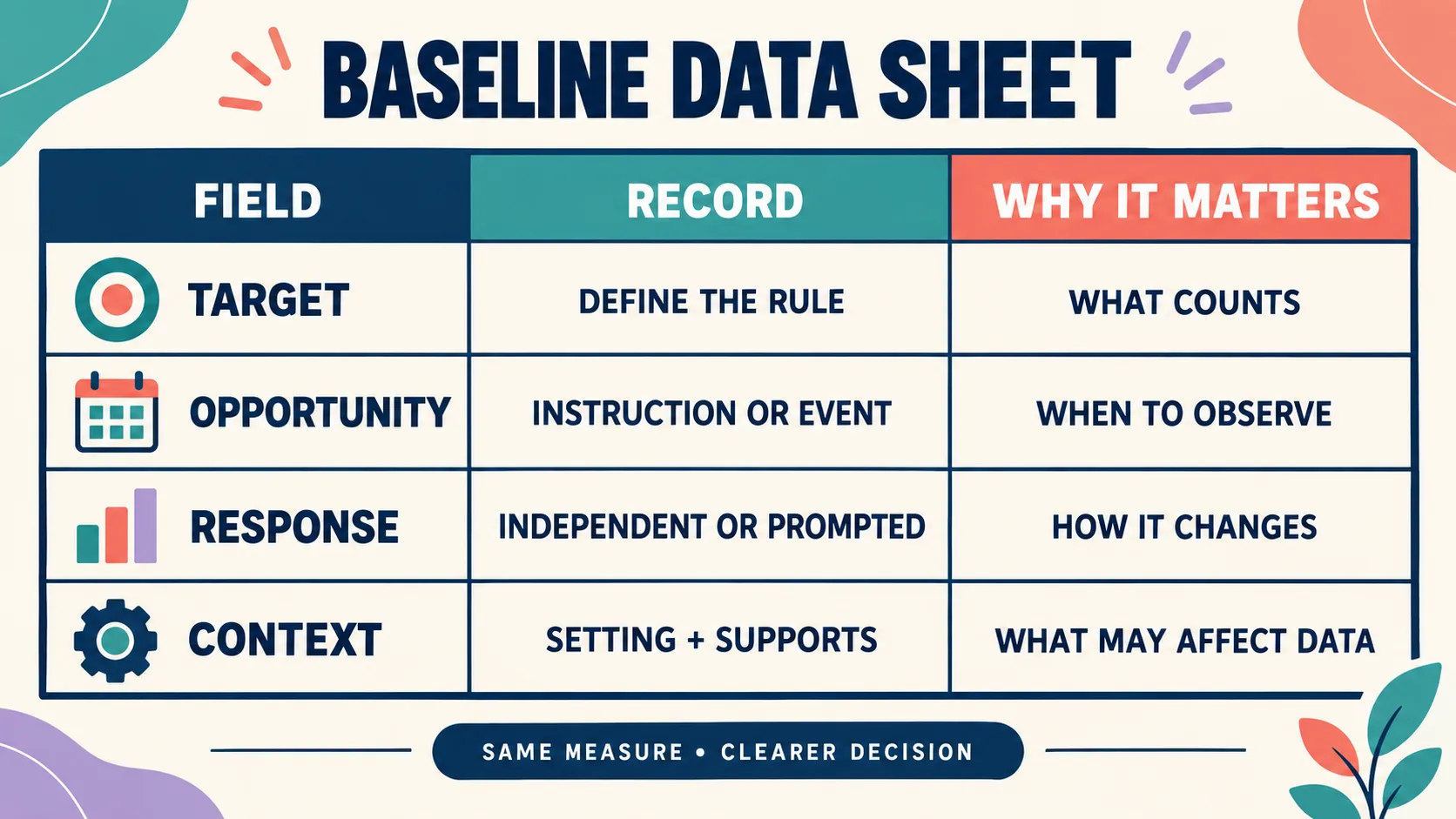
A baseline data sheet should be simple enough for consistent use and detailed enough to preserve interpretation. The exact fields vary, but most useful sheets include:
- Target and operational definition: the response or skill being measured, including start, stop, and exclusion rules.
- Date, time, and duration: enough information to compare sessions and calculate rate or duration correctly.
- Opportunity or trial information: the instruction, activity, material, or event that made the response possible.
- Response and prompt level: independent, prompted, incorrect, no response, or another defined code.
- Context variables: setting, communication partner, relevant schedule changes, and supports already in place.
- Consequence and safety notes: what happened after the response and whether a safety procedure altered the observation.
- Observer and reliability field: who collected the data and when a second observer checked the measurement.
Keep interpretations such as “seemed unmotivated” separate from behavior data. Record reported context, such as a new caregiver or unusual schedule, without treating it as the cause unless the assessment supports that conclusion.
How Do You Collect Baseline Data for Skill Acquisition?
For a skill-acquisition program, sample representative targets. Confirm that an opportunity exists, present the programmed instruction, and record the response without adding the teaching prompt that the intervention will evaluate. Mark targets already performed independently instead of teaching them again.
Use a response form that matches the learner’s communication system. Vocal, sign, picture, written, or speech-generating-device responses may be valid when they meet the defined goal. Do not make vocal imitation a hidden requirement for functional communication.
Do not withhold necessities or ignore distress to protect a data point. Maintain assent, safety, and ordinary access while avoiding the new contingent teaching arrangement. If the observation becomes unsafe or invalid, stop, document it, and collect another representative sample.
How Do You Collect Baseline Data for Behavior Reduction?
For a behavior-reduction goal, choose the clinically important dimension. Frequency fits discrete events; rate helps compare observations of different lengths; duration captures persistence; and latency captures delay before starting. One 2-second episode is not equivalent to a 20-minute episode.
Record when the response occurs and what follows it, but do not assume that a baseline ABC record proves function. Those notes can guide an assessment; they do not replace a functional analysis when one is needed. Include replacement or adaptive behavior data when the treatment decision depends on it.
How Much Baseline Data Is Enough?
There is no single correct number of baseline sessions. Consider stability, variability, risk of delaying helpful treatment, available opportunities, and the design. A stable pattern may support a sooner phase change, but it is not the only ethical factor.
Look for an interpretable pattern. If sessions vary from 5 to 60 minutes, a raw count may change because exposure changed. If task difficulty changes, accuracy may reflect materials rather than learning. If a new staff member is learning the definition, variability may be measurement error. Mark these events and decide whether more observation or training is needed.
Baseline is also not a promise that the intervention will work. It is a comparison condition. Later decisions should use the graph, treatment integrity, social validity, and the learner’s meaningful outcomes. The BACB Ethics Code emphasizes correctly selecting and implementing data procedures and using the results to make decisions; collecting more points does not automatically make a weak measure strong.
Baseline Data vs. a Baseline Probe
A baseline probe is a brief sample of performance under defined conditions. Baseline data can include repeated measurements across sessions and may be used to describe a phase in a single-case design. A probe may answer a narrow question, such as whether a learner can perform an untrained target, while a baseline phase usually supports a broader comparison before an intervention.
Read the site’s baseline probe ABA guide for that distinction, and compare it with the existing baseline design guide. This article focuses on the collection workflow: define, arrange, observe, record, graph, and mark the phase change. The terms overlap in ordinary conversation, but a BCBA exam question may use them to test the scope of the measurement.
What Are Common Baseline Data Collection Mistakes?
- Starting with a vague label: “Noncompliance” or “poor language” cannot guide a reliable measurement until the response and opportunity are defined.
- Changing the measure after baseline: A treatment graph is difficult to interpret if baseline used frequency and treatment uses percentage without a clear reason.
- Teaching during a probe without recording it: An unplanned prompt or correction can make a later response look independent.
- Ignoring session length: Raw counts from unequal observation periods may be misleading; use rate or another suitable metric when exposure differs.
- Assuming three points always settle the question: Stability, variability, safety, urgency, and design logic all affect the decision.
- Withholding necessary support: Data quality never justifies ignoring assent, safety, communication access, or essential care.
- Calling baseline “untreated” without checking the context: Existing schedules, prompts, reinforcement, or environmental supports may still be active.
FAQ
Should baseline data be collected before every ABA goal?: A baseline or other starting measure is usually useful before making a new behavior-change decision, but the exact method depends on the goal, risk, existing data, and clinical context. A stable, recent record may answer the question better than repeating a long probe without a purpose.
Can reinforcement be used during baseline?: Safety, assent, access, and ordinary supports should not be removed simply to protect a data point. The key is to distinguish the baseline condition from the new reinforcement arrangement being evaluated, document what occurred, and avoid accidentally teaching the target while claiming to measure prior performance.
What is the best measurement system for baseline?: There is no universal best system. Select the measure that matches the behavior’s dimension and the decision: frequency or rate for discrete events, duration for persistence, latency for starting speed, and trial or opportunity data for skill performance. Keep the definition and denominator clear.
Bottom line: To collect baseline data in ABA well, define the target and opportunity first, select a matching measure, observe under a clearly described condition, record prompts and context, graph the pattern, and mark the phase change. Baseline is a decision tool, not a ritual number. When you are ready to practice measurement and design scenarios, use the free BCBA mock exam. For targeted review, use our how to collect baseline data aba practice questions to apply the concept in exam-style scenarios.
Quick Review Checklist
Use this final checklist to turn how to collect baseline data aba into exam-ready reasoning. The goal is not to memorize a label in isolation; it is to identify the relevant evidence and explain why the best answer fits the scenario. Key ideas to review:
- State the central definition or decision point for how to collect baseline data aba in your own words.
- Identify the detail that makes how to collect baseline data aba different from its closest related ABA term.
- Separate the observable facts in a scenario from assumptions that are not supported by the facts.
- Write one example and one nonexample so you can recognize the concept in a new setting.
Exam application checks:
- Ask what the question is actually requesting before comparing the answer choices.
- Mark the antecedent, response, consequence, or other evidence that supports the selected answer.
- Look for a distractor that describes a related process but does not answer the specific question.
Final self-check:
- Explain how you would verify the interpretation with clear observations or data.
- Change one detail in the scenario and decide whether your answer should change.
- Give a one-sentence rationale that a supervisor or study partner could evaluate.
Take the Free BCBA Mock Exam
When you are ready to apply the idea, use the free practice resource below for additional feedback. Take the Free BCBA Mock Exam



