
BCBA exam preparation If you searched for ABA flashcards actions, the useful question is not only which cards contain the most terms. It is what each card asks you to do. A card that makes you recognize a definition can support early learning, but BCBA preparation also requires discrimination, prediction, application, and explanation. Your flashcards should therefore become small decision prompts—not a pile of vocabulary you flip until the wording feels familiar.
Table of Contents
- What Actions Should ABA Flashcards Trigger?
- How to Build an Action-Based Flashcard
- How to Map Flashcards to BCBA Domains
- How to Move From Recall to Scenario Decisions
- How to Use Mistakes as Your Next Study Plan
- A Short ABA Flashcard Routine
- ABA Flashcards Actions FAQ
- Take the Free BCBA Mock Exam
This guide shows how to turn ABA flashcards into an active study system: choose the action a card should trigger, connect cards to the current BCBA content outline, add scenario variation, and log the errors that should shape your next practice session. The approach is educational guidance, not BACB advice, an official BACB product, or a promise of a passing result. Verify current certification and examination information in the BACB Handbook and the BCBA Test Content Outline.
What Actions Should ABA Flashcards Trigger?
The word “action” can mean two things in a flashcard system. It can describe an action in an ABA example, such as a learner requesting a break or a technician recording duration. It can also describe the action you take as the student: define, discriminate, predict, calculate, select, or explain. For BCBA exam preparation, the second meaning is especially valuable because it turns a card from a recognition exercise into a small rehearsal of professional reasoning.
Begin with a clear target. The BACB’s current BCBA Test Content Outline describes the knowledge and skills assessed on the examination and organizes them into content areas and tasks. It should be your scope map. A commercial deck, shared deck, or personal deck is a study aid; it should not replace the official outline, handbook, or Ethics Code as the source for current certification and examination rules.
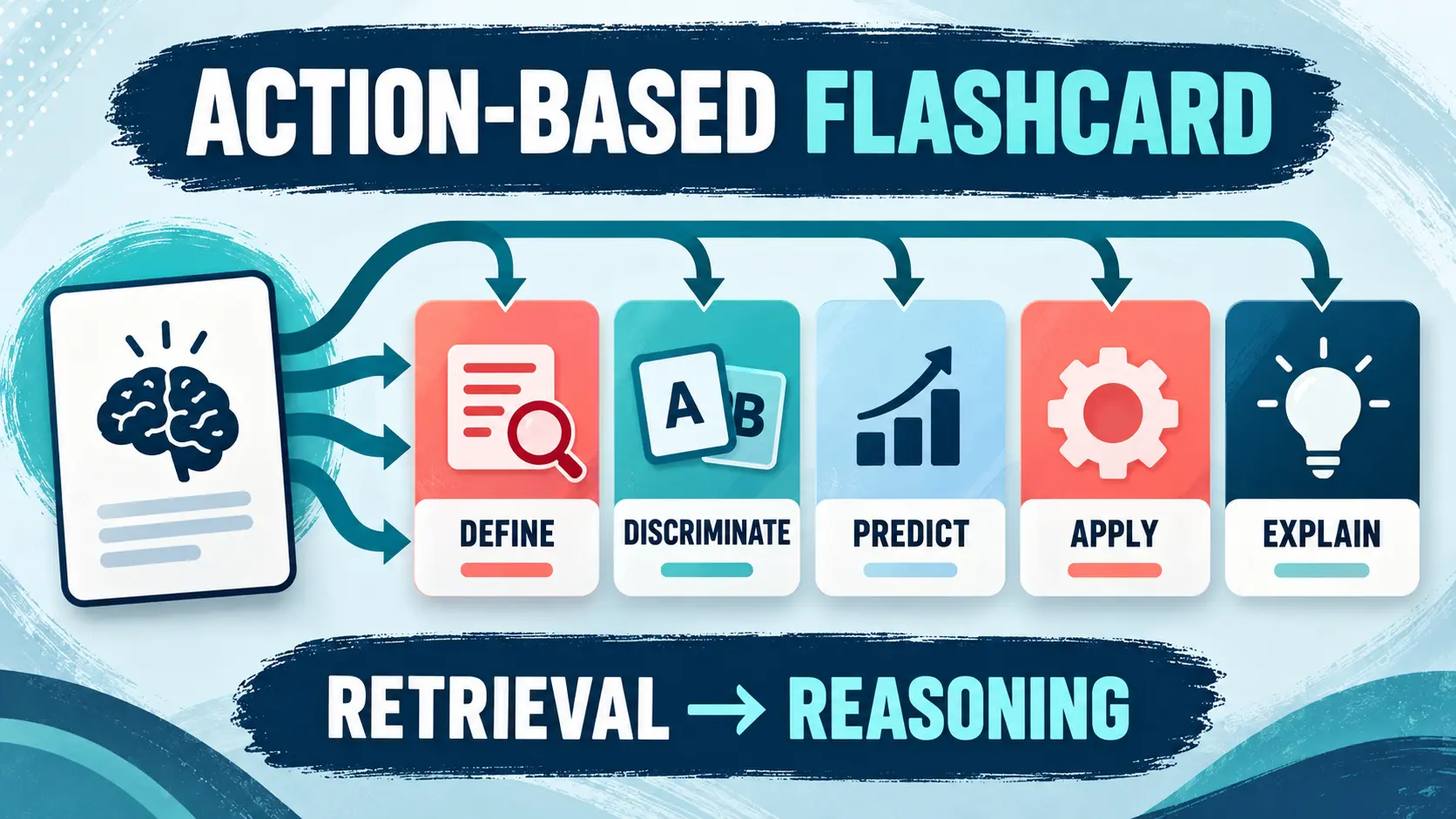
A strong action card has one controlling prompt and one observable response. “What is negative reinforcement?” is a reasonable starting point, but it mainly asks for a definition. “Identify the behavior, the removed stimulus, and the future change that would support negative reinforcement in this scenario” asks you to analyze the contingency. Both cards may use the same term, but the second card creates more useful practice.
- Define: state the concept in precise, plain language.
- Discriminate: tell the concept apart from a close alternative.
- Predict: state what should change if the described contingency is operating.
- Apply: select the best concept for a new scenario.
- Explain: identify the clue that controls the decision and reject the strongest distractor.
Do not force every card to test every action. A definition card can be appropriate when a term is new. The improvement is to graduate the card: after you can define the term reliably, add a discrimination card, then a scenario card, then a short explanation card. The sequence prevents a familiar phrase from creating a false sense of readiness.
How to Build an Action-Based Flashcard
Use a compact card structure so that the front and back do different jobs. The front should require a response before you see the explanation. The back should show the reasoning, not merely a dictionary sentence. If the card is so crowded that the answer is visible from the front, split it into two cards or change the prompt.
| Card element | What it should do | Example prompt |
|---|---|---|
| Target | Name one concept or task without hiding the target inside a long paragraph. | What is stimulus generalization? |
| Action | Require the learner to define, compare, calculate, or apply. | Which detail shows generalization rather than maintenance? |
| Controlling clue | Point to the fact that should determine the answer. | The response occurs with a new but similar stimulus. |
| Boundary | Show what would make a nearby answer incorrect. | It is not maintenance if the stimulus or task changed. |
| Next action | Tell you whether to repeat, vary, calculate, or apply the concept. | Write one new scenario with a different stimulus. |
For a definition card, keep the answer short enough to retrieve. For an application card, include only the facts needed to make the decision. Extra details can be useful later, but a card that contains every possible exception becomes a reading task rather than a retrieval task. Keep technical precision in the explanation and keep the prompt focused.
When you create a deck from a lesson or textbook, write the card in your own words and then verify the technical definition against a primary or trusted source. Do not copy confidential BACB examination questions, recalled items, or answer choices. Original practice scenarios can teach reasoning, but they must be labeled as unofficial study content.
How to Map Flashcards to BCBA Domains
Organizing cards by topic can help you find a gap, but studying only by topic can hide an important difference: the same term may require different actions. A candidate may recognize “latency” as a definition yet still select the wrong measurement procedure in a scenario. Tag each card with both a content area and a response action.
- Content tag: the domain, task cluster, or concept family the card represents.
- Action tag: define, distinguish, interpret, calculate, select, or explain.
- Difficulty tag: recall, discrimination, or application.
- Error tag: knowledge, reading, calculation, discrimination, or pacing.
Use the official outline as the map, not a deck’s marketing label. The current BCBA outline includes areas such as behaviorism and philosophical foundations, concepts and principles, measurement and data interpretation, experimental design, ethics, behavior assessment, behavior-change procedures, intervention selection and implementation, and personnel supervision and management. A deck can summarize those areas, but it cannot make an outdated or incomplete deck current merely by calling it “6th edition.” Check the source date and coverage yourself.
Once a week, sort your cards by action tag rather than only by domain. A short “distinguish” session might compare positive versus negative reinforcement, respondent versus operant conditioning, or stimulus versus response generalization. A short “interpret” session might ask what a graph, measurement procedure, or data pattern supports. The goal is flexible retrieval: the learner should be able to respond when the wording and surface details change.
How to Move From Recall to Scenario Decisions
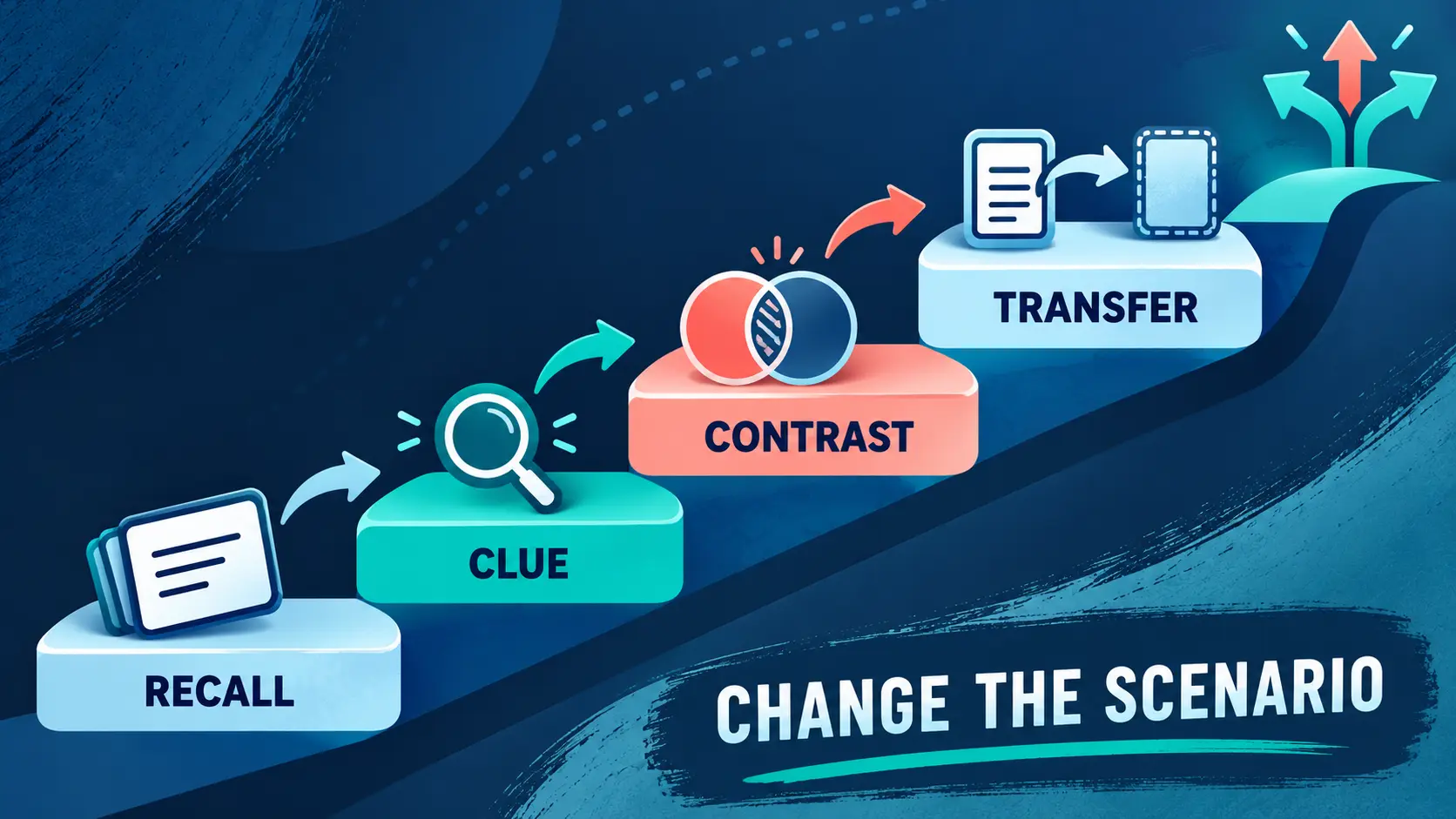
Flashcards become more valuable when they create a small bridge to scenario practice. After answering a term card, ask one follow-up question: “What would this look like in a new example?” For a card about differential reinforcement, change the response, setting, reinforcer, and competing behavior. For a measurement card, change the critical dimension and ask which procedure would represent the behavior most directly.
Use a four-step progression. First, retrieve the concept without looking at notes. Second, state the controlling clue. Third, compare the best answer with one plausible alternative. Fourth, apply the idea to a new scenario. If you miss the first step, return to a brief definition card. If you miss the third step, make a discrimination card. If you miss only the fourth step, you need more varied application—not necessarily more definitions.
Here is a simple example. Front: “A learner answers a question only after a verbal prompt. What should you examine before calling the response independent?” Your answer should focus on the prompt’s role and the conditions under which the response occurs. The useful back of the card would explain the clue, name the nearby mistake, and ask you to write a variation in which the relevant antecedent is present without the prompt. That is an action card because it asks you to analyze and transfer, not just recite.
Keep the scenario original and modest. A flashcard is not a substitute for a full assessment, treatment plan, or professional supervision. It is a controlled practice prompt for examination reasoning. Avoid turning a simplified card into a universal clinical recommendation, especially when the real decision would require client information, cultural variables, risk assessment, or a qualified supervisor’s judgment.
How to Use Mistakes as Your Next Study Plan
A percentage tells you how many cards were answered correctly; it does not tell you what to do next. Log the error category and the card action that failed. This takes less time than rereading the entire deck and gives your study session a reason.
- Knowledge error: you could not state the concept or rule; review a concise explanation and retest later.
- Discrimination error: you knew both terms but confused their controlling features; write a contrast card.
- Application error: you recalled the definition but missed its use in a new scenario; create two varied examples.
- Calculation or data error: you mishandled a number, unit, graph, or measurement dimension; work a fresh item slowly, then repeat under time.
- Reading or pacing error: you knew the concept but misread the stem or rushed; practice marking the controlling facts before choosing.
Schedule the next exposure based on the error, not on the order of the deck. A missed definition can return after a short interval. A discrimination error deserves two examples with the same surface topic but different controlling clues. An application error should be checked with a new scenario. When a card is answered correctly several times, change its example or action instead of endlessly repeating the same wording.
A Short ABA Flashcard Routine
A ten- to fifteen-minute session can be enough to create useful feedback when the routine is deliberate. Start with a mixed set so you do not rely on topic order. Answer before flipping. Mark the action you attempted and record only the error type that changes your next step.
- Choose five to ten cards from more than one BCBA content area.
- Answer each prompt aloud or in a short written note before viewing the back.
- For every miss, write the controlling clue and the strongest distractor.
- Convert one miss into a new discrimination or scenario card.
- Finish with one timed or mixed practice question that uses a different surface example.
Use the current BACB materials to confirm the scope and rules that matter for your exam path. The BACB states that it does not endorse specific study guides and that buying study materials does not guarantee a passing result. That is why a useful deck should be judged by its source, coverage, action prompts, feedback, and transfer—not by its card count or a marketing claim.
When your flashcards are helping you retrieve and discriminate, use a practice set to test whether that reasoning survives longer scenarios. Try the free BCBA mock exam after your ABA flashcards actions review, then classify the mistakes before choosing the next card set. Treat the result as study feedback, not a promise about the official examination.
ABA Flashcards Actions FAQ
What does “actions” mean in an ABA flashcard deck?: It can mean actions shown in an ABA scenario, but for studying it is more useful to treat it as the response the card requires from you: define, discriminate, predict, calculate, apply, or explain. Labeling the action helps you see whether your deck tests only recognition or also requires flexible reasoning.
Are flashcards enough for BCBA exam preparation?: Flashcards can support recall and discrimination, but they are not a complete preparation system. Pair them with the current BACB outline, source-checked explanations, varied scenarios, data or calculation practice when relevant, and timed practice. A card deck should reveal what to study next rather than become the only format you use.
Should I use downloaded or shared ABA flashcards?: You can use them as a starting point, but check the date, source, domain coverage, terminology, and explanation quality. Do not use cards that claim to reproduce real BACB questions or confidential exam content. Rewrite weak cards in your own words and verify current policy claims against official BACB materials.
Take the Free BCBA Mock Exam
When you are ready to apply the idea, use the free practice resource below for additional feedback. Take the Free BCBA Mock Exam



