

Baseline probe ABA questions are really questions about experimental logic. Learn what baseline measures, what a probe samples, when a probe is efficient, and why a probe point cannot automatically replace a complete baseline phase.
Table of Contents
- What Is a Baseline Probe in ABA?
- How Is a Baseline Different From a Probe?
- When Should You Use a Baseline Probe ABA Procedure?
- How Do You Plan a Good Probe?
- How Do You Graph Baseline and Probe Data?
- Can One Probe Replace Baseline?
- What Does the BCBA Exam Test?
- What Is the Bottom Line?
- Quick Review Checklist
- Take the Free BCBA Mock Exam
A baseline probe ABA discussion begins with a distinction. Baseline is the measurement of a target before the intervention or teaching arrangement is introduced. A probe is a planned observation used to sample performance under selected conditions, often without the prompts or teaching procedures that would normally be delivered. Both can produce data points, but they answer different questions.
The BCBA Test Content Outline connects measurement with experimental design and data-based decisions. A probe can save time and reduce unnecessary exposure to training trials, but it must be labeled honestly. A single probe may show current performance; it does not automatically demonstrate experimental control or a functional relation.
What Is a Baseline Probe in ABA?
A baseline probe is an observation conducted before the relevant intervention or teaching procedure is implemented for the target. It helps the team estimate the starting level, trend, and variability of the behavior. The condition should be described: materials, instructions, opportunity count, consequence, prompt level, and any restrictions on assistance.
In skill acquisition, a probe may test whether a learner can perform a step without direct teaching on that step. In experimental design, a baseline point is part of the comparison condition. The same word “probe” can therefore appear in different contexts, so read the question for the function of the observation rather than memorizing the label alone.
How Is a Baseline Different From a Probe?
Baseline is a condition or phase used to describe behavior before treatment. A probe is a sampling procedure. A probe can occur during baseline, maintenance, generalization, or after a teaching sequence. It is defined by what the observer arranges and records, not simply by where it appears in the timeline.
| Feature | Baseline | Probe |
|---|---|---|
| Main purpose | Describe starting performance under a comparison condition | Sample performance under a planned, limited observation |
| Teaching during observation | Usually absent for the target being assessed | Usually absent or restricted to protect the sample |
| What it can support | Starting level, trend, and comparison | Current performance, maintenance, or generalization information |
| What it cannot prove alone | That later change was caused by treatment | A stable baseline or a functional relation |
When Should You Use a Baseline Probe ABA Procedure?
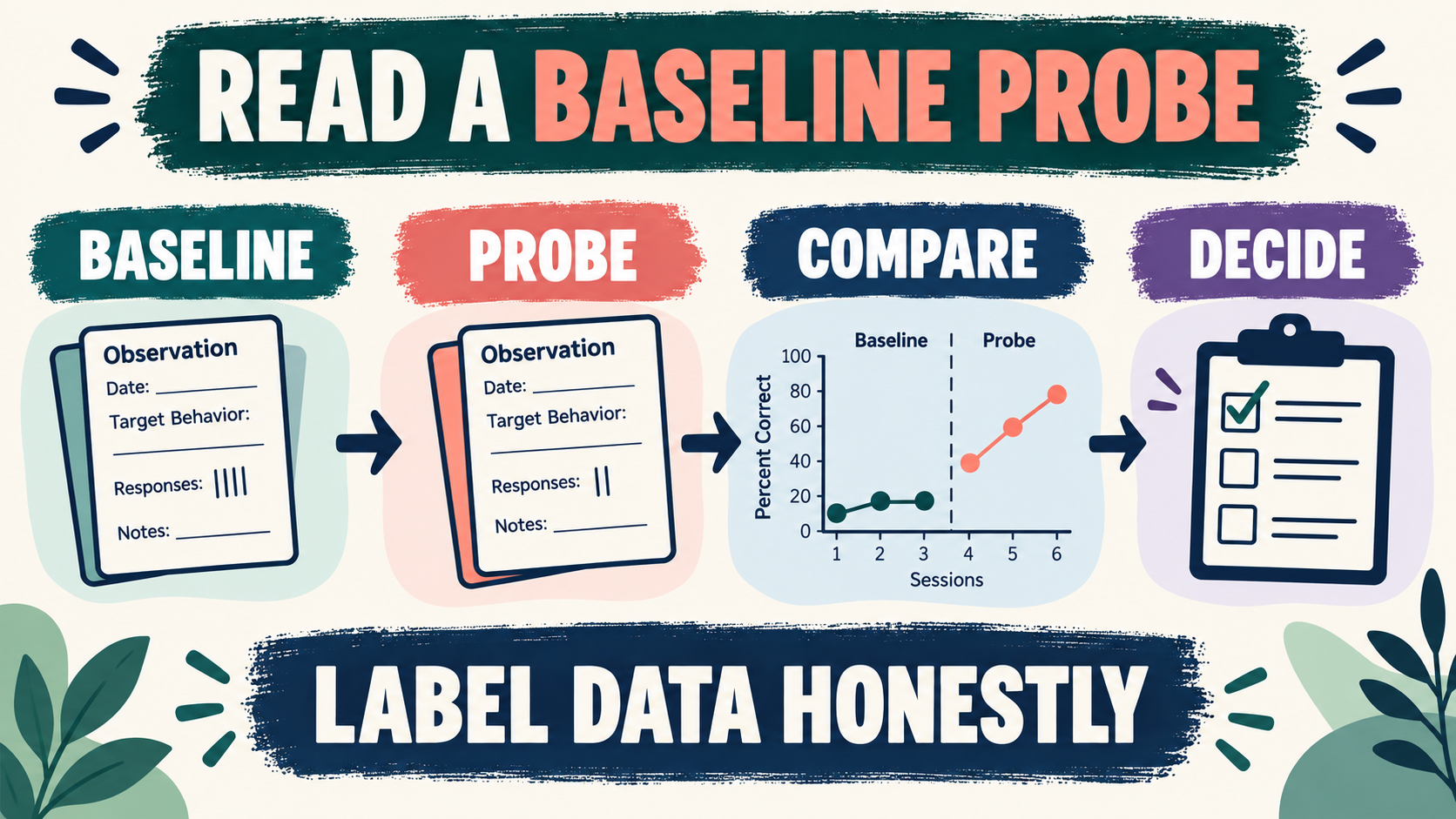
Probes are useful when repeated teaching trials could create unwanted practice effects, when the target is already in a skill sequence, or when the team wants to check generalization without delivering the full teaching package. For example, a teacher may teach selected examples of a concept and periodically probe untrained examples to see whether responding transfers.
Use a probe only when the decision is clear. If the question is whether the learner can perform an untrained step, sample that step with the same materials and response definition. If the question is whether a behavior changed because of an intervention, a brief probe alone is not enough; use a design that provides repeated, interpretable comparisons.
How Do You Plan a Good Probe?
Define the target and opportunity before the observation. State what counts as correct, incorrect, prompted, no response, or not applicable. Choose materials and examples that represent the skill. Decide whether the learner receives a consequence after each trial, after the probe, or not during the probe. The consequence rule matters because it can change later responding.
Keep probe conditions stable enough to compare, but do not pretend that a probe is identical to every natural situation. Record the person, setting, materials, instruction, prompt, and time since the last teaching session. Those details make it possible to decide whether a low score reflects a skill deficit, poor stimulus control, an unfamiliar example, or an unusually difficult probe.
How Do You Graph Baseline and Probe Data?
Place data in chronological order and label the observation type. A baseline phase may appear as a separate condition, while probe points can be marked with a distinct symbol or placed in a maintenance or generalization panel. Do not connect a probe to a treatment data series in a way that implies continuous teaching occurred between points.
Graph the metric that matches the target: percentage correct, frequency, rate, latency, duration, or another defined measure. Include the number of opportunities when percentage data could be misleading. A score of 80% from four opportunities is not equivalent to 80% from twenty opportunities.
Can One Probe Replace Baseline?
Usually, no. One point can be informative, especially when a behavior is dangerous or a learner’s time is limited, but it gives little information about trend and variability. A single probe cannot show whether the score is typical, whether responding was improving before the intervention, or whether the measurement was reliable.
There are situations in which a team uses a brief or staggered assessment because extended baseline is impractical or unsafe. That is a design decision that should be justified, monitored, and communicated. The appropriate answer is not “a probe always proves mastery” or “a probe is never useful.” The answer depends on the inference the team wants to make.
What Does the BCBA Exam Test?
- Baseline versus probe: baseline describes a comparison condition; a probe is a planned sample.
- No teaching is not the whole definition: read the purpose, consequence arrangement, and location in the design.
- A probe does not prove maintenance: maintenance requires performance after teaching has been reduced or removed across relevant conditions.
- A probe does not prove generalization: generalization requires variation in people, settings, stimuli, or responses as planned.
- Percentage needs a denominator: opportunity count and scoring rules affect interpretation.
- Experimental control needs repetition: one point rarely establishes a functional relation.
What Is the Bottom Line?
Baseline probe ABA questions are about what the observation lets you infer. Define the target, sample under planned conditions, label the point honestly, and match the graph to the design. Use probes to make assessment efficient, not to overclaim evidence. For more practice with measurement and experimental-design distinctions, try the free BCBA mock exam. It is a study tool and does not replace individualized supervision or assessment.
For targeted review, use our baseline probe ABA practice questions to apply the concept in exam-style scenarios.
Quick Review Checklist
Use this final checklist to turn baseline probe ABA into exam-ready reasoning. The goal is not to memorize a label in isolation; it is to identify the relevant evidence and explain why the best answer fits the scenario. Key ideas to review:
- State the central definition or decision point for baseline probe ABA in your own words.
- Identify the detail that makes baseline probe ABA different from its closest related ABA term.
- Separate the observable facts in a scenario from assumptions that are not supported by the facts.
- Write one example and one nonexample so you can recognize the concept in a new setting.
Exam application checks:
- Ask what the question is actually requesting before comparing the answer choices.
- Mark the antecedent, response, consequence, or other evidence that supports the selected answer.
- Look for a distractor that describes a related process but does not answer the specific question.
Final self-check:
- Explain how you would verify the interpretation with clear observations or data.
- Change one detail in the scenario and decide whether your answer should change.
- Give a one-sentence rationale that a supervisor or study partner could evaluate.
Take the Free BCBA Mock Exam
When you are ready to apply the idea, use the free practice resource below for additional feedback. Take the Free BCBA Mock Exam



