

Quick answer: If you are asking how much does ABA therapy cost, there is no single national price. A family’s cost can include an assessment, direct treatment, BCBA supervision, caregiver coaching, treatment-plan updates, travel or location rules, and the insurance or Medicaid cost-sharing that applies to each service. The number on a provider’s fee schedule is not always the amount the family pays. To estimate the real cost, ask which services are covered, how they are billed, what the allowed amount is, whether authorization is required, and how the deductible, copay, coinsurance, and out-of-pocket maximum apply.
Table of Contents
- What Does “Cost” Mean in ABA Therapy?
- How Is ABA Therapy Billed?
- What Factors Change the Cost of ABA Therapy?
- How Do Deductibles, Copays, and Coinsurance Affect ABA Cost?
- How Can You Estimate Your Family’s ABA Cost?
- What About Medicaid and State Coverage?
- What Should You Ask an ABA Provider About Cost?
- How Should Families Check an EOB and Provider Bill?
- Does the Setting Change ABA Therapy Cost?
- What Cost Red Flags Should Families Watch For?
- How Much Does ABA Therapy Cost? FAQ
- Key Takeaway
- Take the Free BCBA Mock Exam
Search results often present a simple hourly range, but a single number can mislead. ABA is commonly billed in time-based units and different people may provide different parts of care. Private-pay rates, negotiated insurance rates, state Medicaid schedules, provider availability, and a child’s plan all vary. This guide gives families a method for checking the numbers that apply to them. It is educational information, not a promise of coverage or financial advice.
What Does “Cost” Mean in ABA Therapy?
When a family asks how much does ABA therapy cost, they may mean at least four different numbers:
- Billed charge: the amount a provider submits for a service.
- Allowed amount: the amount an insurer or payer recognizes under its contract or fee schedule.
- Payer share: what insurance, Medicaid, or another program pays after its rules are applied.
- Family share: the deductible, copay, coinsurance, noncovered service, or balance the family may owe.
These numbers can differ substantially. An in-network provider may accept the allowed amount as payment in full except for the member’s cost sharing, while an out-of-network provider may have different rules. A private-pay family may receive a quoted rate but still need to ask whether assessment, caregiver coaching, reports, cancellations, or travel are included.
How Is ABA Therapy Billed?
ABA services are often billed in time-based units rather than as one unlimited “session” price. The exact code, unit length, credentialed provider, payer policy, and documentation requirements vary. A direct service with a technician, a BCBA assessment, supervision, caregiver training, and treatment-plan work may not be priced or covered in the same way. Ask the provider for a written explanation of:
- which services are proposed and who provides each one;
- the unit length and expected units per visit or week;
- the billed charge, in-network allowed amount, and expected family share;
- the authorization, diagnosis, referral, or treatment-plan documents required;
- how parent training, supervision, reassessment, reports, and missed visits are handled; and
- which services are not covered or may be billed separately.
What Factors Change the Cost of ABA Therapy?
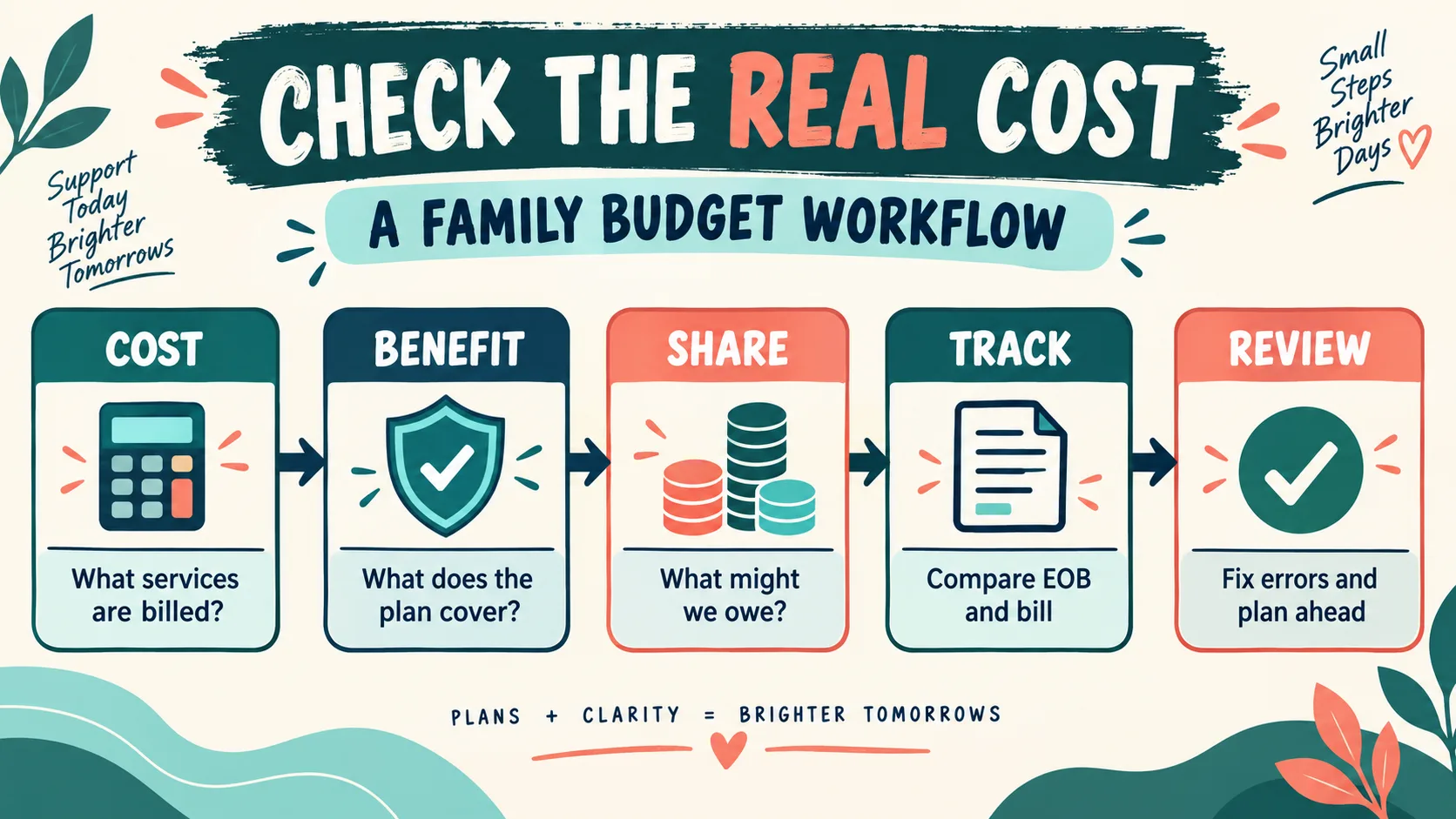
The total cost is shaped by more than the provider’s advertised hourly rate. The first major factor is the service mix: an assessment and plan-development period may look different from recurring direct treatment. The second is the setting. Home-based care may involve travel or location rules; clinic care may have different staffing and facility costs; school or community services may require permissions and coordination; virtual coaching may change what can be observed and billed.
Hours also matter, but “more hours” is not a universal recommendation. The appropriate schedule depends on the child’s goals, clinical assessment, availability, educational routine, family capacity, payer authorization, and response to treatment. A responsible provider should explain why the proposed service amount is appropriate and how progress will be reviewed.
Finally, administrative details affect the family budget. A waitlist can delay care; an out-of-network provider can change the family share; a missed authorization renewal can interrupt payment; and an explanation of benefits (EOB) can look different from the provider’s invoice. Put the financial workflow in writing before services begin.
How Do Deductibles, Copays, and Coinsurance Affect ABA Cost?
Insurance vocabulary is easy to mix up. Use the table below as a question guide, then confirm the answer in the plan documents or with the insurer. The plan’s behavioral-health rules may not be identical to the rules for every other medical service.
| Term | What it usually means | Ask the insurer | Why it matters |
|---|---|---|---|
| Deductible | The amount a member may pay for covered care before the plan begins sharing costs | Does ABA run through the deductible, and which services count? | Early-year family costs may be higher under some plans |
| Copay | A fixed member amount for a covered service or visit under the plan’s rules | Is the copay per visit, per day, per code, or per provider? | The number of billed visits or services can change the annual total |
| Coinsurance | A percentage of the applicable allowed amount after the plan’s conditions are met | What allowed amount and percentage apply to each ABA service? | A percentage is not the same as a percentage of the provider’s sticker price |
| Out-of-pocket maximum | A plan-year limit for eligible member cost sharing under the plan’s rules | Which ABA payments count, and are out-of-network costs treated differently? | It can change the family’s later-year exposure, but exclusions still matter |
How Can You Estimate Your Family’s ABA Cost?
Use a worksheet rather than relying on a marketing estimate. Start with the proposed service units per week and the number of weeks in the plan period. For each service, record the provider’s billed charge, the allowed amount if available, and the member amount listed by the insurer. Then add any recurring noncovered expenses such as travel, supplies, private-pay coaching, or missed-visit fees. Your worksheet should answer:
- What is the estimated allowed amount for direct treatment, assessment, supervision, and caregiver training?
- Which deductible, copay, or coinsurance rule applies to each service?
- What authorization, network, or medical-necessity condition could change the estimate?
- What is the expected family share per week and per plan year if the schedule stays the same?
- What happens when a service is denied, a claim is corrected, or the plan year resets?
Do not treat the result as a guaranteed bill. It is a planning estimate that needs to be checked against the plan, provider contract, and actual EOBs. If the estimate and the first bill do not match, ask the insurer and provider to identify the exact code, unit, allowed amount, adjustment, and member responsibility.
What About Medicaid and State Coverage?
Medicaid coverage is not one identical national benefit in day-to-day administration. States determine eligibility, networks, medical-necessity processes, authorization, provider rules, and how services are delivered within federal requirements. The CMS Medicaid autism-services page links to federal guidance and state-related resources, but a family still needs the specific state plan or managed-care instructions that apply to the child. Ask the state Medicaid agency or plan:
- Does the child qualify for the benefit or pathway being discussed?
- Is a diagnosis, referral, medical-necessity review, or treatment authorization required?
- Which providers, settings, services, and hours are covered?
- Are there copays, limits, waiting-list rules, or renewal documents?
- How can the family appeal a denial or request a continuity-of-care review?
What Should You Ask an ABA Provider About Cost?
Before signing a service agreement, ask for answers in writing:
- What exactly is included? Separate assessment, direct treatment, BCBA supervision, parent training, reports, meetings, travel, and supplies.
- How do you bill? Ask about time units, codes, minimum visits, rounding, cancellations, and balance billing.
- Are you in network? Confirm the specific plan and location, not just the insurer’s brand name.
- Who obtains authorization? Ask what the family must submit and who tracks renewals.
- What if the claim is denied? Ask who provides records, corrections, appeal support, and a temporary payment plan.
- How can the schedule change? Ask how a lower or higher level of service is evaluated and documented.
- What will we receive? Confirm access to treatment plans, EOB explanations, data summaries, invoices, and cancellation policies.
How Should Families Check an EOB and Provider Bill?
An EOB is usually an insurer’s explanation of how a claim was processed; it is not always the same as a bill. Compare the date of service, provider, code or service description, units, billed charge, allowed amount, insurance payment, adjustment, and member responsibility. Look for duplicate dates, unexpected units, a service that was not provided, or a family amount that conflicts with the plan explanation.
Contact the provider’s billing office for coding or invoice questions and the insurer for benefit, network, or adjudication questions. Keep call dates, names, reference numbers, authorizations, and corrected documents. If a family believes a claim was processed incorrectly, ask about the formal correction or appeal path rather than simply ignoring the bill.
Does the Setting Change ABA Therapy Cost?
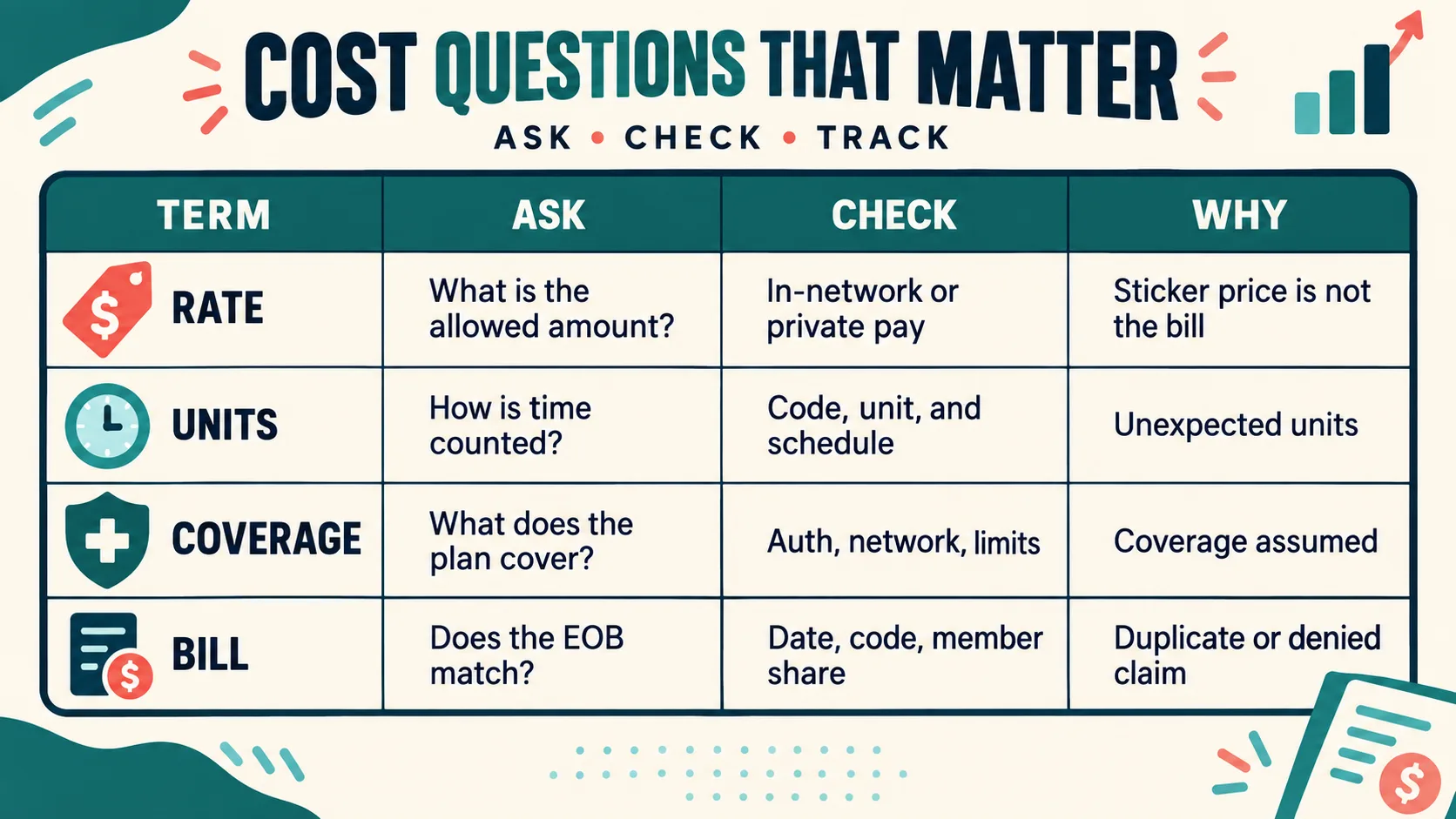
The setting can affect staffing, travel, scheduling, supervision, and which payer rules apply. Home-based, clinic-based, school-based, and virtual services may all use different arrangements. A lower advertised hourly figure may not be cheaper after travel, uncovered parent coaching, wait time, or missed access is included.
Compare the service that will actually be delivered. Ask whether the child’s goals can be addressed in the setting, whether the BCBA can observe relevant routines, whether caregiver training is included, and how the plan generalizes. Cost should be considered alongside quality, access, fit, and the family’s ability to sustain the schedule.
What Cost Red Flags Should Families Watch For?
Pause if a provider promises that insurance will pay a specific amount without checking the plan, pressures you to sign before giving a written estimate, cannot explain the service units, refuses to identify separate charges, or treats a denial as the family’s problem without offering documentation. Also ask about unusually high cancellation fees, unclear balance billing, automatic schedule increases, and services described as “free” that later require a separate contract.
Financial clarity is part of informed decision-making. The BACB Ethics Code for Behavior Analysts provides professional context for client welfare, clear communication, confidentiality, and individualized service decisions. A provider should be able to explain what is known, what is estimated, what depends on authorization, and what the family can do when the plan changes. If the answers stay vague, compare another provider or ask the insurer for a benefit call before starting.
How Much Does ABA Therapy Cost? FAQ
Is there an average hourly cost for ABA therapy?: There is no reliable universal hourly number that applies to every state, provider, service code, payer, and family. Published rates may describe a billed charge, an allowed amount, or a public fee schedule—not the family’s final share. Ask for the exact service and payer assumptions behind any number.
Does insurance cover ABA therapy?: Some plans and public programs cover ABA or related behavioral-health services when eligibility, medical necessity, authorization, network, and documentation rules are met. Coverage varies. Verify the specific plan, service, provider, location, and member cost sharing before relying on a statement.
Can Medicaid make ABA therapy free?: A family’s responsibility may be low or zero for an eligible, covered service, but “Medicaid” does not remove the need to verify eligibility, authorization, network, limits, and state-specific rules. Ask the state agency or managed-care plan for the current answer.
Why did the provider bill more than the estimate?: Possible causes include a deductible reset, out-of-network processing, different service units, authorization limits, a denied claim, a corrected claim, or a mismatch between the EOB and invoice. Compare the claim details and ask both the provider and insurer targeted questions.
Key Takeaway
How much does ABA therapy cost depends on the service mix, units, setting, payer, authorization, allowed amount, and family cost-sharing rules. Build an estimate from the actual plan and provider, then verify it against EOBs and invoices. If you are studying BCBA concepts such as measurement, supervision, ethics, and treatment planning, reinforce those skills with the site’s free BCBA mock exam. For targeted review, use our how much does aba therapy cost practice questions to apply the concept in exam-style scenarios.
Take the Free BCBA Mock Exam
If you want a low-pressure way to check your recall, use the free practice resource below. Take the Free BCBA Mock Exam



