
Quick answer: ABA therapist certification is not one universal credential with one national application. “ABA therapist” is commonly used as a job or service label, while the actual credential may be Registered Behavior Technician (RBT), Board Certified Assistant Behavior Analyst (BCaBA), Board Certified Behavior Analyst (BCBA), or a state-specific license or registration. The right path depends on the role you want, the level of supervision you will receive, the services you will provide, and the rules in the state where you work.
Table of Contents
- Is ABA Therapist Certification a Single Credential?
- Which Credential Matches the Role?
- What Does RBT Certification Involve in 2026?
- What Steps Lead to RBT Certification?
- How Is BCaBA Different From an RBT?
- How Is BCBA Different From an ABA Therapist Job Title?
- What Should Applicants Know About the 2027 BCBA Changes?
- Do State Rules Change ABA Therapist Certification?
- How Should You Evaluate an ABA Certification Program?
- Why Does Supervision Matter After Certification?
- How Do the Credentials Compare at a Glance?
- ABA Therapist Certification Application Checklist
- ABA Therapist Certification FAQ
- Is RBT the same as ABA therapist certification?
- Can I become an ABA therapist without a graduate degree?
- Does the 2027 change apply to every ABA therapist?
- Key Takeaway
- Take the Free BCBA Mock Exam
For many entry-level ABA jobs, RBT certification is the credential people mean. It is a paraprofessional certification for delivering behavior-analytic services under close, ongoing supervision. BCaBA and BCBA are different professional certifications with different education, fieldwork, examination, and supervision expectations. Before paying for a course, verify the current requirements with the Behavior Analyst Certification Board (BACB), confirm your state’s rules, and ask the employer what credential it actually requires.
Is ABA Therapist Certification a Single Credential?
No. The phrase can describe several different employment situations. One employer may use “ABA therapist” for an RBT who implements parts of a behavior plan. Another may use it for a behavior technician who is trained by the agency but is not BACB-certified. A job advertisement may also use the phrase for a BCaBA or BCBA, even though those certifications involve a broader scope of professional responsibility.
That difference matters because a title on a job board does not tell you who is allowed to assess behavior, design a treatment plan, supervise staff, or change clinical procedures. Read the job duties and supervision language rather than assuming that “therapist” means a particular license. If the advertisement is vague, ask the hiring organization which credential, background check, training, and state authorization are required before accepting the role.
Which Credential Matches the Role?
Use this comparison as a starting point, not as a substitute for the current BACB handbook or state law. The word “typical” is intentional: employers and jurisdictions can add requirements.
| Credential or label | Typical role | Supervision and scope | What to verify |
|---|---|---|---|
| RBT | Paraprofessional implementing assigned behavior-analytic services | Works under close, ongoing supervision; does not independently design treatment | Current BACB eligibility, competency assessment, exam, supervision, and employer rules |
| BCaBA | Assistant behavior analyst providing services within a defined professional structure | Practices under the supervision of a qualified BCBA or other approved supervisor | Degree, coursework, fieldwork, exam, renewal, and state licensure requirements |
| BCBA | Independent behavior analyst responsible for assessment, plans, supervision, and clinical decisions | Has a higher certification level but still follows ethics, documentation, and jurisdiction rules | Current BACB pathway, exam rules, state license, payer credentialing, and role expectations |
| Behavior technician or ABA therapist | Employer-defined direct-care or support role | May be trained and supervised by an agency even without a BACB credential | State law, employer training, payer rules, background checks, and supervision plan |
The most important distinction is independence. An RBT is not a replacement for the BCBA who assesses, interprets data, writes or modifies a treatment plan, and supervises service delivery. A BCaBA is also not interchangeable with a BCBA. If a website or course presents all of these titles as the same “ABA therapist certification,” treat that as a warning sign.
What Does RBT Certification Involve in 2026?
The current BACB RBT Handbook describes RBT certification as a process with eligibility, training, competency assessment, application, examination, and ongoing supervision components. The handbook should be your controlling source because requirements can change. In general, an applicant should expect to document the required age and education level, complete the current training requirement, complete a competency assessment, satisfy background and abuse-registry checks, submit an application, and pass the RBT examination.
Do not rely on an old blog post that lists a fixed number of hours. The training and competency assessment must meet the current BACB standard, and a course certificate alone does not make you an RBT. Application, examination, and ongoing supervision still matter.
RBT certification is also not a promise that every employer, insurer, or state will accept the same arrangement. An agency may require more training, a state may require a separate registration, and a payer may require particular provider credentials. Treat the BACB credential, state authorization, employer onboarding, and payer credentialing as related but separate checks.
What Steps Lead to RBT Certification?
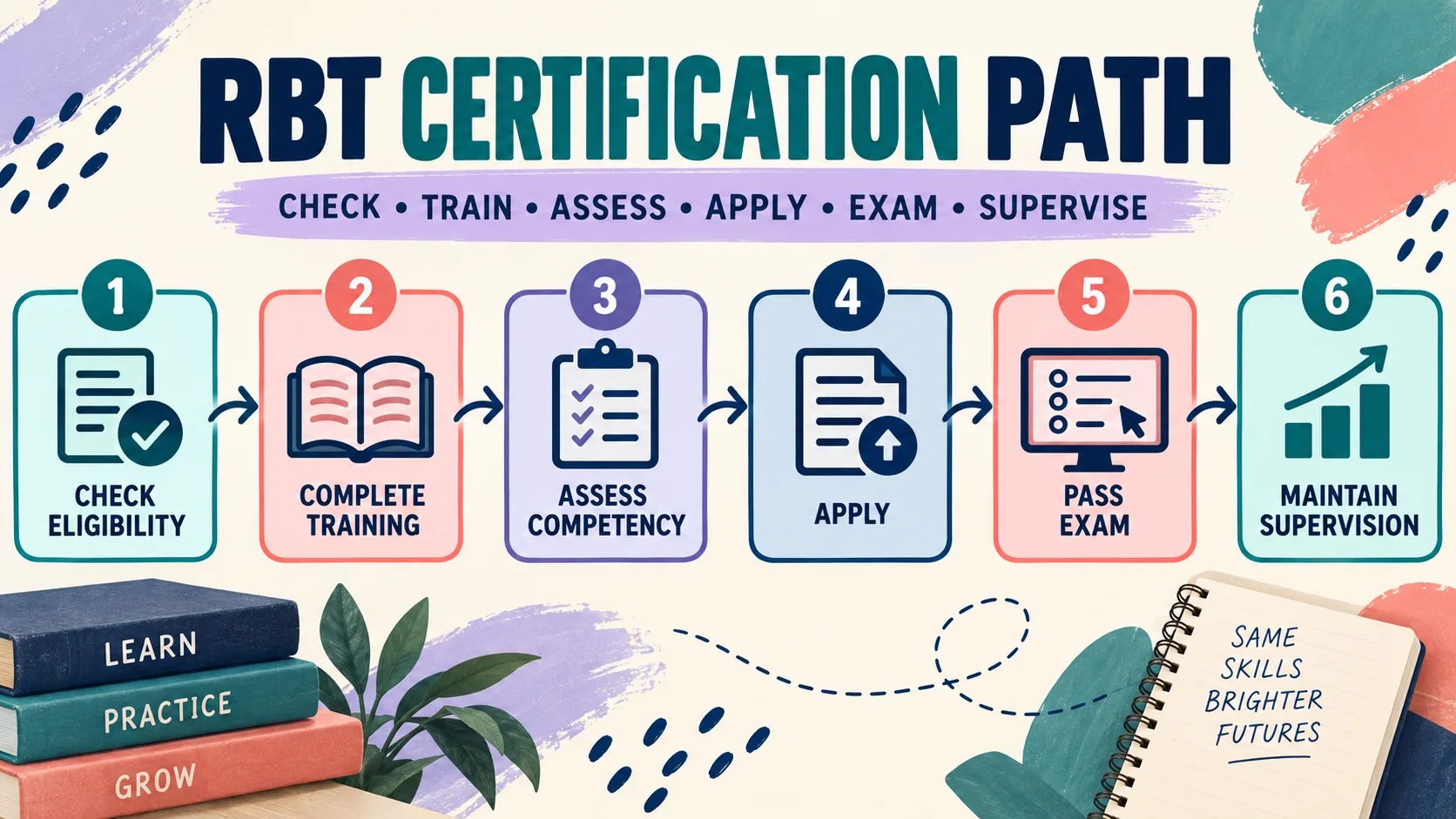
A practical path usually looks like a sequence rather than a single class. First, confirm that you meet the current eligibility rules. Next, choose training that explicitly matches the current BACB requirements and keep proof of completion. Then arrange the competency assessment, complete the application accurately, resolve any documentation issue, and schedule the examination through the approved process.
After passing, the work continues. An RBT must work within the assigned scope and receive the required ongoing supervision. Ask the prospective employer who will supervise you, how often supervision occurs, how feedback is documented, and what happens when the supervisor is unavailable. A credential without a workable supervision plan is not a complete employment plan.
- Check the current BACB RBT Handbook before enrolling.
- Confirm the training provider can document the required content and completion.
- Ask who will complete the competency assessment and what evidence is retained.
- Prepare truthful application, background-check, and identity information.
- Plan for the examination and for continuing supervision after certification.
How Is BCaBA Different From an RBT?
BCaBA certification is an assistant behavior analyst pathway, not an advanced version of the RBT application. It is built around higher education and coursework expectations, supervised fieldwork, an examination, and ongoing professional requirements. The BCaBA role may involve more analysis and implementation responsibility than an RBT role, but it remains subject to supervision and jurisdiction rules.
Someone considering BCaBA should map the entire pathway before enrolling: the accepted degree route, required behavior-analytic coursework, fieldwork option, supervisor qualifications, documentation system, exam application, and renewal obligations. Compare that plan with the jobs available in the state where you intend to work. A program can sound attractive while still failing to meet the current certification or licensure requirements.
If you are deciding whether to start with RBT work, remember that RBT experience may be useful but is not automatically a universal prerequisite for BCaBA or BCBA certification. The education and fieldwork pathway is what determines eligibility. Our related guide on whether you have to be an RBT before BCBA explains that distinction in more detail.
How Is BCBA Different From an ABA Therapist Job Title?
BCBA is a professional certification, while “ABA therapist” is usually an employer or public-facing label. A BCBA may assess behavior, select measurement systems, develop or supervise intervention plans, train caregivers and staff, interpret progress data, and make clinical decisions within the person’s training and legal authority. A direct-care worker may implement assigned procedures but should not be presented as the person independently responsible for the entire case.
Families should ask who completes the assessment, writes the plan, observes sessions, changes procedures, and answers questions about consent, assent, risk, and data. Those answers reveal whether “ABA therapist” means a supervised technician, assistant analyst, BCBA, or team.
What Should Applicants Know About the 2027 BCBA Changes?
The BACB has announced significant BCBA and BCaBA requirement changes taking effect January 1, 2027. That announcement is important, but it should not be misread as a new universal “ABA therapist certification.” The 2027 transition concerns the BACB certification pathways and their eligibility rules. It does not turn RBT, BCaBA, BCBA, state licensure, and an employer’s job title into interchangeable terms.
If you plan to apply near the transition, identify which pathway and application date apply to you. Save the current BACB handbook and transition guidance, check whether your coursework or fieldwork is accepted under the route you are using, and ask the certification board or program—not a social-media summary—what changes for your situation. A program that is accurate for a 2026 applicant may describe a different route for an application submitted after January 1, 2027.
The safest planning rule is to date your checklist. Write down the handbook version, application date, supervisor requirements, education route, fieldwork documentation, and exam version that apply. Recheck the official BACB pages before paying a nonrefundable fee or assuming that a course will preserve eligibility across the transition.
Do State Rules Change ABA Therapist Certification?
Yes. BACB certification and legal permission to practice are not always the same thing. Some states regulate behavior analysis through a professional license, title protection, registration, Medicaid or insurance rules, or employer-specific requirements. Other jurisdictions may use different terms for technicians and assistants. A person can hold a national credential and still need a separate state step before performing certain services.
Check the licensing board, health department, Medicaid agency, or insurance rule for the state where the service will be delivered. Ask whether the rule applies to the individual, the supervising analyst, the agency, or all three. Also verify whether the service setting—home, clinic, school, community, or telehealth—changes the requirements.
- Is the title “behavior analyst,” “assistant behavior analyst,” or “behavior technician” protected?
- Does the state require registration or licensure in addition to BACB certification?
- Does the employer need a separate facility or payer credential?
- Who may supervise the work and how must supervision be documented?
- Are there special rules for minors, schools, telehealth, or Medicaid services?
How Should You Evaluate an ABA Certification Program?
Start with the outcome, not the marketing design. A trustworthy program names the credential, current standard, documentation, and steps that remain after the course. Paying tuition should never be presented as automatic BACB certification or state licensure. Ask for a written answer to these questions:
- Is this program for RBT, BCaBA, BCBA coursework, or only employer training?
- Which version of the BACB handbook or requirements does the program use?
- Does the advertised price include training, competency assessment, application, exam, and renewal costs?
- Who provides supervision after employment, and is that service included?
- How does the program address the January 1, 2027 BCBA/BCaBA transition?
- What happens if the state or payer requires an additional registration?
Be cautious about guarantees such as “become certified in one weekend,” “no supervision needed,” or “work independently after a short course.” Fast training can be useful when it is part of a complete pathway, but it cannot replace an eligibility check, competency assessment, exam, supervision, ethics, or state compliance.
Why Does Supervision Matter After Certification?
Supervision is not just a signature on a form. It is the system that connects training to safe service delivery. A supervisor should observe or review work, provide feedback, address client and family questions, monitor whether procedures are being followed, and help the supervisee stay within scope. The exact frequency and documentation requirements depend on the credential and current BACB rules.
Before accepting an RBT or assistant role, ask how supervision works during orientation, direct sessions, cancellations, staff turnover, and emergencies. Find out who is available when a child’s behavior changes or a procedure seems ineffective. Also ask how consent, assent, dignity, confidentiality, cultural responsiveness, and data integrity are handled in routine practice.
The BACB Ethics Code for Behavior Analysts is a useful official reference for professional conduct and client-centered responsibilities. An ethical workplace should make it possible to raise a concern without being pressured to work outside your training or hide an error in documentation.
How Do the Credentials Compare at a Glance?
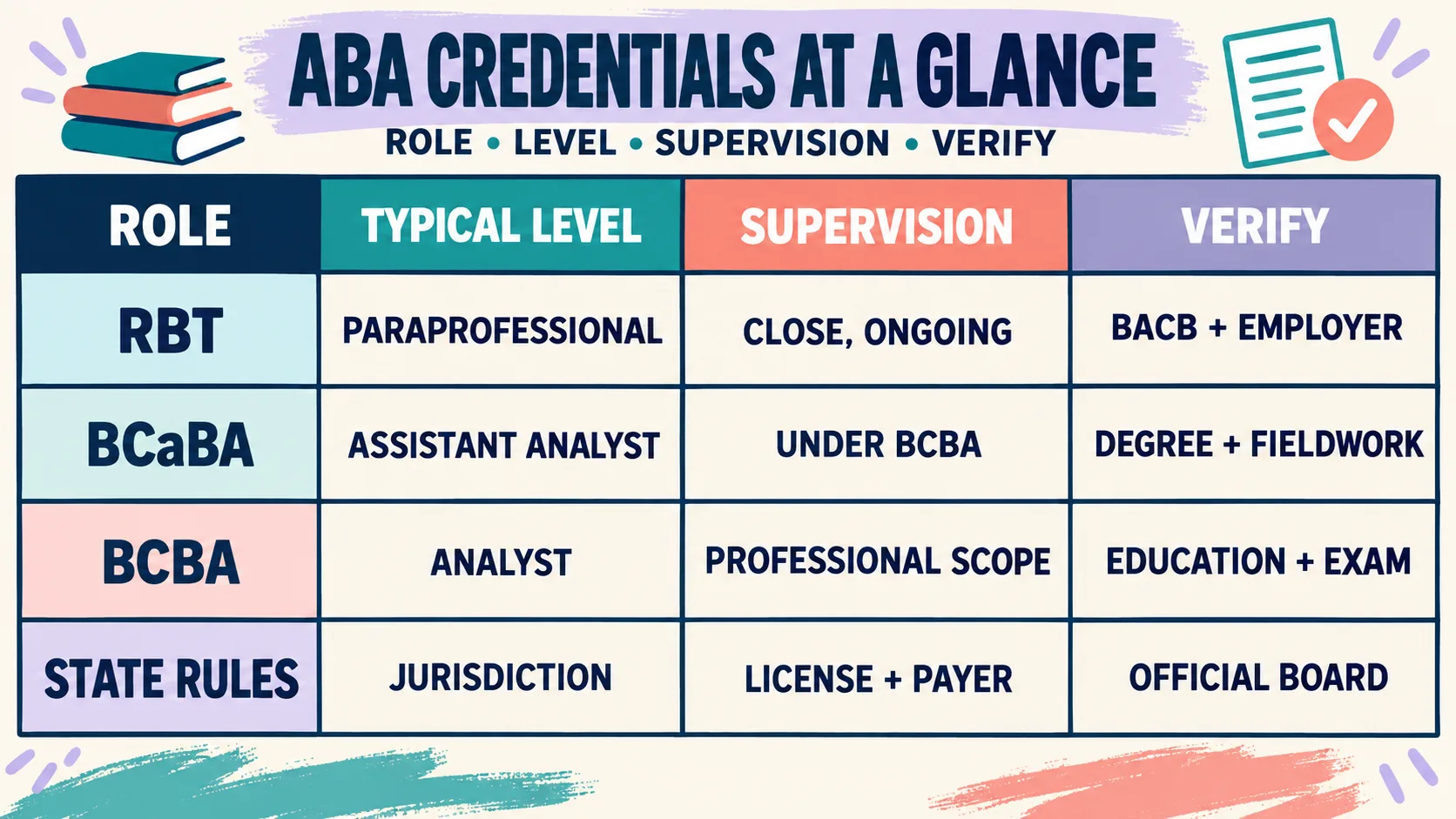
Use the visual as a planning shortcut, then verify every item against the current official source. The useful question is not “Which certificate is fastest?” but “Which role, supervision structure, and legal pathway match the work I intend to do?” For a job or provider, identify who assesses, supervises, delivers direct care, and answers treatment questions.
ABA Therapist Certification Application Checklist
Before you commit to a course or job, complete this short review:
- Name the exact target: RBT, BCaBA, BCBA, state license, or employer-only technician training.
- Read the current official BACB requirements for that target.
- Check the state rules where you will actually work.
- Confirm education, training, assessment, background-check, application, and exam steps.
- Identify the supervisor and how supervision will be delivered and documented.
- Budget for application, examination, renewal, background-check, training, and state fees.
- Record whether the plan is affected by the January 1, 2027 BCBA/BCaBA transition.
- Save official links and the date you last verified each requirement.
ABA Therapist Certification FAQ
Is RBT the same as ABA therapist certification?
No. RBT is a specific BACB paraprofessional certification. “ABA therapist” is a broad job or service phrase that may refer to an RBT, an employer-trained technician, or another professional. Ask what credential and duties the employer means.
Can I become an ABA therapist without a graduate degree?
Some direct-care roles and the RBT pathway do not require the same graduate degree used for BCBA certification, but current eligibility, training, assessment, exam, supervision, employer, and state rules still apply. Not needing a graduate degree does not mean that no credential or supervision is required.
Does the 2027 change apply to every ABA therapist?
No. The announced January 1, 2027 changes concern BCBA and BCaBA certification requirements. They do not create one universal ABA therapist license and do not eliminate the need to check RBT, state, employer, and payer rules separately.
Key Takeaway
ABA therapist certification is a search phrase, not a single credential. Start by naming the role: RBT, BCaBA, BCBA, state-regulated professional, or employer-trained behavior technician. Then verify the current BACB pathway, supervision plan, state rules, payer requirements, and the January 1, 2027 BCBA/BCaBA transition. If you are preparing for the analyst-level concepts behind supervision, measurement, ethics, and treatment planning, reinforce your study with the site’s free BCBA mock exam. For targeted review, use our aba therapist certification practice questions to apply the concept in exam-style scenarios.
Take the Free BCBA Mock Exam
If you want a low-pressure way to check your recall, use the free practice resource below. Take the Free BCBA Mock Exam



