
Quick answer: There is no single answer to “how long does ABA therapy last?” Some families use a focused plan for several months, while others receive broader support for one or more years. The length depends on the learner’s goals, baseline skills, response to teaching, generalization across settings, caregiver priorities, service intensity, staffing, authorization rules, and whether the plan is still producing meaningful benefit. A one-to-three-year range sometimes appears in provider education, but it is a planning frame—not a promise, prescription, or graduation date.
Table of Contents
- What Does “How Long” Mean in ABA Therapy?
- How Can You Think About ABA Therapy in Phases?
- What Factors Change How Long ABA Therapy Lasts?
- How Should a BCBA Review Progress Before Changing the Timeline?
- When Might ABA Therapy Hours Be Reduced?
- What Does Transition or Discharge Planning Include?
- How Can Insurance or Authorization Affect the Timeline?
- What Should Families Ask About the ABA Timeline?
- What Ethical Boundaries Matter When Discussing Duration?
- How Long Does ABA Therapy Last? FAQ
- Key Takeaway
- Take the Free BCBA Mock Exam
It helps to separate four timelines: how long an individual session lasts, how many hours are scheduled each week, how long an authorization period lasts, and how long the overall service relationship continues. A BCBA should review data and goals regularly, communicate what is changing, and plan a safe reduction or transition when the current level of support is no longer the best fit. This article is educational and cannot determine an individual treatment schedule.
What Does “How Long” Mean in ABA Therapy?
Families often use “duration” to mean the total number of months or years. The clinical team may be talking about a different unit: a two-hour session, a weekly schedule, an authorization window, a treatment phase, or the time needed for one goal. Clarifying the unit prevents an hours-per-week recommendation from being mistaken for a promise about the total course of care. Ask which of these questions you actually need answered:
- Session length: How long is each visit, and what happens during that time?
- Weekly intensity: How many hours are planned across home, clinic, school, telehealth, or community settings?
- Authorization period: For how many dates, units, or hours has the payer approved care before another review?
- Goal timeline: What will the team review after a defined teaching period?
- Total service duration: What evidence will support continuing, reducing, pausing, or transitioning services?
A clear answer names the decision point and the evidence that will be reviewed. “Your child needs two years” is much less useful than “we will review these goals, graphs, generalization probes, and family priorities at the next planned review, then decide whether the current level of support remains appropriate.”
How Can You Think About ABA Therapy in Phases?
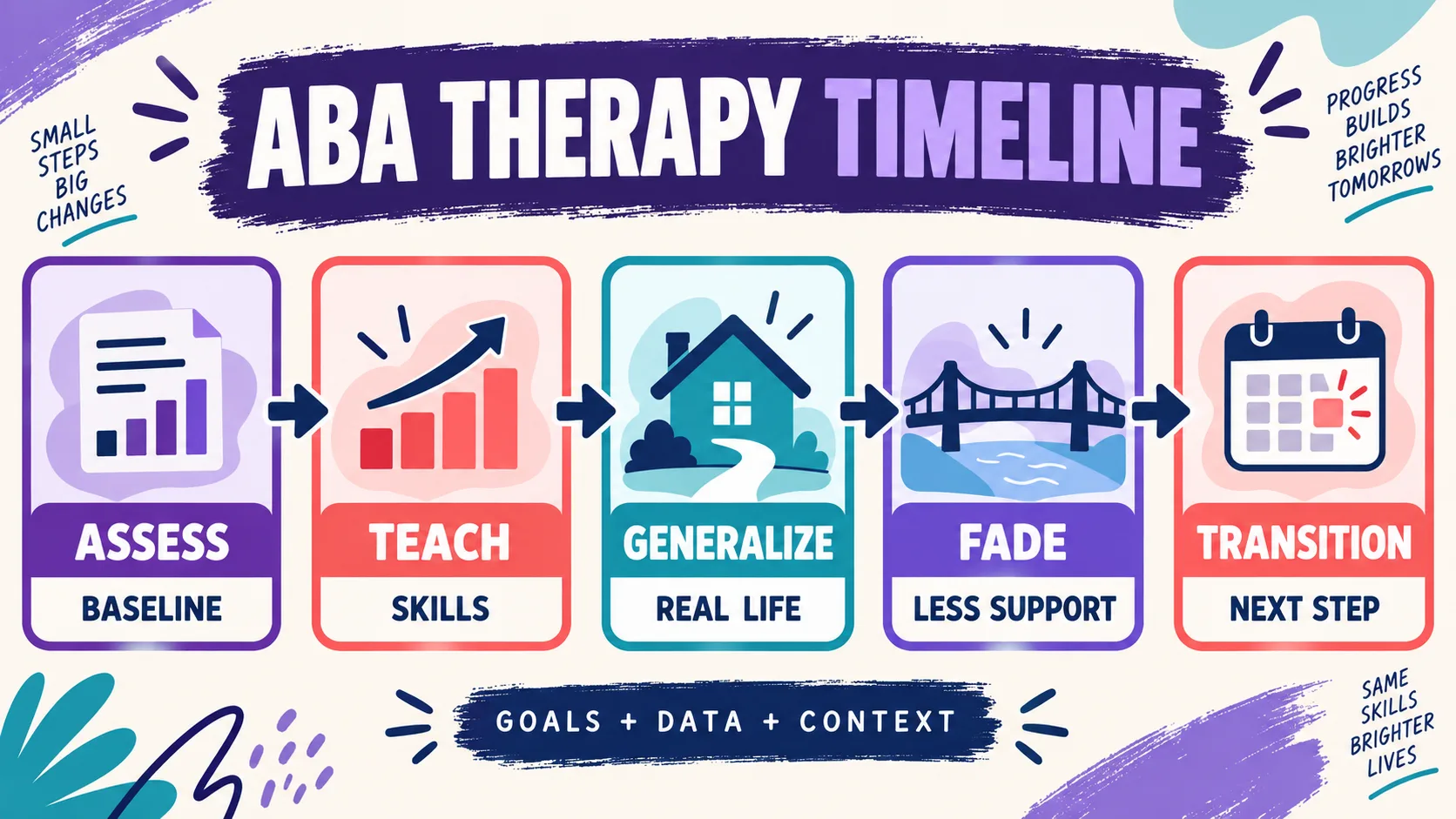
A phase model gives families a more realistic picture than a fixed countdown. The phases can overlap, repeat, or move at different speeds for different goals. They also do not imply that every learner needs the same intensity or sequence.
| Phase | Main question | Evidence to review | Possible next decision |
|---|---|---|---|
| Assessment and setup | What goals are meaningful and measurable? | Baseline information, interviews, observation, priorities, and context | Write or refine the individualized plan |
| Initial teaching | Is the learner acquiring the target skill or replacement behavior? | Direct measures, treatment integrity, prompt levels, and learner assent or participation | Continue, adjust, or test a better-supported approach |
| Generalization | Does the skill occur with people, materials, and settings that matter? | Probes across settings, communication partners, and natural routines | Add practice, vary examples, or begin fading selected supports |
| Maintenance and fading | Can progress remain stable with less structured help? | Durability, independence, caregiver implementation, and response to planned changes | Reduce intensity, change the service mix, or continue targeted support |
| Transition or discharge | What support is appropriate next? | Goal status, safety, family priorities, natural supports, and continuity plan | Transfer, pause, discharge, or create a maintenance check-in plan |
This structure also explains why two children of the same age may have different timelines. One may be working on a narrow set of goals and move to maintenance quickly. Another may need a longer period to build communication, adaptive, or safety skills across several environments. The timeline should follow the goals and evidence, not a marketing package or a comparison with another family.
What Factors Change How Long ABA Therapy Lasts?
The first factor is the goal set. A focused plan for one routine may be different from a comprehensive plan addressing communication, independence, social participation, learning readiness, and behavior reduction. “More goals” does not automatically mean “more hours,” and “more hours” does not automatically mean faster progress. The BCBA should explain why the proposed service level matches the assessment and the family’s priorities.
Baseline skills and learning conditions matter as well. The team may need to establish communication, tolerating changes, attending, imitation, or functional alternatives before a later goal can be taught efficiently. Health, sleep, access to reinforcement, sensory or environmental conditions, transportation, school schedules, and the learner’s willingness to participate can change the pace of teaching without reflecting a lack of effort.
Generalization is another major variable. A skill that appears only with one therapist, one set of materials, or one clinic room is not yet the same as a skill used independently at home, school, or in the community. Time spent coaching caregivers, teachers, or other communication partners may be essential to making progress useful in daily life.
Continuity also affects the timeline. Staff turnover, missed sessions, authorization gaps, limited provider availability, and changes in family routines can interrupt learning opportunities. These are service-delivery conditions to discuss openly, not reasons to blame the learner or guarantee a new end date.
How Should a BCBA Review Progress Before Changing the Timeline?
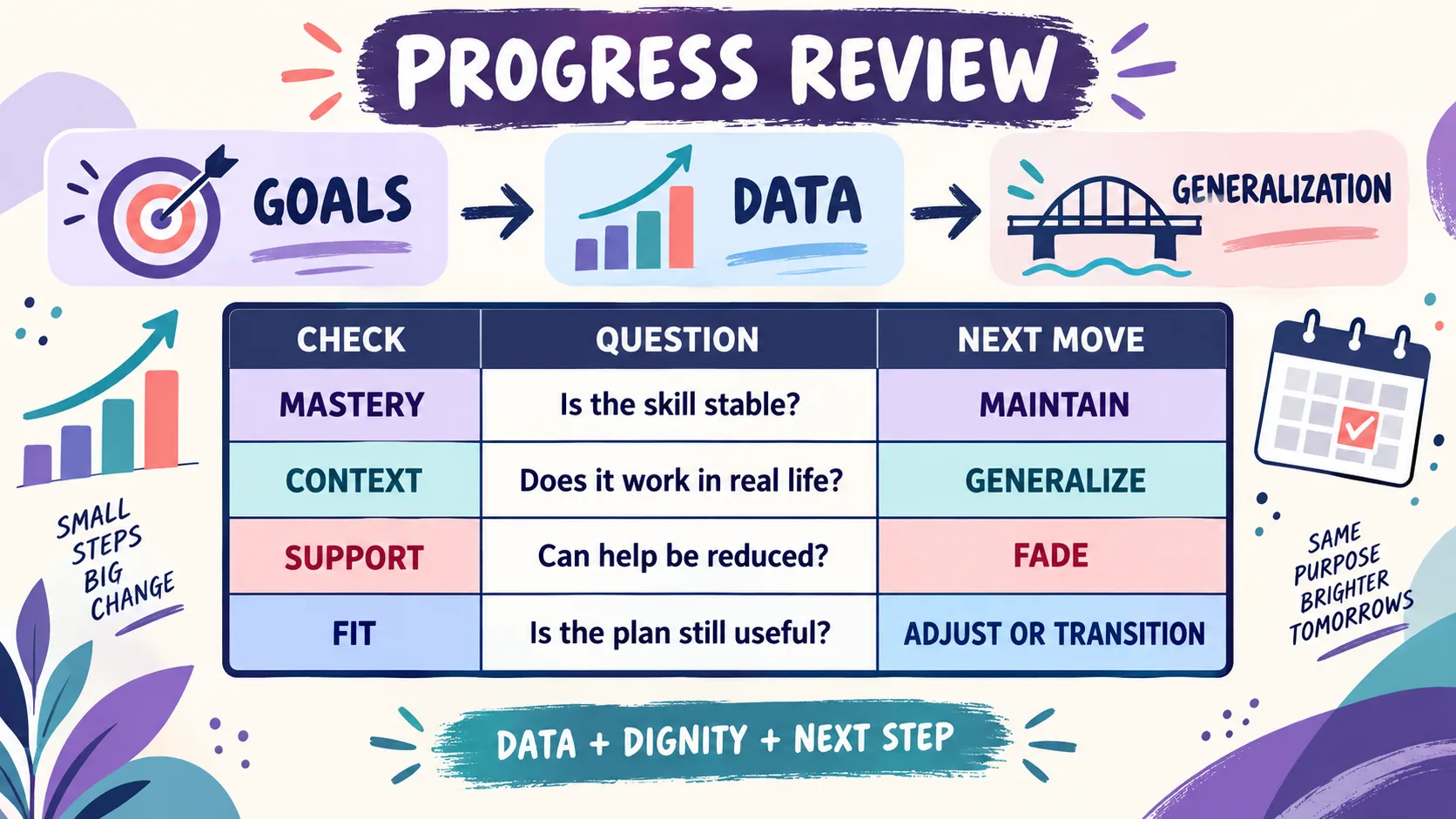
A duration decision should be connected to observable data and meaningful outcomes. A BCBA may examine level, trend, variability, rate of acquisition, prompt dependence, treatment integrity, generalization, maintenance, and the social validity of the goals. The exact measures depend on the plan. The key question is whether the current service arrangement is helping the learner participate more effectively in the contexts that matter to the learner and family. Ask the team to explain what the graph or progress report means in ordinary language. Useful questions include:
- Which goals are increasing, stable, or not yet improving?
- Are the data complete enough to support a decision?
- Is the learner using the skill with new people, materials, and settings?
- Are prompts being faded, or is the learner becoming dependent on a particular cue?
- Has the family’s priority changed since the plan was written?
- What will be tested before adding hours, reducing hours, or changing the procedure?
A review should also consider assent, dignity, safety, burden, and the fit of the goals. Continuing a service simply because it has always been scheduled is not the same as demonstrating current benefit. Conversely, a short plateau does not automatically mean that services should stop. The team should investigate measurement, treatment integrity, context, motivation, and the procedure before making a high-impact change.
When Might ABA Therapy Hours Be Reduced?
Hours may be reduced when a learner can meet meaningful goals with less structured support, when selected skills remain stable during planned probes, or when a different service mix better matches current needs. A reduction should be planned and monitored rather than treated as a sudden disappearance of support.
Fading can involve fewer direct hours, longer intervals between visits, more caregiver or teacher coaching, a shift from clinic to natural environments, narrower goals, or periodic maintenance checks. The plan should state what will be monitored and what would trigger a review. If a skill deteriorates after a change, the team can examine the data and determine whether the change should be adjusted.
Do not compare “hours” without comparing the service model. Two programs may use the same weekly number but differ in direct teaching, caregiver training, supervision, school coordination, and documentation. Ask what the hours include and how they connect to the goals.
What Does Transition or Discharge Planning Include?
Transition planning starts before the final visit. The current BACB continuity-of-services toolkit discusses interruption, transition, and discontinuation considerations. It is a professional resource, not a fixed treatment-duration schedule. A responsible plan identifies what happens to current goals, data, materials, caregiver strategies, referrals, and responsibility for follow-up. Possible transition questions include:
- Which skills are maintained independently, and which still need occasional support?
- Who will respond if a safety concern or significant regression appears?
- What information can be transferred, with consent, to the next provider or school team?
- Will the family receive a maintenance plan, written recommendations, or community referrals?
- Is the change caused by progress, a change in need, lack of benefit, funding, staffing, relocation, or another factor?
Discharge is not a judgment about a person’s worth or a claim that no future support will ever be needed. It is a change in the professional service arrangement. The plan should avoid abandonment, explain the reason for the transition, and give the family a reasonable path to continuity when another resource is appropriate.
How Can Insurance or Authorization Affect the Timeline?
Insurance approval and clinical duration are related but not identical. A payer may authorize a defined number of dates or units and require progress documentation before extending care. An authorization end date is an administrative checkpoint, not proof that a learner is ready to stop. Likewise, a clinical recommendation is not a guarantee that a plan will approve every requested hour.
Ask the provider or plan what must be submitted before the next review, when the packet is due, who tracks the deadline, and what happens if the review is delayed. Keep the authorization period separate from the overall treatment plan. The site’s ABA service-initiation guide addresses getting started, while the ABA cost guide addresses financial planning; neither can determine an individual duration or payer decision.
For broader plan-verification questions, keep benefit, network, authorization, and cost answers in a written record. If a claim or authorization is denied, request the written reason and follow the applicable reconsideration or appeal process. Do not change clinical information merely to fit a payer rule.
What Should Families Ask About the ABA Timeline?
At intake, ask what the first review will examine and how the team will share data. During services, ask which goals are improving, how skills are being generalized, and what changes are being considered. When the plan shifts, ask what will be monitored and who owns the follow-up. These questions make “how long does ABA therapy last?” an ongoing conversation instead of a one-time estimate.
A good answer should be specific without pretending to know the future. It might identify the current goals, review cadence, planned measures, staffing assumptions, and possible transition signals. It should also invite the learner and family to share priorities, concerns, cultural context, and preferences about the service model.
What Ethical Boundaries Matter When Discussing Duration?
The current BACB ethics codes provide professional context for competence, individualized services, communication, confidentiality, and appropriate transitions. A BCBA should not guarantee that therapy will last a particular number of years, promise a specific outcome, or continue a program solely because a payer or employer expects a certain volume of hours.
Families should receive plain-language explanations of what is known, what is being measured, what is uncertain, and what decision comes next. Respectful care also means that progress is not defined only by compliance or the disappearance of harmless differences. Goals should connect to communication, autonomy, safety, participation, and the priorities of the learner and stakeholders.
How Long Does ABA Therapy Last? FAQ
Is one to three years a guaranteed ABA therapy timeline?: No. That range appears in some provider education, but it is not a universal rule. Some focused plans are shorter, some broader plans continue longer, and the timeline can change as goals, settings, resources, and progress change.
Does more ABA therapy always mean faster progress?: No. The appropriate service level depends on the learner, goals, context, quality of implementation, caregiver participation, and data. More hours can create more learning opportunities for some plans, but hours alone do not guarantee a particular outcome.
How often should an ABA plan be reviewed?: The review schedule depends on the treatment plan, clinical needs, service setting, and payer requirements. Ask the BCBA what data will be reviewed, how often the family will receive an update, and what events would prompt an earlier review.
When is a child ready to stop ABA therapy?: There is no single age or score that answers this question. A transition decision should consider meaningful goal progress, generalization, maintenance, independence, safety, family priorities, natural supports, and an appropriate continuity plan. It should be discussed with the treating team and documented rather than based on a generic internet timeline.
Key Takeaway
ABA therapy may last months, years, or move through changing levels of support; the right timeline is individualized and evidence-informed. Separate session length, weekly intensity, authorization periods, and total service duration. Review progress, generalization, maintenance, family priorities, and transition options before deciding whether to continue, change, fade, or discharge services. If you are preparing for BCBA exam questions about data-based decisions, ethics, and supervision, reinforce those skills with the site’s free BCBA mock exam. For targeted review, use our how long does ABA therapy last practice questions to apply the concept in exam-style scenarios.
Take the Free BCBA Mock Exam
If you want a low-pressure way to check your recall, use the free practice resource below. Take the Free BCBA Mock Exam



