

Quick answer: ABA health insurance is not one universal benefit with one national set of rules. Whether a plan pays for applied behavior analysis depends on the member’s plan documents, state or program requirements, network status, clinical criteria, prior authorization process, and cost-sharing terms. Before scheduling a full treatment plan, verify each item with the insurer or plan administrator, ask the provider what they can submit, and record the representative’s name, reference number, and next step.
Table of Contents
- What Does ABA Health Insurance Coverage Actually Mean?
- What Should You Verify Before Calling Your Insurer?
- How Do You Check Network and Credential Requirements?
- What Does Prior Authorization Usually Involve?
- How Do You Estimate Your Out-of-Pocket Cost?
- How Do You Track an Insurance Call?
- What Should You Do If an Authorization or Claim Is Denied?
- How Should Families Compare Provider Answers?
- What Ethical Boundaries Matter When Discussing ABA Insurance?
- ABA Health Insurance FAQ
- Key Takeaway
- Quick Review Checklist
- Take the Free BCBA Mock Exam
Use this guide as a verification framework, not as a promise that a particular service will be covered. Medicaid and CHIP autism-service details can vary by state and program. Marketplace information can explain broad mental-health coverage context, but it does not replace the member’s Evidence of Coverage or a written plan determination. The official Medicaid autism-services resource and HealthCare.gov mental-health coverage page are useful starting points, followed by a plan-specific call.
What Does ABA Health Insurance Coverage Actually Mean?
When someone asks whether health insurance covers ABA, they may be asking several different questions at once. A plan may list autism treatment or behavioral-health services as a benefit, yet still require an in-network provider, a diagnosis or assessment, medical-necessity documentation, prior authorization, a treatment plan, utilization review, or periodic reauthorization. A benefit description answers only part of the question. Separate these terms before you call:
- Benefit: whether the plan includes a relevant service category or coverage pathway.
- Eligibility: whether the member is active and the particular benefit applies to this person, setting, age range, and diagnosis.
- Network: whether the provider and the professionals delivering care are contracted under the right plan and location.
- Authorization: whether the plan requires approval before an assessment, treatment episode, number of hours, or continued care.
- Cost sharing: the deductible, copayment, coinsurance, out-of-pocket maximum, and any limits that may affect what the family pays.
A phone representative may confirm that a service category exists without confirming that a specific request will be approved. Ask what is verified, what remains subject to clinical review, and how the plan will communicate a final decision.
What Should You Verify Before Calling Your Insurer?
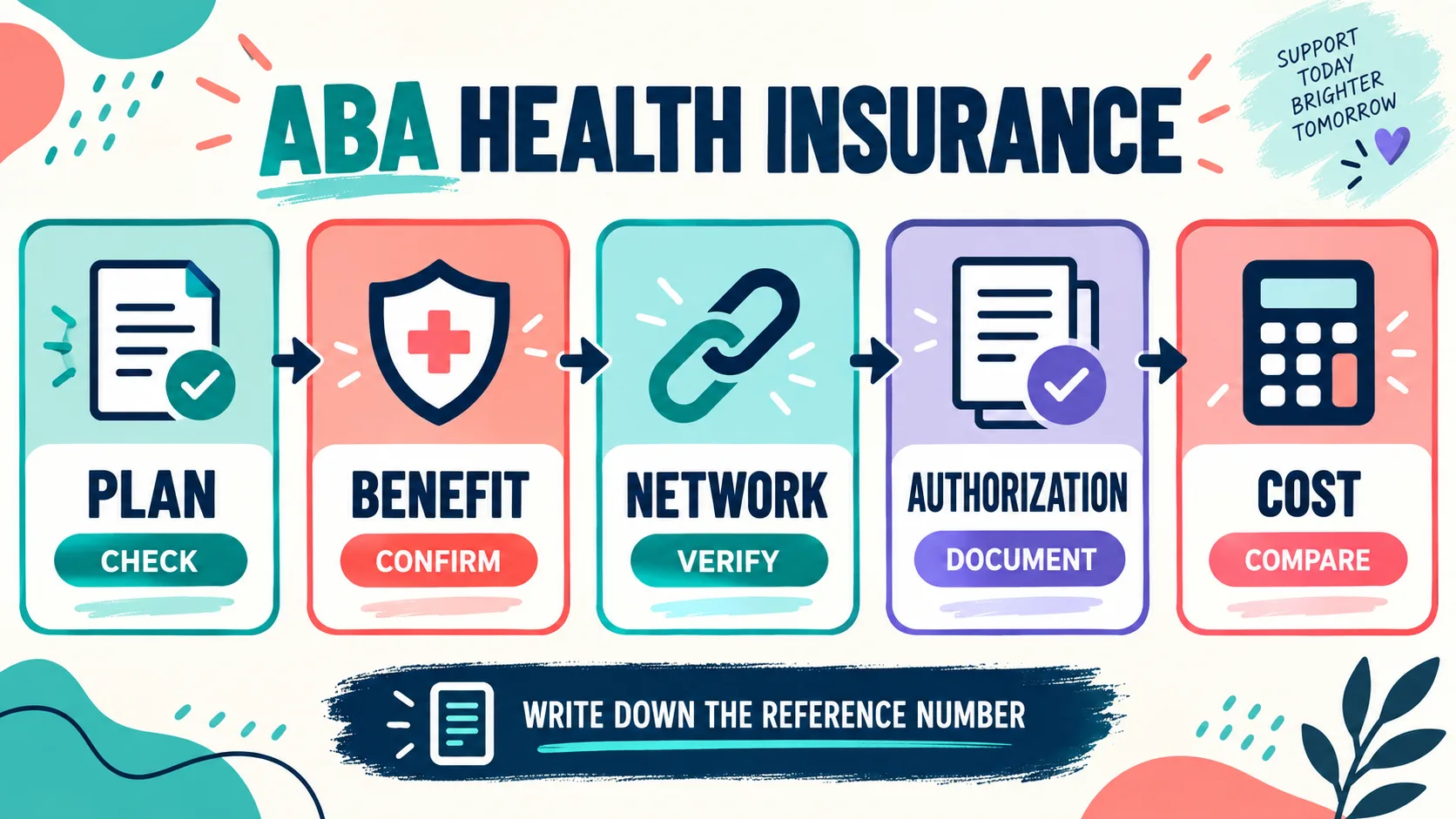
Collect the information needed to make the call specific. Have the member ID, group number, date of birth, plan name, employer or state-program information, provider name, provider NPI if available, service location, and the proposed service type in front of you. If the question concerns an assessment, ongoing treatment, caregiver training, telehealth, or school collaboration, say so. “ABA” may be routed differently depending on the service being requested. Ask the plan to explain its current process for the following items:
- Does the plan list ABA, behavior treatment, autism services, or another relevant category?
- Does the member’s exact plan include that benefit, and are there exclusions or visit, hour, age, setting, or diagnosis limits?
- Is the proposed provider in network for this plan, location, and service type?
- Does the plan require a referral, assessment, prior authorization, single-case agreement, or designated care manager?
- Which documents must the provider submit, and where should they be sent?
- What deductible, copayment, coinsurance, and out-of-pocket rules apply?
- How long does a review usually take, and what reference number identifies the call?
Do not treat a general benefits answer as a guarantee of payment. Ask for the relevant section of the plan document or a written explanation, and confirm whether the answer is based on the member’s actual plan rather than a generic product description.
How Do You Check Network and Credential Requirements?
Network verification has more than one layer. A clinic may appear in a public directory while a particular BCBA, assistant, technician, location, or service code is not loaded the same way. Ask the insurer to verify the provider’s legal name, NPI, tax identification or group affiliation when appropriate, service address, and the exact plan network. Then ask the provider to confirm the same details from its credentialing or billing team.
Credential requirements can also affect the path to authorization. The plan may ask for a licensed or certified professional, a supervising clinician, an assessment signed by a particular type of provider, or a treatment plan that uses specified codes. These requirements can change by payer and state. A BCBA credential does not by itself override a plan rule, state license requirement, or provider-enrollment condition.
If no suitable in-network provider is available, ask whether the plan has a gap exception, single-case agreement, continuity-of-care process, or another out-of-network pathway. Do not assume an exception will be approved. Ask which department decides, what evidence is needed, and whether approval must be obtained before services begin.
What Does Prior Authorization Usually Involve?
Prior authorization is a utilization-review process, not a guarantee that treatment is appropriate or payable. The plan may request an assessment, diagnosis information, baseline data, treatment goals, proposed frequency, caregiver participation, risk information, progress data, and a plan for reviewing outcomes. The exact packet, forms, codes, and submission channel belong to the payer or program. Ask the provider who is responsible for each part of the submission. A useful intake handoff identifies:
- who checks eligibility and network status;
- who completes the clinical assessment and treatment recommendation;
- who submits the authorization request and confirms receipt;
- who responds to requests for additional information; and
- who tracks the approved dates, units, codes, expiration date, and reauthorization deadline.
Ask for a confirmation that the request was received. If the plan says a service is “covered after authorization,” ask whether that phrase means the benefit is available subject to clinical review, whether payment is subject to the member’s cost sharing, and what happens if the request is reduced or denied. Keep copies of the submitted packet and the final decision.
How Do You Estimate Your Out-of-Pocket Cost?
Cost estimates should be treated as planning numbers until the plan processes a claim. Start with the plan year and the member’s current deductible and out-of-pocket totals. Then ask whether ABA is processed under medical, behavioral-health, autism-specific, or another benefit category; whether the provider is in network; whether different services have different cost sharing; and whether the plan applies visit, hour, or annual limits.
The site’s ABA services cost guide can help organize general price questions, but it cannot calculate a family’s plan-specific responsibility. Ask the insurer for a written benefits explanation and ask the provider how its billed codes, units, cancellation rules, and non-covered services fit the estimate. Keep the estimate separate from a final claim response.
For each number, record whether it is a deductible amount, copayment, coinsurance percentage, allowed amount, provider charge, or out-of-pocket maximum contribution. A phrase such as “covered at 80%” is incomplete unless you know 80% of what amount, after which deductible, under which network, and subject to which authorization.
How Do You Track an Insurance Call?
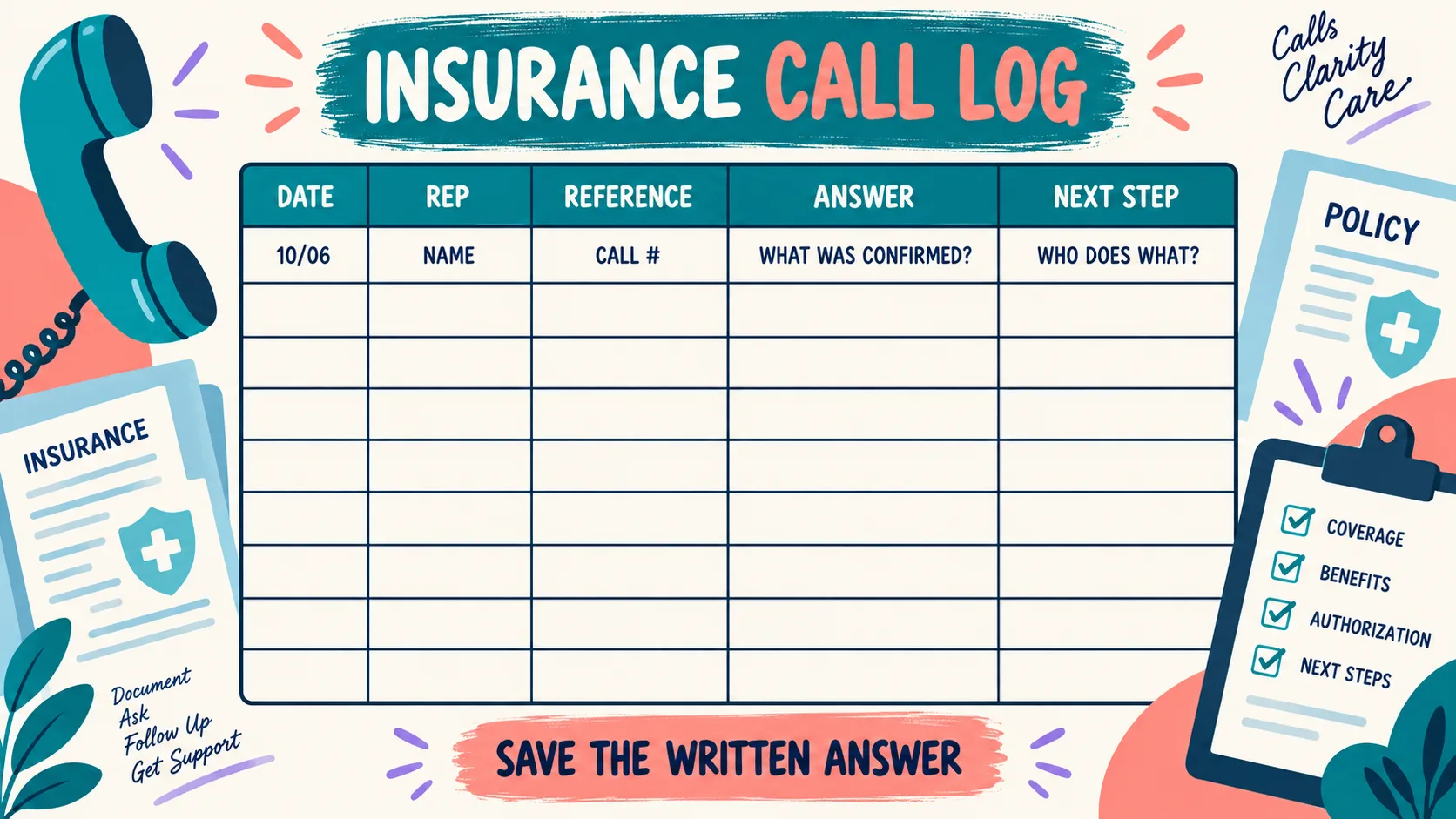
A written call log prevents a family or intake team from having to reconstruct a complicated conversation. Record the date and time, department, representative, reference number, exact question, answer, documents requested, and next action. If the representative cannot answer, ask which department can and whether the transfer keeps the same reference number.
| Field | What to record | Why it matters |
|---|---|---|
| Plan and member | Plan name, member ID, group, and effective date | Shows which coverage was checked |
| Network | Provider, NPI or group, location, and network answer | Prevents a directory listing from being treated as confirmation |
| Authorization | Required forms, submission route, dates, units, and reference number | Creates a trail for follow-up and reauthorization |
| Cost | Deductible, copay, coinsurance, limits, and allowed-amount explanation | Makes an estimate interpretable |
| Next step | Owner, deadline, documents, and the next call or portal task | Turns the conversation into an action plan |
Use secure storage for member information. Share only the minimum necessary details with the people who need them, and follow the plan’s portal, fax, or secure-mail instructions. A call log is useful operational documentation; it is not a substitute for the insurer’s formal notice.
What Should You Do If an Authorization or Claim Is Denied?
First, identify what was denied and why. “Not covered” could mean the benefit is excluded, the provider is out of network, the documentation was incomplete, the request did not meet the plan’s stated criteria, authorization was missing, or the claim was submitted under a different code or date. Ask for the written explanation, the appeal or reconsideration deadline, and the address or portal for the next step.
Compare the notice with the submitted request and plan documents. Ask the provider whether it can correct a billing or documentation error and ask the insurer whether a peer review, reconsideration, appeal, gap exception, or continuity-of-care process applies. Medicaid, CHIP, Marketplace, employer, and individual plans can have different procedures. When a state regulator, ombudsman, or member advocate is relevant, use the official contact information for the applicable plan and jurisdiction.
Do not backdate services, change clinical information to fit a payer rule, or tell a family that an appeal will succeed. The goal is an accurate record and a timely, plan-appropriate response. If the issue involves immediate safety or an interruption of necessary care, contact the treating team and the appropriate plan or public-program channel promptly.
How Should Families Compare Provider Answers?
Ask each provider the same practical questions: Which plans and products do you currently accept? Who checks benefits? Who submits prior authorization? Which documents will you need from the family? What happens if the plan reduces hours or denies a request? How will the team communicate deadlines, missing documents, and changes in authorization? A provider cannot promise that the payer will approve a request, but it should be able to explain its process.
Compare the specificity of the answers, not just the provider’s list of logos. A good answer distinguishes eligibility from approval, explains who owns follow-up, and tells you what the family must do. If a provider says “insurance covers everything” without asking for the plan name, member information, location, or service details, treat that as a reason to ask more questions.
What Ethical Boundaries Matter When Discussing ABA Insurance?
Insurance communication should be accurate, respectful, and limited to what the speaker can verify. The current BACB ethics codes provide professional context for competence, confidentiality, communication, and protecting clients and stakeholders. A BCBA can explain the clinical information being requested and coordinate with a payer, but should not guarantee coverage, misrepresent a diagnosis, or let billing pressure determine clinical recommendations.
Families also deserve language that respects their priorities. Explain what is known, what is pending, who makes the decision, and what alternatives or follow-up paths exist. Avoid framing an insurance limit as a measure of a person’s worth or progress. Clear documentation protects the family, the provider, and the clinical integrity of the service.
ABA Health Insurance FAQ
Does every health insurance plan cover ABA?: No. Coverage depends on the actual plan, applicable state or program rules, network, eligibility, clinical criteria, and authorization requirements. Even when a plan lists an autism or behavioral-health benefit, the specific service request may still require review.
What should I ask the insurance company first?: Ask whether the member’s exact plan includes a relevant ABA or autism-service benefit, whether the proposed provider is in network, whether prior authorization is required, which documents are needed, and how cost sharing is calculated. Ask for a reference number and written confirmation whenever possible.
Can a provider verify ABA benefits for me?: Many providers can help verify benefits and prepare an authorization packet, but the family should understand what was checked and retain the plan’s response. Provider verification is useful coordination; it is not a guarantee of payment or a replacement for the member’s formal plan notice.
What if the insurer and provider give different answers?: Record both answers, ask each party to identify the plan document, code, network record, or authorization rule they relied on, and request a written clarification. Ask who owns the next step. If a deadline or interruption is involved, escalate through the plan’s official member or appeals channel instead of relying on an informal verbal promise.
Key Takeaway
ABA health insurance research is most useful when it ends with a documented plan-specific answer: benefit, eligibility, network, authorization, cost, deadline, and next action. Verify current rules through the applicable plan and official program sources, keep a secure call log, and avoid promising that a service will be approved. If you are preparing for BCBA exam questions about ethics, supervision, documentation, and data-based decisions, reinforce those skills with the site’s free BCBA mock exam. For targeted review, use our aba health insurance practice questions to apply the concept in exam-style scenarios.
Quick Review Checklist
Use this final checklist to turn aba health insurance into exam-ready reasoning. The goal is not to memorize a label in isolation; it is to identify the relevant evidence and explain why the best answer fits the scenario. Key ideas to review:
- State the central definition or decision point for aba health insurance in your own words.
- Identify the detail that makes aba health insurance different from its closest related ABA term.
- Separate the observable facts in a scenario from assumptions that are not supported by the facts.
- Write one example and one nonexample so you can recognize the concept in a new setting.
Exam application checks:
- Ask what the question is actually requesting before comparing the answer choices.
- Mark the antecedent, response, consequence, or other evidence that supports the selected answer.
- Look for a distractor that describes a related process but does not answer the specific question.
Final self-check:
- Explain how you would verify the interpretation with clear observations or data.
- Change one detail in the scenario and decide whether your answer should change.
- Give a one-sentence rationale that a supervisor or study partner could evaluate.
Take the Free BCBA Mock Exam
If you want a low-pressure way to check your recall, use the free practice resource below. Take the Free BCBA Mock Exam



