
Quick answer: Virtual ABA therapy uses secure remote communication to deliver some or all parts of an individualized behavior-analytic service. Depending on the program, a BCBA may provide caregiver coaching, assessment, consultation, treatment-plan review, supervision, or direct child-facing work through video. Virtual care can improve access and help skills transfer into home routines, but it is not automatically the right format for every goal or every learner. Clinical fit, caregiver availability, privacy, state and payer rules, technology, and the plan’s actual service model all matter.
Table of Contents
- What Is Virtual ABA Therapy?
- How Does a Virtual ABA Session Work?
- Who May Benefit From Virtual ABA Therapy?
- How Does Virtual ABA Compare With In-Person and Hybrid Care?
- What Technology and Privacy Checks Matter?
- What Should You Verify Before Starting Virtual ABA?
- What Questions Should You Ask a Virtual ABA Provider?
- What Ethical Boundaries Matter in Virtual ABA?
- Virtual ABA Therapy FAQ
- Key Takeaway
- Take the Free BCBA Mock Exam
Do not evaluate a program only by its words “online ABA.” Ask what happens on screen, who is physically with the learner, how data are collected, what the BCBA observes directly, and when the team uses in-person or hybrid support. A virtual appointment can be meaningful clinical care; it can also be a poor fit if the format prevents safe observation, active participation, or useful generalization.
What Is Virtual ABA Therapy?
Virtual ABA therapy is a remote service format in which a behavior analyst and family or implementation team communicate through video or another approved telehealth channel. The exact model varies. In one program, the caregiver may practice a daily routine while the BCBA coaches in real time. In another, the BCBA may review data, train a local implementer, observe a session, or adjust a treatment plan. Some providers also offer direct child-facing sessions, while others use virtual care mainly for consultation and parent training. That distinction matters because “virtual” describes how people connect, not what clinical work is automatically included. Ask whether the program provides:
- assessment or reassessment;
- caregiver training and coaching;
- direct teaching with the learner;
- BCBA supervision or case consultation;
- data review and treatment-plan changes;
- coordination with school or other providers; and
- in-person visits when a goal or safety concern requires them.
A provider should be able to explain which professional is responsible for clinical decisions and which adult is expected to implement the plan between sessions. Virtual ABA is not simply putting a child in front of a screen and hoping that progress occurs.
How Does a Virtual ABA Session Work?
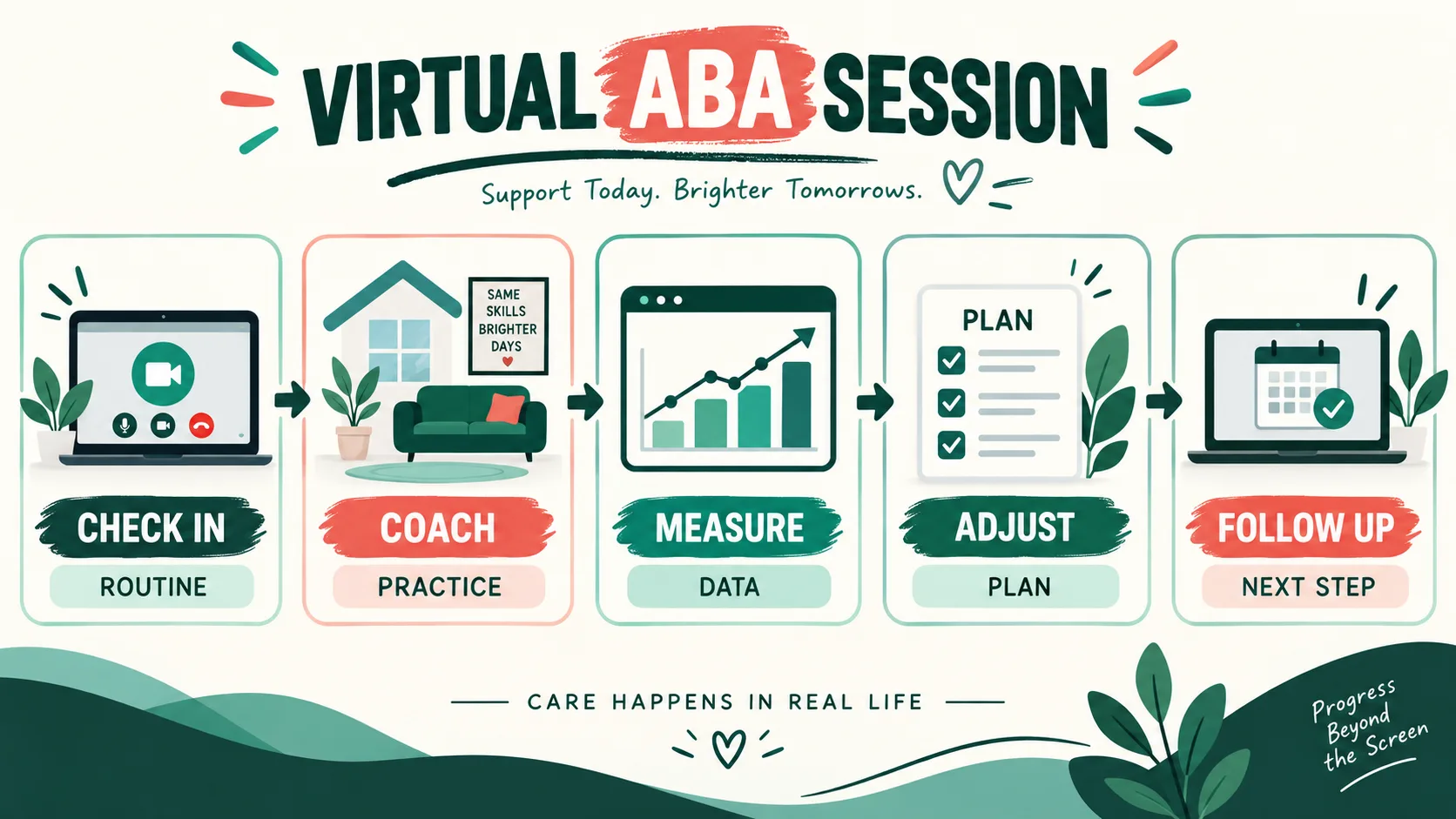
A well-designed session usually begins with a brief check-in: what happened since the last visit, which target matters today, and whether any health, safety, schedule, or technology issue affects participation. The BCBA then observes or coaches an activity connected to the treatment plan. The activity might be requesting, following a routine, practicing communication, tolerating a transition, completing a daily-living step, or helping a caregiver arrange useful practice opportunities.
The adult at home is often an active participant. The BCBA may model a strategy, have the caregiver try it, provide feedback, and discuss how to use it in another routine. Data can include direct counts, duration, latency, task-analysis steps, caregiver implementation measures, or structured notes, depending on the goal. The team should state what is recorded, who records it, and how the data affect the next decision.
Before the session ends, clarify the next practice step and the conditions for asking for help. If the family is expected to implement a procedure between visits, the instruction should be observable and realistic. A plan that sounds clear to a clinician but cannot be used during breakfast, homework, bedtime, or a community routine needs revision.
Who May Benefit From Virtual ABA Therapy?
Virtual ABA may be worth considering when the family wants coaching in the setting where a skill naturally occurs, when travel or waitlists limit access, when a qualified BCBA is not nearby, or when the primary need is consultation and caregiver training. It can also be useful for a hybrid plan in which remote BCBA oversight is combined with in-person implementation. Potential fit is not determined by diagnosis alone. Consider:
- Can a caregiver or another trained adult participate reliably?
- Can the learner engage with the activity and the communication method for the needed period?
- Is there a reasonably private, safe, and workable space?
- Can the team observe the behavior and context that matter, rather than only a narrow camera view?
- Does the remote format match the goal, or does the goal require physical materials, movement, in-person prompting, or direct safety support?
- Will the plan include generalization across people, rooms, routines, and community settings?
A learner may need more in-person support when immediate physical safety is central, when the caregiver cannot be present, when the service requires hands-on prompting that cannot be modeled safely over video, or when the remote view cannot capture the relevant environment. Those are clinical-fit questions for the treating team, not a judgment about the family’s commitment.
How Does Virtual ABA Compare With In-Person and Hybrid Care?
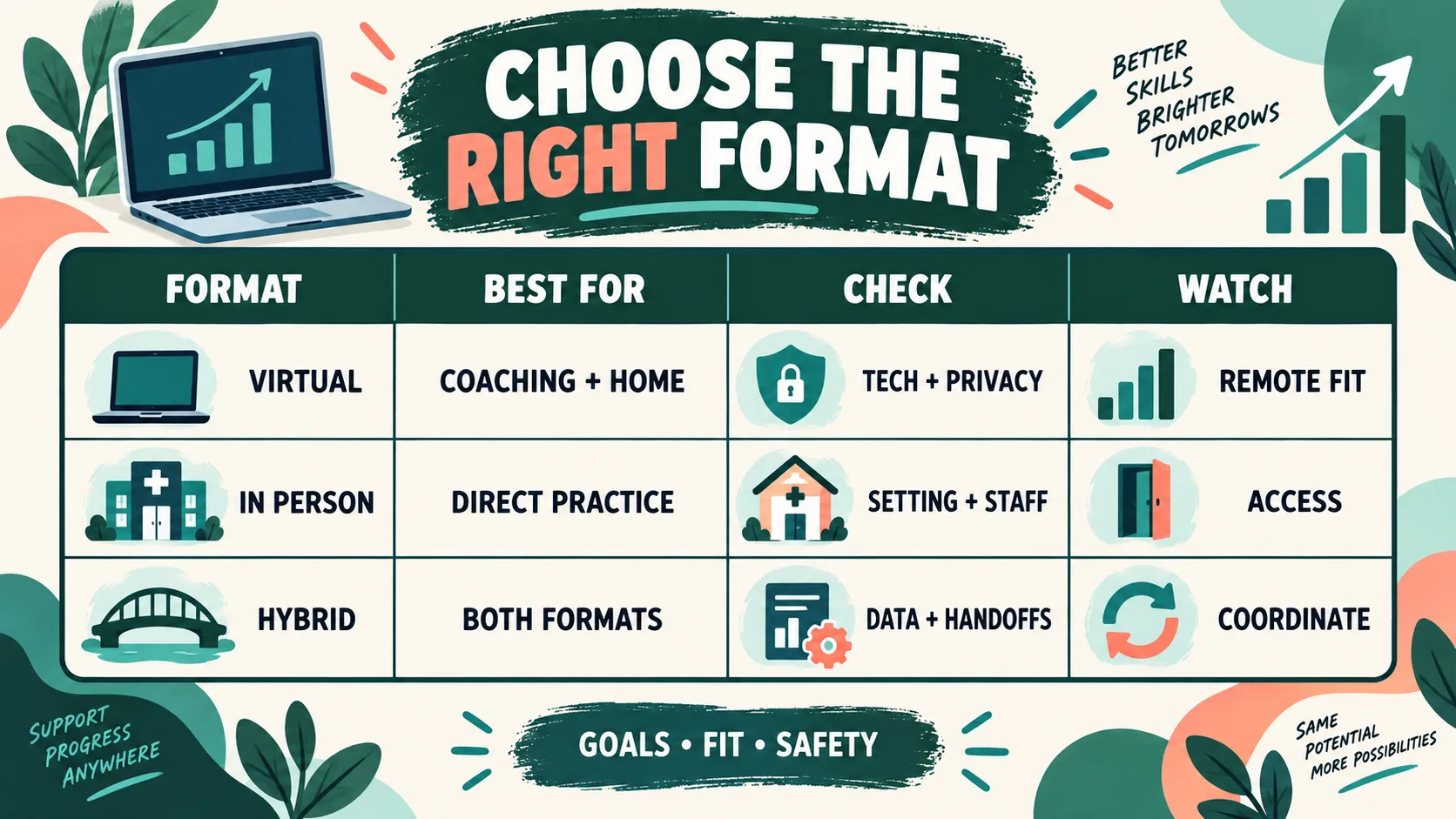
There is no single “best” format for all goals. Compare the service model, not just the label. A virtual program may be excellent for caregiver coaching but not provide the direct in-person teaching a learner needs for a particular skill. An in-person clinic may offer materials and staff access but give the family less practice in daily routines. A hybrid plan can combine strengths while adding scheduling and coordination work.
| Format | Often useful for | Questions to verify | Possible limitation |
|---|---|---|---|
| Virtual | Caregiver coaching, consultation, home routines, and remote oversight | Who participates, how data are collected, and what the BCBA can observe | Requires reliable technology, privacy, and an available implementer |
| In person | Direct teaching, environmental assessment, and goals needing physical materials or proximity | Setting, staff continuity, travel, caregiver training, and supervision | Travel, waitlists, staffing, or unfamiliar settings may reduce access |
| Hybrid | Combining direct practice with remote coaching and plan review | How providers share data, who owns the plan, and how visits are coordinated | More handoffs can create gaps unless responsibilities are written down |
The site’s remote telehealth BCBA workflow guide goes deeper into professional practice. This article has a different purpose: helping a family understand what the service format means before choosing or starting care.
What Technology and Privacy Checks Matter?
Technology should support the clinical plan without creating avoidable privacy risk. The official HHS telehealth privacy and security tips recommend practical safeguards such as using a private location, controlling who can hear or see the appointment, keeping devices updated, avoiding public Wi-Fi, and protecting accounts. A provider should also explain how its platform handles access, recordings, messages, images, and stored data. Before the first session, ask:
- Which platform will be used, and how will the family receive the secure link?
- Are sessions recorded? If so, why, where are recordings stored, who can access them, and how long are they retained?
- What should the family do if the connection fails or someone enters the room?
- Can captions, interpreters, assistive technology, or other communication accommodations be provided?
- How should the family share data, photos, or videos, and what channel should not be used?
The HHS telehealth technology guidance supplies important privacy context, but a “HIPAA-compliant” label by itself does not prove that a program is clinically appropriate. Evaluate security, consent, staff training, data handling, and the actual treatment workflow together.
What Should You Verify Before Starting Virtual ABA?
Ask the provider to describe the service in concrete terms before enrolling. Confirm who writes and updates the treatment plan, who supervises implementation, how caregiver participation is measured, which goals can be delivered virtually, and what happens when the team needs an in-person observation or a different setting.
Also verify the administrative details. The plan may require a diagnosis, referral, prior authorization, specific provider credentials, a service location, or a code that differs from ordinary behavioral-health care. HealthCare.gov explains that Marketplace behavioral-health benefits depend on the state and the specific plan; its information is not a universal guarantee that a particular virtual ABA request will be approved. Ask the insurer and provider about the exact member plan, network status, authorization, cost sharing, and telehealth rules.
Jurisdiction matters too. The BCBA, learner, caregiver, and service location may be in different places, and state licensing or payer requirements can affect what is allowed. Ask the provider how it verifies the location of the learner at each session and how it handles a family traveling or moving. Do not rely on a provider’s “available nationwide” language without asking which credential, license, and plan rules apply to your situation.
What Questions Should You Ask a Virtual ABA Provider?
- What exactly is virtual? Is the program parent training, consultation, direct child-facing treatment, supervision, or a combination?
- Who must be present? Ask whether a caregiver, technician, or other trained implementer is required for every session.
- How is progress measured? Ask which behaviors or skills are recorded, who records them, and how the BCBA reviews data.
- When is in-person support needed? Ask what happens if a goal, safety concern, or camera limitation makes remote care insufficient.
- How does the team generalize skills? Ask how the learner practices with different people, materials, settings, and routines.
- What are the response and backup plans? Ask who to contact when technology fails, a behavior escalates, or the caregiver cannot implement safely.
- What does the payer require? Confirm network, authorization, documentation, session limits, and out-of-pocket terms before assuming coverage.
Specific answers are more useful than a promise that virtual ABA is “the same as in-person.” Sometimes the formats can support the same goal; sometimes they require different procedures, staffing, or environmental arrangements. The provider should be able to explain the difference.
What Ethical Boundaries Matter in Virtual ABA?
The current BACB ethics codes provide professional context for competence, confidentiality, client welfare, and individualized service decisions. A BCBA should not promise that virtual care will work for everyone, misrepresent what can be observed through a camera, or continue a remote procedure when the format creates unacceptable risk or no meaningful progress.
Caregiver involvement should be treated as a supported role, not as a reason to shift all clinical responsibility onto the family. The team should teach the relevant skills, provide feedback, respect the family’s boundaries and culture, and adjust the plan when the workload is unrealistic. Explain what is expected before billing or authorization begins.
Virtual ABA Therapy FAQ
Can all ABA therapy be done virtually?: No. Some goals may be appropriate for caregiver coaching or remote consultation, while others need direct in-person observation, physical materials, environmental access, or immediate safety support. A BCBA should determine the format from the assessment, goal, context, and applicable requirements.
Is virtual ABA therapy effective?: Effectiveness depends on the learner, goal, service design, caregiver participation, implementation quality, measurement, and clinical fit. Ask how the provider evaluates progress and what changes when a learner is not benefiting. Do not treat a provider’s general outcome claim as a guarantee for one family.
Does insurance cover virtual ABA therapy?: Coverage varies by plan, state, network, service code, provider credentials, authorization, and telehealth policy. Verify the member’s exact plan with the insurer and ask the provider what it can submit. A general statement that “telehealth is covered” is not the same as approval for a particular ABA request.
What equipment does a family usually need?: Programs commonly require a compatible device, stable connection, camera and microphone, a private space, and a way to share data securely. Ask the provider about accessibility features, backup options, and whether the family should avoid recording or sending clinical information through ordinary text or social-media apps.
Key Takeaway
Virtual ABA therapy is a service format, not a guarantee that every part of ABA belongs online. Compare what the program actually delivers, who participates, how progress is measured, when in-person support is needed, and how privacy, jurisdiction, and insurance are verified. If you are preparing for BCBA exam questions about supervision, ethics, data, and treatment fit, reinforce those skills with the site’s free BCBA mock exam. For targeted review, use our virtual aba therapy practice questions to apply the concept in exam-style scenarios.
Take the Free BCBA Mock Exam
If you want a low-pressure way to check your recall, use the free practice resource below. Take the Free BCBA Mock Exam



