

Quick answer: Yes. Generalization training and discrimination training can be conducted together when the program teaches a learner to respond accurately to the relevant cue and then checks whether that response transfers across people, settings, materials, examples, and related situations. The procedures solve different problems, so combining them is not contradictory. Discrimination training builds precision; generalization programming builds portability.
Table of Contents
- Generalization Training and Discrimination Training Can Be Conducted Together in ABA
- How Do the Two Procedures Support Each Other?
- What Does Discrimination Training Teach?
- What Does Generalization Training Add?
- How Can You Program Both Procedures in One ABA Plan?
- What Does the Combination Look Like in Real Examples?
- What Data Help You Decide Whether the Plan Is Working?
- What Are Common BCBA Exam Traps?
- FAQ
- Quick Review Checklist
- Take the Free BCBA Mock Exam
For a BCBA candidate, the key is to identify what the question is asking you to change. If the learner responds to the wrong cue, begin by arranging a clearer discrimination. If the learner responds correctly only with one instructor or one set of materials, program generalization and measure the transfer. In practice, strong teaching plans often include both steps instead of treating them as competing choices.
Generalization Training and Discrimination Training Can Be Conducted Together in ABA
They can, because the procedures target different dimensions of responding. Discrimination training arranges consequences so that a response is more likely in the presence of one stimulus or condition than another. Generalization training deliberately varies relevant features or tests untrained conditions so that the skill is not tied to one narrow teaching arrangement.
Consider a learner who is being taught to request a break. The learner may first need to discriminate the break card from unrelated cards and learn that handing it to the communication partner produces the programmed response. Once that relation is established, the team can vary the card’s location, the communication partner, the room, and the acceptable response form. The team is still teaching accurate stimulus control while also asking whether the communication skill works outside the original teaching set.
| Program component | Primary question | What the BCBA arranges | Useful success signal |
|---|---|---|---|
| Discrimination training | Does the learner respond to the relevant cue and not to the comparison cue? | Clear stimuli, a defined response, differential consequences, prompting, and error correction. | High accuracy under the programmed contrast with fewer prompts. |
| Generalization training | Does the skill occur with relevant untrained examples or conditions? | Purposeful variation across people, places, materials, instructions, response forms, or motivating conditions. | Reliable performance during probes outside the exact teaching set. |
How Do the Two Procedures Support Each Other?
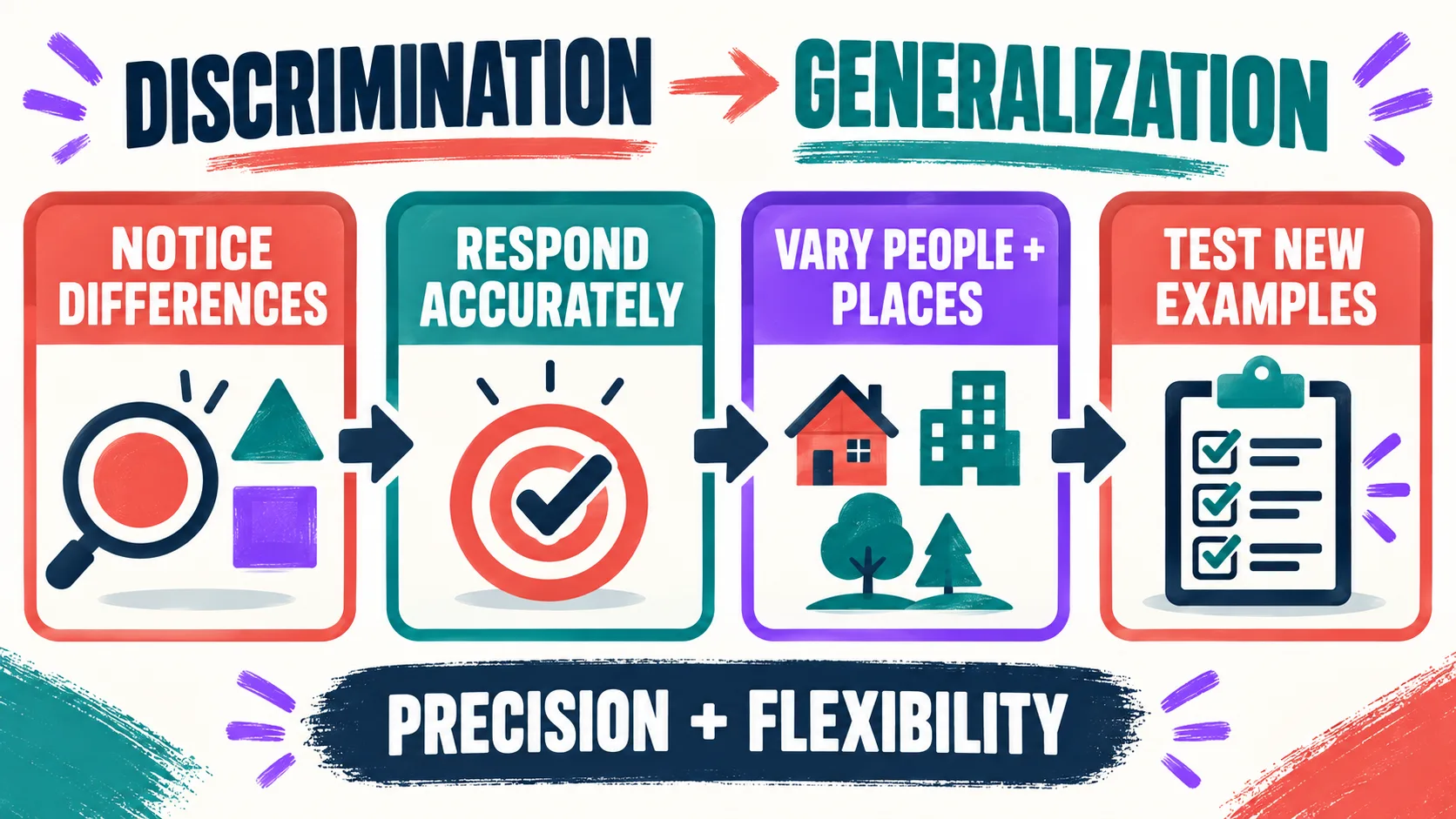
Discrimination without generalization can produce brittle learning. A learner may select the correct picture only when it is in the same position, answer only when the original therapist asks, or follow a safety direction only in the therapy room. Generalization without a clear discrimination can produce broad but inaccurate responding. The learner may touch every picture, answer every question with the same word, or approach an unsafe cue as if it were the trained cue.
A useful sequence is therefore teach the distinction, vary the relevant conditions, and probe what was not directly taught. This is not a rule that every program must follow in one fixed order. A learner may need interspersed variation early, while another learner may benefit from a short, highly controlled discrimination phase before new exemplars are introduced. The decision should come from the learner’s data, skill history, communication access, and the practical goal of the program.
What Does Discrimination Training Teach?
Discrimination training teaches a conditional relation between an antecedent and a response. In a basic example, an SD signals that a particular response is likely to contact reinforcement, while an S-delta signals that the same response will not produce that programmed consequence. The goal is not simply to make the learner “notice a difference.” The goal is to establish a measurable pattern of responding that is controlled by the relevant stimulus or context.
Before teaching, define the target in observable terms. “Understands the difference” is too vague to score. A stronger target might say, “When shown a red circle and a blue square and asked to select the red circle, the learner touches the red circle within five seconds.” The plan should specify the comparison stimulus, prompt hierarchy, consequence, error-correction procedure, mastery criterion, and the conditions under which the skill will be checked.
Discrimination training is also broader than a simple visual matching task. It can involve spoken instructions, people, locations, times of day, safety signals, social cues, academic materials, or functional communication opportunities. The relevant question is always: which feature should control the response, and which irrelevant features should not?
What Does Generalization Training Add?
Generalization describes behavior occurring under conditions that differ from the original teaching conditions while remaining relevant to the skill. A team may plan for stimulus generalization by varying examples, people, settings, materials, or distances. It may plan for response generalization by accepting multiple functionally equivalent ways to meet the same goal. It may also plan for maintenance by checking performance after prompts or dense reinforcement have been reduced.
Generalization should be programmed, not assumed. A learner who performs at 90 percent in a teaching room has demonstrated that performance in that room under those conditions. That result does not automatically prove the same skill will occur in a classroom, home, store, or community setting. A generalization probe should identify the new condition, limit unnecessary prompting, and record enough information to support a decision.
Variation must still be purposeful. Changing every feature at once can make it impossible to determine what helped or hindered performance. Start with the dimensions that matter most to the client’s daily life. For a communication goal, that might mean varying communication partners and routines. For a safety goal, it might mean different locations, distances, and examples of the relevant signal. The team can increase variation gradually as the data support it.
How Can You Program Both Procedures in One ABA Plan?
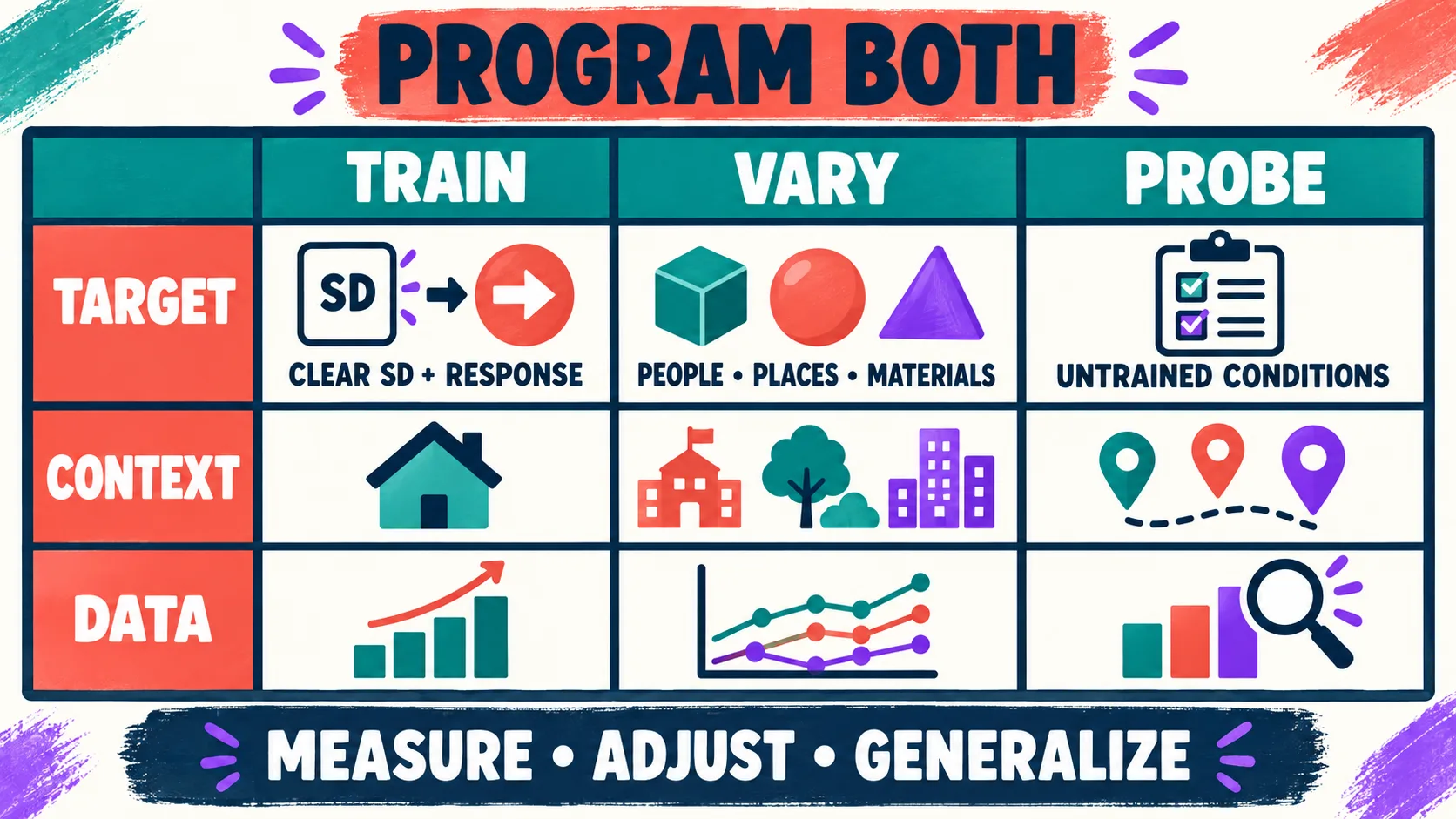
The following workflow keeps the distinction between teaching and transfer visible:
- Define the functional outcome. State what the learner should do, where the skill matters, and whose participation or safety it supports. Avoid choosing a drill merely because it is easy to count.
- Identify the relevant contrast. Decide what should occasion the response and what should not. Include the likely distractions or competing cues that matter in the natural environment.
- Teach an initial discrimination. Arrange clear examples, use an ethical prompt and error-correction plan, and deliver consequences consistently. Record independent and prompted responses separately.
- Introduce purposeful variation. Change one or more relevant dimensions, such as person, place, material, wording, distance, or response form. Keep the target response and reinforcement logic clear.
- Probe an untrained condition. Test a meaningful example that was not directly taught. If a prompt is necessary for safety, document it rather than describing the trial as independent.
- Review data and adjust. If accuracy drops only with one partner, the plan may need partner training. If errors occur only with a particular distractor, the discrimination needs clearer teaching. If the learner uses a different but functional response, consider response generalization rather than automatically correcting it.
- Plan maintenance and future probes. Identify when the skill will be checked after the teaching phase, after a schedule change, or in a new routine. Generalization is a continuing programming responsibility, not a one-time decoration in the treatment plan.
What Does the Combination Look Like in Real Examples?
Communication: A learner may discriminate between a request card and a finished card, then use the relevant request with a parent, teacher, and support staff member. The team can vary the card’s location and the activity while keeping the response definition and communication access consistent. Data should show both accurate selection and whether the request works with the people who need to understand it.
Safety: A learner may learn to stop when a specific adult gives a safety instruction, but the plan should not assume that one voice, one hallway, or one practice prop represents every safety situation. After teaching the discrimination, the team can introduce different voices, distances, locations, and safe practice examples. Because safety programs carry higher risk, the BCBA should use appropriate safeguards, coordinate with caregivers, and never create an unsafe test simply to demonstrate generalization.
Academic responding: A student may discriminate the target letter from similar letters on a worksheet, then identify it in books, signs, digital materials, and handwritten examples. The response may generalize across fonts and sizes, while the discrimination remains precise enough to avoid selecting visually similar but incorrect letters.
What Data Help You Decide Whether the Plan Is Working?
Collect data that separate the two questions. For discrimination, record accuracy by stimulus or condition, errors to the comparison cue, prompt level, latency when relevant, and the consequence delivered. For generalization, record performance by person, setting, materials, instruction wording, response form, and whether the condition was trained or untrained. A single overall percentage can hide the exact dimension that needs support.
Look for patterns instead of reacting to one unusual trial. If a learner is accurate with the therapist and inaccurate with a parent, the next step may be caregiver coaching or a partner-specific probe. If performance is strong with trained pictures and weak with new examples, add exemplars or adjust the teaching arrangement. If the learner responds broadly but inaccurately, return to the relevant discrimination rather than simply adding more variation.
For a refresher on the antecedent–response relations that make these decisions interpretable, review the site’s stimulus control ABA guide and its focused discrimination training BCBA exam guide. For the current exam framework, compare the official BCBA Test Content Outline and the BACB task-list hub. Those pages provide the surrounding concepts; this article focuses on how to combine precision and transfer in one plan.
What Are Common BCBA Exam Traps?
- Assuming mastery equals generalization: High accuracy in the teaching set is not proof of performance in untrained conditions.
- Calling every error a generalization problem: If the learner never learned the relevant contrast, strengthen discrimination before changing many contexts.
- Changing too many variables at once: Purposeful variation should still permit interpretation of the data.
- Confusing response generalization with incorrect responding: A novel response may be acceptable when it serves the same function and meets the target definition.
- Using a vague goal: “Generalizes the skill” is not measurable until the team names the conditions, response, criterion, and probe plan.
FAQ
Is generalization training the opposite of discrimination training?: No. Discrimination training promotes accurate responding under the relevant cue, while generalization programming checks whether that accurate behavior transfers across relevant changes. A well-designed program may use both.
Should every example be varied from the first trial?: Not necessarily. Some learners benefit from a clear initial teaching arrangement; others need variation early to prevent narrow stimulus control. Use baseline, learner response patterns, risk, and data to decide how quickly to introduce new exemplars.
What should a BCBA write in the generalization plan?: Identify the target response, the trained conditions, the untrained conditions to probe, the people responsible for practice, the measurement system, the reinforcement plan, and the decision rule for adding or reducing support. Include maintenance checks when the skill must remain durable.
Bottom line: Generalization training and discrimination training can be conducted together because effective ABA programming needs both accurate stimulus control and useful transfer. Teach the relevant distinction, vary the conditions that matter, probe what was not taught, and let the data determine the next adjustment. When you are ready to practice this kind of scenario, try the free BCBA mock exam and look for the question’s target: precision, transfer, maintenance, or a combination. For targeted review, use our generalization training and discrimination training can practice questions to apply the concept in exam-style scenarios.
Quick Review Checklist
Use this final checklist to turn generalization training and discrimination training can into exam-ready reasoning. The goal is not to memorize a label in isolation; it is to identify the relevant evidence and explain why the best answer fits the scenario. Key ideas to review:
- State the central definition or decision point for generalization training and discrimination training can in your own words.
- Identify the detail that makes generalization training and discrimination training can different from its closest related ABA term.
- Separate the observable facts in a scenario from assumptions that are not supported by the facts.
- Write one example and one nonexample so you can recognize the concept in a new setting.
Exam application checks:
- Ask what the question is actually requesting before comparing the answer choices.
- Mark the antecedent, response, consequence, or other evidence that supports the selected answer.
- Look for a distractor that describes a related process but does not answer the specific question.
Final self-check:
- Explain how you would verify the interpretation with clear observations or data.
- Change one detail in the scenario and decide whether your answer should change.
- Give a one-sentence rationale that a supervisor or study partner could evaluate.
Take the Free BCBA Mock Exam
When you are ready to apply the idea, use the free practice resource below for additional feedback. Take the Free BCBA Mock Exam



