
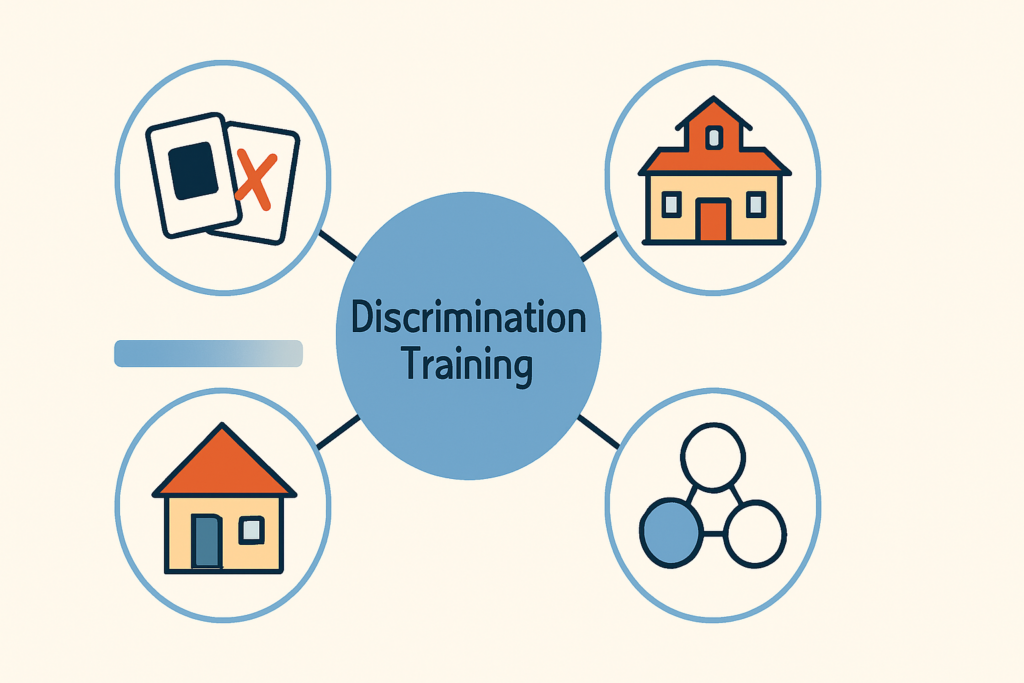
Quick answer: Discrimination training teaches a learner to respond differently to different stimuli: a response is reinforced in the presence of one stimulus (the SD) and not reinforced in the presence of another (the S-delta). The outcome is stimulus control.
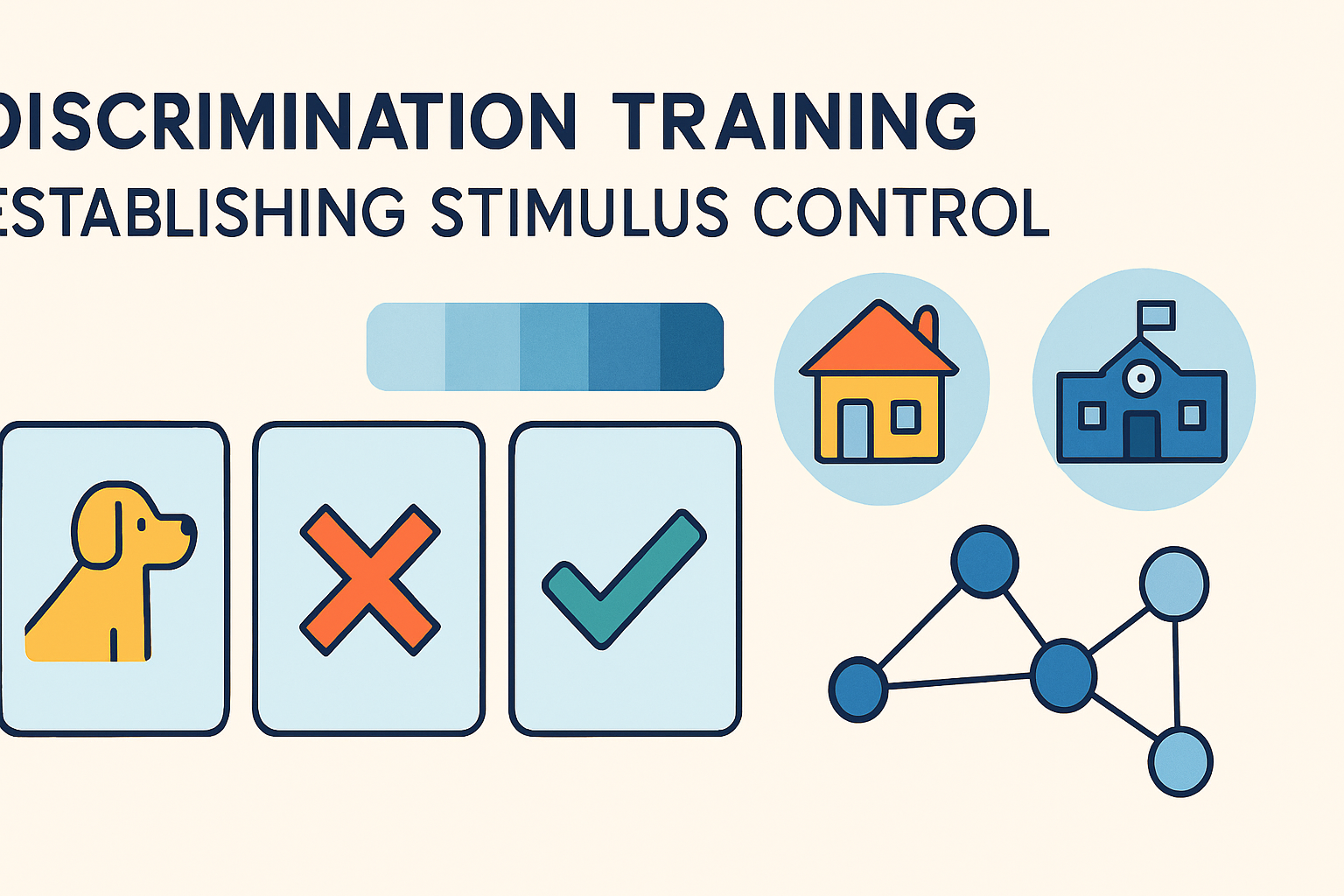
What is Discrimination Training? Establishing Stimulus Control
Discrimination training is a fundamental behavioral procedure that teaches individuals to respond differently to different environmental stimuli. This process establishes stimulus control, where specific behaviors occur only in the presence of particular antecedent conditions.
Table of Contents
- What is Discrimination Training? Establishing Stimulus Control
- Discrimination Training in Practice: Worked Examples for BCBAs
- Exam Relevance and Common Procedural Pitfalls
- Quick-Reference Implementation Checklist
- Summary: The Pathway to Stimulus Control
- References
The procedure arranges the environment so that reinforcement is available only when a specific stimulus is present, while responses in the presence of other stimuli are not reinforced.
Core Definitions: SD, S-Delta, and the Three-Term Contingency
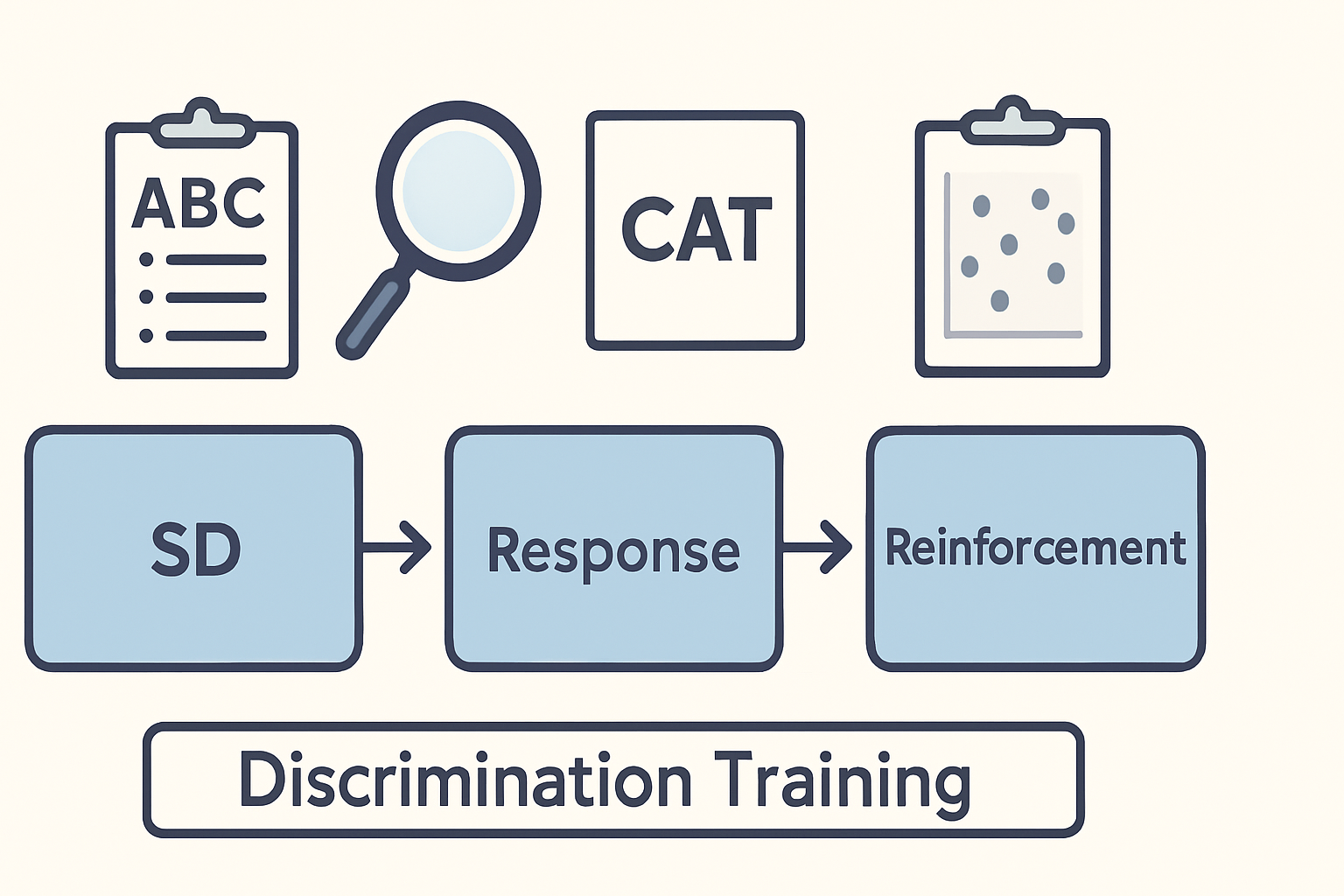
A discriminative stimulus (SD) signals that reinforcement is available for a particular response. In contrast, an S-delta (SΔ) indicates that reinforcement is NOT available for that same response.
The three-term contingency framework explains this relationship: antecedent (SD or SΔ) → behavior → consequence (reinforcement or extinction).
Simple vs. Conditional Discrimination: A Critical Distinction
Simple discrimination involves one SD signaling reinforcement availability for one specific response. For example, a red card signals ‘touch’ while a blue card does not.
Conditional discrimination occurs when the context or a second stimulus modifies the function of the primary SD. This includes procedures like matching-to-sample or receptive instructions with multiple objects present.
Discrimination Training in Practice: Worked Examples for BCBAs
Understanding discrimination training requires seeing it in action. These examples demonstrate how the procedure works across different contexts and behavioral functions.
Example 1: Teaching Receptive Identification of Colors
This discrete trial training example shows simple discrimination:
- Antecedent: Therapist presents red and blue cards, gives SD ‘Touch red’
- Behavior: Client touches red card
- Consequence: Therapist delivers reinforcement (praise, token)
- Error correction: If client touches blue, therapist uses prompt hierarchy and repeats trial
The S-delta (blue card) signals that touching it won’t produce reinforcement, establishing discrimination between stimuli.
Example 2: Discriminating Between a Mand and a Tact
This example demonstrates conditional discrimination with verbal operants:
- Scenario 1 (Mand): Client is thirsty (EO), therapist holds water bottle (SD), client says ‘water’, receives water (reinforcement)
- Scenario 2 (Tact): No thirst EO, therapist shows water bottle (SD), client says ‘water’, receives praise (generalized reinforcement)
The presence or absence of the motivating operation changes the function of the same SD, creating conditional discrimination.
Example 3: Reducing Elopement Through Environmental Discrimination
Discrimination training can decrease problem behaviors by teaching appropriate alternatives:
- Antecedent: Green ‘walk’ signal (SD) vs. red ‘stop’ signal (SΔ) at curb
- Behavior: Client crosses only on green signal
- Consequence: Safe crossing (natural reinforcer)
This addresses potential functions of elopement like automatic reinforcement or escape, replacing them with discriminated responding.
Exam Relevance and Common Procedural Pitfalls
BCBA candidates must understand both the theoretical foundations and practical implementation challenges of discrimination training.
Frequent Exam Traps: Stimulus Control vs. Motivation
Common mistakes include:
- Attributing lack of discrimination to ‘not knowing’ when it’s actually an MO issue (e.g., satiation)
- Confusing prompt dependence with true stimulus control
- Misidentifying S-deltas or failing to program sufficient exemplars
- Overlooking the role of motivating operations in conditional discrimination
Understanding the difference between SD vs MO is crucial for accurate assessment and intervention planning.
Key Considerations for Procedural Integrity
Successful discrimination training requires attention to these critical elements:
- Ensure SD and S-delta are salient and distinct to the learner
- Reinforce correct responses immediately and consistently
- Use effective prompt hierarchies and fade systematically
- Plan for generalization from the start by varying stimuli and contexts
- Collect treatment integrity data to monitor implementation fidelity
Discrimination Training and Conditional Discrimination
Two terms are easy to confuse on the exam:
- Simple discrimination — responding differently to two stimuli based on a history of differential reinforcement (respond to the SD, not the S-delta).
- Conditional discrimination — the correct response depends on another stimulus or context (e.g., “touch red” vs “touch blue” — which response is correct is conditional on the instruction). Matching-to-sample tasks are the classic example.
The goal of all discrimination training is to bring behavior under the control of the right antecedents — the foundation of stimulus control and of most language and academic programs.
Put this to the test
Practice items like this under real exam conditions with our free BCBA mock exam — instant scoring and rationales.
Quick-Reference Implementation Checklist
Use this checklist when planning and implementing discrimination training procedures:
- Identify target behavior and appropriate reinforcers
- Select clear, distinct SD and SΔ stimuli
- Establish baseline performance before intervention
- Design prompting strategy and fading plan
- Program for response maintenance and generalization
- Collect data on both correct responses and errors
- Monitor procedural integrity throughout implementation
- Adjust based on data analysis and learner progress
For more on data collection methods, see our guide on data collection in ABA.
Summary: The Pathway to Stimulus Control
Discrimination training represents the systematic process of bringing behavior under the control of relevant environmental stimuli. Through careful arrangement of antecedent conditions and contingencies of reinforcement, practitioners establish stimulus control that enables functional, context-appropriate responding.
Mastering this procedure requires understanding both simple and conditional discrimination, recognizing common implementation pitfalls, and maintaining procedural integrity throughout intervention. For BCBA candidates, this knowledge is essential not only for exam success but for effective clinical practice.
To deepen your understanding of related concepts, explore our resources on stimulus control and verbal operants. For comprehensive exam preparation strategies, visit the BACB Task List 6th Edition guide.
References
Complete BCBA Exam Prep
Turn this topic into exam-day practice
Practice concepts in context with five full-length 6th Edition mock exams, two bonus practice exams, a 6th Edition study guide, and key-term flashcards—all in one $120 USD package.
Get the $120 All-in-One Prep Pack
Review everything included on the product page before ordering. No pass guarantee is implied.



