
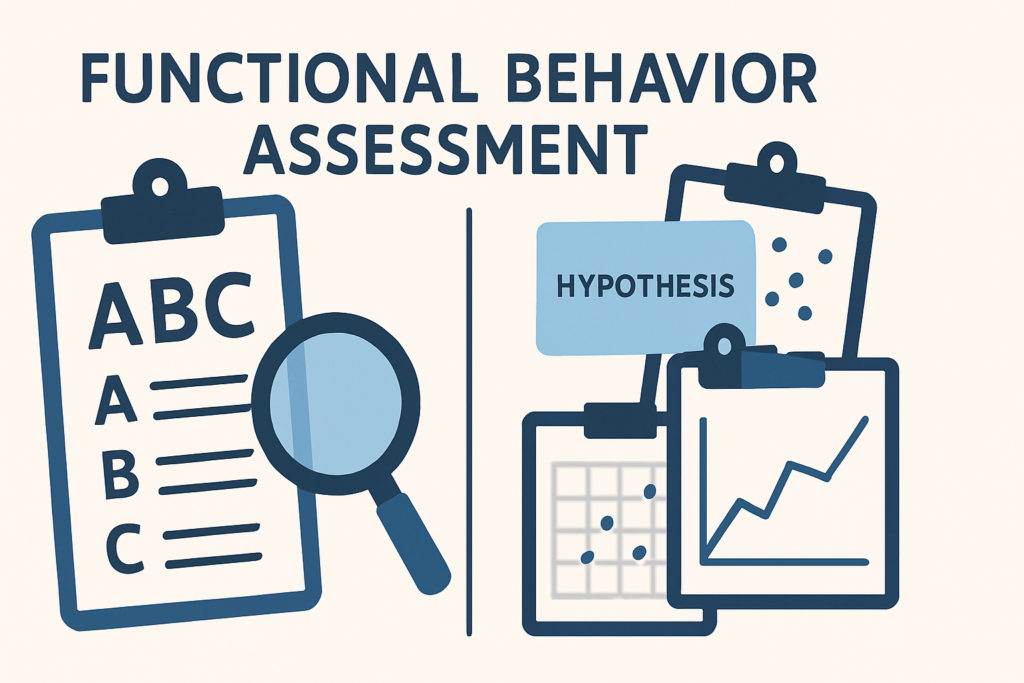
What is a Functional Behavior Assessment?
A Functional Behavior Assessment (FBA) is a systematic process used to identify the environmental variables that maintain challenging behavior. This comprehensive approach helps behavior analysts understand why behaviors occur rather than just describing what they look like.
Table of Contents
- What is a Functional Behavior Assessment?
- The Step-by-Step FBA Process
- FBA in Practice: Worked Examples for BCBA Candidates
- FBA on the BCBA Exam: Relevance and Common Traps
- Quick FBA Review Checklist
- Summary and Next Steps for Mastery
Core Definition and Purpose
The primary goal of an FBA is to determine the function of behavior – the specific reinforcement maintaining it. This process involves collecting data through multiple methods to develop a data-based hypothesis about what purpose the behavior serves for the individual.
Understanding the function allows practitioners to design effective interventions that address the root cause rather than just suppressing symptoms. This approach aligns with the scientific principles of applied behavior analysis.
The Ethical Imperative of Assessment
The BACB Ethics Code emphasizes conducting thorough assessments before implementing interventions. Section 2 specifically requires behavior analysts to base their recommendations on objective data rather than assumptions.
Conducting an FBA demonstrates professional competence and ensures interventions are socially valid and likely to be effective. This ethical foundation protects client welfare and promotes meaningful behavior change.
The Step-by-Step FBA Process
The FBA process follows a logical sequence that builds from initial identification to hypothesis testing. Each step provides essential information for the next phase.
Step 1: Defining the Target Behavior
Begin by creating an operational definition that describes the behavior in observable, measurable terms. Avoid vague labels like ‘aggression’ and instead specify topographical features that can be reliably recorded.
- Make definitions clear and objective
- Include examples and non-examples
- Ensure multiple observers would agree on occurrences
- Focus on measurable dimensions like frequency, duration, or intensity
Step 2: Gathering Information (Indirect Assessment)
Indirect methods collect historical data through interviews, questionnaires, and record reviews. Common tools include the Functional Assessment Screening Tool (FAST) and Motivation Assessment Scale (MAS).
While valuable for generating initial hypotheses, indirect assessments have significant limitations. They rely on memory and subjective interpretation, making them insufficient alone for determining function.
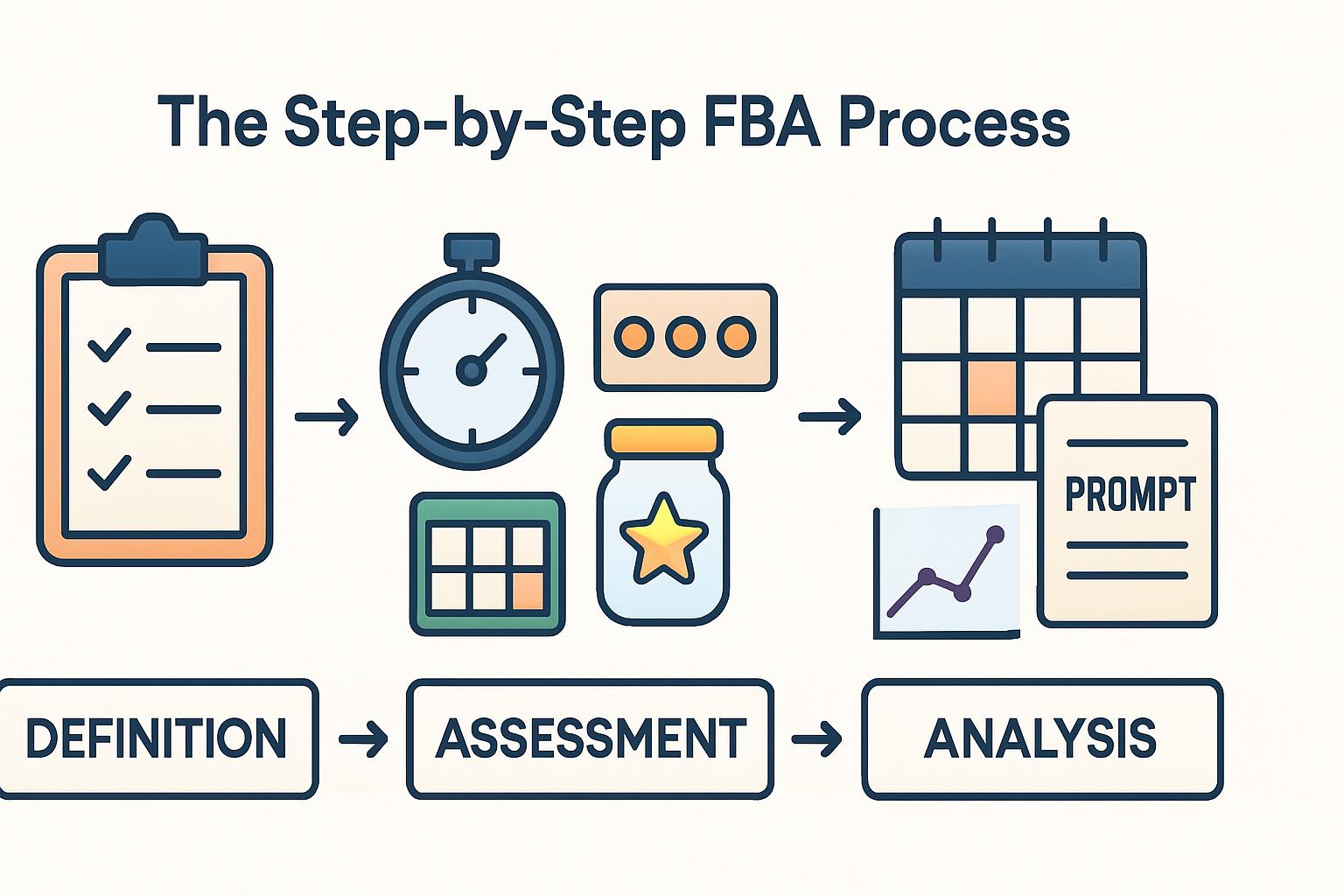
Step 3: Direct Observation and Data Collection
Direct observation involves systematically recording antecedent-behavior-consequence sequences in natural settings. This descriptive assessment provides objective data about environmental correlations.
Common methods include ABC recording, scatterplots, and conditional probability analyses. These tools help identify patterns and potential maintaining variables in the natural environment.
Step 4: Formulating and Testing a Hypothesis
Based on collected data, develop a testable hypothesis about the behavior’s function. The SEAT framework categorizes functions as Sensory, Escape, Attention, or Tangible reinforcement.
The hypothesis should be specific enough to guide intervention development and include predictions about what should happen when environmental variables are manipulated.
FBA in Practice: Worked Examples for BCBA Candidates
Understanding FBA concepts requires applying them to realistic scenarios. These examples demonstrate how to analyze ABC data and identify behavioral functions.
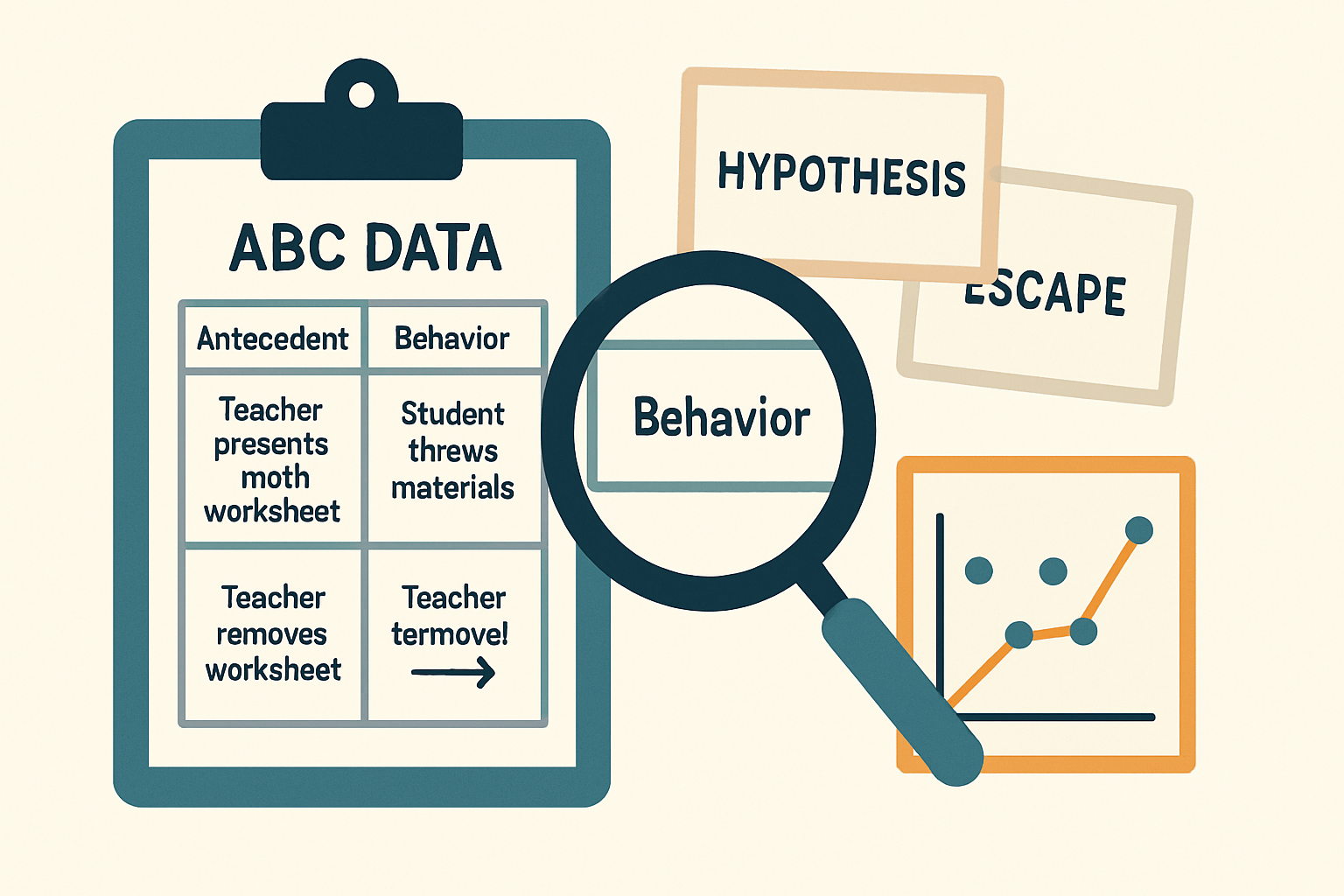
Example 1: Escape-Maintained Behavior in a Classroom
Data shows: When teacher presents math worksheet (antecedent), student throws materials (behavior), teacher removes worksheet (consequence). This pattern occurs during 8 of 10 math sessions.
Hypothesized function: Escape from demands. The behavior consistently results in termination of the non-preferred activity, suggesting negative reinforcement maintains it.
Example 2: Attention-Maintained Behavior During Play
Data shows: When peers play without including child (antecedent), child hits peer (behavior), peers stop game and attend to child (consequence). This occurs primarily during unstructured play times.
Hypothesized function: Access to attention. The behavior produces social interaction that was absent before its occurrence, indicating positive reinforcement through attention.
Example 3: Tangible-Maintained Behavior at Home
Data shows: When parent says ‘no’ to candy request (antecedent), child screams and hits parent (behavior), parent gives candy to stop screaming (consequence). This occurs consistently at grocery store checkout.
Hypothesized function: Access to tangibles. The behavior produces access to preferred items that were previously denied. Note potential multiple functions if attention also increases during episodes.
FBA on the BCBA Exam: Relevance and Common Traps
The BCBA exam extensively tests FBA knowledge across multiple domains. Understanding both the process and common pitfalls is essential for success.
Linking FBA to the Task List
Several Task List items directly relate to FBA procedures. Key sections include B-01 (defining behavior), B-04 (designing measurement systems), B-09 (conducting preference assessments), and F-07 (conducting functional assessments).
Mastering these areas requires understanding both the theoretical foundations and practical applications of assessment procedures. For more on measurement systems, see our guide on data collection methods.
Frequent Exam Missteps and How to Avoid Them
Common errors include confusing topography with function, over-relying on indirect assessments, and misinterpreting correlation as causation in ABC data.
- Remember: Same behavior topography can serve different functions
- Direct observation data takes precedence over interview reports
- Correlation in ABC data suggests but doesn’t prove function
- Always consider setting events and motivating operations
- Test hypotheses through systematic manipulation when possible
Quick FBA Review Checklist
Use this checklist to ensure you’ve covered all essential FBA components during study sessions or actual practice.
- Define target behavior with operational definition
- Conduct indirect assessment (interviews, rating scales)
- Complete direct observation using ABC recording
- Analyze patterns in antecedent and consequence data
- Formulate testable hypothesis about function
- Consider multiple control and compound schedules
- Develop intervention based on identified function
- Plan for generalization and maintenance
Summary and Next Steps for Mastery
Mastering Functional Behavior Assessment requires both conceptual understanding and practical application. The process represents a cornerstone of ethical, effective behavior analytic practice.
For further study, review the four functions of behavior and practice analyzing ABC data from various scenarios. Consider how motivating operations might influence behavioral functions across different contexts.
The BACB provides additional resources on assessment standards in their Ethics Code, while peer-reviewed journals like the Journal of Applied Behavior Analysis offer numerous examples of FBA applications in research and practice.



